
As promised, this is Part II of my initial foray into the topic of medieval magic. As a springboard, I will be using a chapter by Mark Williams from the Routledge History of Medieval Magic, titled “Magic in Celtic Lands”. The chapter features examples from Ireland and Wales but, for my purposes, I will focus on Ireland today.
Firstly, what is the impetus for this line of enquiry? The most immediate reason is that I’m obsessed with the middle ages and I function, personally, within ‘the’ Irish mythological framework. Our textual evidence of Irish myth originates or begins in the middle ages in spite of its narrative setting in the Iron Age. Personally, I tend to take the academic view that Irish myth – such as we have it – is medieval literature. More specifically, I’m interested in topics such as the ways in which the format of rosc poetry carries ‘magical’ potency; in Irish mythological tropes around prophecy; the literal singing or chanting component of ‘enchantment’ such as it appears in certain stories; and a certain recurring visual motif involving ‘bird heads’ or bird headed…ness? I’ll get into my thoughts on what this currently means for my magico-spiritual artistic practice toward the end of this post.
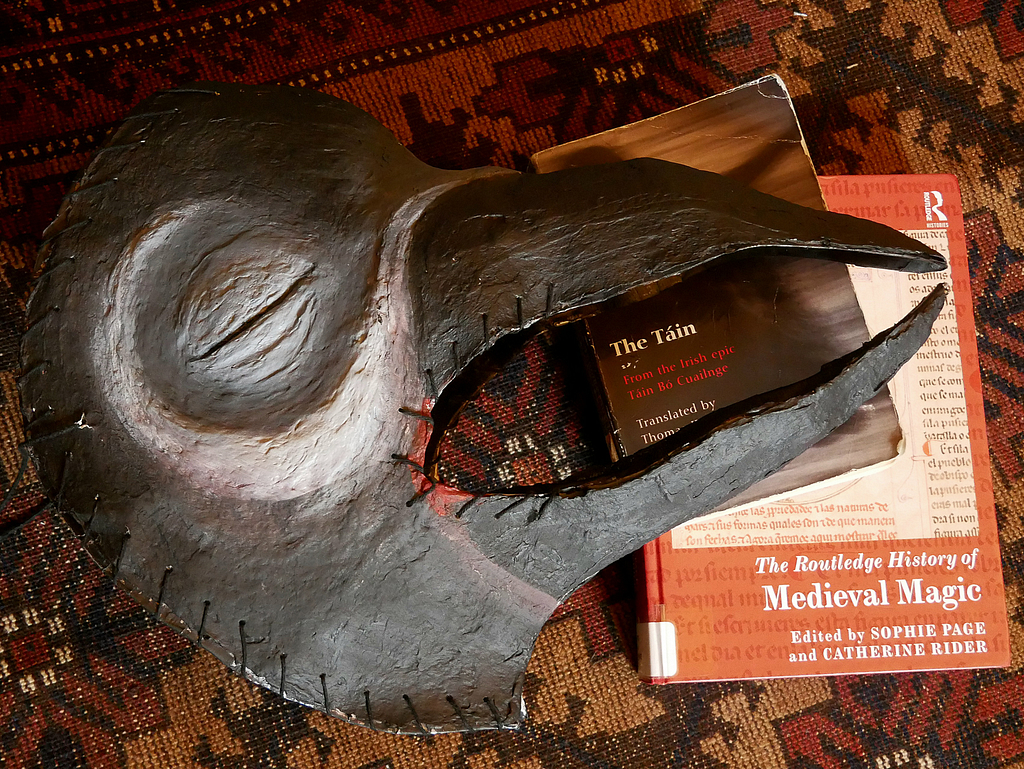
Some BRIEF background information… The word “Celtic”, as Mark Williams states, “is a difficult term, precise only when deployed in a linguistic context: it is used in a parallel manner to “Roman” and “Germanic” to denote a major branch of the Indo-European language family.” (123) Scholarship on the topic applies to regions linguistically Celtic whereas popular culture and imagination thinks of places like Ireland and Scotland and so on as ‘celtic lands’ (as Williams words it) or in terms of ‘celtic heritage’. Williams also notes that relating similar motifs between Ireland and Wales and calling them “Celtic” might no longer be done with confidence:
“it is increasingly acknowledged that similarities between the two countries’ literary traditions – formerly taken as evidence for a shared cultural inheritance – may in fact be medieval borrowings or independent innovations. […] The question of what medieval Irish literature in particular owed to the Bible and to the wider European world was a controversial area of critical debate for much of the second half of the last century, and the examination of magic is likely to constellate the issue once again in significant ways.
The field of Irish and Welsh magic is therefore excitingly wide open, and a reconsideration of all the surviving records and representations of magical practices is badly needed.” (123)
THAT is exciting!
Dreams of diving headlong into the world of Celtic Magic Academia and never resurfacing aside (for now), I want to discuss some particulars of this chapter that jumped off the page and screamed ‘remember and explore me!’ Firstly, Williams emphasizes the potential for differences between literary magic and historical magical practice. In so doing, he introduces characteristics on the Irish ‘literary druid’ (127) and provides two examples: Cathbad (who we might perceive as ‘good’ or praiseworthy in the the stories, though he tends to get on my nerves) and Mog Ruith, with whom I am less familiar.
“Mog Ruith, in contrast, is a more morally ambiguous figure. In Forbuis Dromma Damghaire, he is Fiachu’s major secret weapon against the forces of Cormac (though Cormac has his own team of druids too), being a miracle-worker possessed of a spectacular repertoire. He can alter his size at will, set things on fire with his breath, cause rains of blood, send people to sleep for long periods and create magical animals which go after enemy champions […] At one point, he puts on a cloak and “bird-headdress” and ascends into the air.” (130)
My eyes nearly fell out when I read that last sentence. Those of you familiar with my youtube channel, you may remember the ritual costume I made for Samhain in which I crafted a bird mask and black linen veil (rather in the style of modern folkloric/pagan pageantry) for the purpose of shapeshifting and affecting change in my personal life and spiritual practice.
I got this idea mainly from associations with the crow and the Morrígan*, my personal obsession with shapeshifting motifs, as well as a specific mention in the foretales of the Táin Bó Cuailgne, as translated by Thomas Kinsella. From Cúchulainn’s training in arms:
“[While on raid for Scáthach, his warrioress mentor] he came back the way he had gone, and met a one-eyed hag in his path. She told him to get out of her way. He said that would leave him no room to pass except the sea-cliff below them. But she begged him to get out of her way. So he let her have the path, except where he clung by his toes. She struck at his big toe as she passed him by, to knock him off the path down the cliff. But he saw her in time and gave his hero’s salmon-leap upward. Then he struck off the hag’s head. She was Eis Enchenn, the bird-headed, mother of the three last warriors to die at his hands. It was to avenge their ruin that she lay in wait for him.” (Kinsella, 33)
These stories are hardly a feminist utopia (just read a few paragraphs in either direction from this point) but – in addition to the one-eyed hag which is a descriptor that exists in other stories, including for the Morrígan, Herself – I was particularly interested in this ‘birdheaded’ detail…is it a kenning? An epithet? Was it literal or metaphorical? It seems important, especially as it occurs in a section of Cúchulainn’s stories that involves so many magically potent martial prophetesses. I don’t yet know how it is phrased in the Old Irish or any specifics about Kinsella’s translation choices here.
Thus, as regards Mog Ruith, I had never encountered an explicit mention of donning a bird headdress for the purpose of shifting shape or flying before. Yet, from an UPG** perspective, you might say this is what I did for Samhain. I like that but I don’t need it to be objectively ‘true’. I DO need to learn Old Irish and research the heck out of this for the rest of my living days. It has also only further cemented my tendency to merge bird-symbolism and artistic practice. The alchemy of art (including costumery and stitchcraft) is that when we have extant primary evidence from our favoured time periods, we can exist in direct artistic dialogue with them. In my opinion, it makes very fertile ground for personal gnosis.
I have more to say on Mark Williams’ chapter – including another juicy tidbit about the Túatha Dé (god-peoples) and their ‘theological knowledge’ allowing them to occupy a similar ontological category to medieval demons… and how that’s born out in other medieval Irish literature… but this blog post is long enough, I think.
Until next time!
Nerdily yours,
Sorsha.
* I don’t use the phrase ‘matron deity’ but I guess you could consider me a ‘devotee’ in so far as I live my life & devotional practice ‘under the auspices of Her wing’ (as I often put it.) In this post, I have used her most well known name… but I’m not necessarily only referring to one Morrígan here.
** Unverified Personal Gnosis
Citations:
- Kinsella, Thomas. The Táin: From the Irish Epic Táin Bó Cuailgne. Oxford University Press, 2002. A 2002 reissue of the Oxford Universtiy Press 1970 edition, with illustrations by Louis Le Brocquy.
- Page, Sophie, et al. “Magic in Celtic Lands.” The Routledge History of Medieval Magic, Routledge, Taylor Et Francis Group, London ; New York, New York, 2021, pp. 123–135.
Leave a Reply