Whoever or whatever reads this blog with any regularity may remember that last year I conceieved of a musical project called “The Devil Makes Three”…
I designed it along the lines of Tom Waits’ “Orphans” trilogy – each volume linking together to create a larger picture whilst also functioning as a standalone album. I had a very clear idea of what I wanted to say with Vols. 2 and 3 from a creative standpoint. Their soundscapes were different from each other but clearly defined and I felt that they complimented each other nicely. If one listened to them in numeric order they formed a progression of musical style that said (to me) outward hunter/prey to inward haunting/personal.
The problem was that Vol. 1 was 1) only vaguely defined in terms of what I wanted to say creatively, 2) very literal in it’s interpretation of that creative goal, and 3) articulated through the tastes of others rather than a better representation of my taste… and as such also didn’t fit stylisticly into the broader picture. It provided no real conceptual or narrative development in the project as a whole and, in my mind, made it impossible for any (totally fictional would-be listener) to *want* to progress to the others.
I also realised that the three volume set was totally lacking in metal and metal adjacent genres… which was ridiculous as I listen to mostly metal/shoegaze/gothic psych doom rock nightmare-fuel-cruel-harpy-demonic-witch-magical-shapeshifter-shit by faaaarrrrrrr the most in my life!*
Having finally acquired a new (to me) computer, I can now post the finished result. I’m actually really proud of it!
I may do more proper liner notes for each disc in the future because I have really built in a LOT of stuff that I’d like to document… Imagine, if you will, that a witch can live and tell you stories by wearing music as a kind of sonic glamour. That.
But for now, Vol. 1 is called “The Words They Hear”.
If you were to ask,"What is it like to be a born a changeling witch?", or, "What was it like to be a child stuffed to the brim with dark magick?", or, "What does Badb/Nemain sound like to those with an ear to hear them?" ...you may consider this mix to be *an* answer.
In keeping with the rest of the project, there are 15 tracks on the album. There is some chronological progression but this is not an obligatory interpretation. Explicit mention of the Devil themself appears in the tracklisting – in this case you will note that I have featured Gil Scott-Heron’s genius track “Me and the Devil” …which then makes a distinctly more femme-gendered appearance in a Soap&Skin cover on Vol 2.
I would also like to point out the explicit recurring celestial rise/fall/rise theme on this volume… Also “Orion” is an explicit name I have called a certain thing in my life since I was a …teenager? That’s the first time it shows up in my poetry at any rate. But enough concept teasers, here’s the playlist:
Here are links to Vol 2. “The Stories They Tell” and Vol. 3 “The Tongues They Hold” for anyone interested in listening to the rest. As I said, I’ll likely write about each mix in their own dedicated blog post at some point. For now, I think it’s better that any would-be listener just develops their own relationship to the compilations but…
If Vol 1. is Badb/Nemain...
Vol 2. could be considered Macha and...
Vol 3. Anand.
Though of course, they’re all three all three all of the time.
~ Saoirse.
PS. At some point I also want to draw detailed and specific cover art for each one… because I have nooooo chiiiiiiiiill!
*There are some exceptions of note – one example in this mix is that I don’t listen to The Yagas as a band… but I do like “The Crying Room” as a track.
So I’m reworking the first disc of my “You and Me and the Devil Makes Three” mix-set to be less of a randomized selection of the others’ tastes and, instead, more in line with mine… and focusing on what it is to be a changeling (child) witch. It reminded me that I wanted to post a few videos (three, in fact) that capture what my dreams/nightmares were like as a little kid. While no single of one of these videos is an exact replica, taken as a group and sort of …meshed together… you get a near-perfect representation of what they look(ed) like.
Right down to painted faces, labyrinthine city structures and old parking garages, strange dingy forgotten tenement buildings, grown-up-children, poverty, splitting wounds, blood, and disease… and a lot of very sad lonely people crying for things I couldn’t even give myself.
The earliest and most ‘proto-typical’ of these dreams that I can remember was from when I was six. Many of them are recurring. Many show up in my poetry (of which I have included some examples in this post). And they are, of course, on-going.
… When the Morrígan makes sense to you, I guess it’s because REASONS. 😉
The medieval clothes, sad smiles, strange long wooden hallways with dusty floors… so real.
I know it’s supposed to be tense by cinematic design but I literally can’t watch this one without every muscle clamping in my body. So fucking scary! And good!
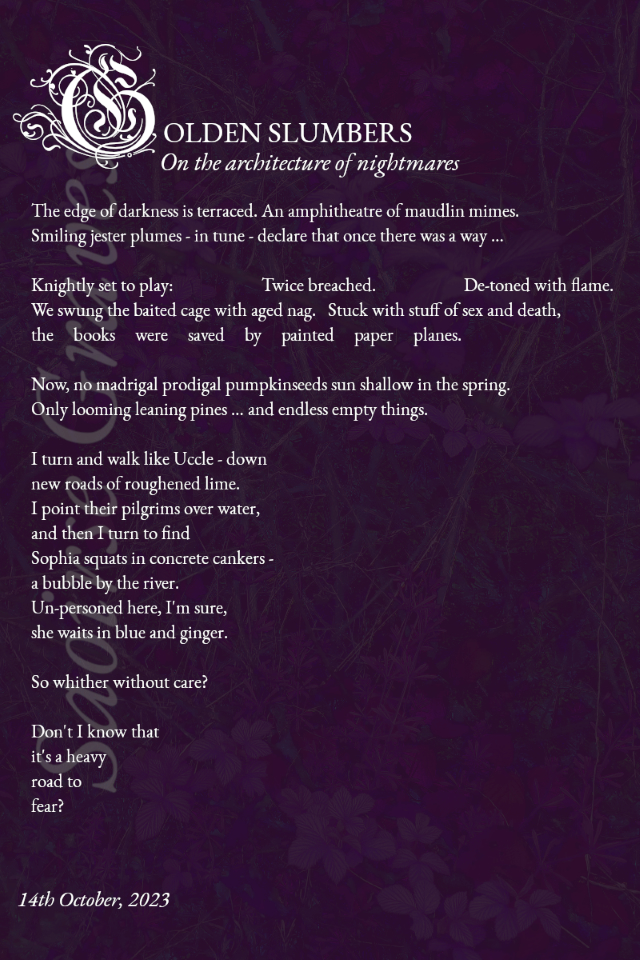
This one reminds me of a figure I encountered in ‘dreams’ inspired by the song “Golden Slumbers” which used to frighten the fuck out of me as a kid… A strange painted man in a suit, surrounded by other theatrical faces fading into the night on wide & shallow concrete steps under a single street lamp telling me “Once there was a way to get back home…”
Do with all that what you will… it makes for great creative fodder.
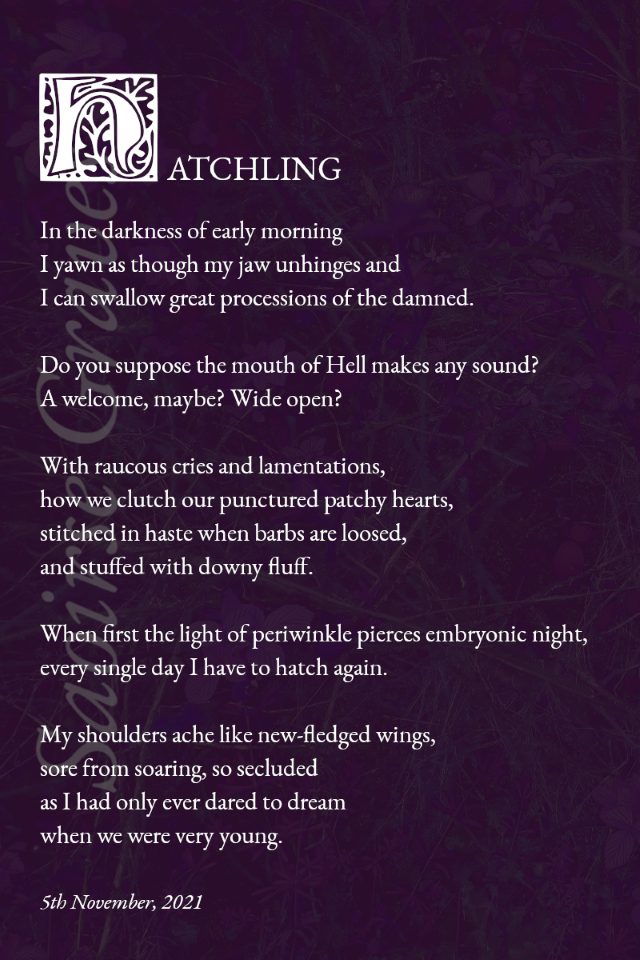
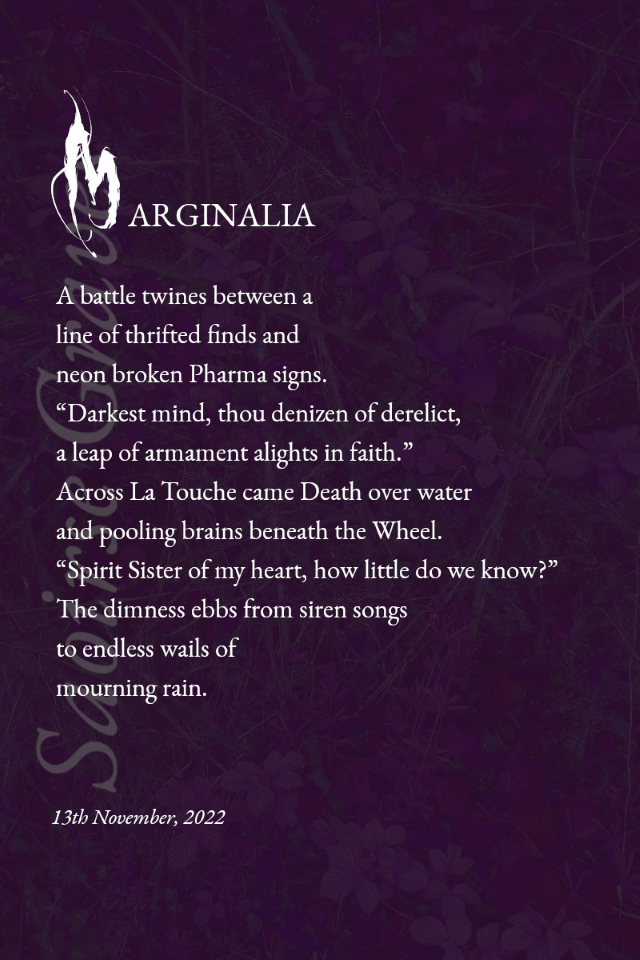
The first among other things, makes reference to the dragon-dreams in Laurence Yep’s work “Dragonwings”… the mental image of sore shoulders after intense dreams had a huge impact on me as a kid. The other two are “simply” more narrative descriptions of specific dreams.
~ Saoirse.
PS. The featured image on this post is a photo of me that is no less unsettling in it’s original form… Sweet dreams, witchy children 😛
I have been working on categorising my poetry. I knew there were a few themes that, in general, a lot of my poetry might fall under… but I have spent the last week or so slowly charting, dating, accounting for and making sure I had back ups of my poetry and the first realisation that came out of this is that I have written over 70 poems since the beginning of 2021.
There are almost no poems before that until you travel back about 10 years.
Turns out field-working autistic burnout and shuffling personal care away from heavily medicated *misdiagnoses* brings the poet back out in a person… but I digress.
What is challenging about assigning organised and uniform categories to my poetry is that, of course, there is organic overlap. This is precisely what it is to be an archivist (i.e. why we don’t rearrange physically what we categorise intellectually) …Or if I were to try and write up a descriptive summary of each poem and derive collection schema from there… THAT would be more like the work of a rare books librarian wrangling unique/historic items into DCRM(B) and MARC-XML friendly formats.
…I digressed again.
The point is, it’s tough but I LOVE doing this sort of thing… ad infinitum, it seems.
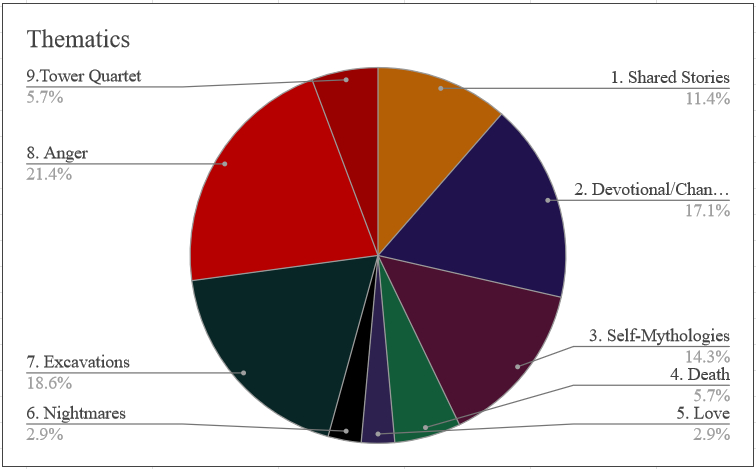
Here is a pie chart I have constructed and colour-coded to represent the themes and distribution of my poetry as of right now. Representing 71 poems written between January 9th, 2021 and October 15th, 2024. (I’ve written a few more but for various reasons they are not included on this list.)
(Interestingly, there are a few I cannot find copies of though I know I at least have physical copies somewhere. Bad LIS-professional! No cookie!!!)
The colours are loosely significant but the important thing to absorb here is that a) poetry is one of the main ways I channel my anger… especially as an autistic who goes largely non-verbal under social/interpersonal duress and b) I actually think of the Tower Quartet and (Channeled) Anger as subsets of a larger intellectual fonds …which is called “Excavations”. You will see that title in the pie chart as pertaining to a single slice, but really you can also view “Excavations” more broadly as occupying just over 45% of the chart! …The unifying emphasis is on digging deep, getting into the chthonic, and shadow-working my shit… oh, and a little revenge poetry here and there.
The thematics in the rest equally relate to each other pretty intensely. My poetry is always devotional in nature but some poems are more direct forms of near-audible gnosis. This makes sense to me from a mythic perspective as it is (personally) derived from the function of verse, alliteration, sorcery, ‘supplication’, evocation, and so on in medieval Irish literature.
I have made “Death” green mainly to evoke a #deathpositive association – ‘verdure from void’. I could equally (and perhaps should) have made it some kind of gold colour:
“I know you’ll remember me when I’m gone
remember my stories, remember my songs
I’ll leave them on earth, sweet traces of gold
oh, they’re calling me home, they’re calling me home.”
~ “They’re Calling Me Home”, Rhiannon Giddens
I will likely include little blurbs illuminating each category on a basic level whenever I manage to post them.
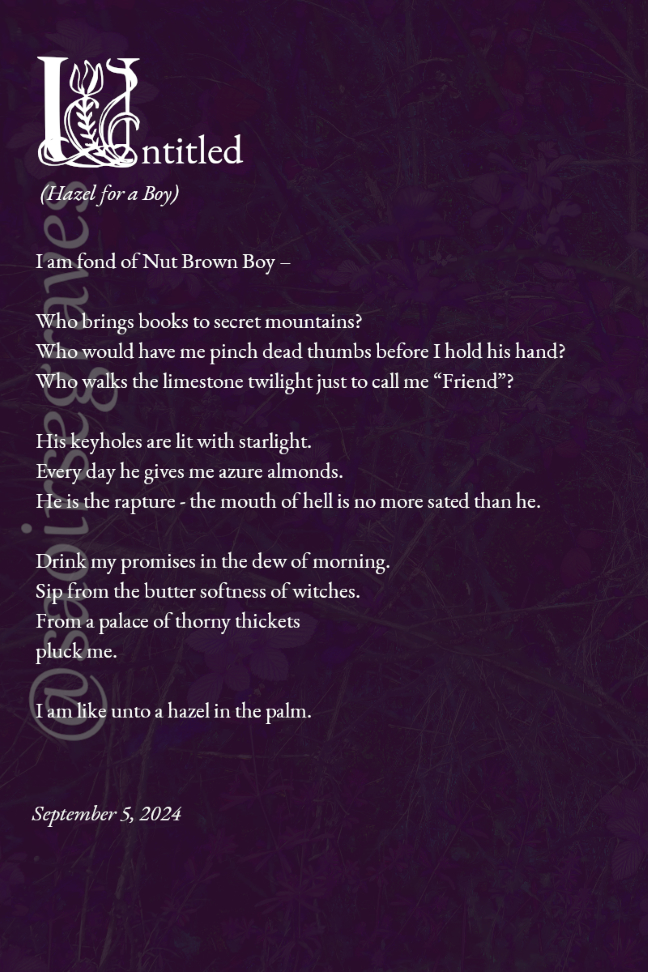
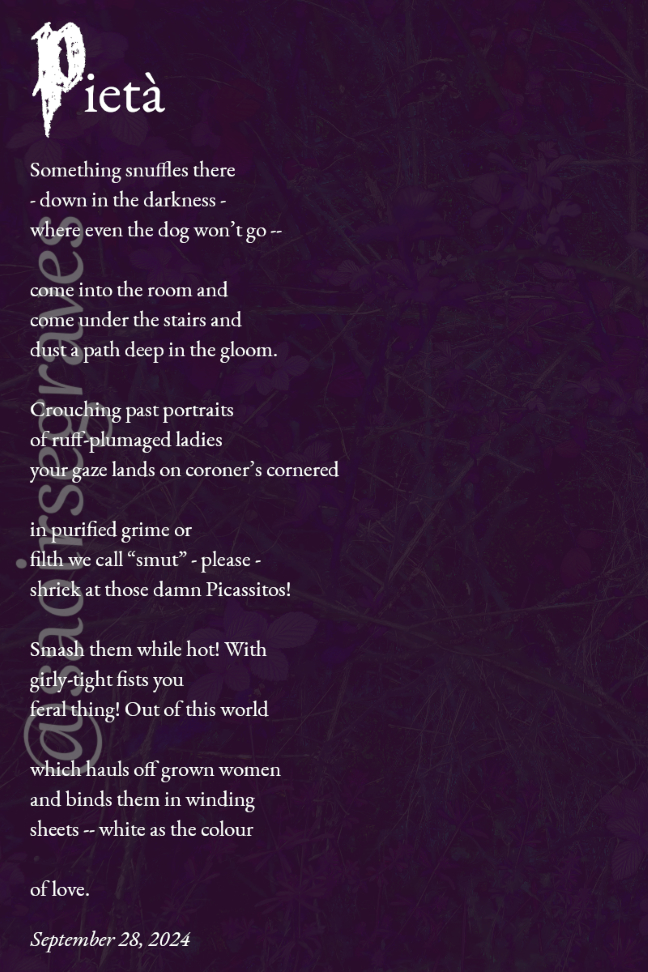
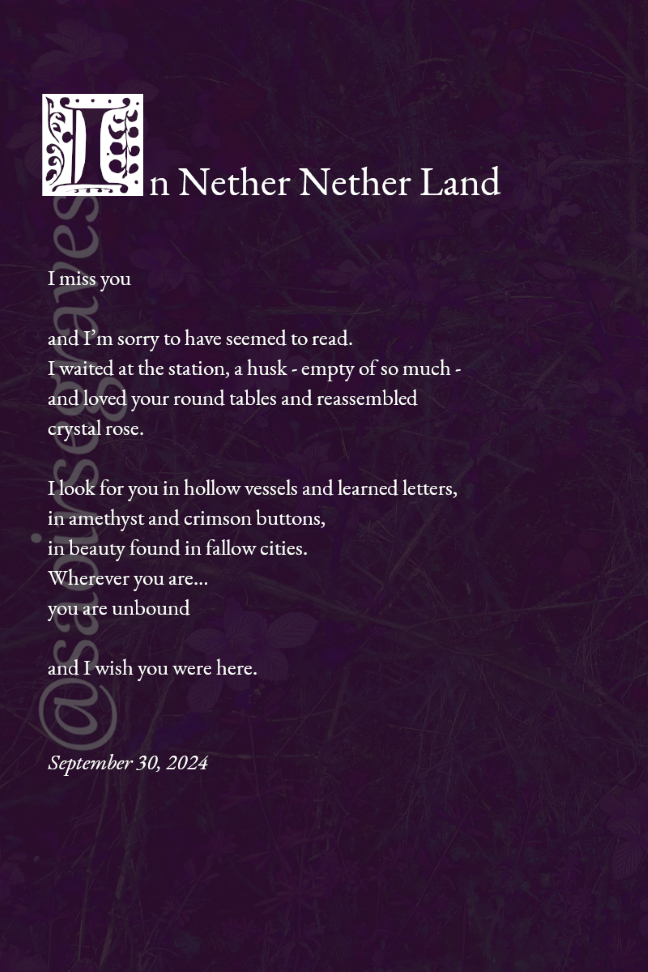
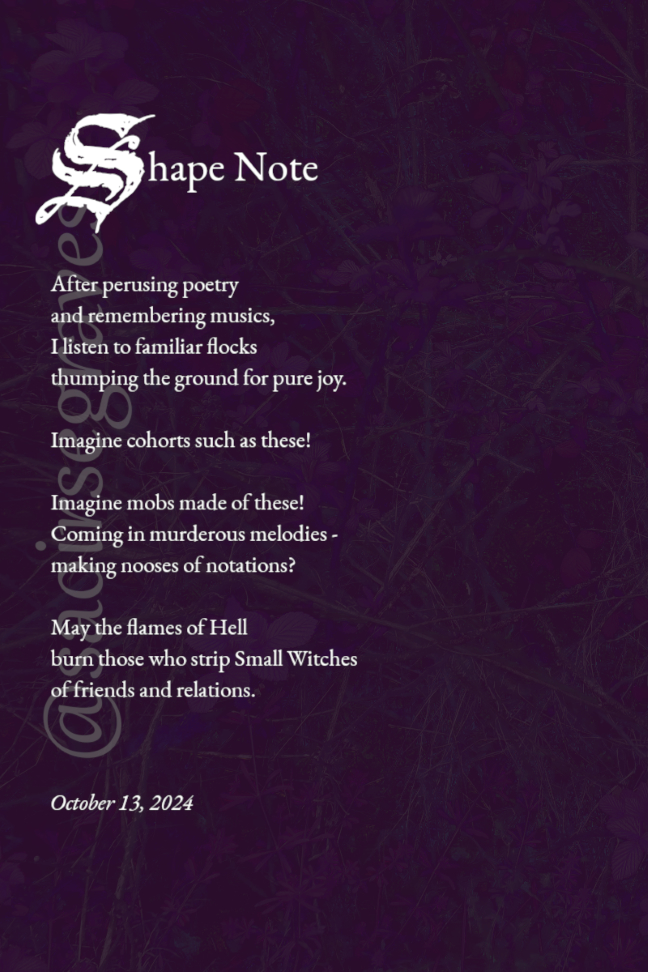
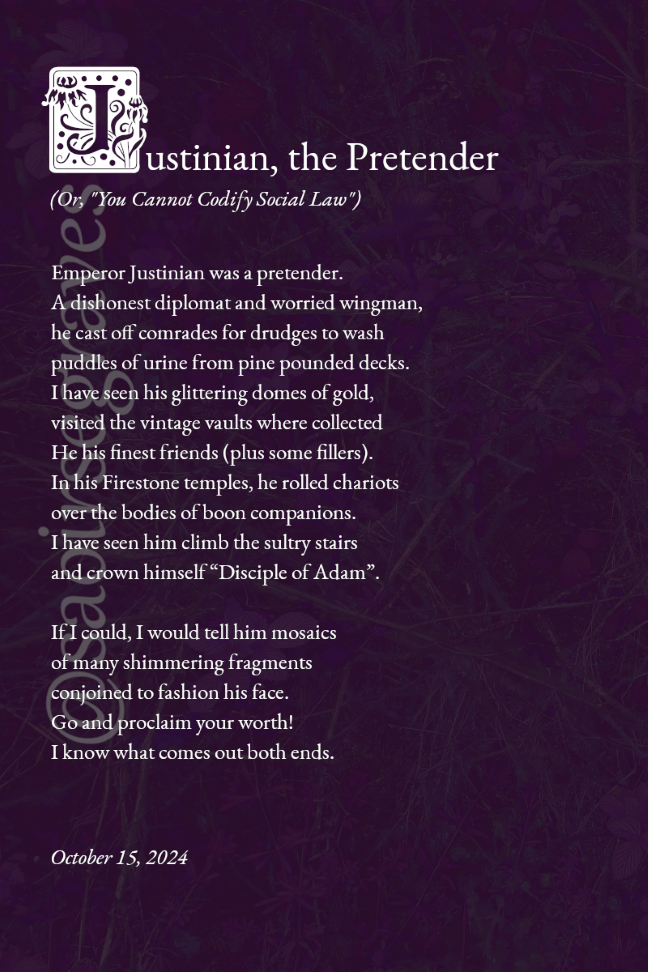
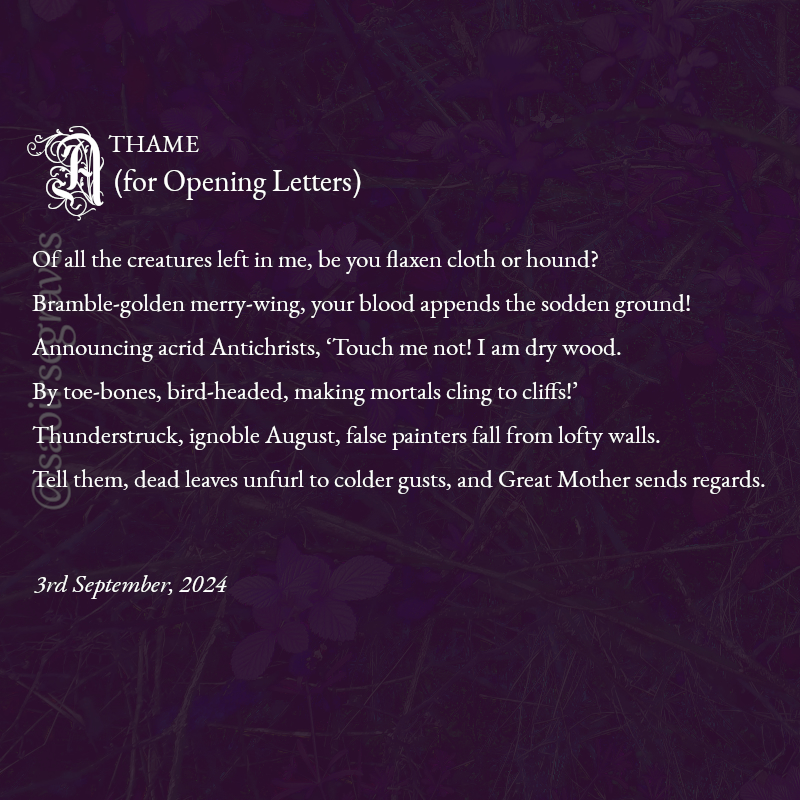
At any rate, I still need to figure out how to create a poetry gallery where poems that can’t occupy a single slide might appear… Until then, here are some of the poems I’ve written in September and October (minus “Athame”… which I have posted already.)
I suppose this set is all rather on the nose, but the themes of each are as follows: Love, Excavation, Death, Anger, and Anger.
For what it’s worth, I guess.
~ Saoirse.
* Get it? Theme-attics and Scheme-attics? Because it’s a post about poetry thematics and schematics? And I have a thing for sad attics? Ba-dum-tssshhh!!! Genius at it’s finest. I kill me.
Every now and then – almost unsuspectingly – a poem will emerge swift and nearly full-fledged. When this happens it always reminds me of No Face from “Spirited Away”. I feel that as I emerge from a place of intensity, often a place that’s not so good for me, the poem spews forth like tarry gall – I get the thing out feeling cleansed and returned to self.
Or perhaps the poem emerges like some kind of ectoplasmic gauze with my words already jotted on it. My poetry is always filtered through and/or dedicated to the Morrígan as the medieval literature abounds with (Her) prophecy and sorcery in verse. (A rabbit hole I’ll explore on this blog as time goes on.)
In any case, yesterday I was playing the dulcimer and mulling over a few things and upon striking the last lines of a tune, the poem started coming out. In my distraction, I hit the strings of the last chord in such a manner that a resonant overtone or harmonic sounded loud and clear – like a bell.
Luckily I was already at my desk. Dulcimer placed carefully to one side, pen and paper already in hand.
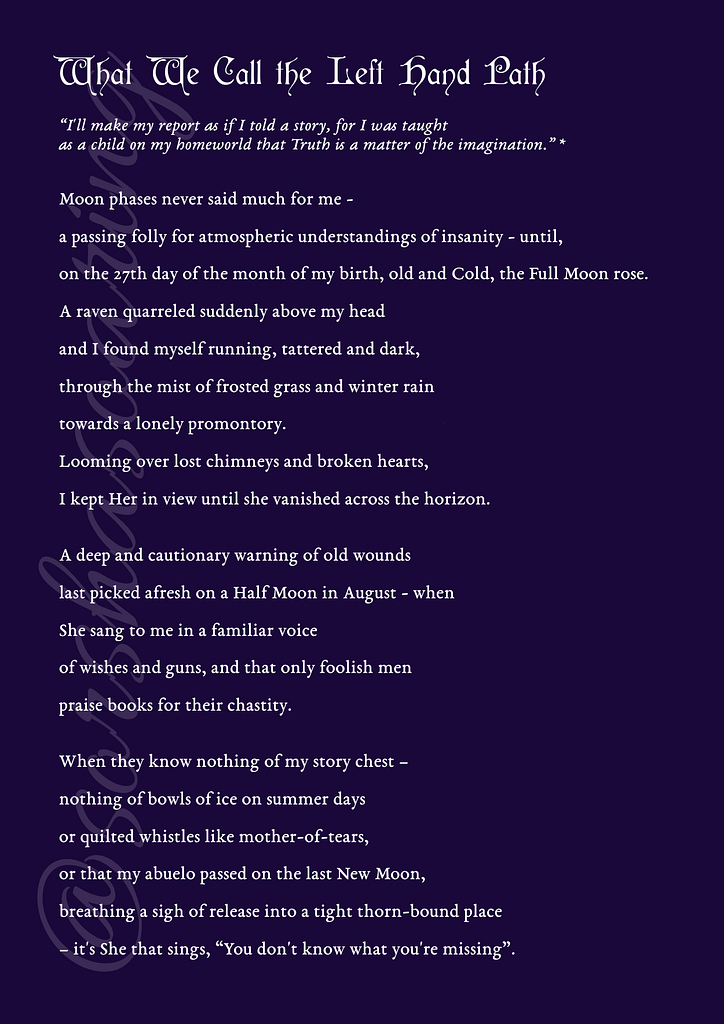
Here is what I coughed up:
* The quotation at the beginning is taken from the opening line of Ursula K. LeGuin’s The Left Hand of Darkness.
** It should also be noted that there is a version of “Hares on the Mountain” that makes an appearance in this poem. It’s Roud Folk Song Index No. 329 (here’s a link). I don’t know if anyone else finds that certain songs (be they old or new) have a way of following you around in life but this is one such song for me. Specifically, for this poem, you can find renditions of it by Josienne Clarke & Ben Walker or by Shirley Collins.
*** There is only one half-truth in this poem. 🎃
I’d love to hear any thoughts people have on how their gnosis occurs… and does it take time to understand certain parts of it? Is it instantaneous or cumulative? Or both?
My aim with my online presence in a holistic sense is to do the work of further developing a unique and authentic artistic style and to build that as an inseparable part – maybe even just an outward expression of – my witchcraft and personal paganism. (In some ways, my goal is also to work myself up to a place where I can open my etsy shop and trust myself to handle things like paper work and post offices with reliability.)
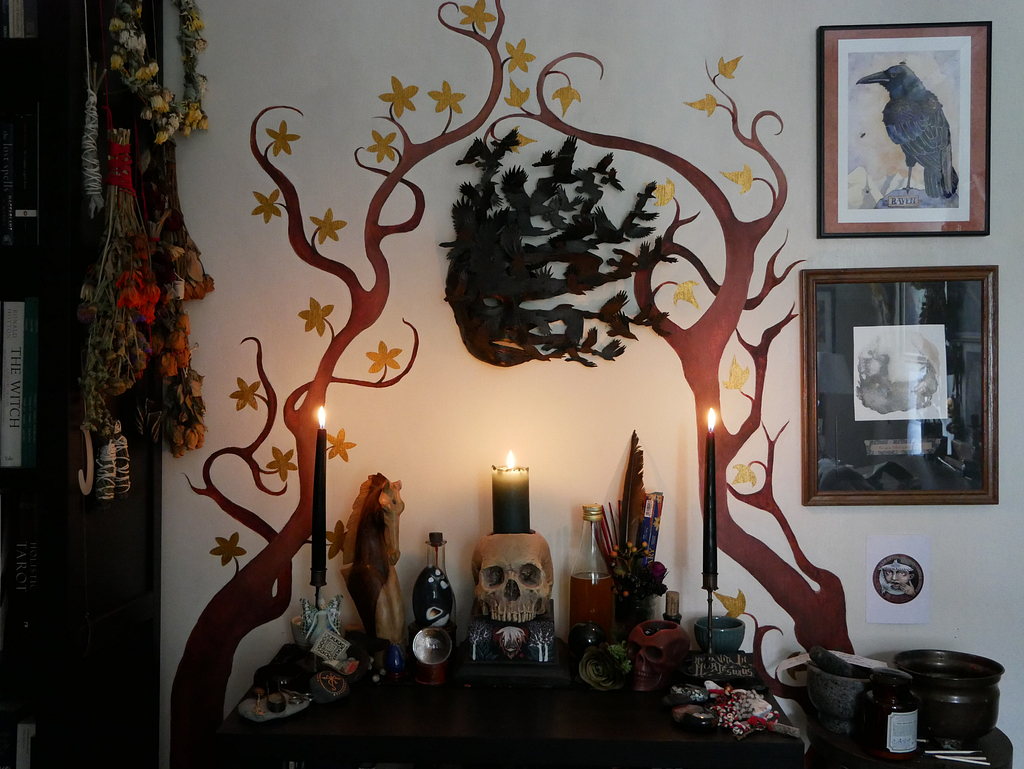
There are many topics that get poured into this massive cauldron of bubbling inspiration and what I want to do is explore that process in a conscientious, intentional manner so that whatever comes out (at any given time) does so as fully considered, balanced, and informed as it can be at that time. Some recent ingredients (or topics) of focus have centred around revamping my altar and strengthening the practical aspects of my devotion to the Morrígan.
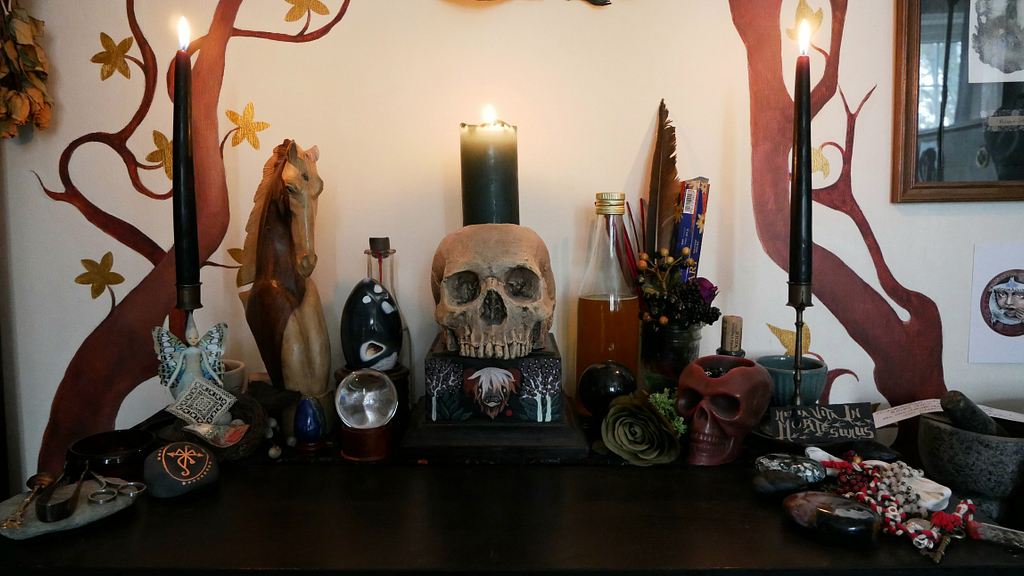
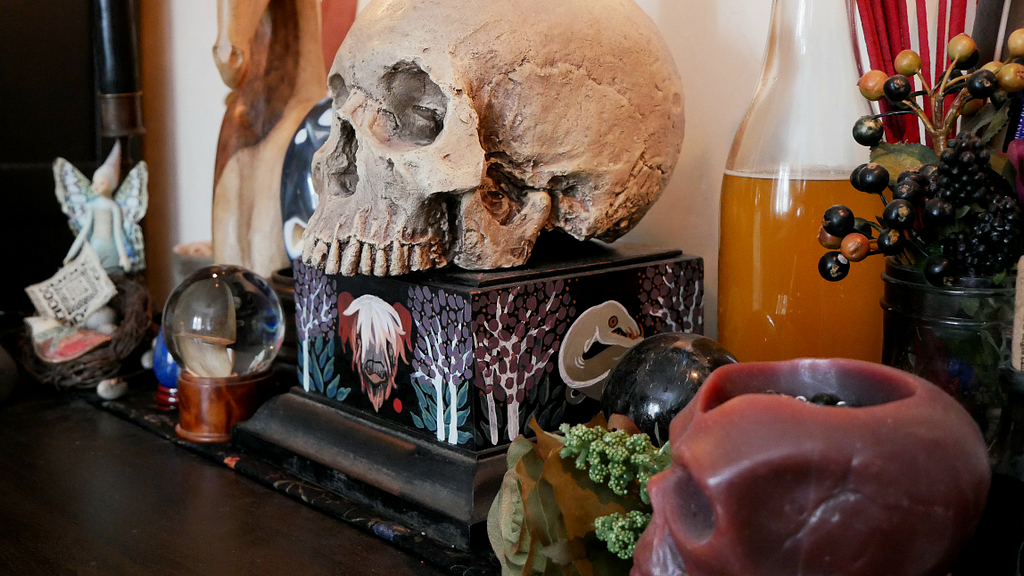
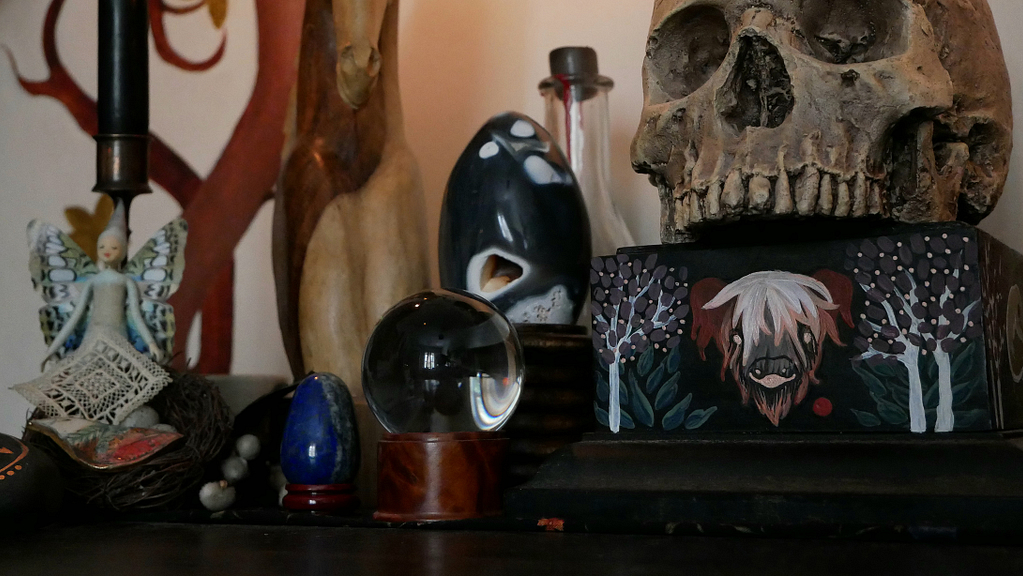
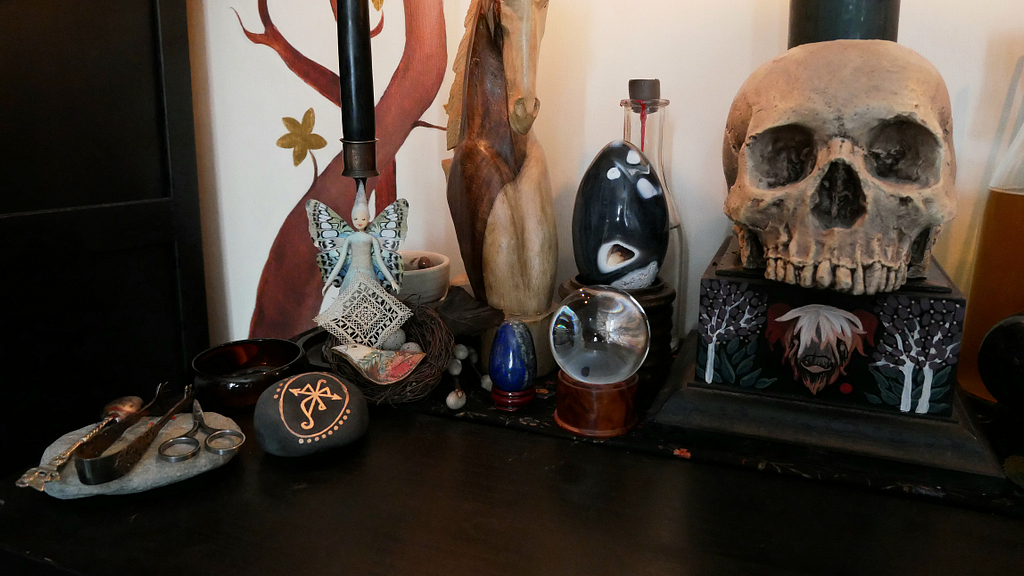
I wanted the art on my altar to function more directly on the Morrígan in her many aspects. I have felt for a long time that I was placing too much emphasis on her bird forms (Badb), her horse forms (assuming we take Macha to be a facet of the same goddess or even her sister), and to some extent her association with war and death. Thus, the altar has the bird, the horse, and the more cosmic otherworldly aspect accounted for but no wolf, cow, or eel… and also no succinct representation of triplicates either! (It used to but hasn’t had for a while – long story.)
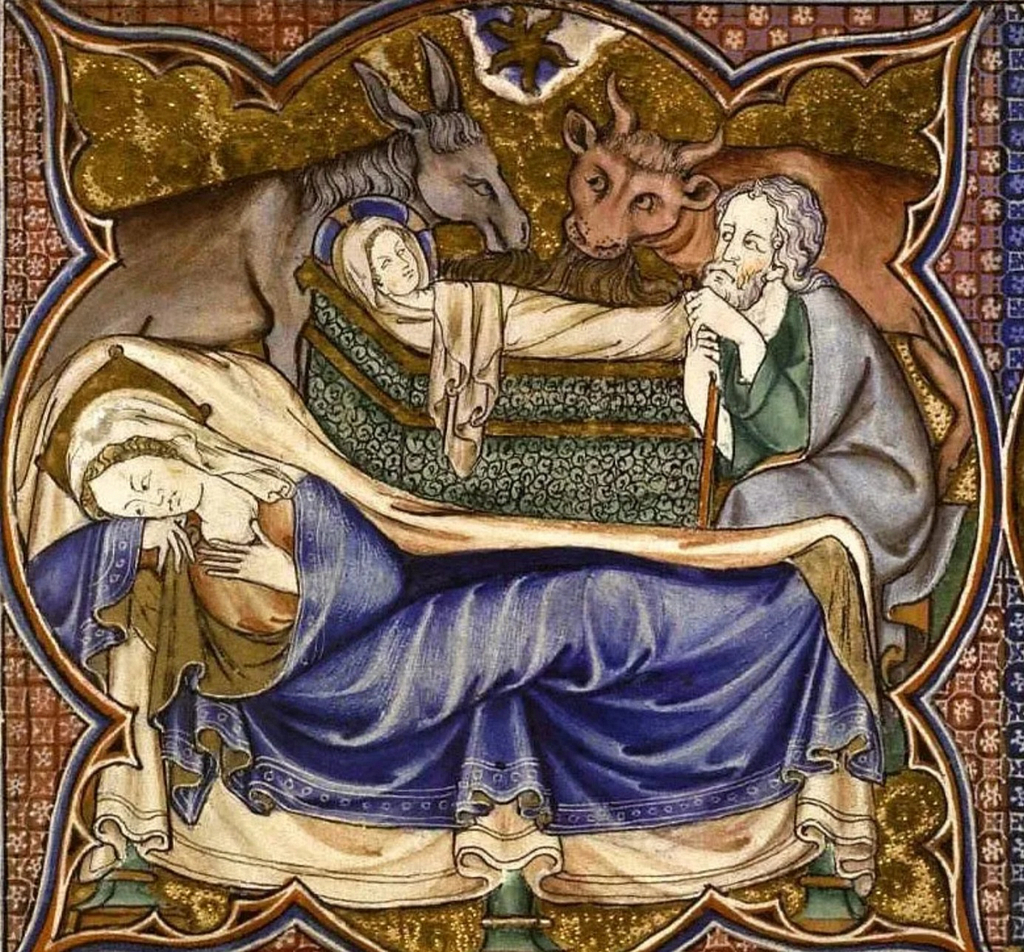
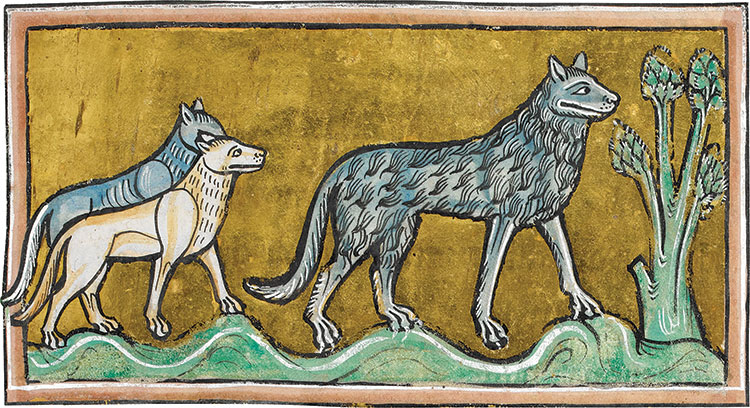
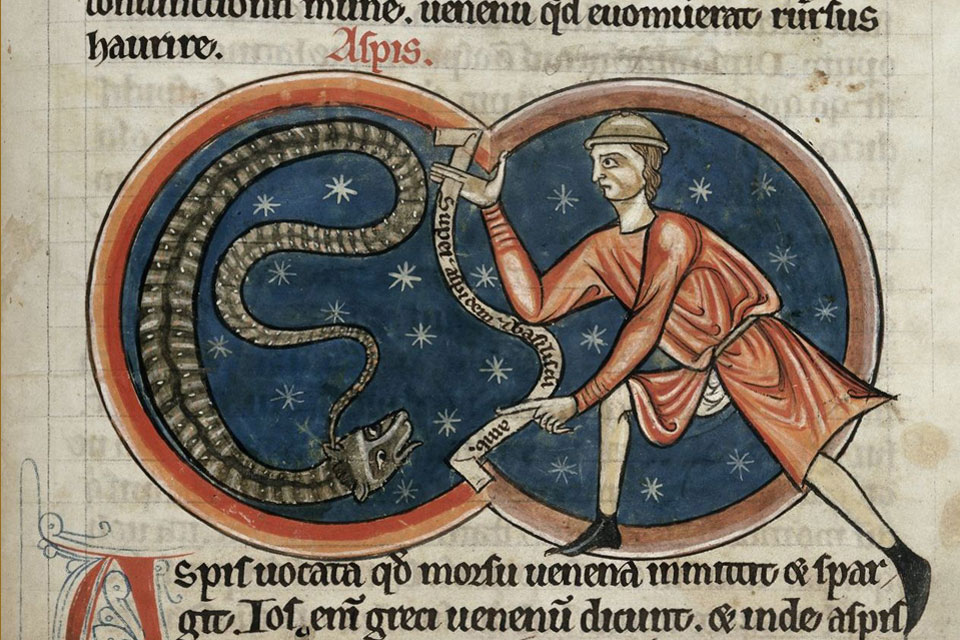
The next question I had was how could I represent so many new animal forms without entirely dismantling my altar for a new layout? I generally take a medieval inspired approach to Irish myth so the first place I looked was medieval manuscripts for representations of the animals in question (or near enough). Below are some examples (including source information) of wolves, cows, and…anything like a snake or fish to give a stylistic basis for drawing an eel. (Oddly, eels were fairly commonplace food items in the middle ages but I’ve had a hard time sourcing properly cited examples. Thanks Pinterest 🙄)
Psalter of Robert De Lisle, c.1310Rochester Bestiary, c. 1230Der Naturen Bloeme of Jacob van Maerlant, c. 1350Harley MS 4751 (ft. additions of Gerald of Wales’ Topographia Hibernica, late 12th-early 13th c.
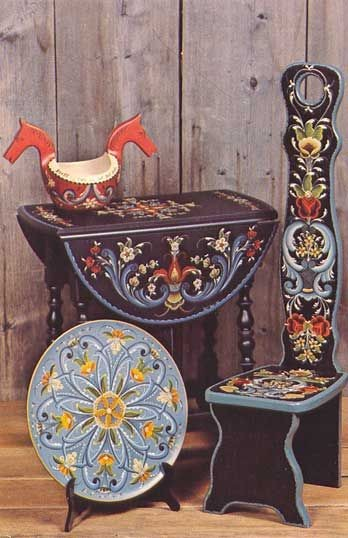
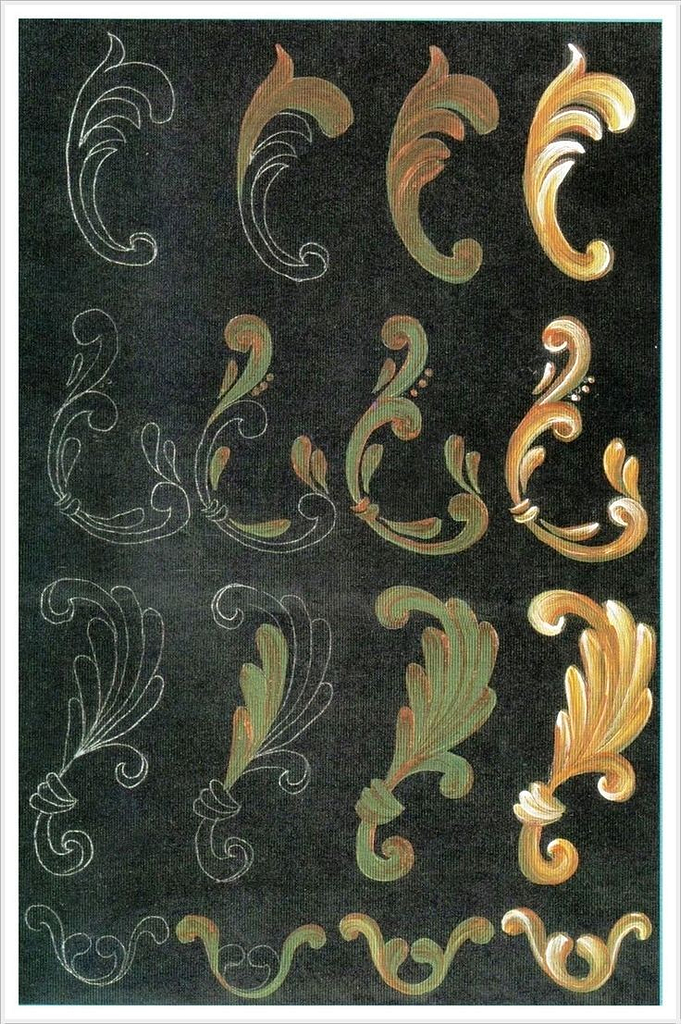
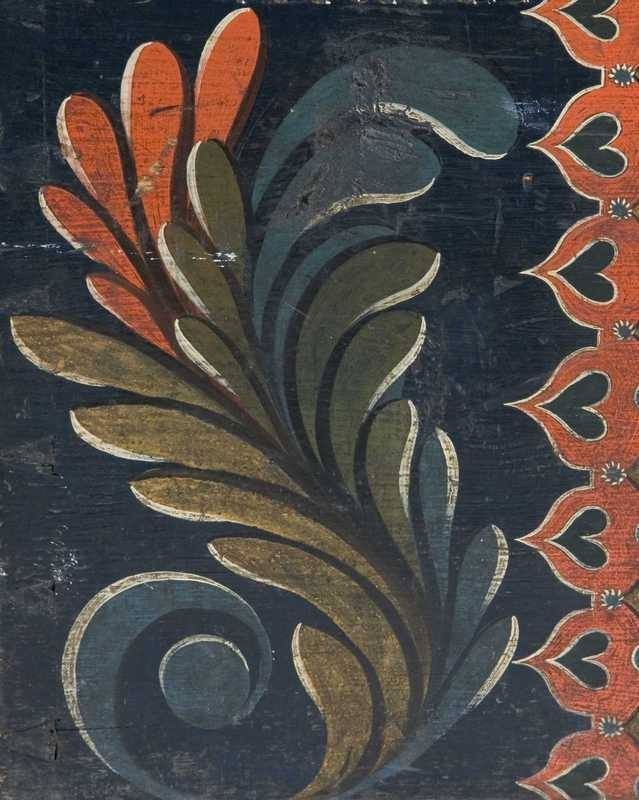
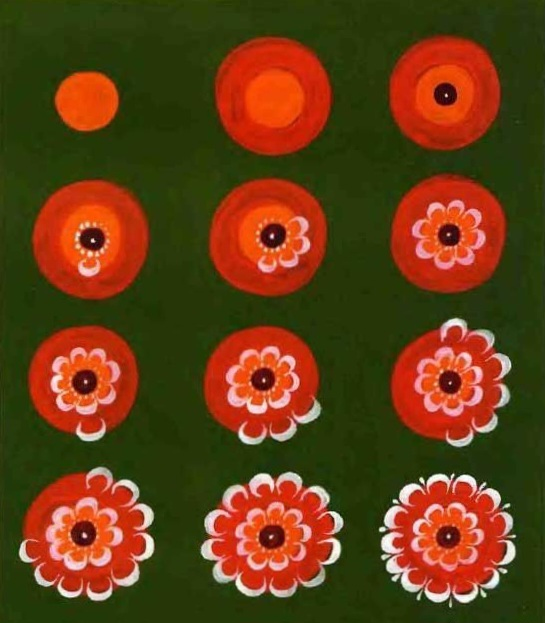
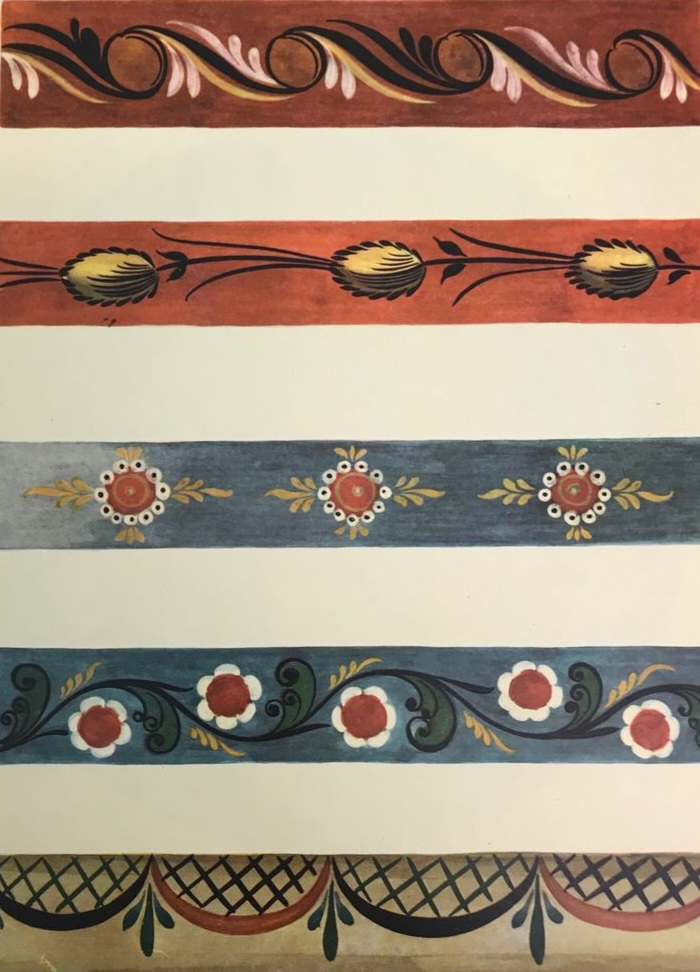
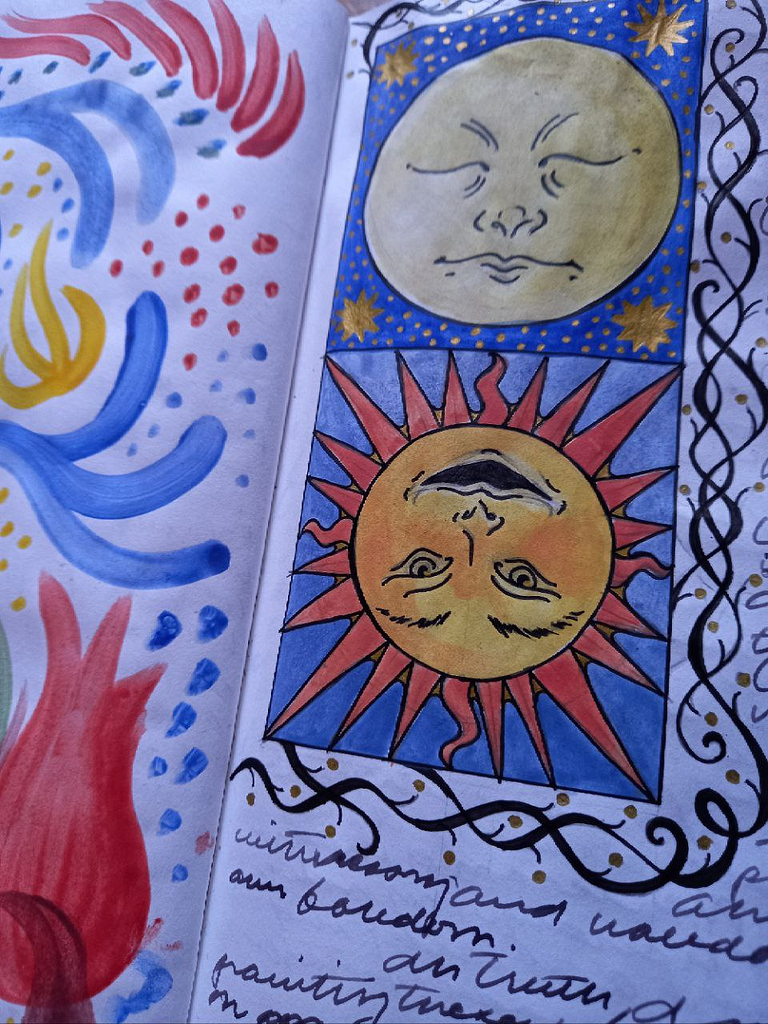
I am also always itching to paint on my furniture (and my walls…as with my altar space) and this seemed like a very good, risk free chance to work on developing my own technique inspired by medieval aesthetics and mimicking various folk styles such as Scandinavian (esp. Norwegian) rosemaling. I also grew up and worked in an area of the US with a lot of old houses that featured strange old paintings in their attics from the folk arts movement – an artistic tradition that included painting folk motifs on furniture as well. Below are some examples that I used as a basic reference as well as a page of my Book of Illuminations where I had some fun practising brush strokes!
Examples of rosemaling style painting – largely uncredited on Pinterest.
So I went to the vintage/antique shopping. Among other treasures such as a white rosary specked with what I assume is years of incense resin and a really beautiful old green glass bottle…I found a black wooden statue base. Bought it, took it home, cleaned it up and worked on designing how to paint it! Yorick was being fussy about the box he had been on anyway. 😉
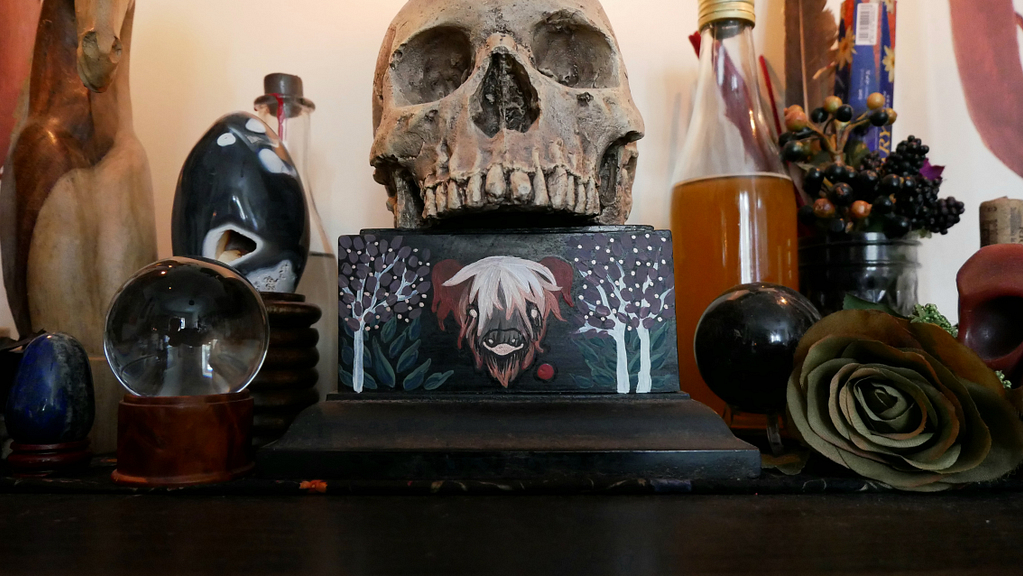
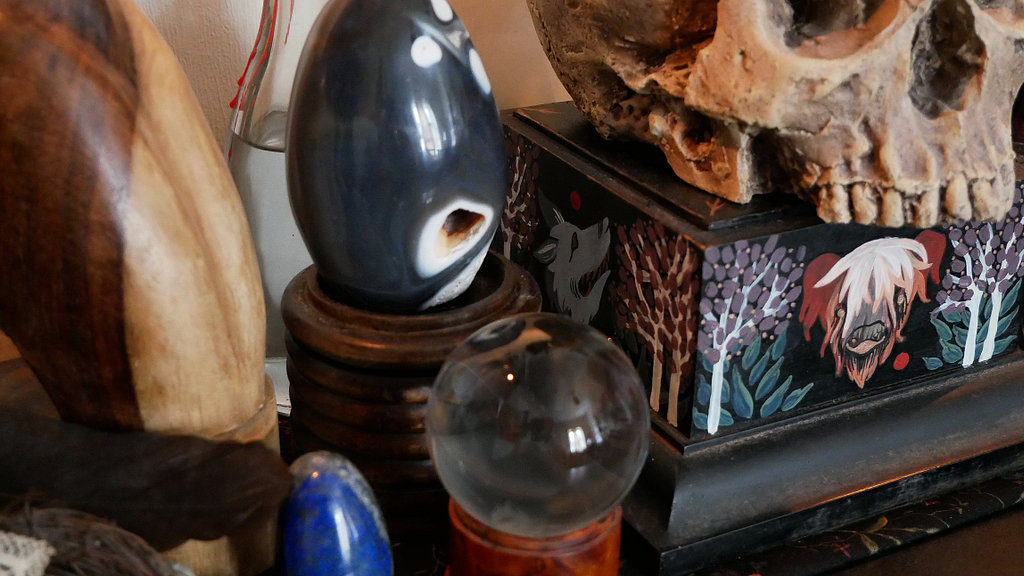
Out of all of this I designed three panels for the statue platform. I incorporated a few William Morris/Arts & Crafts movement/stained glass inspired elements as well (most notably in the birch trees and the leaves behind them.) Note! The cow faces forward and is also somewhat based on modern highland cows… The part of the Táin where the Morrígan takes this form describes Her as a ‘hornless red heifer’. I decided to lighten the colours on her head and keep her ears red as a slight nod to otherworldly cows or cows from the sidhe which are often described as white with red ears. The final product also shows three drops of blood, one for each animal, which are placed spatially in such a way as vaguely indicates where Cúchulainn’s sling shot injured Her in each case. Below are my notes and sketches!
Astral egg symbols abound!Paint experiments.Sketches based on medieval examples – focusing on directionality of brush strokes. Eel modeled loosely on a fresh water species.
The final result up close and in situ! This shrine feels so much more complete now. Best believe the gold of Her eyes lights up in reflected candle light.
A video showing some of this process will follow in a day or so, so stay tuned for that! I will endeavour to update this blog post with the embedded video when it is ready.
As promised, this is Part II of my initial foray into the topic of medieval magic. As a springboard, I will be using a chapter by Mark Williams from the Routledge History of Medieval Magic, titled “Magic in Celtic Lands”. The chapter features examples from Ireland and Wales but, for my purposes, I will focus on Ireland today.
Firstly, what is the impetus for this line of enquiry? The most immediate reason is that I’m obsessed with the middle ages and I function, personally, within ‘the’ Irish mythological framework. Our textual evidence of Irish myth originates or begins in the middle ages in spite of its narrative setting in the Iron Age. Personally, I tend to take the academic view that Irish myth – such as we have it – is medieval literature. More specifically, I’m interested in topics such as the ways in which the format of rosc poetry carries ‘magical’ potency; in Irish mythological tropes around prophecy; the literal singing or chanting component of ‘enchantment’ such as it appears in certain stories; and a certain recurring visual motif involving ‘bird heads’ or bird headed…ness? I’ll get into my thoughts on what this currently means for my magico-spiritual artistic practice toward the end of this post.
Some BRIEF background information… The word “Celtic”, as Mark Williams states, “is a difficult term, precise only when deployed in a linguistic context: it is used in a parallel manner to “Roman” and “Germanic” to denote a major branch of the Indo-European language family.” (123) Scholarship on the topic applies to regions linguistically Celtic whereas popular culture and imagination thinks of places like Ireland and Scotland and so on as ‘celtic lands’ (as Williams words it) or in terms of ‘celtic heritage’. Williams also notes that relating similar motifs between Ireland and Wales and calling them “Celtic” might no longer be done with confidence:
“it is increasingly acknowledged that similarities between the two countries’ literary traditions – formerly taken as evidence for a shared cultural inheritance – may in fact be medieval borrowings or independent innovations. […] The question of what medieval Irish literature in particular owed to the Bible and to the wider European world was a controversial area of critical debate for much of the second half of the last century, and the examination of magic is likely to constellate the issue once again in significant ways. The field of Irish and Welsh magic is therefore excitingly wide open, and a reconsideration of all the surviving records and representations of magical practices is badly needed.” (123)
THAT is exciting!
Dreams of diving headlong into the world of Celtic Magic Academia and never resurfacing aside (for now), I want to discuss some particulars of this chapter that jumped off the page and screamed ‘remember and explore me!’ Firstly, Williams emphasizes the potential for differences between literary magic and historical magical practice. In so doing, he introduces characteristics on the Irish ‘literary druid’ (127) and provides two examples: Cathbad (who we might perceive as ‘good’ or praiseworthy in the the stories, though he tends to get on my nerves) and Mog Ruith, with whom I am less familiar.
“Mog Ruith, in contrast, is a more morally ambiguous figure. In Forbuis Dromma Damghaire, he is Fiachu’s major secret weapon against the forces of Cormac (though Cormac has his own team of druids too), being a miracle-worker possessed of a spectacular repertoire. He can alter his size at will, set things on fire with his breath, cause rains of blood, send people to sleep for long periods and create magical animals which go after enemy champions […] At one point, he puts on a cloak and “bird-headdress” and ascends into the air.” (130)
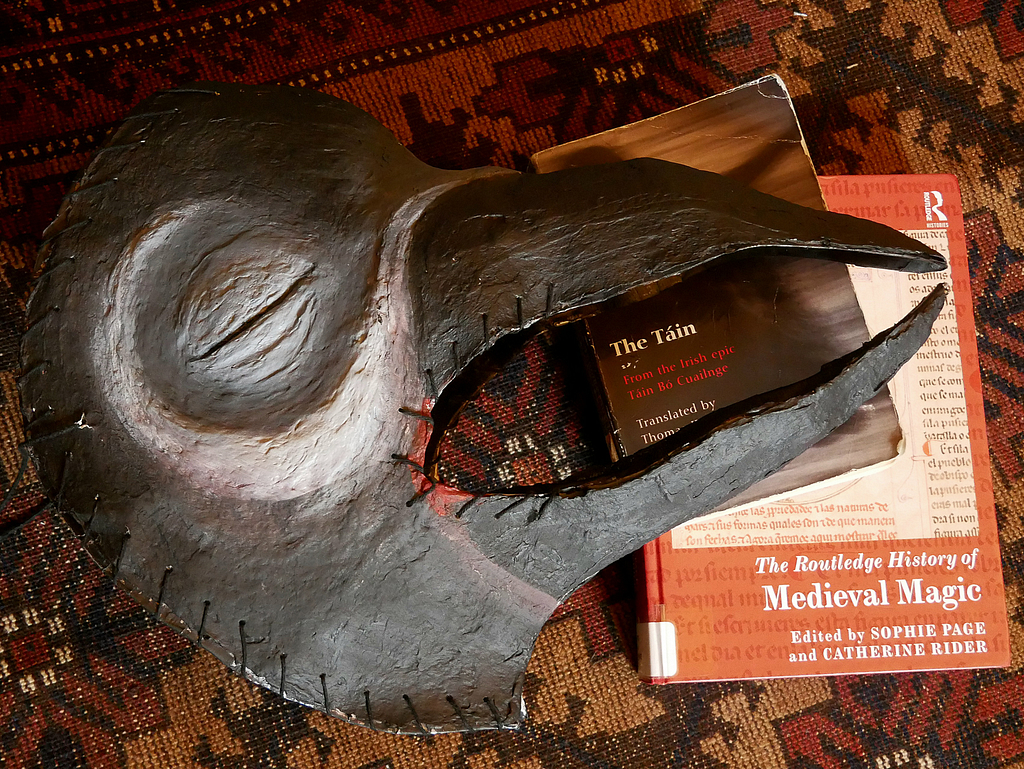
My eyes nearly fell out when I read that last sentence. Those of you familiar with my youtube channel, you may remember the ritual costume I made for Samhain in which I crafted a bird mask and black linen veil (rather in the style of modern folkloric/pagan pageantry) for the purpose of shapeshifting and affecting change in my personal life and spiritual practice.
My video last Samhain, vlogging the #artwitch process…
I got this idea mainly from associations with the crow and the Morrígan*, my personal obsession with shapeshifting motifs, as well as a specific mention in the foretales of the Táin Bó Cuailgne, as translated by Thomas Kinsella. From Cúchulainn’s training in arms:
“[While on raid for Scáthach, his warrioress mentor] he came back the way he had gone, and met a one-eyed hag in his path. She told him to get out of her way. He said that would leave him no room to pass except the sea-cliff below them. But she begged him to get out of her way. So he let her have the path, except where he clung by his toes. She struck at his big toe as she passed him by, to knock him off the path down the cliff. But he saw her in time and gave his hero’s salmon-leap upward. Then he struck off the hag’s head. She was Eis Enchenn, the bird-headed, mother of the three last warriors to die at his hands. It was to avenge their ruin that she lay in wait for him.” (Kinsella, 33)
These stories are hardly a feminist utopia (just read a few paragraphs in either direction from this point) but – in addition to the one-eyed hag which is a descriptor that exists in other stories, including for the Morrígan, Herself – I was particularly interested in this ‘birdheaded’ detail…is it a kenning? An epithet? Was it literal or metaphorical? It seems important, especially as it occurs in a section of Cúchulainn’s stories that involves so many magically potent martial prophetesses. I don’t yet know how it is phrased in the Old Irish or any specifics about Kinsella’s translation choices here.
Thus, as regards Mog Ruith, I had never encountered an explicit mention of donning a birdheaddress for the purpose of shifting shape or flying before. Yet, from an UPG** perspective, you might say this is what I did for Samhain. I like that but I don’t need it to be objectively ‘true’. I DO need to learn Old Irish and research the heck out of this for the rest of my living days. It has also only further cemented my tendency to merge bird-symbolism and artistic practice. The alchemy of art (including costumery and stitchcraft) is that when we have extant primary evidence from our favoured time periods, we can exist in direct artistic dialogue with them. In my opinion, it makes very fertile ground for personal gnosis.
I have more to say on Mark Williams’ chapter – including another juicy tidbit about the Túatha Dé (god-peoples) and their ‘theological knowledge’ allowing them to occupy a similar ontological category to medieval demons… and how that’s born out in other medieval Irish literature… but this blog post is long enough, I think.
Until next time!
Nerdily yours, Sorsha.
* I don’t use the phrase ‘matron deity’ but I guess you could consider me a ‘devotee’ in so far as I live my life & devotional practice ‘under the auspices of Her wing’ (as I often put it.) In this post, I have used her most well known name… but I’m not necessarily only referring to one Morrígan here. ** Unverified Personal Gnosis
Citations:
Kinsella, Thomas. The Táin: From the Irish Epic Táin Bó Cuailgne. Oxford University Press, 2002. A 2002 reissue of the Oxford Universtiy Press 1970 edition, with illustrations by Louis Le Brocquy.
Page, Sophie, et al. “Magic in Celtic Lands.” The Routledge History of Medieval Magic, Routledge, Taylor Et Francis Group, London ; New York, New York, 2021, pp. 123–135.