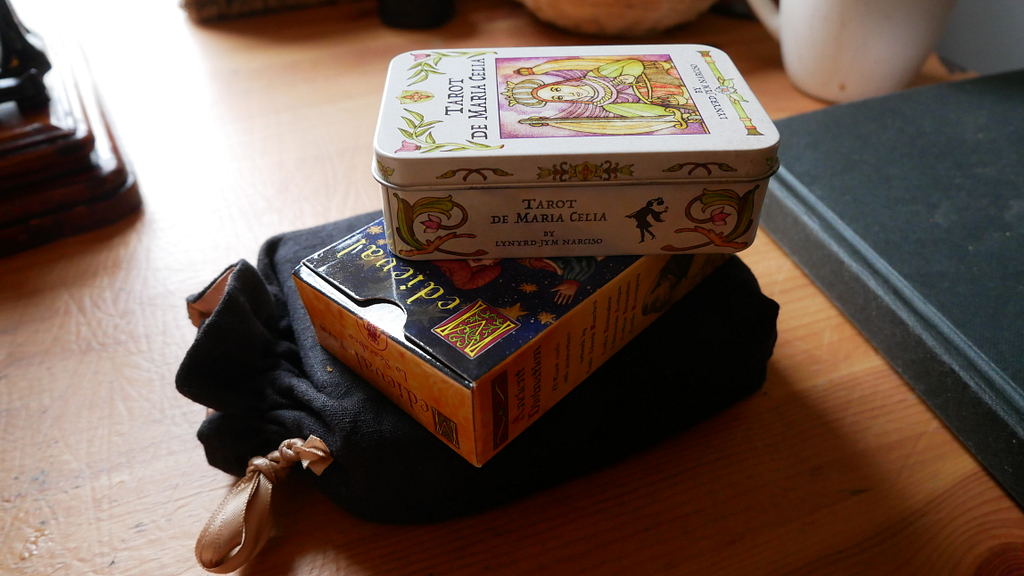
My etsy shop is now live! Here’s the link!!! You can also access the shop through the Etsy button on the home page of this website. Finally. Whew!!!
The experience of putting my art out there has already been rather different than I expected. Call it an ‘apocalyptic outlook’ but I was a little surprised when I posted the listings and the world didn’t suddenly come crashing down on some kind of volcanic Bosch-ian level. It turns out, at least so far, that I can post something and then breathe! And then breathe again! Who knew…
I want to keep this blog entry short so, for now, just a few words on what I’m planning for the shop space.
INKS! For legal reasons, liquid ink will only be available for domestic customers once I post the listing. I am currently investigating techniques for dried/powdered inks for international shipments.
DOLLS/POPPETS! I aim to have some witch dolls as well as smaller poppets available in the coming weeks. These will all be OOAK but my aim is to have a little more uniformity for the smaller ones so that any magickal practitioners can better adapt them for less formal uses.
PRINTS! Over time, I hope to offer more prints. The art featuring black backgroundS (such as my tarot archetypes) cannot be sold as prints in a practical way so I will be featuring art with lighter backgrounds.
✨️A question for readers!✨️ I would love to hear if people are more interested in animal representations (such as corvids, foxes, or generally speaking Irish and American fauna) or if they would prefer more human (or humanoid) portraiture…
I always do a mix in my own art practice, so it would be good to get a sense of what would be better suited specifically for sale!
Any thoughts? Leave a comment!**
Sincerely,
Sorsha.
** Comments are set to manual approval so yours may not be visible right away!
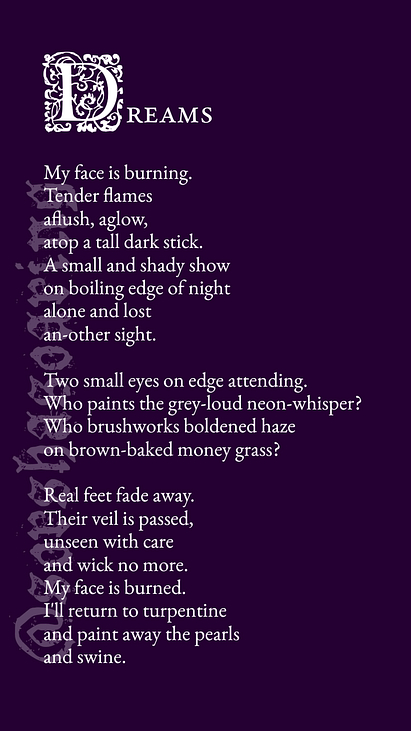
Broadly speaking, the merit we do or don’t assign to the imagination is always on my mind. How do we perceive our purpose – as ‘human persons’ – and do we get to factor in things like… baseline personality traits? Neurological health? Any form of personal needs or even preference?
I suspect it is often perceived as melodramatic when a person states they need imagination and creativity to survive… but in my case at least, this is quite literally true. However, I won’t claim this for neurodivergents exclusively – burn out is a serious issue. We, just like the planet around us, have *finite* resources. Fallow periods allow for growth and growth holds value when tempered and balanced. Diversity – socio-cultural, neurological, biological, and ecological is strength. …At least, I think so.
A small face on the edge of firelight…
I have been dangerously ill many times in my life… and I will never have the more robust and dependable constitution of someone who has not repeatedly nearly destroyed their body in pursuit of constant socially and economically approved extroversion and productivity. I have spent my whole life trying not to be what I am – autistic, yes… which is also a passionate dreamer, irrevocably introverted, desperately sensitive, creative, earnest, and an inquisitive but flawed (‘slow, airheaded’) human.
…Someone I know was recently told, while presenting material on sustainability at a conference, that unless he slept in a hotel room pre-booked for him on location (without his prior consent – he lives within walking distance) he ‘hadn’t really attended the conference’. I have often heard people talk about being pressured to stay on at work after hours or else they’re not a good employee. I myself have been bullied in the workplace and phoned by employers in the evenings and on days off… The world seems to use the word “hobby” to refer to how we spend our *lives* when not working… When people ask us what we are we tell them our professional titles…
Once, on holiday, when I was very low from family trouble, bereavement, and having left my profession due to aforementioned bullying, someone interrupted me over dinner chat to ask (twice) “why, what are YOU doing?” …I’ll never forget how that felt.
“Media vita in morte sumus” *
I say this in sacred space every single day – I am #deathpositive after all. But #deathpositivity is not about expediting the dying process and it is not about the pursuit of suffering and grief. It’s about integrating a healthy organic relationship with the fact that we are finite and it seeks to combat socio-economic oppression… amongst other larger more collective causes.
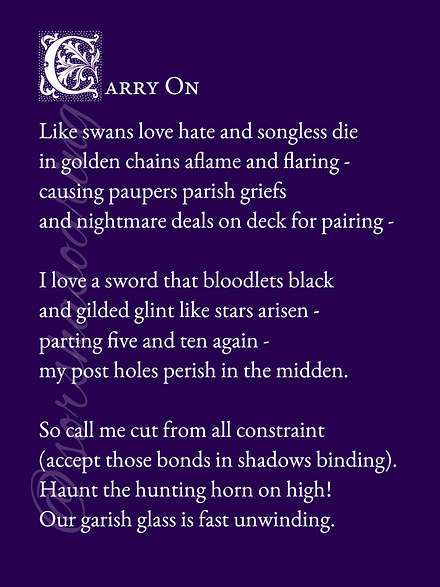
Carry on or carrion?
I dwell between worlds because that’s where I live …and I guess I’m no longer willing to be apologetic or ashamed of that. I am a living organism with no truly objective purpose. I happen to exist…but certainly I was not born to support exponential and exploitative profiteering. I’ll stay a ‘shiftless dreamer’.
Today’s video ~ verdure from void & poetic motifs…
(The featured image on this blog post is of Jane Morris (née Burden) photographed by John Robert Parsons in 1865… and part of a current set of projets or ideas I’m working on.)
As promised, this is Part II of my initial foray into the topic of medieval magic. As a springboard, I will be using a chapter by Mark Williams from the Routledge History of Medieval Magic, titled “Magic in Celtic Lands”. The chapter features examples from Ireland and Wales but, for my purposes, I will focus on Ireland today.
Firstly, what is the impetus for this line of enquiry? The most immediate reason is that I’m obsessed with the middle ages and I function, personally, within ‘the’ Irish mythological framework. Our textual evidence of Irish myth originates or begins in the middle ages in spite of its narrative setting in the Iron Age. Personally, I tend to take the academic view that Irish myth – such as we have it – is medieval literature. More specifically, I’m interested in topics such as the ways in which the format of rosc poetry carries ‘magical’ potency; in Irish mythological tropes around prophecy; the literal singing or chanting component of ‘enchantment’ such as it appears in certain stories; and a certain recurring visual motif involving ‘bird heads’ or bird headed…ness? I’ll get into my thoughts on what this currently means for my magico-spiritual artistic practice toward the end of this post.
Some BRIEF background information… The word “Celtic”, as Mark Williams states, “is a difficult term, precise only when deployed in a linguistic context: it is used in a parallel manner to “Roman” and “Germanic” to denote a major branch of the Indo-European language family.” (123) Scholarship on the topic applies to regions linguistically Celtic whereas popular culture and imagination thinks of places like Ireland and Scotland and so on as ‘celtic lands’ (as Williams words it) or in terms of ‘celtic heritage’. Williams also notes that relating similar motifs between Ireland and Wales and calling them “Celtic” might no longer be done with confidence:
“it is increasingly acknowledged that similarities between the two countries’ literary traditions – formerly taken as evidence for a shared cultural inheritance – may in fact be medieval borrowings or independent innovations. […] The question of what medieval Irish literature in particular owed to the Bible and to the wider European world was a controversial area of critical debate for much of the second half of the last century, and the examination of magic is likely to constellate the issue once again in significant ways. The field of Irish and Welsh magic is therefore excitingly wide open, and a reconsideration of all the surviving records and representations of magical practices is badly needed.” (123)
THAT is exciting!
Dreams of diving headlong into the world of Celtic Magic Academia and never resurfacing aside (for now), I want to discuss some particulars of this chapter that jumped off the page and screamed ‘remember and explore me!’ Firstly, Williams emphasizes the potential for differences between literary magic and historical magical practice. In so doing, he introduces characteristics on the Irish ‘literary druid’ (127) and provides two examples: Cathbad (who we might perceive as ‘good’ or praiseworthy in the the stories, though he tends to get on my nerves) and Mog Ruith, with whom I am less familiar.
“Mog Ruith, in contrast, is a more morally ambiguous figure. In Forbuis Dromma Damghaire, he is Fiachu’s major secret weapon against the forces of Cormac (though Cormac has his own team of druids too), being a miracle-worker possessed of a spectacular repertoire. He can alter his size at will, set things on fire with his breath, cause rains of blood, send people to sleep for long periods and create magical animals which go after enemy champions […] At one point, he puts on a cloak and “bird-headdress” and ascends into the air.” (130)
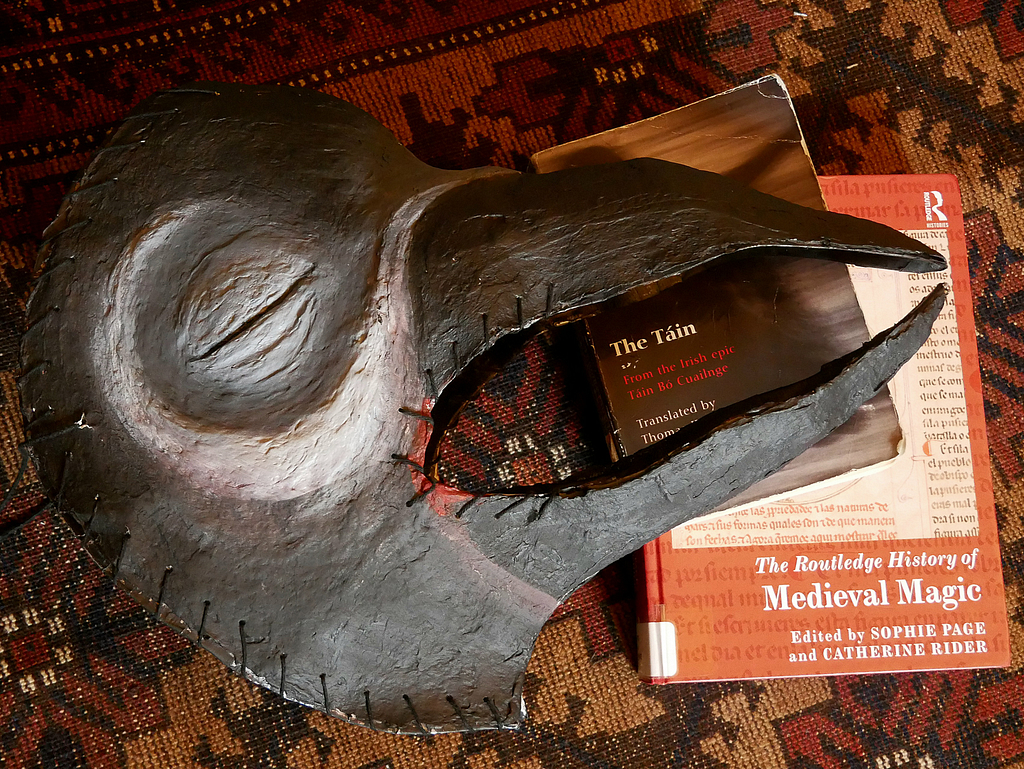
My eyes nearly fell out when I read that last sentence. Those of you familiar with my youtube channel, you may remember the ritual costume I made for Samhain in which I crafted a bird mask and black linen veil (rather in the style of modern folkloric/pagan pageantry) for the purpose of shapeshifting and affecting change in my personal life and spiritual practice.
My video last Samhain, vlogging the #artwitch process…
I got this idea mainly from associations with the crow and the Morrígan*, my personal obsession with shapeshifting motifs, as well as a specific mention in the foretales of the Táin Bó Cuailgne, as translated by Thomas Kinsella. From Cúchulainn’s training in arms:
“[While on raid for Scáthach, his warrioress mentor] he came back the way he had gone, and met a one-eyed hag in his path. She told him to get out of her way. He said that would leave him no room to pass except the sea-cliff below them. But she begged him to get out of her way. So he let her have the path, except where he clung by his toes. She struck at his big toe as she passed him by, to knock him off the path down the cliff. But he saw her in time and gave his hero’s salmon-leap upward. Then he struck off the hag’s head. She was Eis Enchenn, the bird-headed, mother of the three last warriors to die at his hands. It was to avenge their ruin that she lay in wait for him.” (Kinsella, 33)
These stories are hardly a feminist utopia (just read a few paragraphs in either direction from this point) but – in addition to the one-eyed hag which is a descriptor that exists in other stories, including for the Morrígan, Herself – I was particularly interested in this ‘birdheaded’ detail…is it a kenning? An epithet? Was it literal or metaphorical? It seems important, especially as it occurs in a section of Cúchulainn’s stories that involves so many magically potent martial prophetesses. I don’t yet know how it is phrased in the Old Irish or any specifics about Kinsella’s translation choices here.
Thus, as regards Mog Ruith, I had never encountered an explicit mention of donning a birdheaddress for the purpose of shifting shape or flying before. Yet, from an UPG** perspective, you might say this is what I did for Samhain. I like that but I don’t need it to be objectively ‘true’. I DO need to learn Old Irish and research the heck out of this for the rest of my living days. It has also only further cemented my tendency to merge bird-symbolism and artistic practice. The alchemy of art (including costumery and stitchcraft) is that when we have extant primary evidence from our favoured time periods, we can exist in direct artistic dialogue with them. In my opinion, it makes very fertile ground for personal gnosis.
I have more to say on Mark Williams’ chapter – including another juicy tidbit about the Túatha Dé (god-peoples) and their ‘theological knowledge’ allowing them to occupy a similar ontological category to medieval demons… and how that’s born out in other medieval Irish literature… but this blog post is long enough, I think.
Until next time!
Nerdily yours, Sorsha.
* I don’t use the phrase ‘matron deity’ but I guess you could consider me a ‘devotee’ in so far as I live my life & devotional practice ‘under the auspices of Her wing’ (as I often put it.) In this post, I have used her most well known name… but I’m not necessarily only referring to one Morrígan here. ** Unverified Personal Gnosis
Citations:
Kinsella, Thomas. The Táin: From the Irish Epic Táin Bó Cuailgne. Oxford University Press, 2002. A 2002 reissue of the Oxford Universtiy Press 1970 edition, with illustrations by Louis Le Brocquy.
Page, Sophie, et al. “Magic in Celtic Lands.” The Routledge History of Medieval Magic, Routledge, Taylor Et Francis Group, London ; New York, New York, 2021, pp. 123–135.
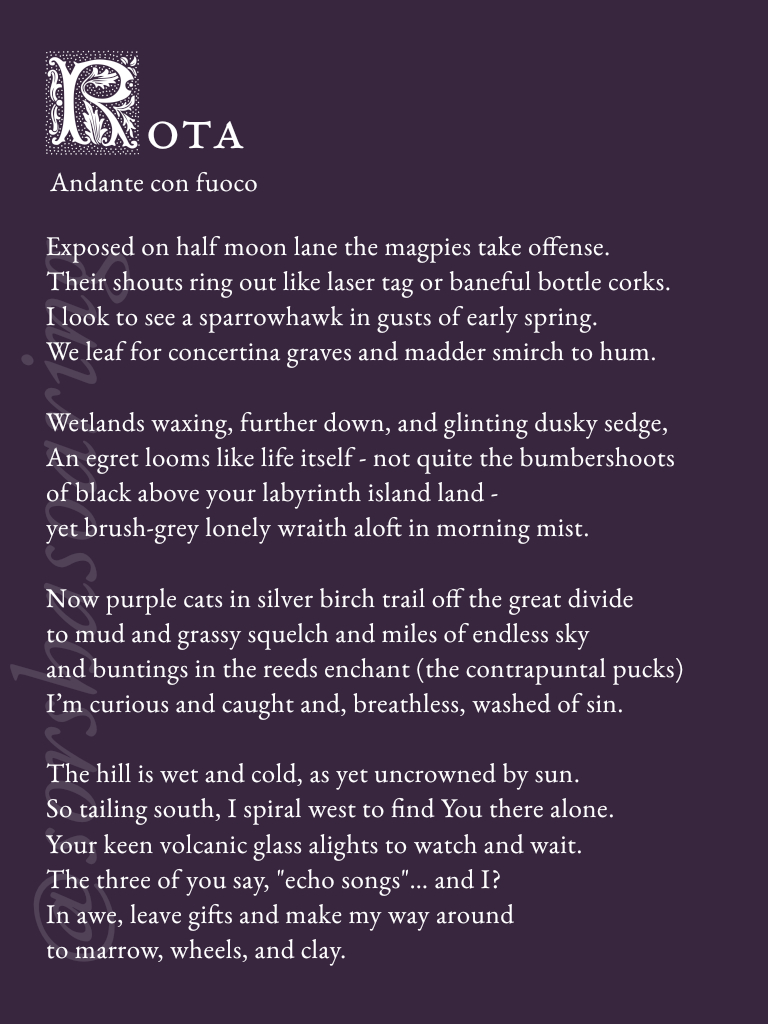
Perhaps it is the time of year – verging on the vernal equinox and a hushed but stirring feeling in the air. On Imbolc, some say that fine weather means six more weeks of winter: the Cailleach has cleared the clouds so that she may gather dryer firewood for more cold weather. If you see a bird fly by with sticks in its beak, on the day, that’s her! The birds have indeed been gathering with a frenzy of late, the weather gusts cold and wet, and everywhere are light burgeoning shades of green and delicate hints of mauve.
This one felt stuck until this morning…go figure. Note ~ “rota” (wheel…) or “rondellus” is the medieval term for a round. “Andante con fuoco”, also in music, means “at walking pace, with fire”.
I’ve been feeling restless – even anxious – and keenly aware that my priorities need a rearrange. It’s been weeks since I’ve been able to sit at my altar without knocking something over or dropping cinders on the floor – that’s strange. I like to spend most of my time alone and yet the world seems very loud and backlit with blue flickering light – that’s telling. I’ve been losing sense of what I love, what projects I want to work on, feeling anxious to meet deadlines that don’t exist – time to slow down. After all, this year’s motto is: NO RUSH.
Gorse… beautiful and so very sharp. I like it for protection/warding work.
It may not seem like much, but I’m leaving Instagram. I feel I am responsible for my own use of time, my own sense of honesty or personal connection with others (and with the collective!), and my own health. Instagram makes it seem that those who live with flare and authenticity have no trouble documenting that on their platform…but I have not found this to be the case in my life. Instagram also makes it seem as though there is no such thing as agency or artists or social awareness or anything at all without their dicey validation.
When catkins look like corpses… “I’ll cut you in half, while you’re smiling ear to ear/And the freedom that you sought/is drifting like a ghost amongst the trees…” (Magic by Bruce Springsteen)
But there ARE other ways to show process, to document inspiration, and to allow others to partake in the kind of slow quiet beauty I wish to cultivate. Hence, this blog post features some examples of the few moments of quiet that I have recently pursued and remembered to value… none of which were posted on Instagram but that I’m happy to highlight here as a signpost for the future.
Variations on a theme…Current corset progress…Modded Somnia Tarot.
A thread of red in the labyrinth of life.
Quietly yours,
Sorsha.
*First line of the Morrígan’s prophecy to the Donn Cúailgne, as translated by Thomas Kinsella.
I mentioned in last week’s video (“Who Painted the Lion?” or “Medieval Shadows & Cards of the Year”) that I have begun exploring academic perspectives on medieval magic. The first thing of note is a fairly baseline agreement on the historical distinction between ‘magic’ and ‘witchcraft’ (something we see holds true in the early modern period as well through secondary works by the likes of Ronald Hutton etc.) The second thing to highlight is that, as with most things, this is an entire academic discipline and a developing one. My intention is to pursue the points that interest me and then see how it feels to relate some of that back to my own work as a modern practitioner of ‘medieval-infused’ witchcraft and art magic.
The aim of this post and any others like it (e.g. capering treacherously on the border, with historical research or context on one side and personal gnosis or numinous magic on the Other) is simply to show ‘process’:
How do I gather ideas or inspiration?
When, how, and why does that inform my magick and art?
Why might that lead to further UPG (Unverified Personal Gnosis)?
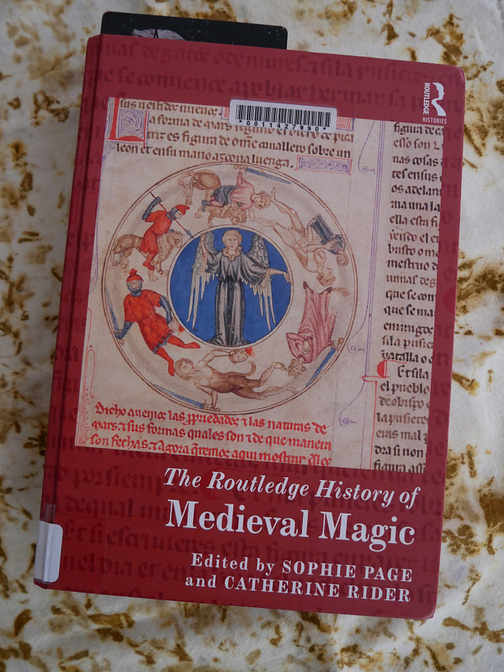
For now, I’ve started with “The Routledge History of Medieval Magic”, edited by Sophie Page* and Catherine Rider and published in 2019. The main goal of the book is to show the current standing of the field but also to illustrate various directions in which it needs expansion. It’s less an overview of what has come before and more an academic call to action with each chapter serving as useful examples, or signposts, for further research. Yes please!!!
Part I, Chapter I: “Rethinking how to define magic” by Richard Kieckhefer presents some interesting ideas surrounding why magic is difficult to define (even for academics! We’ll steer clear of the choppy waters around definitions of magic and witchcraft in modern practice on this blog!)
Concepts that caught my eye came up as he was establishing his main system of “aggregating terms” vs. “constituitive terms” (pp. 15-16) – i.e. the vague umbrella terms like ‘magic’ vs. better defined component parts. He draws a comparison to the term “mysticism”. Like the word magic, ‘mysticism’ resists attempts at explanation and evokes many different ideas or impressions of what it is.
“A comparison may help. It has long seemed to me useful to think of mysticism […] not as a single phenomenon but rather as a cluster of phenomena that may at times be distinct but tend to become intertwined. There is mystical prayer, mystical relationship and mystical consciousness.” (p. 15)
In the medieval Christian context,
mystical prayer – involves “fervent and intense, highly concentrated, focused prayer, cultivated within the setting of the contemplative or monastic life.”
mystical relationship – Kieckhefer represents through Bernard of Clairvaux or “the German sister books that are deeply steeped in “theoerotic” relationship […] with Christ.”** This is the view in which one might ‘burn with love’ for deity.
mystical consciousness – Kieckhefer says can be found in the vernacular sermons of Meister Eckhart “who wants his hearers or readers to gain a lively awareness of God’s presence within herself […] and her own true and eternal presence within God.”
Kieckhefer clarifies that these may all be combined in different ways by a single medieval writer. His example is the writing of Teresa of Ávila. (p.15)
I’m already interested in the murky waters of mystical thinking… not to mention words like “theoerotic” (which, incidentally, might be more readily available to the imaginations of non-Christian devotees of deity or deities).
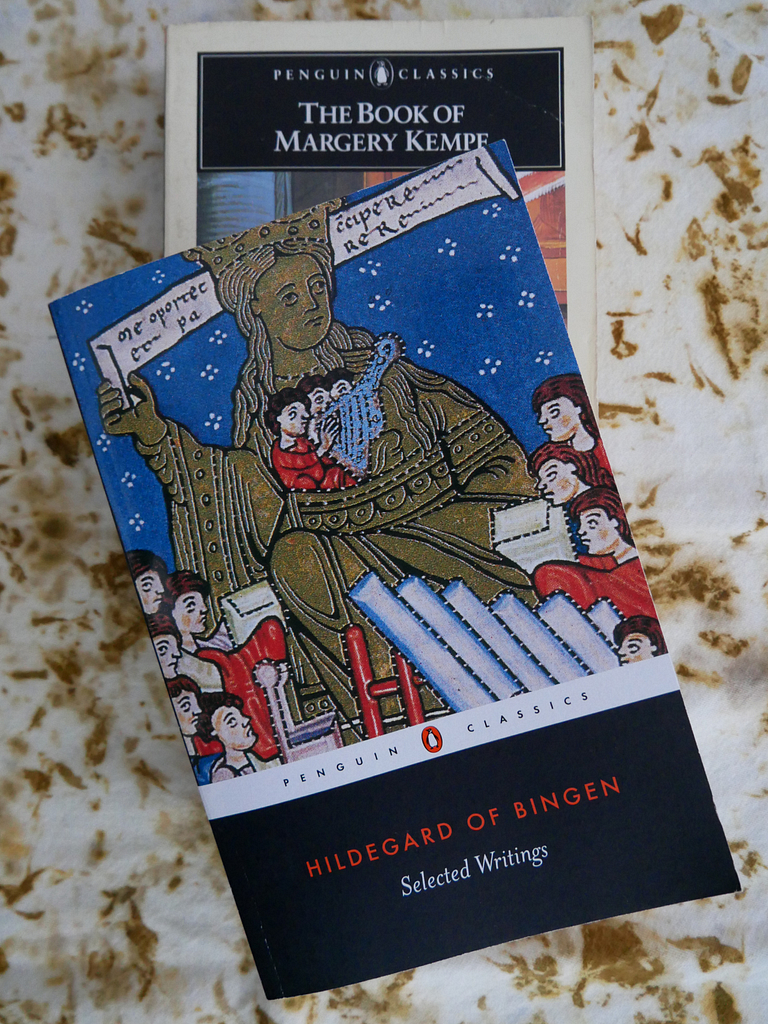
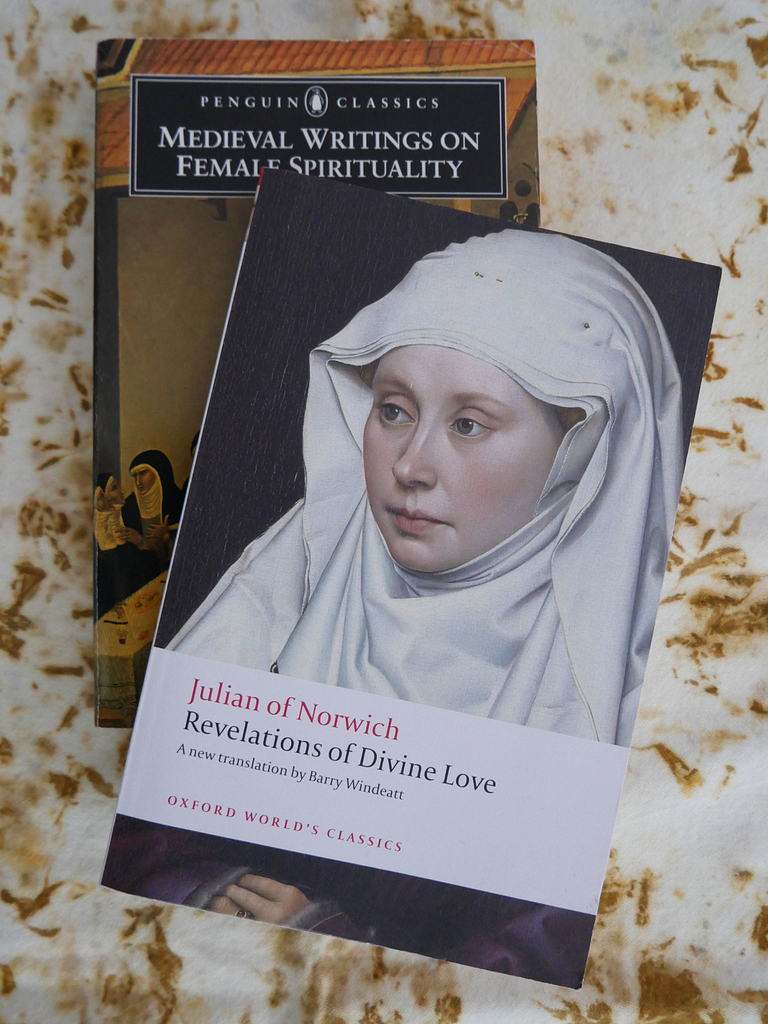
**Some books on my ‘TBR’ taken from my atheist partner’s bookshelf (who’s shelf SHOULD these belong to? Squabbles abound.)
However, coming back to the aggregating term of ‘medieval magic’, Kieckhefer offers at least three options for its constitutive terms: conjuration, symbolic manipulation, and directly efficacious volition. (p. 17-18)
Honing in on symbolic manipulation (hello, art witch here!) Kieckhefer says some really juicy words:
“If a plant shaped like a liver is useful for healing the liver, it is in that sense a sign of what is thought to affect, and the intelligible resemblance is what effects the healing. […] If conjuration is a reprobate branch of religion, symbolic manipulation claims an efficacy like that of science and will be seen by its practitioners as a type of science. The magician who manipulates symbolic links in the natural order might be thought of as tugging on invisible cords that link one level of that order with another. The symbolic links may be articulated in terms of cosmic correspondences and sympathies, at least in sources that provide theoretical grounding for magical practice. If the invisible cords are not thought of as efficacious symbolically, then the process is not magical; the user may not be told explicitly that symbolic links are entailed, and may simply be assured that the results are tried and proven, but in magical operations, the symbolic causality is at least implied by the types of word, ritual and object used.” (p. 17)
Taking this historical analysis and running wild with it in the modern day, I think the analogy of tugging on unseen cords of meaning is just…poetry. This may also provide a very useful visual for what some modern practitioners mean in their discussions of magical correspondences or energetic work. In my view, this perspective posits a model for developing personalised magical symbolism in art as and when it feels creatively powerful to do so. Whether the ‘invisible cords are thought of as efficaciously symbolic’ might be the keystone for agency in that approach. If I were to use the language we have explored here in Kieckhefer’s chapter, then to be an art witch is just as much the work of developing artistic style, an individual (and recognisable) ‘voice’, and recurring visual motifs that – when aggregated – convey an added layer of meaning in the whole that is the finished piece. In other words, they constitute magic.
Art must also speak for itself… but in theory, part of the magick that heightens its efficacy might lie in some of the following: symbolic connections forged by the individual artist; the time spent exploring the meaning of what they want to do or say; practicing techniques for how that might be rendered; and strengthening those motifs (‘correspondences’) over time. Perhaps this is contained in colour choices? Or recurrences in textural play? In different media? Or in more literally repeated visuals like egg symbolism?
I’m reminded of the medieval Irish approach to manuscript illumination and prayer…where the word and all its colours and symbols IS the prayer, IS the presence of the divine in an even more literal sense. (A famous example being the Chi Rho page in the Book of Kells.)
I would very much love to hear your thoughts in the comment sections! How do you feel about the way your creativity or your magick comes together or what that process entails? What do you think about sources of inspiration and how that becomes magickal for you (whether you make art or not!)?
Incidentally, medieval Ireland, medieval Celtic magic, and how that might impact art witchery will be the topic of Part 2 of this post. I’ll leave you with that cliff-hanger – mainly due to space and time constraints – and hope very much to see you there.
Page, Sophie, et al. “Part 1, Chapter 1: Rethinking How to Define Magic.” The Routledge History of Medieval Magic, Routledge, Taylor Et Francis Group, New York, NY, 2019, pp. 15–18.
This week’s video is, in part, an update on my tarot & art practice, projects, & preferences… as well as a discussion of archetypes, imagination, and social expectations. I find endless interest in how this comes to bear on decks that defy or exist tangential to traditional tarot systems.
I also briefly showed my current Oracle deck project, titled “Dreams of Pantagruel”. I will dedicate a video to introducing it properly soon but I must also say a special THANK YOU to Lennan Smith, who made me aware of these images in the first place! I’m still blissfully going down the rabbit hole on this one.
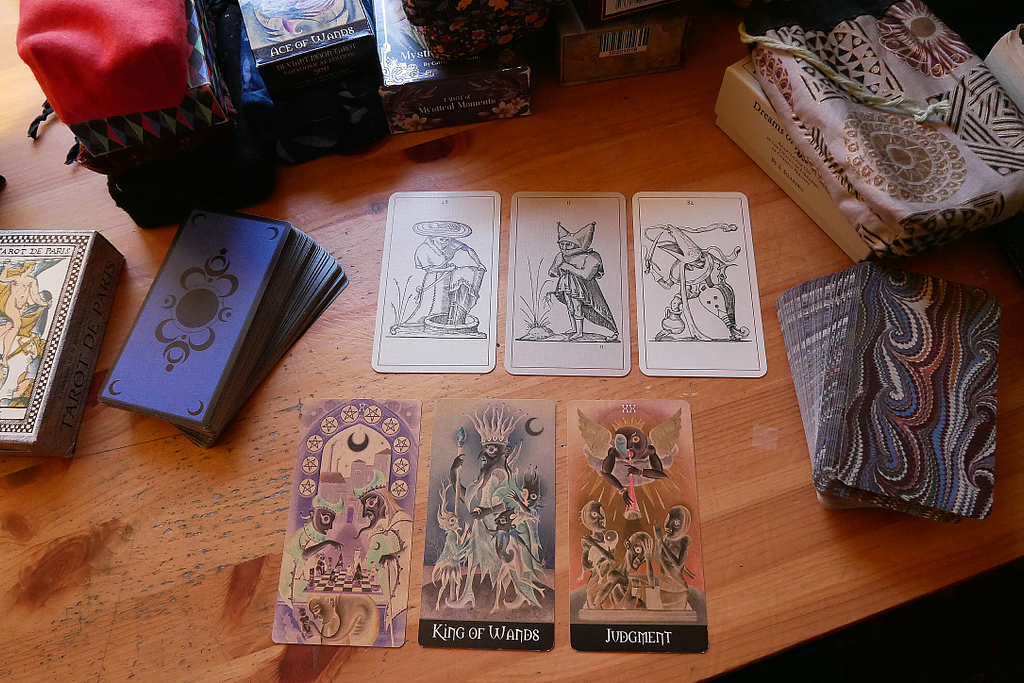
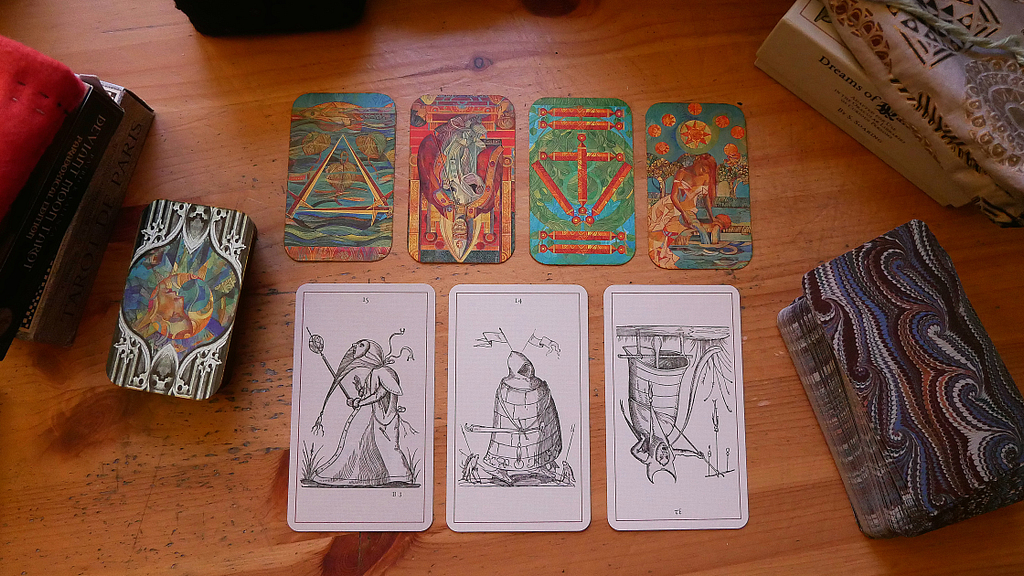
Experiments are on-going in terms of seeing how the deck feels to use. I’m currently focusing on exploring how it reads in conjunction with other decks. You can see a sneak peek of that in the video – I show it next to the Carnival at the End of the World Tarot – but here are some photos of other combinations explored this week:
Dreams of Pantagruel with The Deviant Moon (Paradoxical) by Patrick ValenzaDreams of Pantagruel with a modded Crystal Tarot – incidentally, also an ‘in-between’ deck system…
You can also see it in the featured image for this post along with some very interesting input from the Golden Tarot by Kat Black.
Decks Shown in the video –
Trionfi della Luna Tarot – Pagan Otherworlds Tarot – Medieval Scapini Tarot (modded) – Crystal Tarot (modded) – Hush Tarot Magicae Daemonibus Tarot – Tarot of Mystical Moments – Lonely Dreamer Tarot – Carnival at the End of the World Tarot … deck mentioned but not shown: The Dreaming Way Tarot