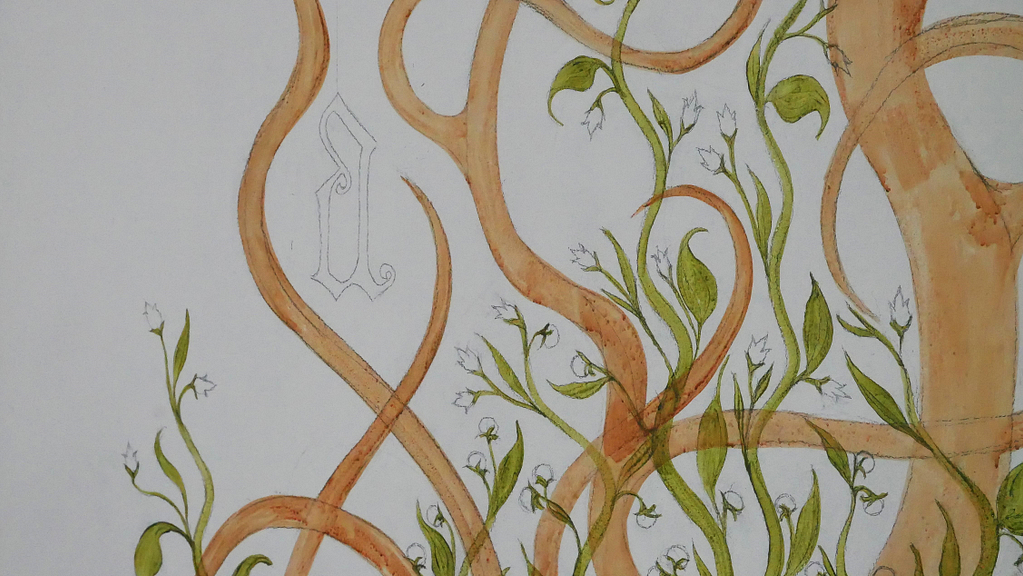
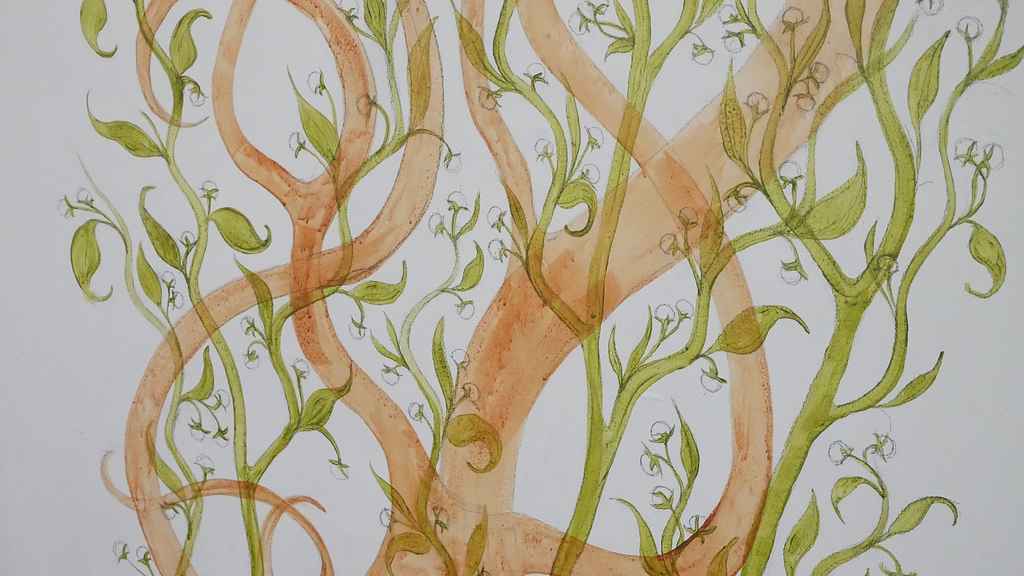
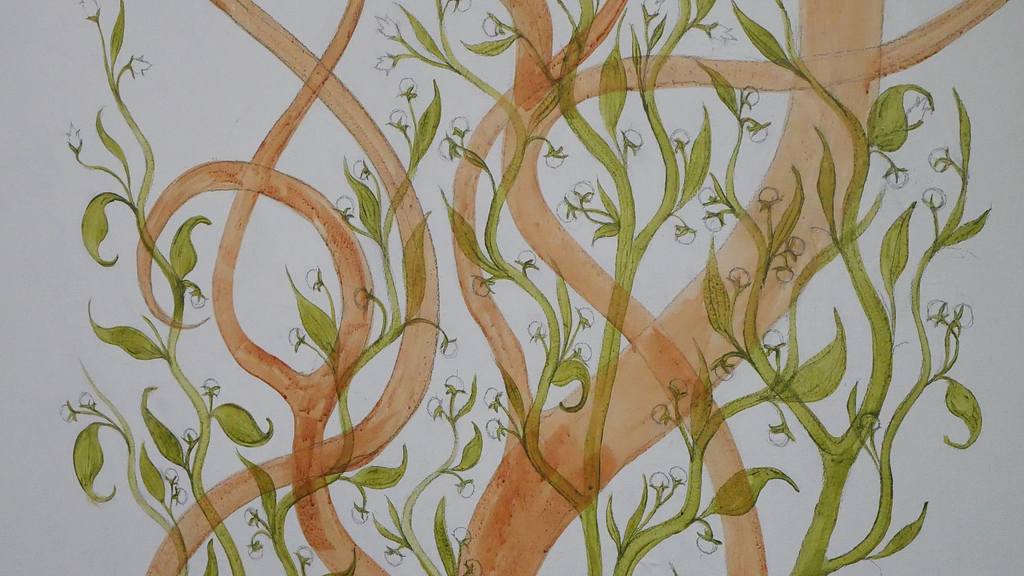
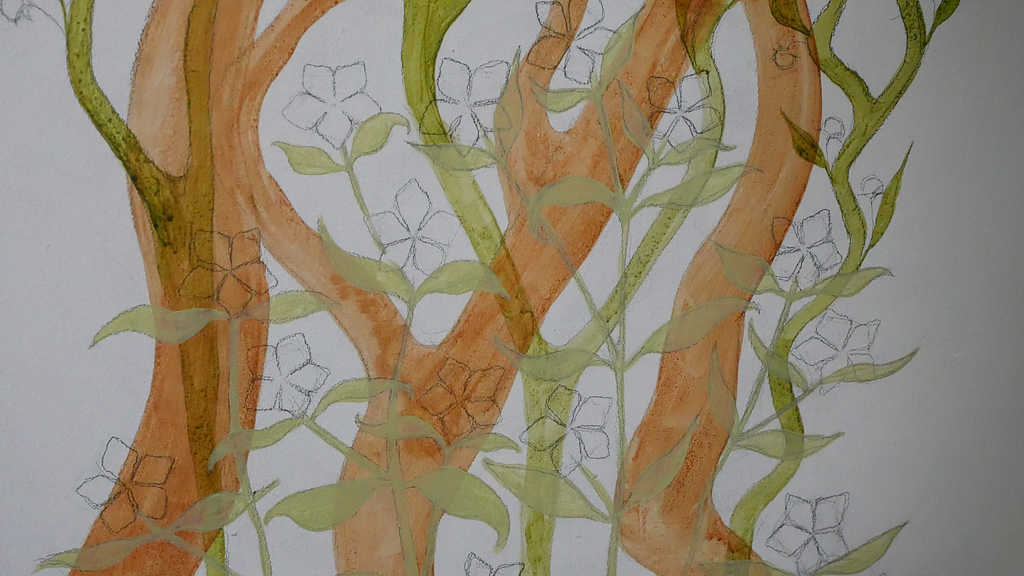
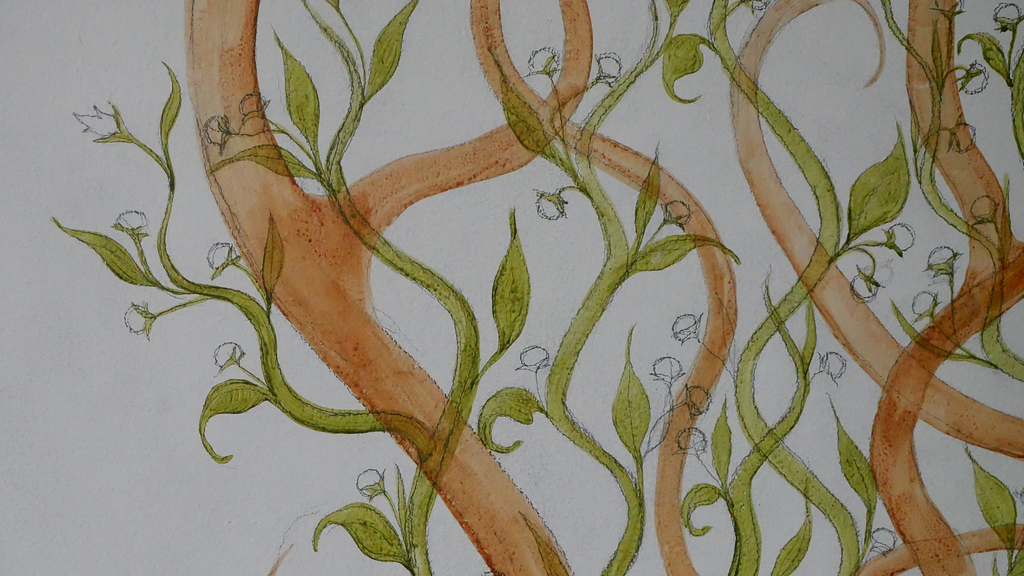
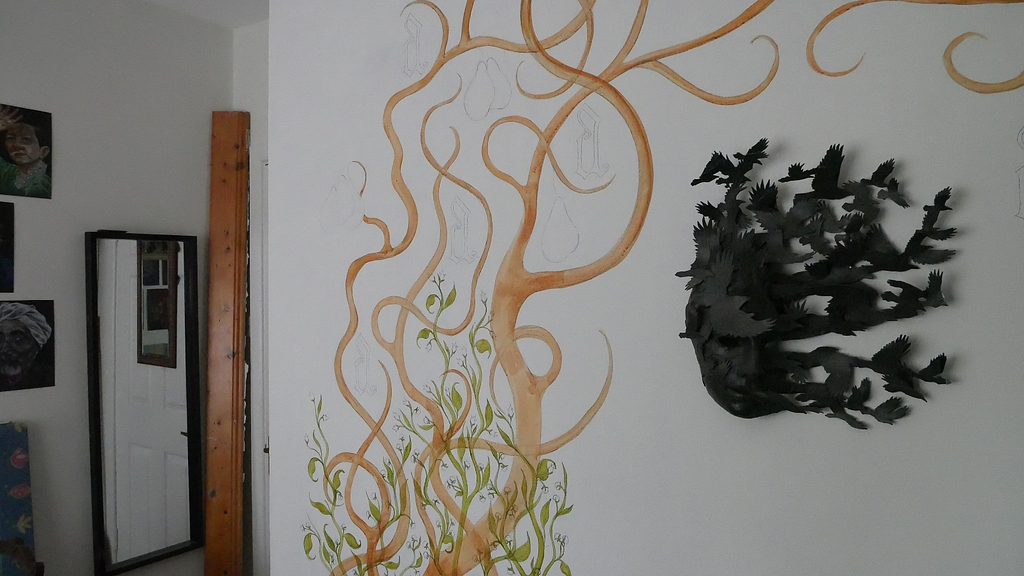
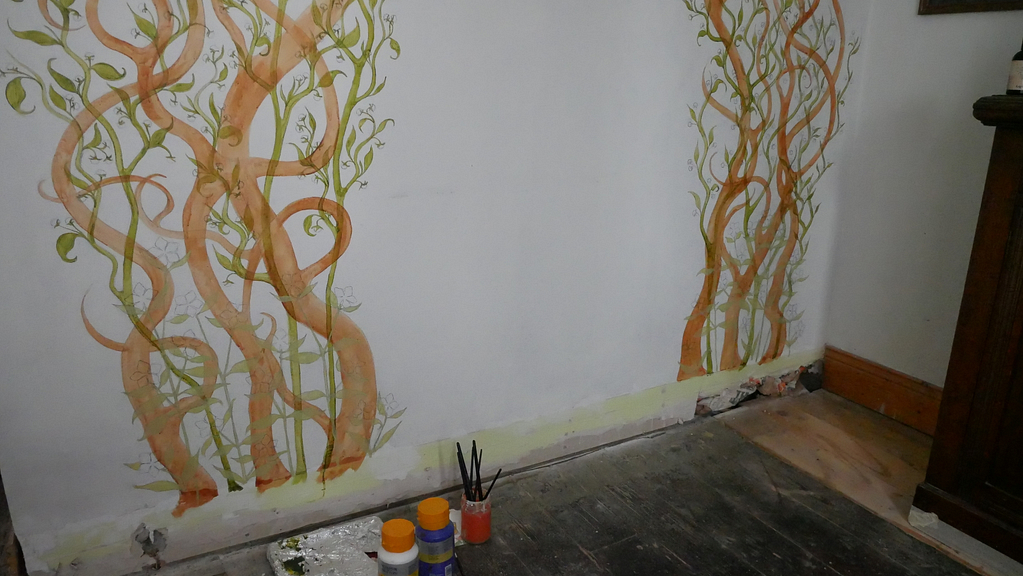
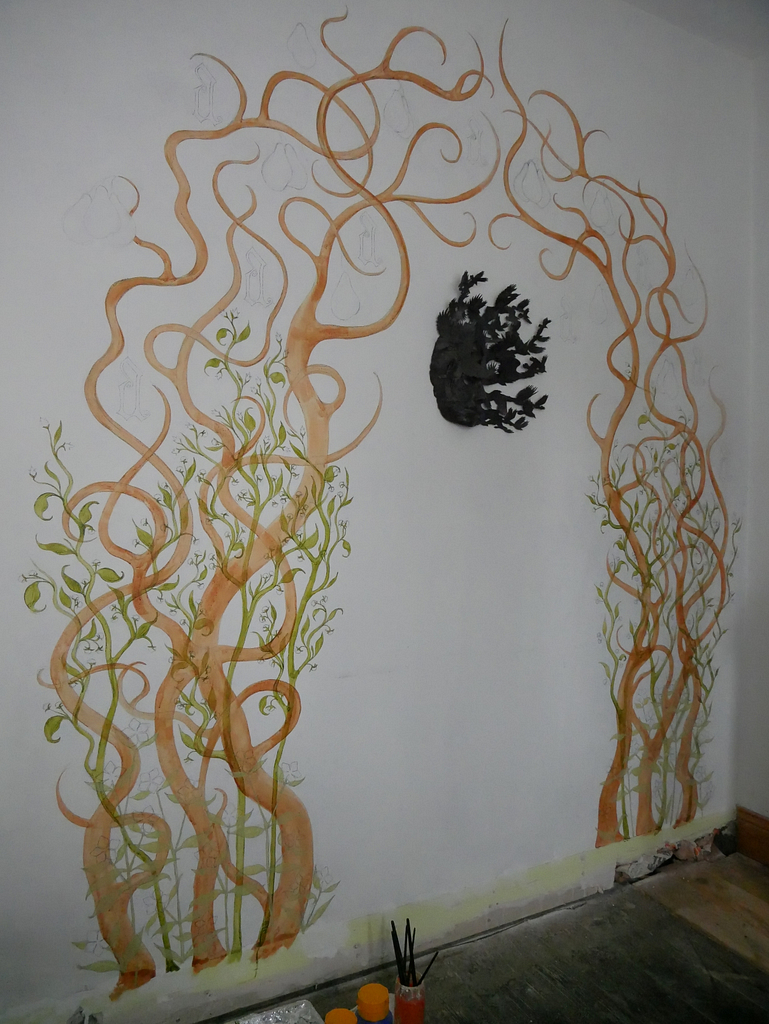
For anyone interested in a few detail photographs of the altar mural featured in my recent “Underpainting” video, here is a little gallery of semi-decent shots! The room is quite small which means the mural is difficult to capture within a single frame despite being very easily taken in, in person. This is probably for the best from the perspective of magickal integrity… it is, after all, intended to flank my altar! At any rate, I have included the Makertube link for the video below (via the ad-free, collective, non-profit from France – PeerTube)!
Here is the video…
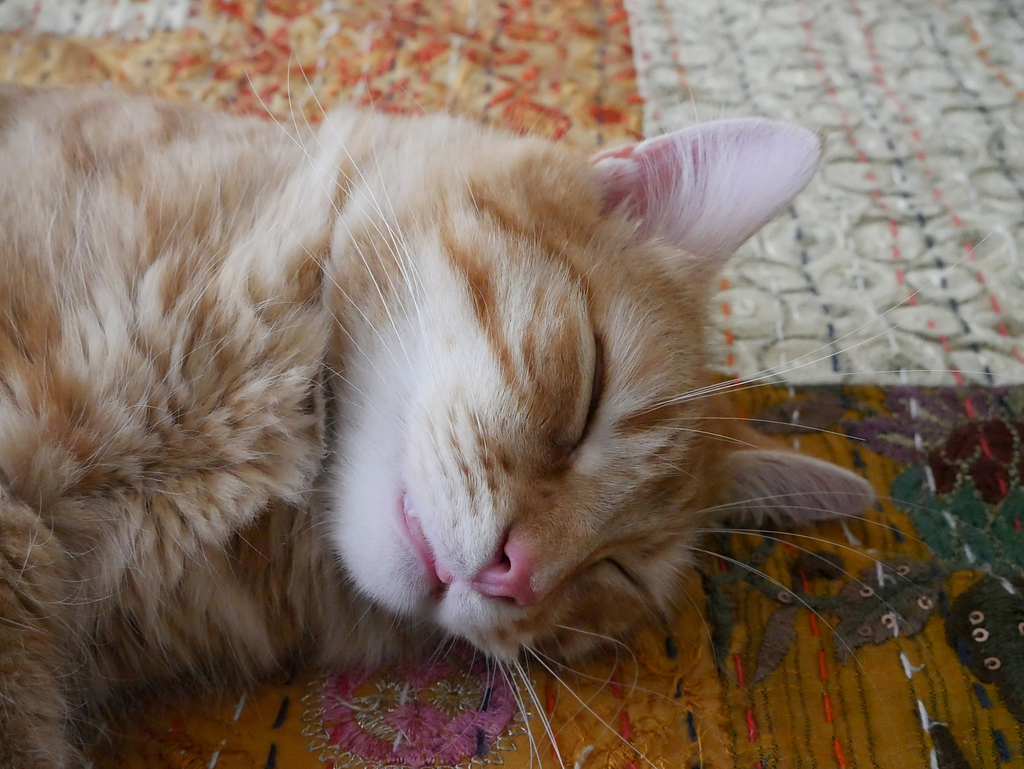
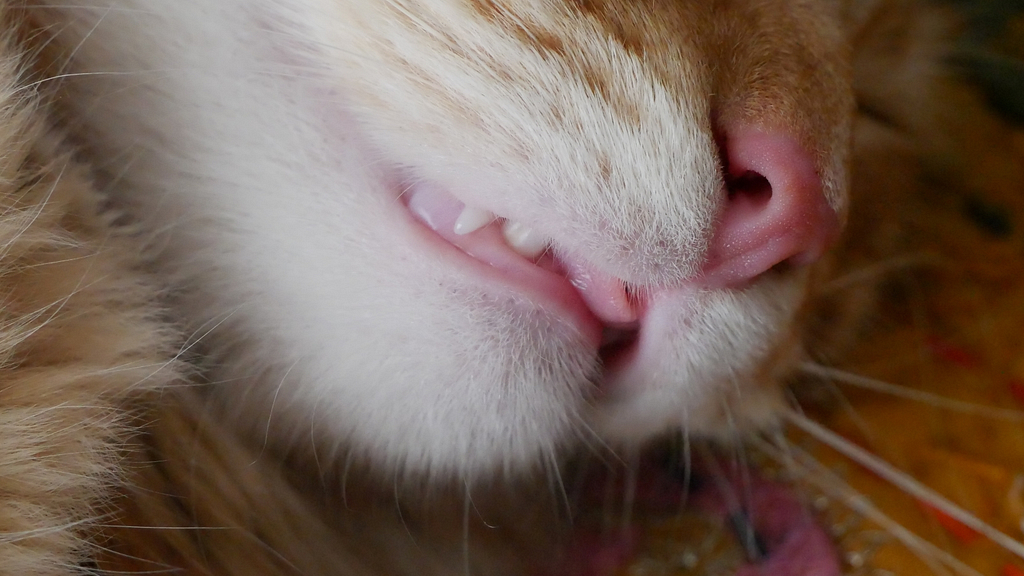
AND here is some bonus cute kitty ‘content’ courtesy of Gurgi:
So I’m reworking the first disc of my “You and Me and the Devil Makes Three” mix-set to be less of a randomized selection of the others’ tastes and, instead, more in line with mine… and focusing on what it is to be a changeling (child) witch. It reminded me that I wanted to post a few videos (three, in fact) that capture what my dreams/nightmares were like as a little kid. While no single of one of these videos is an exact replica, taken as a group and sort of …meshed together… you get a near-perfect representation of what they look(ed) like.
Right down to painted faces, labyrinthine city structures and old parking garages, strange dingy forgotten tenement buildings, grown-up-children, poverty, splitting wounds, blood, and disease… and a lot of very sad lonely people crying for things I couldn’t even give myself.
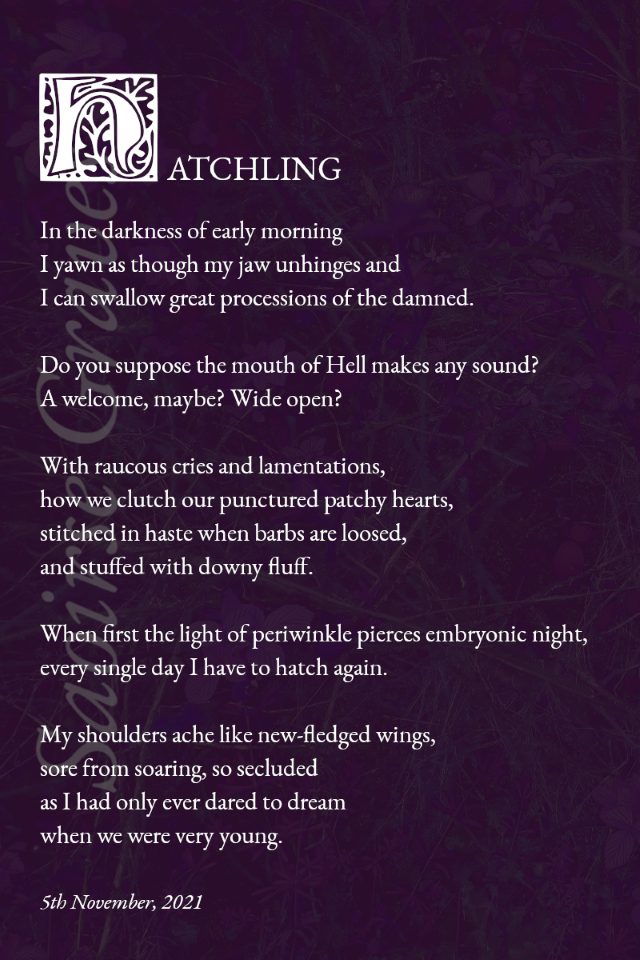
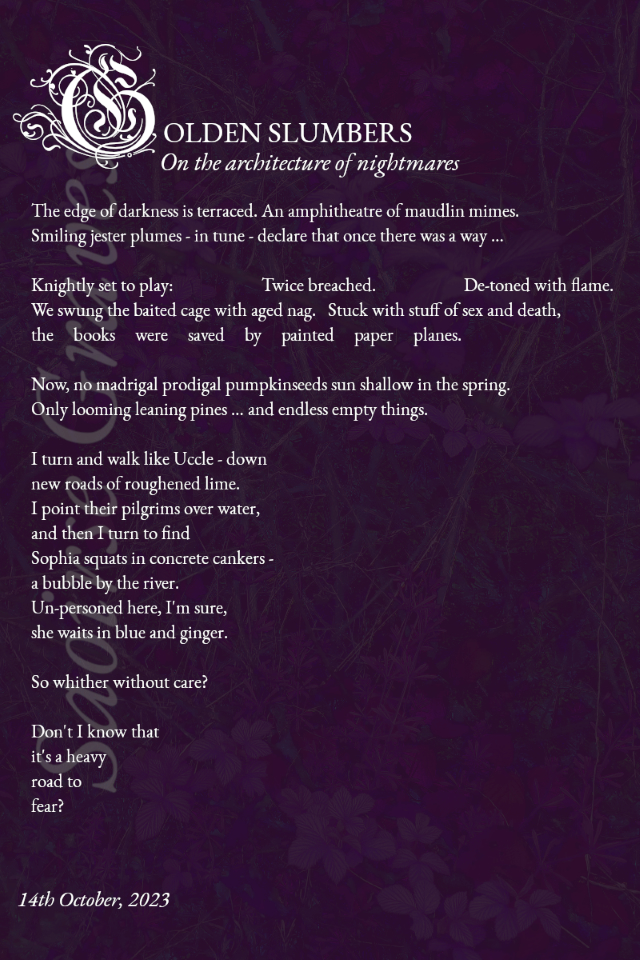
The earliest and most ‘proto-typical’ of these dreams that I can remember was from when I was six. Many of them are recurring. Many show up in my poetry (of which I have included some examples in this post). And they are, of course, on-going.
… When the Morrígan makes sense to you, I guess it’s because REASONS. 😉
The medieval clothes, sad smiles, strange long wooden hallways with dusty floors… so real.
I know it’s supposed to be tense by cinematic design but I literally can’t watch this one without every muscle clamping in my body. So fucking scary! And good!
This one reminds me of a figure I encountered in ‘dreams’ inspired by the song “Golden Slumbers” which used to frighten the fuck out of me as a kid… A strange painted man in a suit, surrounded by other theatrical faces fading into the night on wide & shallow concrete steps under a single street lamp telling me “Once there was a way to get back home…”
Do with all that what you will… it makes for great creative fodder.
The first among other things, makes reference to the dragon-dreams in Laurence Yep’s work “Dragonwings”… the mental image of sore shoulders after intense dreams had a huge impact on me as a kid. The other two are “simply” more narrative descriptions of specific dreams.
~ Saoirse.
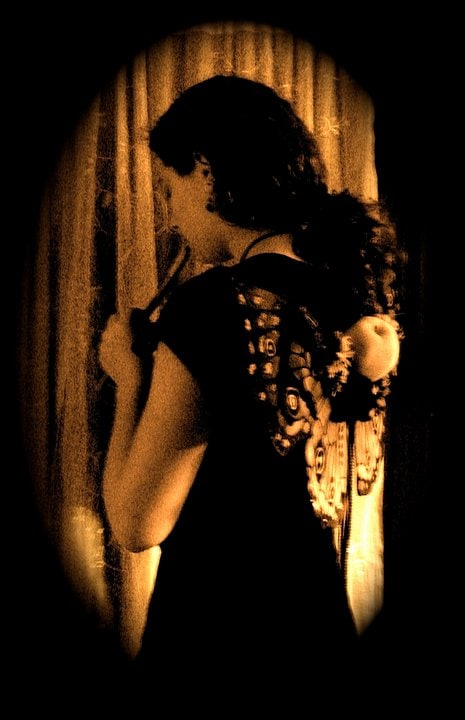
PS. The featured image on this post is a photo of me that is no less unsettling in it’s original form… Sweet dreams, witchy children 😛
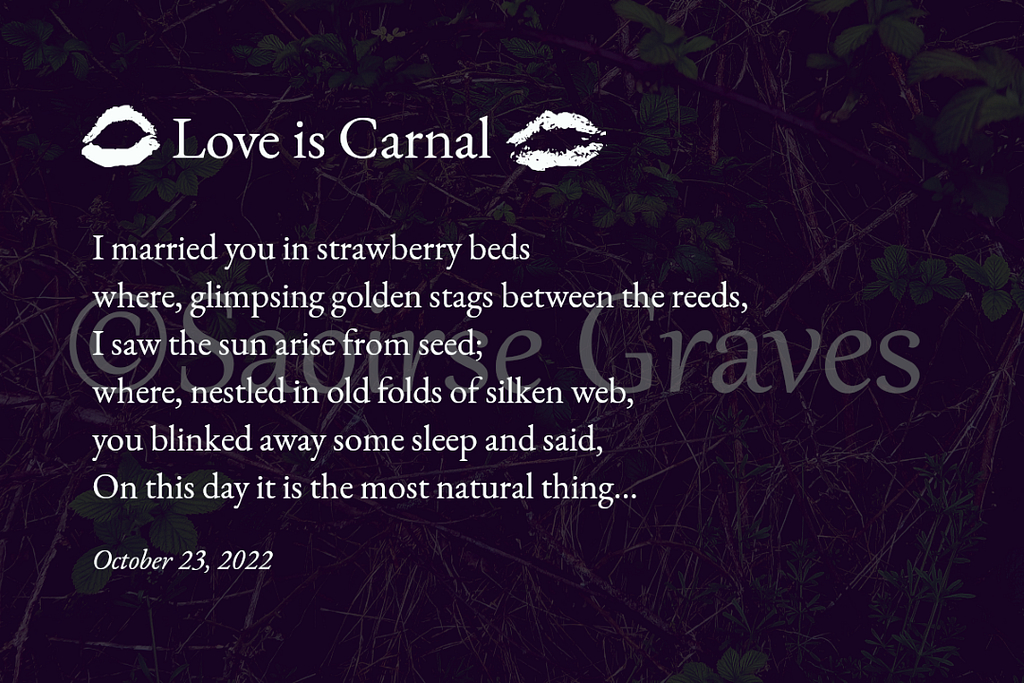
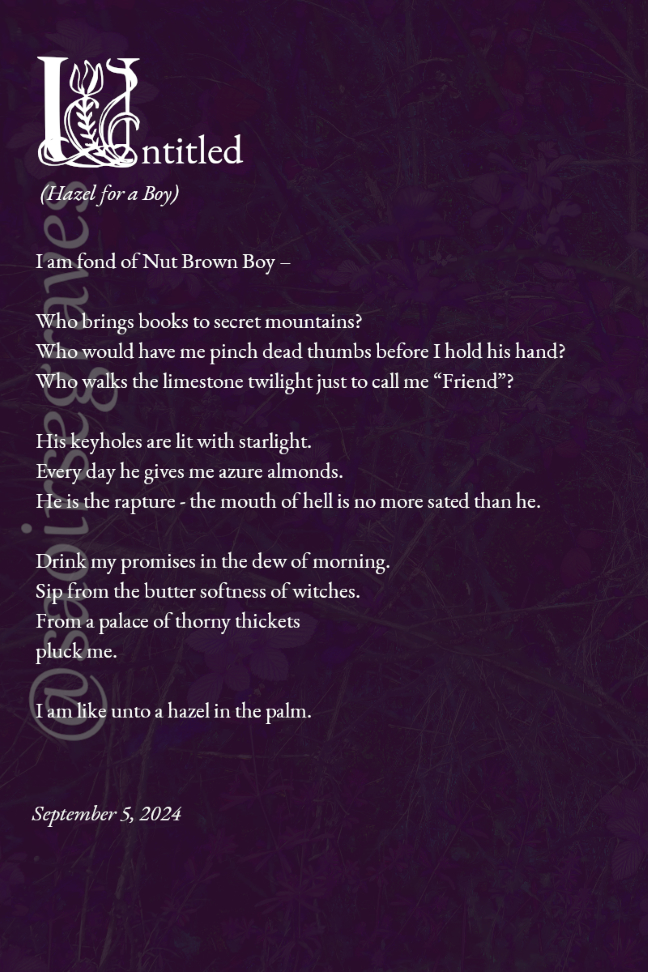
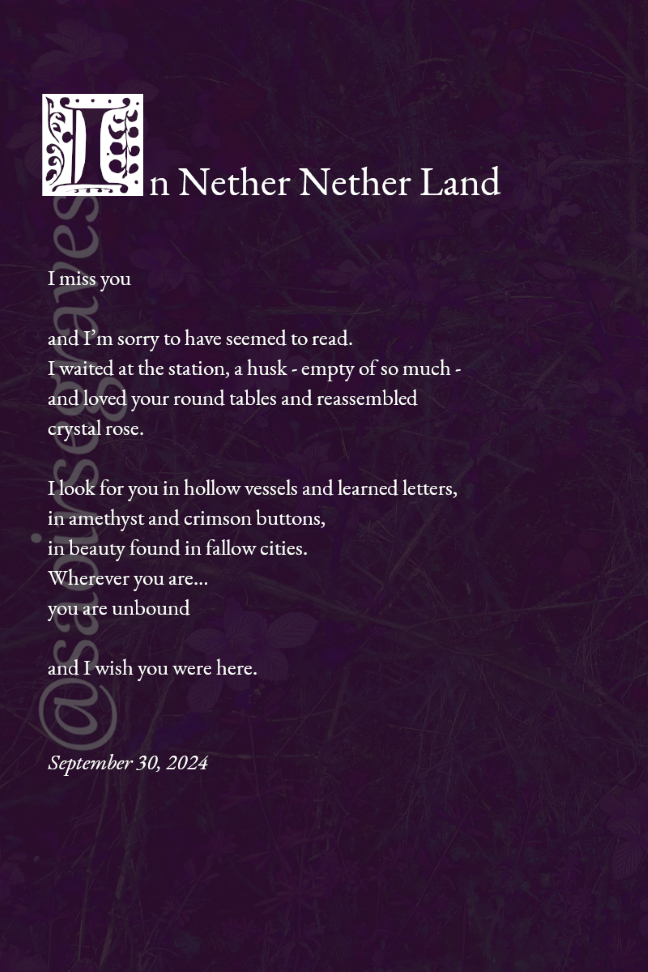
Love poems are undoubtedly the hardest for me to write. I have composed only a handful that I consider successful in my life time. Here are three of those, all about the same person ^_^ You may note the ‘marriage’ of medieval mysticism and Pagan Otherworlds.
Poetry is such a meandering thing. I can’t say I’m the sort who works on the art of writing poetry or who reads widely or consistently to better acquaint myself with the source material… at least, I don’t do this with the kind of structure or consistency that makes sense to declare anywhere on the internet! But I care very intensely about developing a style, voice, and a sensory reality.
My sister writes BEAUTIFUL poetry that is much like her dreams – often in the style of epic narrative. With a temporal flow and an arc of completion. She once pointed out that my poetry evokes vignettes of mood and sensory experience. A window into a brief mystical moment. This is incidentally also very much like my dreams (albeit with the added potential for positivity since my dreams are almost exclusively terrible & terrifying… horrific, gothic, sublime.)
I am firmly of the view that poetry should be read aloud. At least, MINE should be… with breaks (or ‘rests’?) only as dictated by punctuation, rather than (GASP! HORROR!) at the end of every line. If you take into consideration that much of what I’ve written has included direct musical reference (in addition to those that can already be achieved through metre and so on), you may see that I *try* to extend the audio-visual to include music and dance.
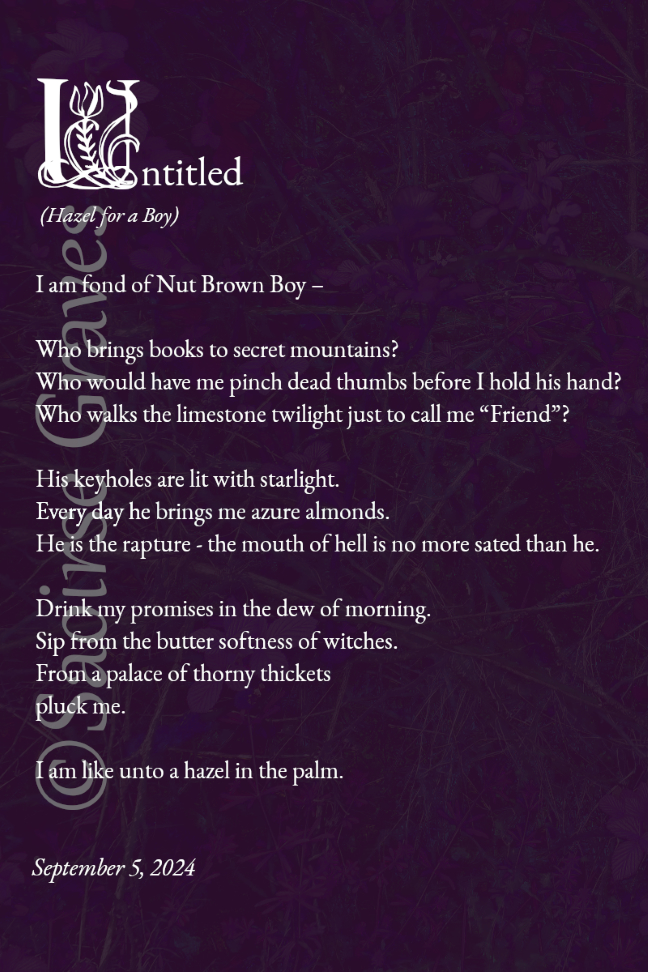
Thus, in the poem “Untitled (Hazel for a Boy)” the hazel in the palm is a reference to the writings of Julian of Norwich on the nature of love… and I have layered this with a common trad descriptor of young beloveds: (nut) brown boy/girl. One long standing favourite of mine is “Ille Dhuinn, S’ Toigh Leam Thu”
The Scottish Gaelic lyrics are as follows:
’Ille dhuinn, ’s toigh leam thu,
’S toigh leam fhìn thu, laochain;
Mas toigh leat mi, is toigh leam thu ‑
’S gur òg a thug mi gaol dhut.

Dh’fhalbh mi mar a b’ àbhaist dhomh
Air sàillibh coimhead chaorach ‑
’S beag a bha dhem fhor orra,
’S mo leannan air a’ chaolas.

Nuair dhìrich mi suas Criongrabhal,
’S e m’ inntinn nach robh aotrom ‑
Bha ’m bàta mach gu Saighdeanais,
’S i toidhdidh fo cuid aodaich.

’S ann a their mo phàrantan
Gur tàmailt leotha m’ fhaoineas ‑
Gum faighinn fear na b’ fheàrr na thu
Le bàtaichean ’s le birlinn.

Ged gheibhinn fear na b’ fheàrr na thu
Le bàtaichean ’s le birlinn,
Gum b’ fheàrr leam fhìn an gille donn
Is e gun bhonn dhen t‑saoghal.

Ged gheall mi dhut gun leanainn thu
’S gun dealaichinn ri mo dhaoine,
Cha d’ rachainn dha Na Hearadh leat
Air cheannachd air an t‑saoghal.

Ged a bhithinn pòsta riut
Is còir agam air d’ fhaotainn,
Cha b’ fhada bhithinn beò agad
’S an Dòmhnallach às m’ aonais.
In English:
Brown-haired lad, I’m fond of you,
I’m really fond of you, boy;
If you’re fond of me, I’m fond of you-
I’ve loved you since I was young.

I set off as usual
to look for the sheep
but scant attention gave I to them,
knowing my beloved was in the strait.

When I climbed Criongrabhal,
my spirits were low –
the ship, with well-trimmed sails,
was out near Saighdeanais.

My parents say that
my foolishness is a source of shame to them –
that I could attract a better man than you,
an owner of ships and galleys.

Though I could have a better man than you,
an owner of ships and galleys,
I would much prefer the brown-haired lad
though he hadn’t a penny in the world.

Though I promised you I’d follow you
and part company from my people,
nothing in the world
could induce me to go to Harris.

I wouldn’t survive long if married to you,
while pining for MacDonald.
Note that in Scottish Gaelic as well as in Irish the manner of describing hair colour is to pair the colour with the type of person directly, e.g. brown boy. The translation above opts for the “brown-haired” descriptor to make it clearer in English.
There are many other examples of songs that make reference to a nut-brown colour (many of which are super cringe tourist favourites here in Ireland) but this is the one that I have most often in mind due to it’s melancholy sound and its emphasis on the difficulties of separation and limited finances. Having formed and kept a bond across the Atlantic … between worlds, over nine waves, across time and space… lends itself quite well to the shared lore of our relationship. Indeed, this kind of poetic layering also lends itself to the spellbound witchy otherworldly quality of being fascinated and devoted to any human person other than myself. <3
Another such colour symbol, of course, is the azure blue… the medieval link with lapiz lazuli and text illuminations. Or the blue-grey/blue green (glás!) of the sea. The list goes ever on and on.
To my chosen person: “I have walked the world to find you. I’ve worn out the soles of three pairs of iron shoes and my hair is no longer red. But I come to claim you…”*
~ Saoirse.
*From “Hans, My Hedgehog” in Jim Henson’s The Storyteller
So we’re officially entering summer-like weather here in Ireland which, of course, means I’m losing my will to think. I have, however, been steadily working away on various creative projects the past few months and my aim is to continue this emphasis on gradual progress. It’s causing an interesting layering of imagery in my projects as well which, ideally, will lend itself to something like stylistic and symbolic cohesion…
The idea for my latest video had it’s origins in a conversation with a friend. We were talking about the impact (over the years) of specific moments where you’re shown what you really aren’t to someone else… human, in this case. I brought up Cake’s “Friend is a Four Letter Word” being pointedly played at me as an example to which she replied “UGH what girl of a certain age HASN’T had that song used at them!?”
To which I would like to add, I’m sure there are a lot of people who used that song either at others or even at *themselves* to absorb or express something toxic that so many of us have internalised.
I myself don’t have the strongest bond to the “she/her” social identity. I have explained this in part in the aforementioned blog post. I don’t spend time calling myself a ‘girl’ or ‘woman’ in my head. That’s something that other people call me… usually the rudest people I know, too. I am less and less willing to have “she/her” plastered everywhere and have been opting instead for “she/they”… and the magical and artistic process behind this video (and other projects) has helped me to draw a crucial line in my life more generally: I can no longer sustain connections with people who see me as a ‘girl’ before they see me as a person.
Good conversations with good friends inspire so much don’t they!?
Thus, rather belatedly, it struck me that this was a bigger picture issue… but in my case this needless dichotomy that as a femme-ish person I may *either* feel human *or* sexual but not both in a patriarchal system has taken on this rage infused haunting quality. Of course, we see this theme all throughout demonic witchcraft tropes and mythic narratives and it’s not accidental at all that the goddess under whose auspice I live is imbued with sexual identity and expression… in a shapeshifting and often horror-based way!
In my opinion sexuality in general is a deeply fluid & poetic thing. It is beyond gender, of course, because gender is non-binary and sexual preferences and identity isn’t really map-able. It’s much like magic. Felt, learned, practiced, explored, poured out, drunk in, sung, quietly spoken… everything everywhere and nothing nowhere all at once. In the mind and/or in the body as you please. Mythicly real and woven from autonomy, agency, and consent.
People don’t get to hear nearly often enough how sensually beautiful they are… because humans really can be like living walking poetry. Embodiments of sacred verse! Yet time and space are wasted in saying you are either ‘friend’ to me or ‘something more’!? What is “more” in this scenario!? I was a mystical sexual being before I met almost everyone I know now (as well as certain people I knew *back then*) and I continue to be when people leave my life story. Yet somehow I could still read a book, climb a mountain, perform in concert halls across cities and countries, have thoughts and opinions all my own about whatever I wish… and appreciate the sensory, sensual, and sexual beauty of my friends regardless of gender.
One thing I have been doing for these projects is constructing “what’s playing in the studio” mixes. I made three that function as a whole unit (not unlike Tom Waits’ “Orphans: Brawlers, Bawlers, & Bastards” trinity) but that can also be listened to individually. Each one has a loose narrative structure on its own but as a group of three albums they also progress from the more collective/general (and femme)* to the more vulnerable/authentic/personal.
*[Edit February 2026 – dissatisfaction with the lack of direction and gendered nature of the first playlist has led me to re-do it to represent the idea of cosmically ‘heard’ words & magical power… making all three volumes subjective and biographical, “auto-” or otherwise. The new thematic progression might be said to be Volume 1 – (Changeling) Words/Volume 2 – (Murder) Stories/Volume 3 – (Nonverbal) Tongues…]
I made the second ‘disc’ first and it’s the one that fed most directly into the video above.
Each one features 15 tracks… see what I did there, tarot-nerds? ^_^ They’re mostly what they say on the tin except for three things: 1) it is worth bearing in mind the unreliable narrator as well as the idea of incompatible yet simultaneous truths; 2) these are not necessarily a faithful representation of *my* taste (although of course, they are born from the limitations of my exposure***); and 3) the third album is my answer to the question “what would I play if I let myself really say what I wanted to say musically?” Note, there are almost no lyrics or words on it at all.
Unfortunately, I can only make these available through youtube at the moment because the third album has two tracks I had to alter slightly to allow for a more natural fade into the next track. If anyone knows a good, free, freely available, and less-ad-ridden way to host these let me know!
Lastly, I’ll give you a visual glimpse of one of my other recent projects completed as part of this on-going process:
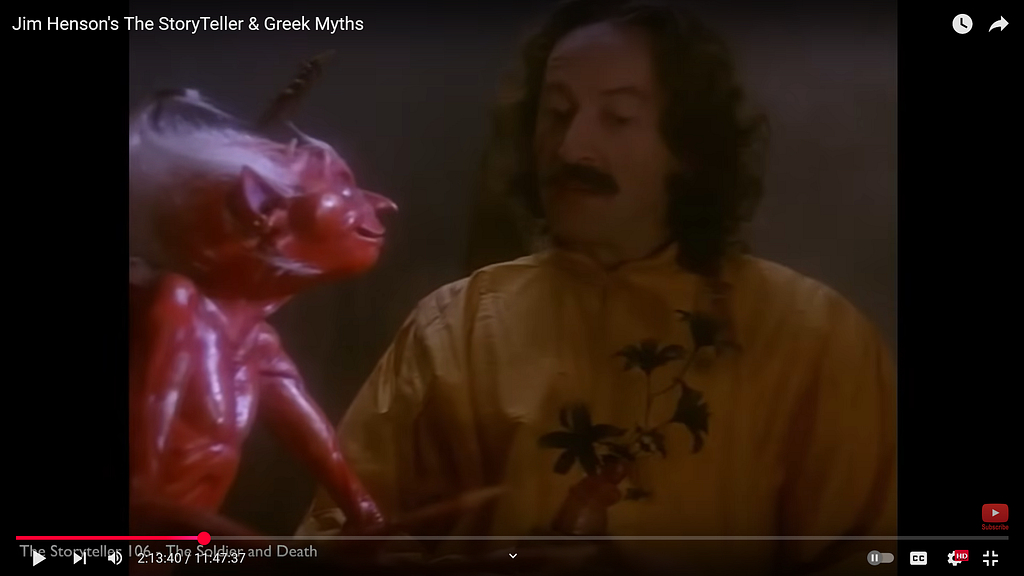
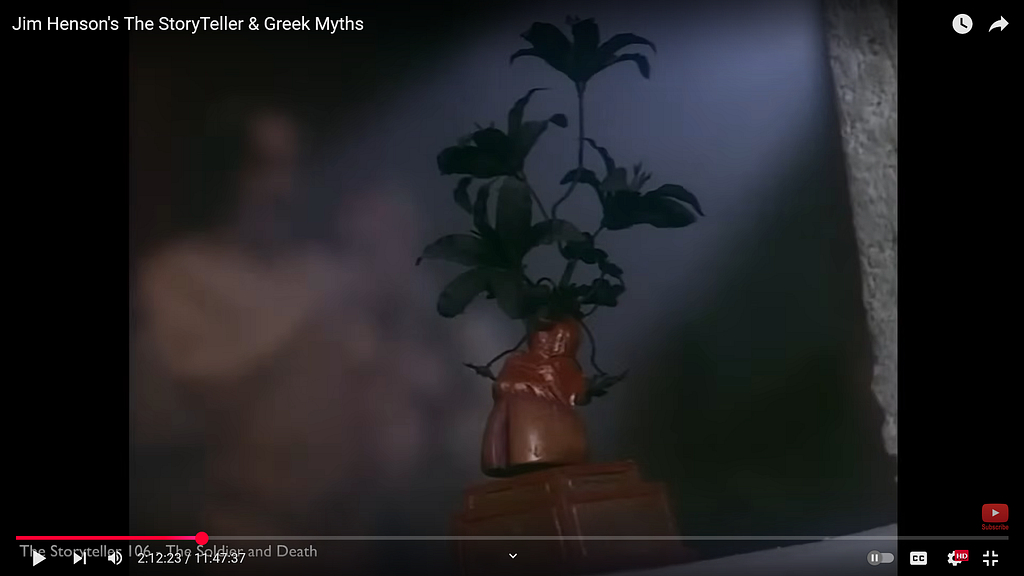
“Now where the Devil is that devil of mine?” – Jim Henson’s The Storyteller, “The Soldier and Death”
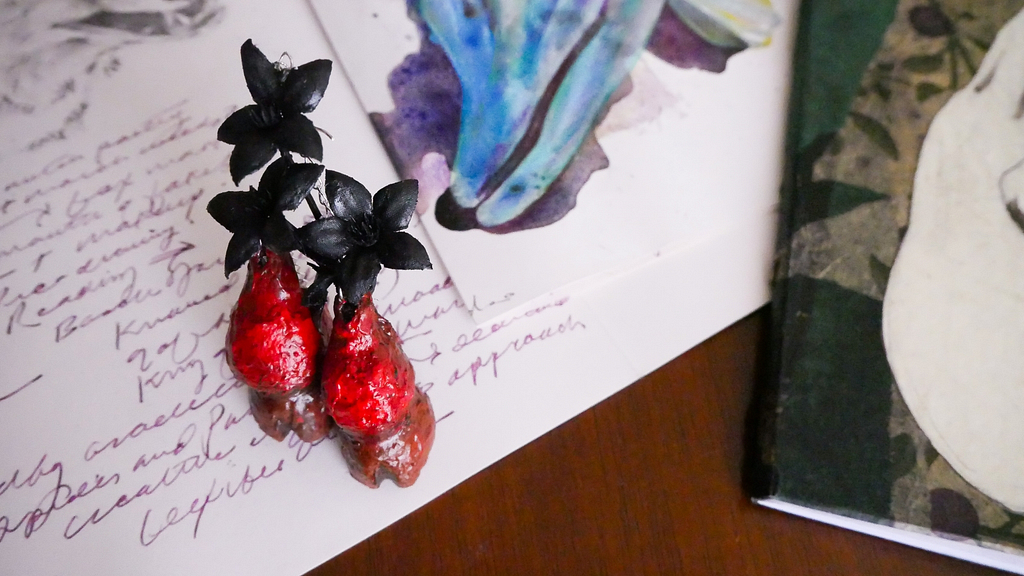
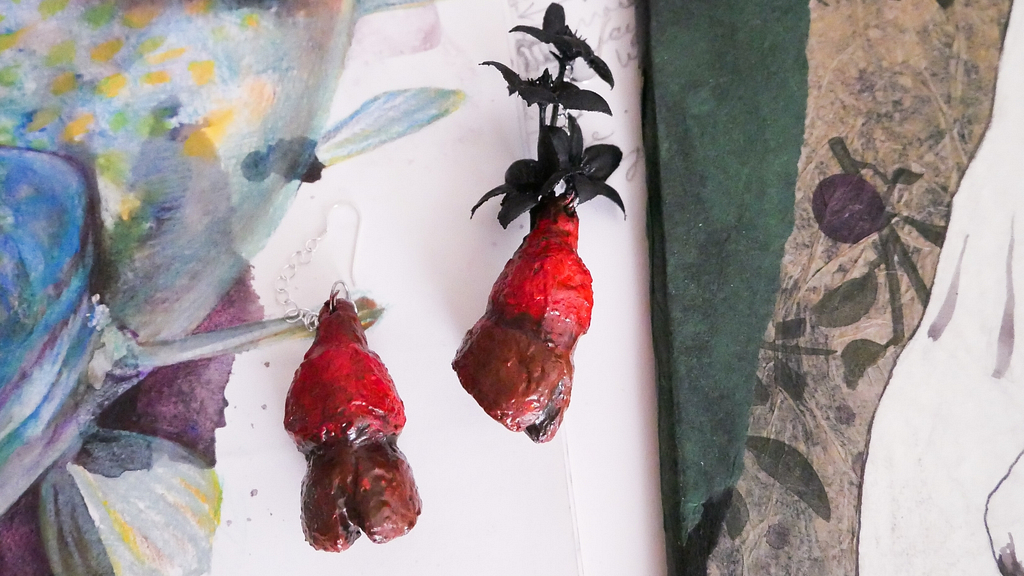
I made myself earrings inspired by the Devil’s foot in Jim Henson’s the Storyteller! You can barely tell, but I am wearing them in certain shots in the video (and in the header image for this post!) The screencaps above are taken from ‘the’ tube but I *DO* own a copy of the DVD series with John Hurt (I don’t have the Greek myths with Michael Gambon and have actually never watched them either.) These are paper mache clay, acrylic paint, and varnished to make them water proof etc.
Ok that’s all for now. Bear in mind, this is all a work in progress and likely poorly expressed! Back to feeling demotivated in the gathering heat.
~ Saoirse.
*** For example, Laura Marling features on the second album twice but I have REAL issues with her worldview as an artist. She’s made some good music in the past, that is all.
"I know you'll remember me when I'm gone.
Remember my stories, remember my songs.
I'll leave them on earth, sweet traces of gold.
Oh they're calling me home, they're calling me home."
~ They're Calling me Home, Rhiannon Giddens
Today would have been the 38th birthday of one of the dearest friends I ever had. Her sudden departure, almost 10 years ago, first set me on what became a #deathpositive path… having learned first hand what it is to have no support in traumatic grief – either societal or personal. All of my intense desire to open into the world of healthy discussion of death, bereavement, mortality, and our fleeting creative beauty (human and otherwise) stems from the broken quiet craggy place in my chest where she used to be… I have never had a fear of death but, oh, my biggest fear is to be left behind. “Don’t go where I can’t follow!”
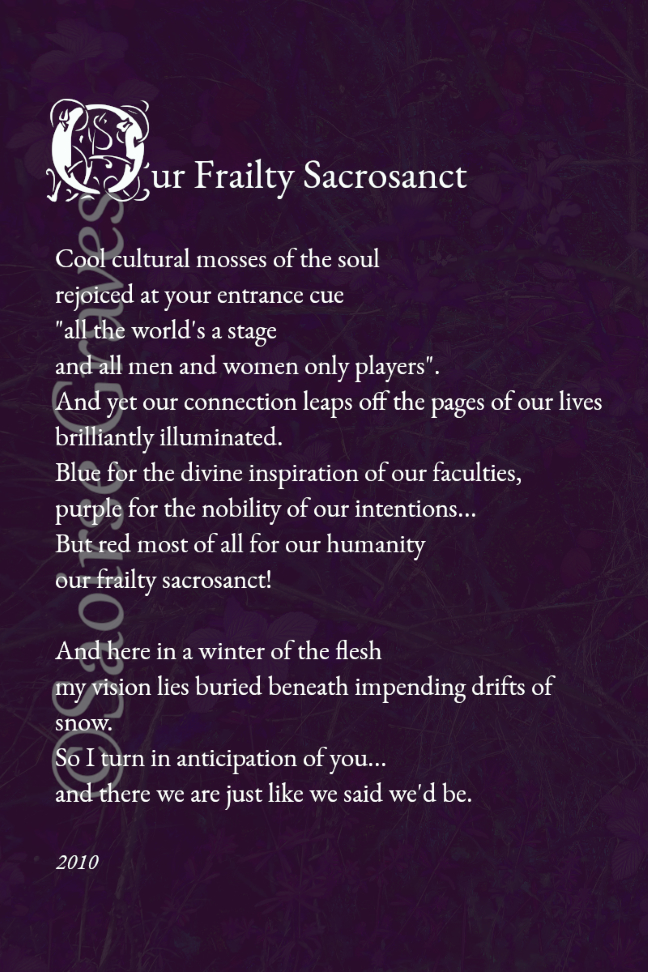
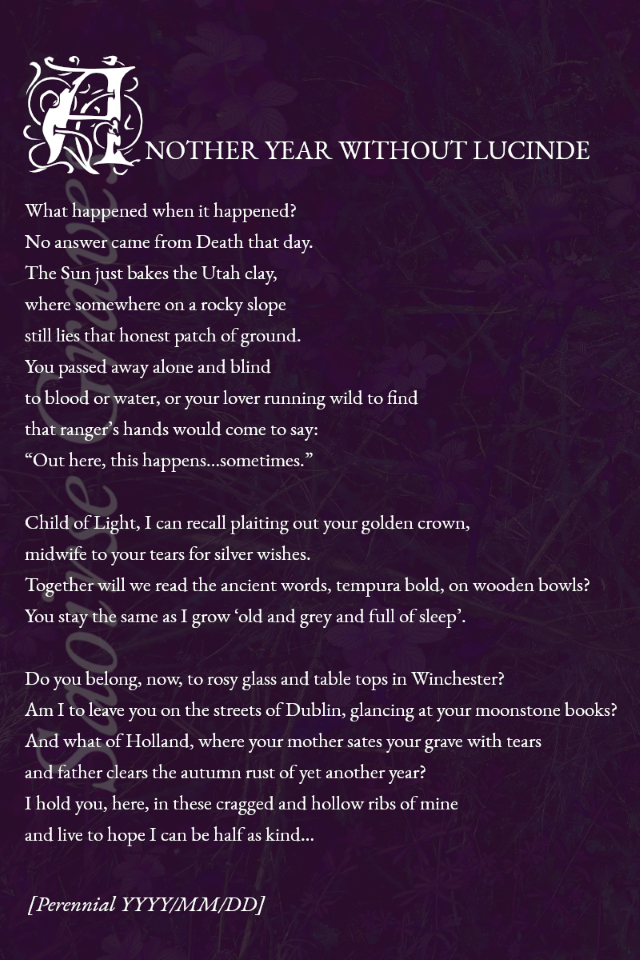
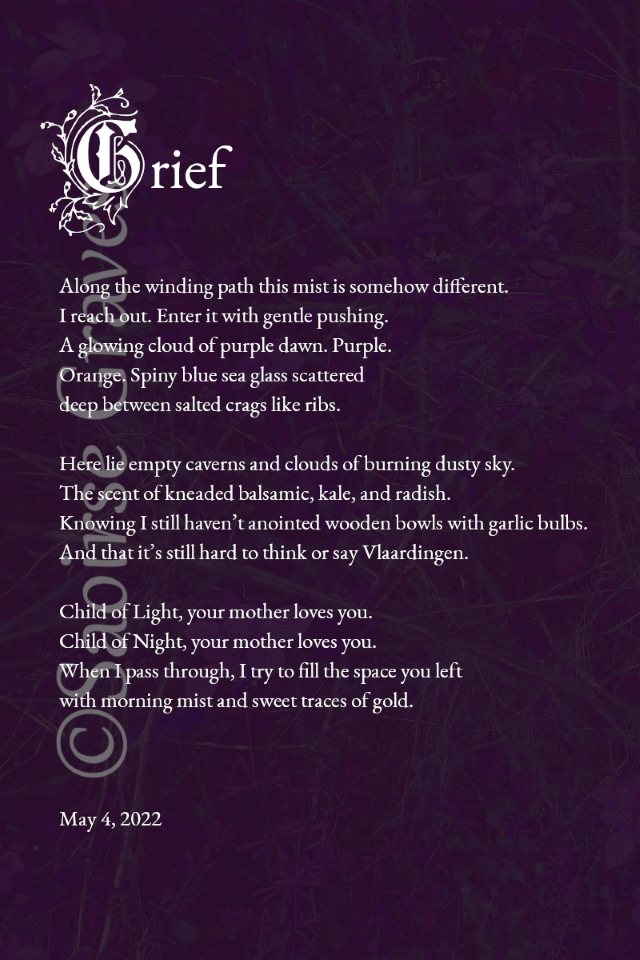
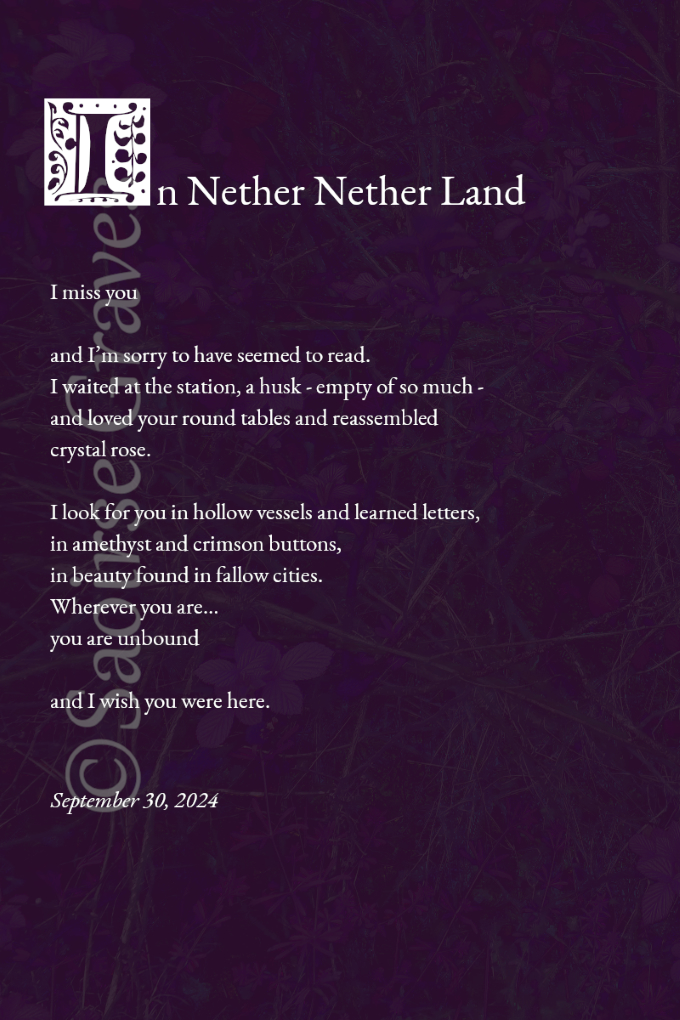
So, to honour her (and another suddenly-passed loved one – my aunt) as deeply and unflinchingly as I can… here are three open & vulnerable poems.
For those who experience discomfort and anxiety around the topic of death or for those who are grappling with their feelings of grief, I found this recent podcast episode gentle, considerate, and very hopeful. It is conducted by Conner Habib – a major force in the #sexpositive movement – with Caitlin Doughty – founder of the #deathpositive movement and the Order of the Good Death:
I had a totally “squee!” moment when they mentioned the “In the midst of life we are in death” quotation… because of course I have that tattooed in Latin on my left arm and I say it every day at the altar when I extinguish the last candle:
Media vita in morte sumus.
For more resources on #deathpositivity – where you can learn, support, and partake in activism as well as look up any resources you may need on your journey of acceptance, appreciation, & celebration of the humanity to be found in mortality – here is the Order of the Good Death website main introductory page ~ https://www.orderofthegooddeath.com/start-here/
To Luus (1987-2015), I promise to continue to learn and to bloom. Happy Birthday.
To Ivana (1960-2020), I promise to wear velvet when the world needs a punch in the face.
I play music for you both.
"Only in silence the word, Only in dark the light, Only in dying life: Bright the hawk's flight on the empty sky."
I have been working on categorising my poetry. I knew there were a few themes that, in general, a lot of my poetry might fall under… but I have spent the last week or so slowly charting, dating, accounting for and making sure I had back ups of my poetry and the first realisation that came out of this is that I have written over 70 poems since the beginning of 2021.
There are almost no poems before that until you travel back about 10 years.
Turns out field-working autistic burnout and shuffling personal care away from heavily medicated *misdiagnoses* brings the poet back out in a person… but I digress.
What is challenging about assigning organised and uniform categories to my poetry is that, of course, there is organic overlap. This is precisely what it is to be an archivist (i.e. why we don’t rearrange physically what we categorise intellectually) …Or if I were to try and write up a descriptive summary of each poem and derive collection schema from there… THAT would be more like the work of a rare books librarian wrangling unique/historic items into DCRM(B) and MARC-XML friendly formats.
…I digressed again.
The point is, it’s tough but I LOVE doing this sort of thing… ad infinitum, it seems.
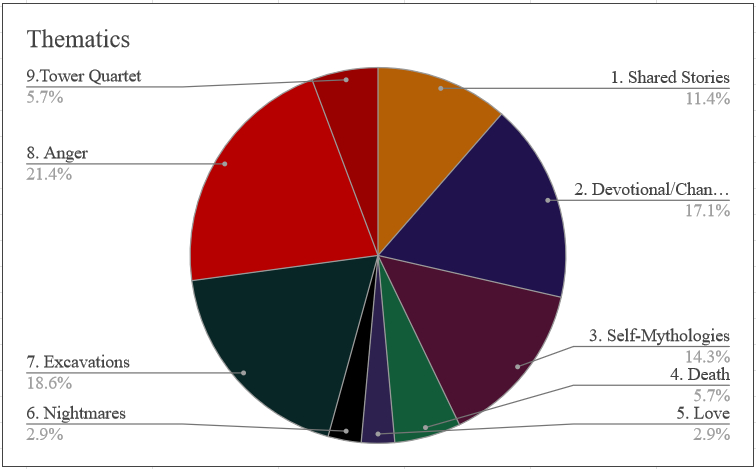
Here is a pie chart I have constructed and colour-coded to represent the themes and distribution of my poetry as of right now. Representing 71 poems written between January 9th, 2021 and October 15th, 2024. (I’ve written a few more but for various reasons they are not included on this list.)
(Interestingly, there are a few I cannot find copies of though I know I at least have physical copies somewhere. Bad LIS-professional! No cookie!!!)
The colours are loosely significant but the important thing to absorb here is that a) poetry is one of the main ways I channel my anger… especially as an autistic who goes largely non-verbal under social/interpersonal duress and b) I actually think of the Tower Quartet and (Channeled) Anger as subsets of a larger intellectual fonds …which is called “Excavations”. You will see that title in the pie chart as pertaining to a single slice, but really you can also view “Excavations” more broadly as occupying just over 45% of the chart! …The unifying emphasis is on digging deep, getting into the chthonic, and shadow-working my shit… oh, and a little revenge poetry here and there.
The thematics in the rest equally relate to each other pretty intensely. My poetry is always devotional in nature but some poems are more direct forms of near-audible gnosis. This makes sense to me from a mythic perspective as it is (personally) derived from the function of verse, alliteration, sorcery, ‘supplication’, evocation, and so on in medieval Irish literature.
I have made “Death” green mainly to evoke a #deathpositive association – ‘verdure from void’. I could equally (and perhaps should) have made it some kind of gold colour:
“I know you’ll remember me when I’m gone
remember my stories, remember my songs
I’ll leave them on earth, sweet traces of gold
oh, they’re calling me home, they’re calling me home.”
~ “They’re Calling Me Home”, Rhiannon Giddens
I will likely include little blurbs illuminating each category on a basic level whenever I manage to post them.
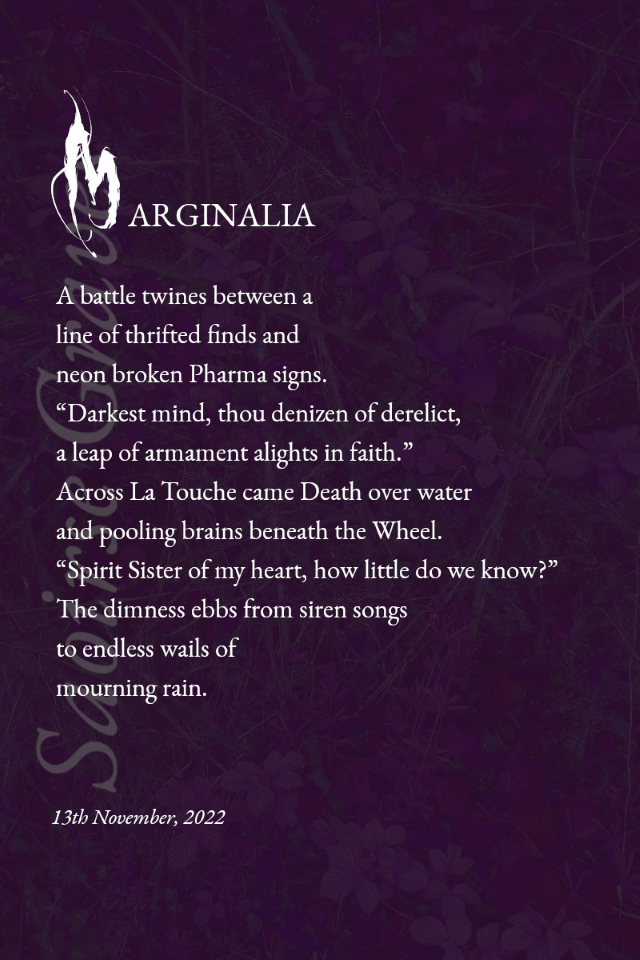
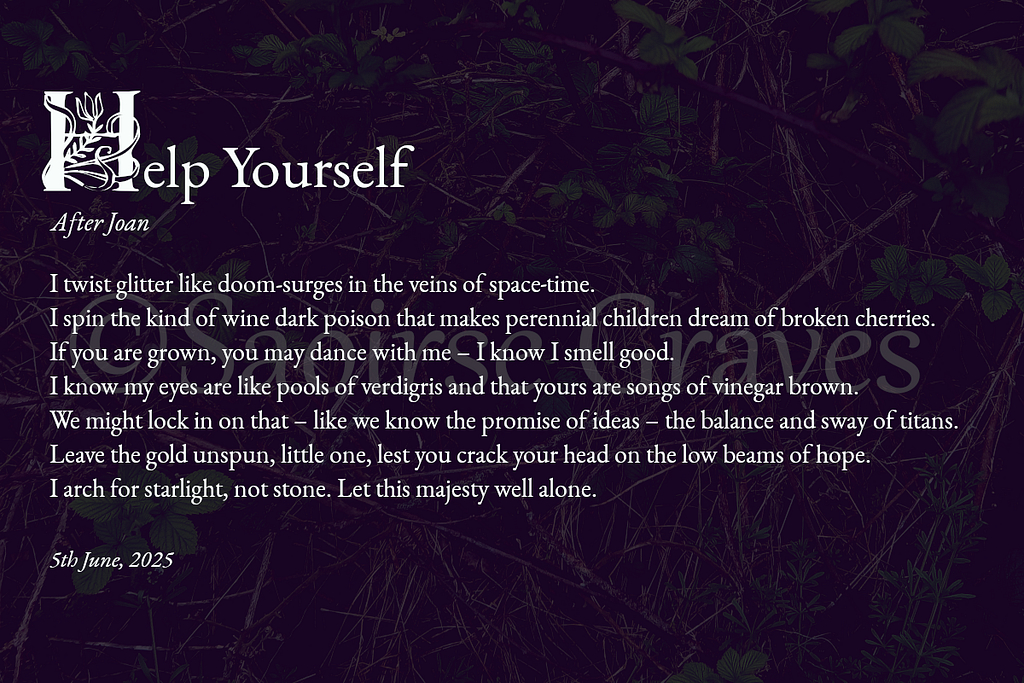
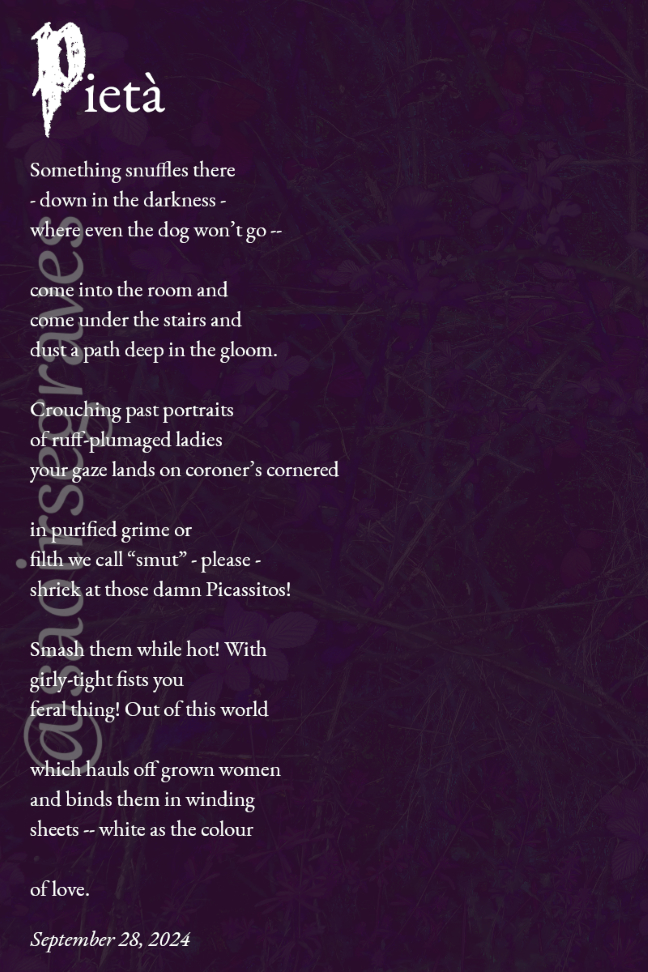
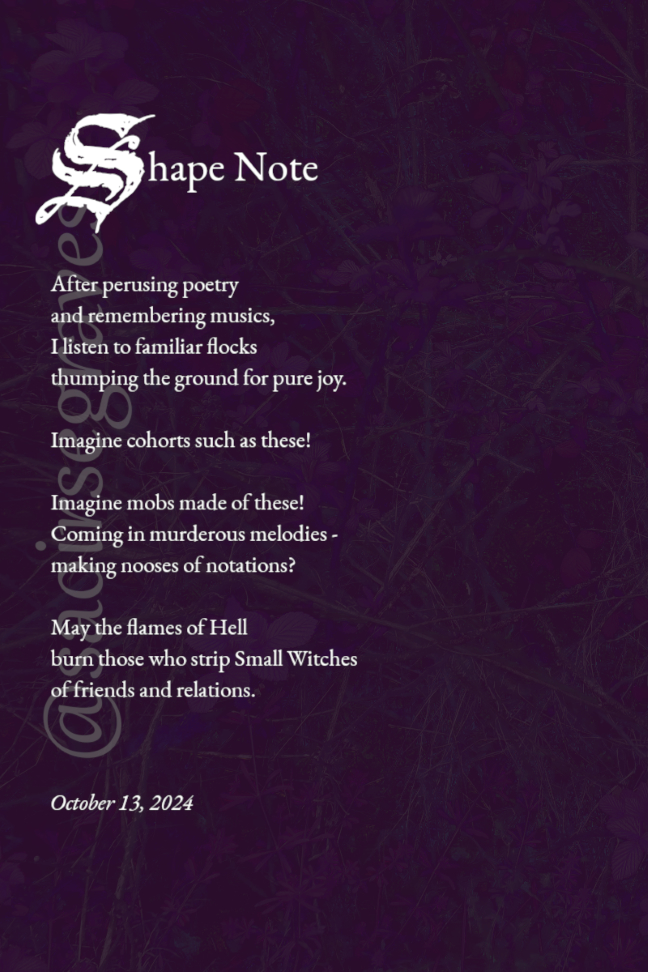
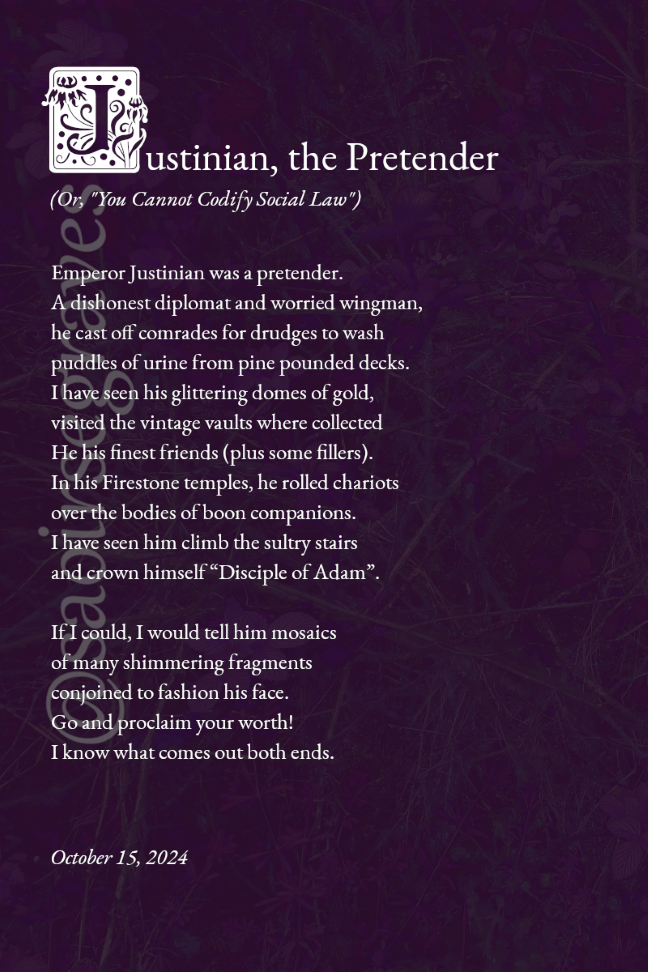
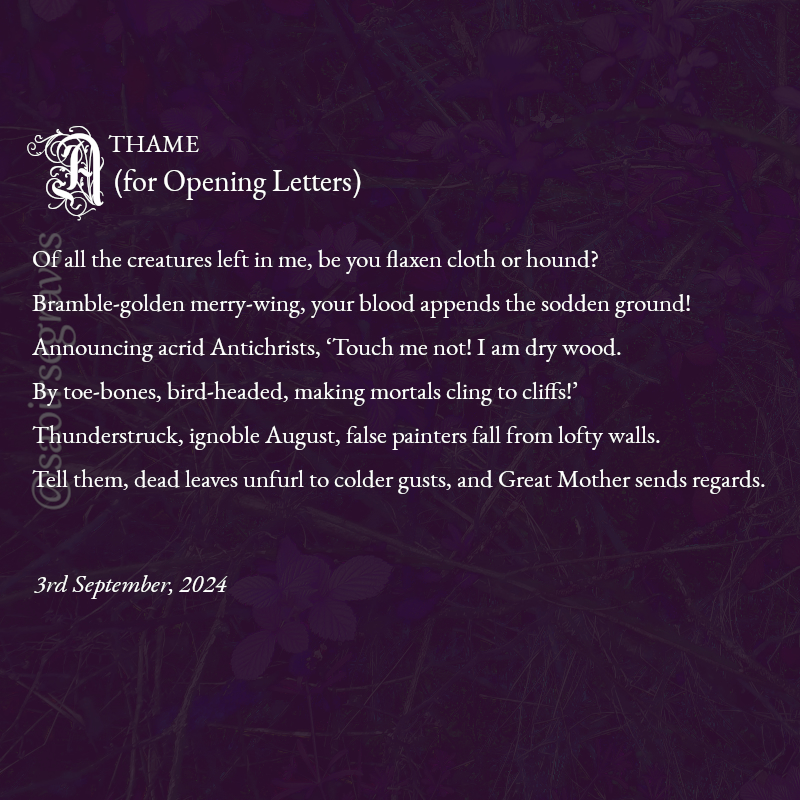
At any rate, I still need to figure out how to create a poetry gallery where poems that can’t occupy a single slide might appear… Until then, here are some of the poems I’ve written in September and October (minus “Athame”… which I have posted already.)
I suppose this set is all rather on the nose, but the themes of each are as follows: Love, Excavation, Death, Anger, and Anger.
For what it’s worth, I guess.
~ Saoirse.
* Get it? Theme-attics and Scheme-attics? Because it’s a post about poetry thematics and schematics? And I have a thing for sad attics? Ba-dum-tssshhh!!! Genius at it’s finest. I kill me.
Time for some #spooky #autumnal #fallvibes! Featuring tarot and witchy shit. Call me crazy, but I think there’s something in this group of concepts – something creatively stimulating at least!
Decks featured:
The Somnia Tarot by Nicolas Bruno
The Deviant Moon Tarot (Paradoxical edition) by Patrick Valenza
[CW – there will be reference to symptoms of trauma but I will not discuss details nor will I indicate any specific type of experience other than to discuss how it affects my magico-spiritual process.]
Half moon this morning. Waxing gibbous. Serendipitously, this is the card I received in a single draw from the Pagan Otherworlds Tarot. How apt.
I have been posting a bit more openly about music lately. Mostly here on the blog. I want to talk a little more specifically about why this – for me – constitutes witchcraft and deep magical healing work.
If anyone wants a recommendation for an amazing young musician and singer coming out of the American ‘Old Timey’ Trad world (as distinct from modern bluegrass!) they should check out Nora Brown. Holy shit her work is good. She’s currently collaborating with a fiddler named Stephanie Coleman and equally her style is deep, rhythmic, and rooted.
I’ve known of Nora Brown for a few years now but yesterday I made an attempt to watch the Tiny Desk concert above. I say ‘attempt’ because by the time they started into ‘The Old Blue Bonnet’ I was shaking, hyperventilating and so on. Having too many visceral and deeply loved memories of American-specific experiences… looking up at the moon through pine needles… fireglow shining through a cabin window at the bottom of a mountain valley… a small trickling stream beneath my feet… elk in the morning, bears on a walk. The music of the unassuming – jeans and t-shirts – trading information, laughing, and the deep heartbeat of boots on a floor keeping the tunes flowing. People talking with their feet and singing with their hands…
I couldn’t do it yesterday.
I told my partner it felt like a world had vanished but that I (and only I among anyone I know now) could hear faint echoes of it calling out “Goodbye! Goodbye!”*
So today is the half moon and I drew the half moon card. To me, the card says ‘Now you can do it and I will help.’ I took slooooow breaths, clutching the deck (my bridge between worlds), listened to this gem of a video and let what once was run its course through the channel of my emotions. Tears again but more manageable this time.
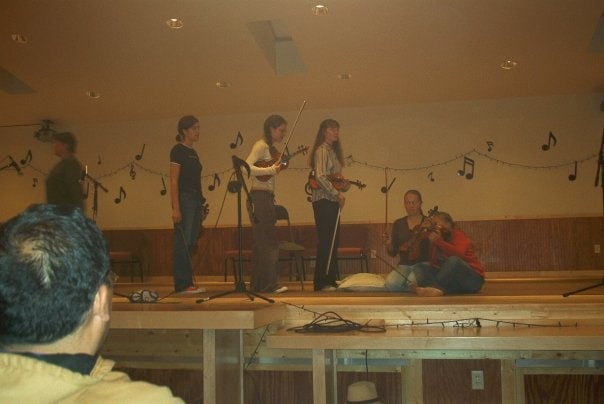
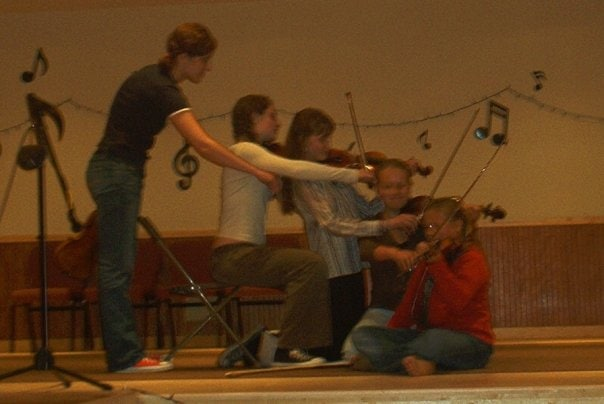
Old grainy photos of a good party trick…if you have lots of fiddlers!
It is, of course, not at all accidental that so much of American trad songs are fixated on war, death, loss, poverty, jail time, labour, loneliness. (The backbone of the ‘American dream’?) When people move too fast over land that isn’t theirs their own pre-existing problems grow with them. I don’t find much to ‘redeem’ about this… but I do find subtlety and nuance, I guess. The tunes I like the most have the least pretense – they’re tunes by and for flawed people. Maybe even the damned (depending on your worldview… I use demonic imagery in my witchcraft for many reasons). They carry no false promises and their dogma sounds tired.
I don’t know if I will ever use my violin for fiddle music again… I have no idea how that would feel in the body. Playing music, by definition, replicates the movements and bodily experiences of the past. That’s what practice IS… taking what you have already done and keeping it alive. Maybe that’s what makes it so hard and so rewarding at once. I am comforted by the knowledge I have of different forms of music and the fact that deep down I am fortunate to have some access to those skills and worlds… but I tend to feel shattered by the awareness that I come from a world in which I did not fit and I live now in a world that doesn’t know about any of that – at all. And I still do not fit.
This, incidentally, is how trad music is formed. Traditions carried. Stories retold and reworked. Sources cited (as is done so amazingly in the Tiny Desk video!)
To be a witch for me (among many other things) is to go to the altar and lay my music at Her feet. To carve a space that is mine… with bits and bobs of my story – the stuff that makes me howl and cry; the stuff that makes me dance; and the stuff that I know emerges syncretic and flawed… and to let it emerge and take its new form anyway. I take it all with me. These things are in my satchel. It’s painful to perceive, now, that no one around me knows it. I’m a person with no context. It must be enough that I know it.
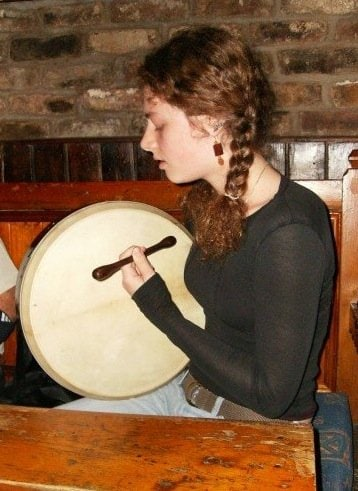
Baby-face Saoirse playing the bodhrán in Ireland. Think this might even have been in Cork!
The half moon will help me see that and shift my perspective back towards joy. And, I’m not totally alone… I can still light a bonfire on occasion and surround myself with other music makers. I know I’ve left things behind for a reason and I guess I’ll keep the practice of fitting into nowhere at all. Chronically transatlantic like so many before me… but hopefully reckoning a bit better with empathy and collective responsibility!
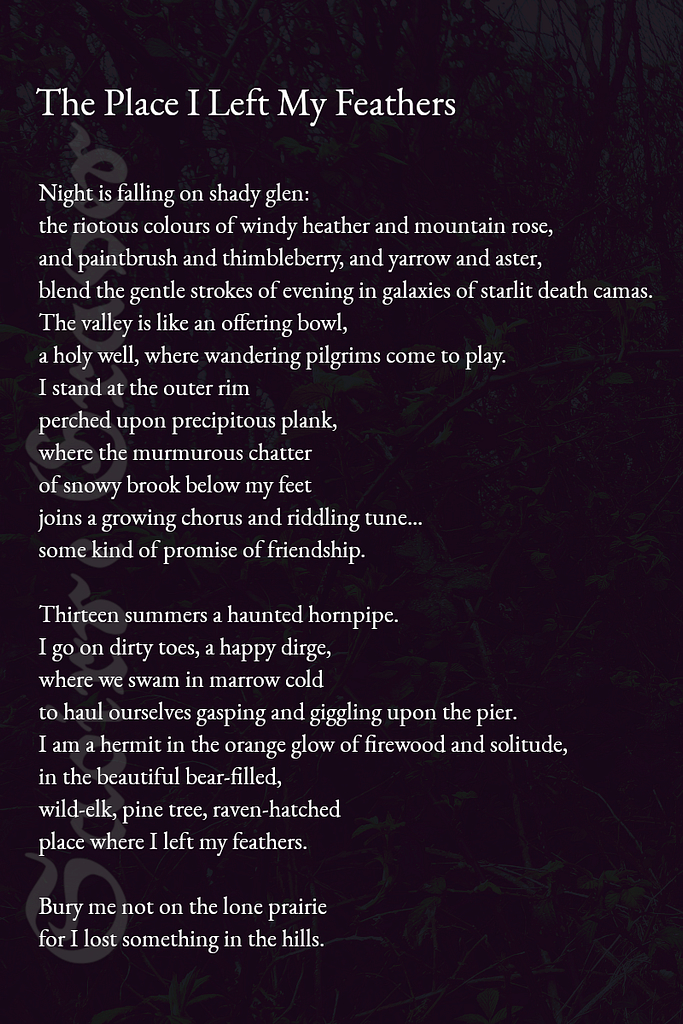
Below, a couple poems I wrote a few years ago, during an earlier phase of processing these things:
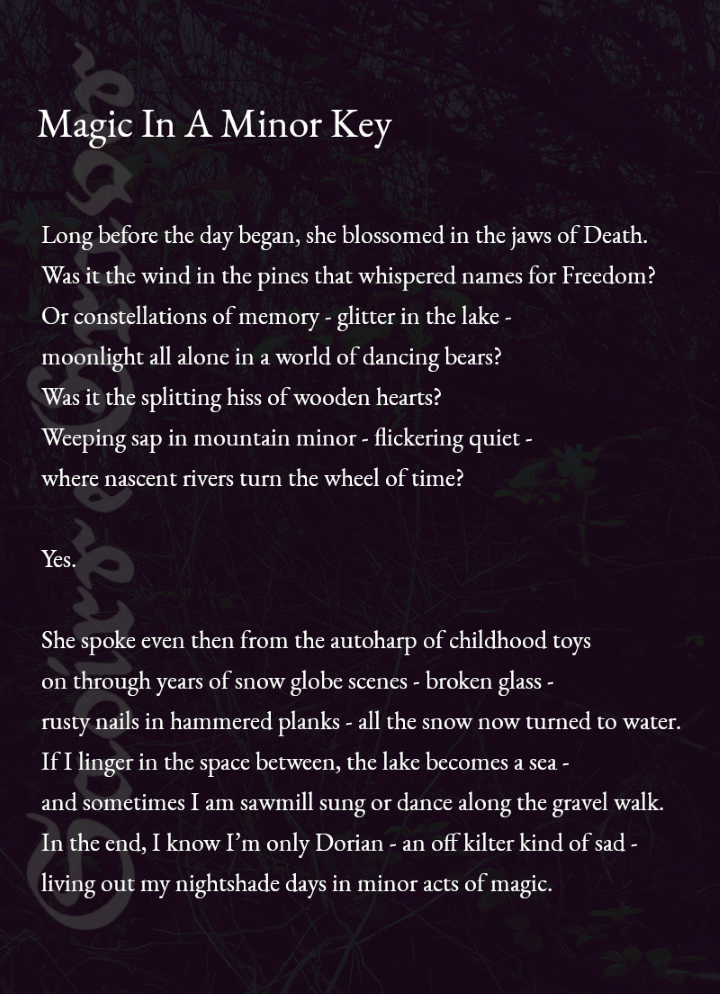
The Morrígan often ‘speaks’ to me through verse (UPG) and the following poem felt like an answer to wondering if she was there ‘even then’.
From 2022, it makes reference to John Prine as well as “Blackbird” performed by the Lonesome Sisters (written by Debra Clifford about her mother… Debra herself passed away in 2022.)
Another old photo. Wistful whistle tunes and homemade wings…
~ Saoirse.
* Rayna Gellert*** has composed some great songs out of this tradition that capture many of these feelings for me – “Strike the Bells” from her album ‘Workin’s Too Hard’ and “Nothing” from her album ‘Old Light: Songs from my Childhood and Other Gone Worlds’ come immediately to mind. Whew!
** This link is to a live performance (including the only mistake I’ve ever heard him make! ^_^) This is important firstly because I think his live renditions have a more dirge-like quality than his recorded version (which is on his album ‘Soon Be Time’) and secondly because he performed this song live for the first time one night at my college (a few years after I had stopped going to the mountains each summer to a camp where he and others taught) … I was talking to him after the gig and he asked me how the tune came across. I told him it was beautiful and made me cry and he told me it was the first time he’d done it on stage!!!
*** Incidentally, the same summer location was where I first had the privilege of meeting Dan Gellert, Rayna’s father. Holy shit that man can play and on the most gorgeous fretless banjo to boot!
I would love to hear your responses, thoughts, etc. in the comments. But please note, I’m not soliciting for comfort or validation. I’m wary of encouraging what I so often interpret in comments as codependent language. I’m fine! I am me and you are you. Concepts & practices such as witchcraft are shared but also truly individual – this is what makes them so potent! 🙂