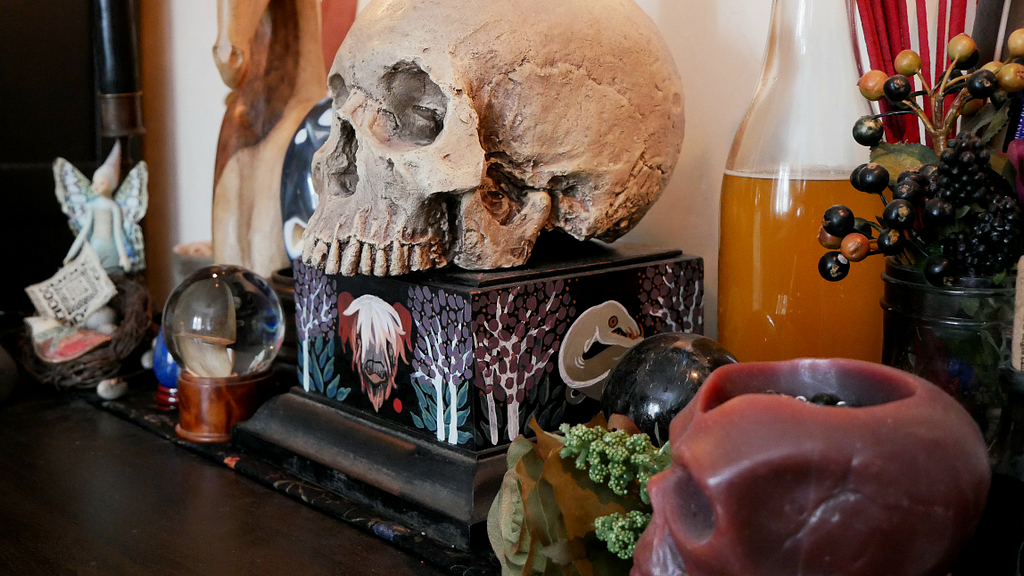
My aim with my online presence in a holistic sense is to do the work of further developing a unique and authentic artistic style and to build that as an inseparable part – maybe even just an outward expression of – my witchcraft and personal paganism. (In some ways, my goal is also to work myself up to a place where I can open my etsy shop and trust myself to handle things like paper work and post offices with reliability.)
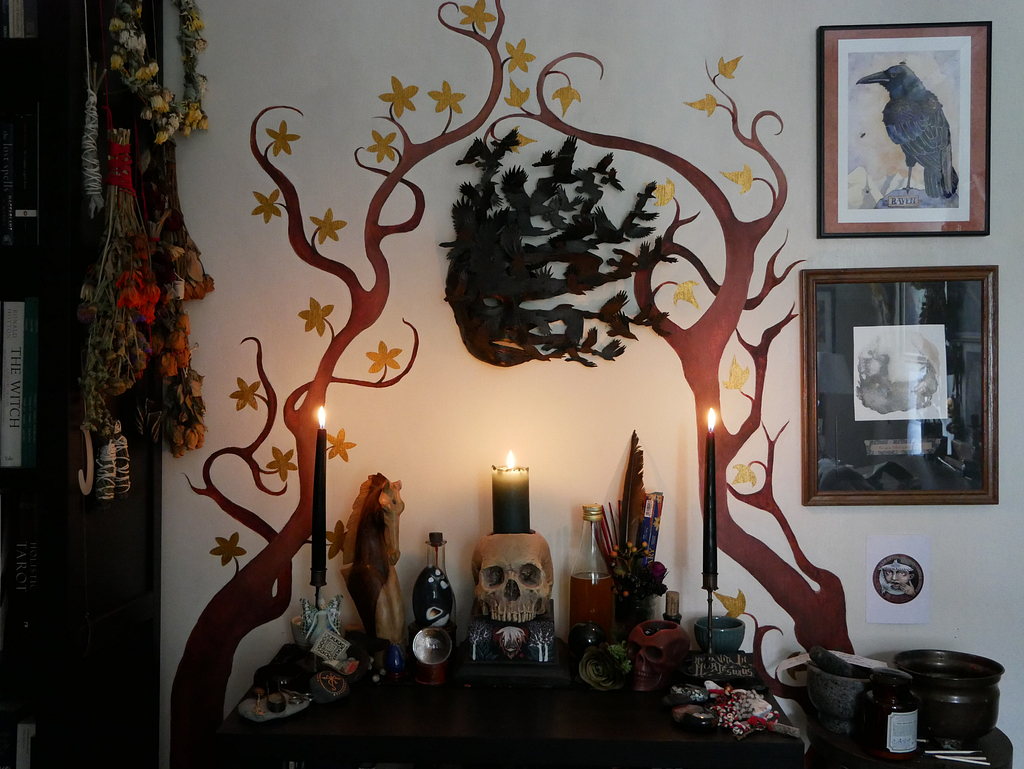
There are many topics that get poured into this massive cauldron of bubbling inspiration and what I want to do is explore that process in a conscientious, intentional manner so that whatever comes out (at any given time) does so as fully considered, balanced, and informed as it can be at that time. Some recent ingredients (or topics) of focus have centred around revamping my altar and strengthening the practical aspects of my devotion to the Morrígan.
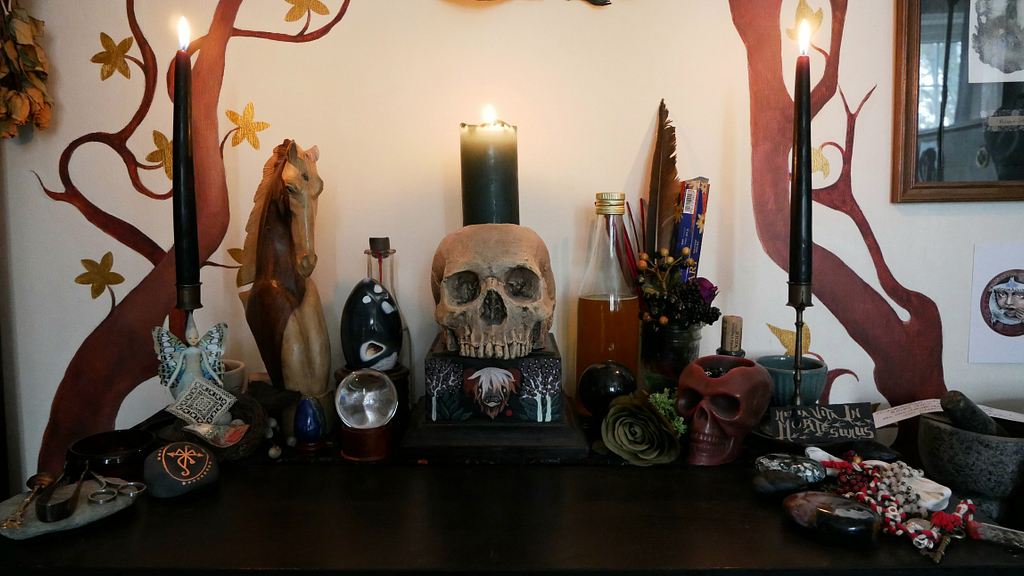
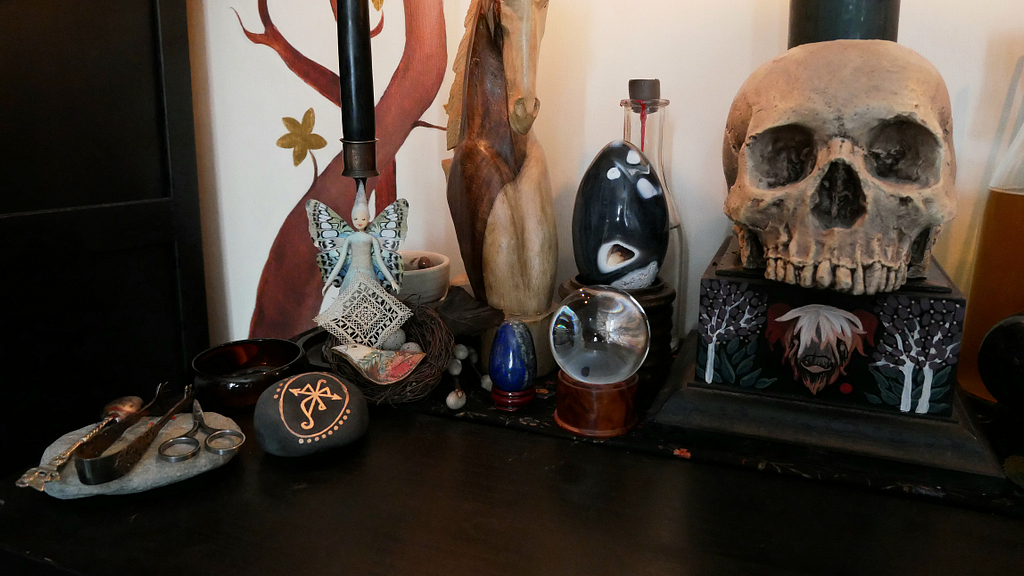
I wanted the art on my altar to function more directly on the Morrígan in her many aspects. I have felt for a long time that I was placing too much emphasis on her bird forms (Badb), her horse forms (assuming we take Macha to be a facet of the same goddess or even her sister), and to some extent her association with war and death. Thus, the altar has the bird, the horse, and the more cosmic otherworldly aspect accounted for but no wolf, cow, or eel… and also no succinct representation of triplicates either! (It used to but hasn’t had for a while – long story.)
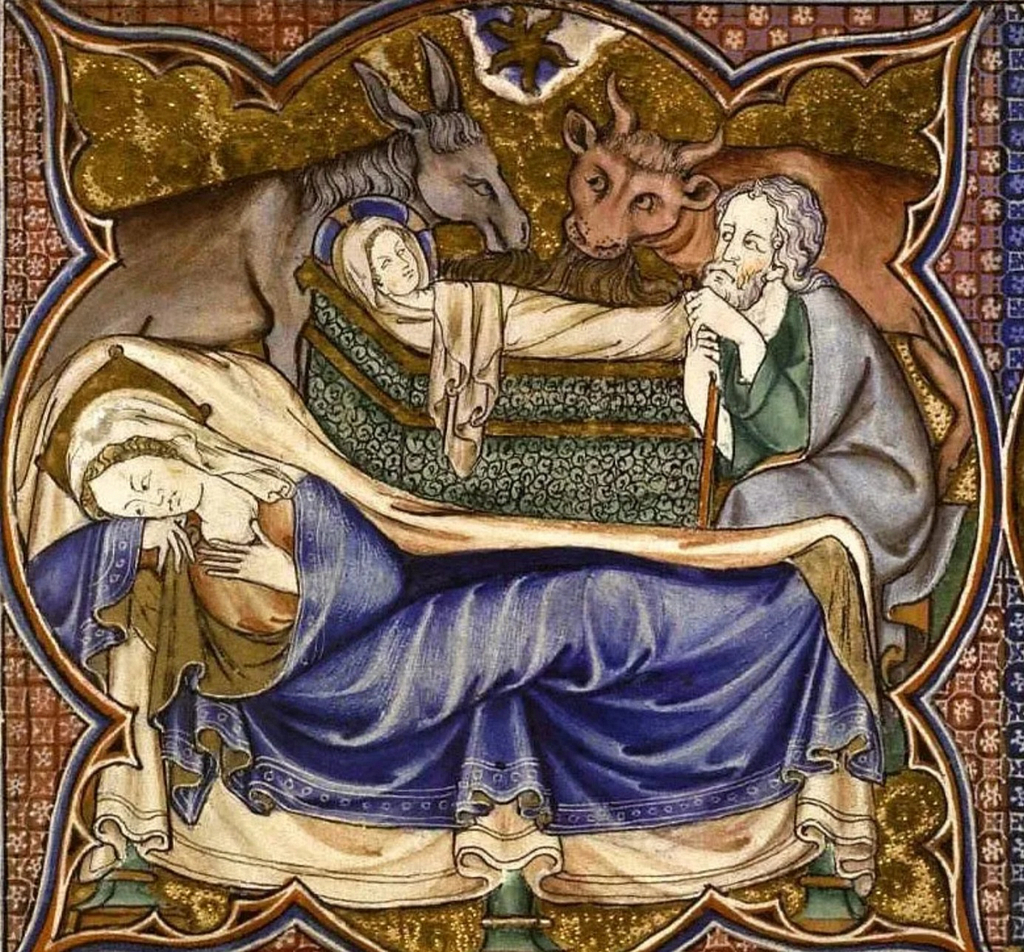
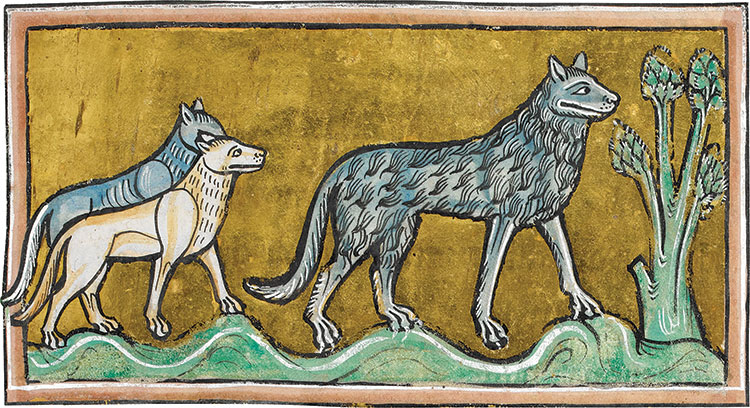
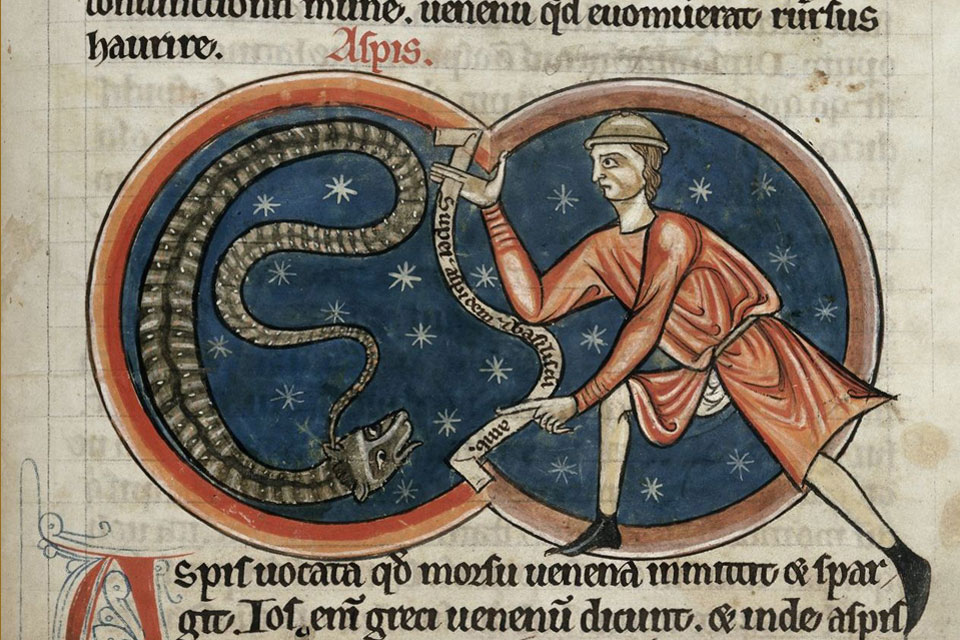
The next question I had was how could I represent so many new animal forms without entirely dismantling my altar for a new layout? I generally take a medieval inspired approach to Irish myth so the first place I looked was medieval manuscripts for representations of the animals in question (or near enough). Below are some examples (including source information) of wolves, cows, and…anything like a snake or fish to give a stylistic basis for drawing an eel. (Oddly, eels were fairly commonplace food items in the middle ages but I’ve had a hard time sourcing properly cited examples. Thanks Pinterest 🙄)
Psalter of Robert De Lisle, c.1310Rochester Bestiary, c. 1230Der Naturen Bloeme of Jacob van Maerlant, c. 1350Harley MS 4751 (ft. additions of Gerald of Wales’ Topographia Hibernica, late 12th-early 13th c.
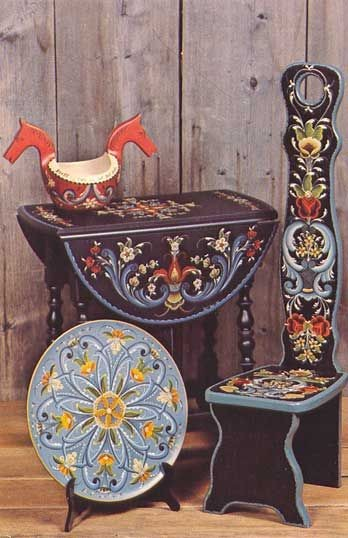
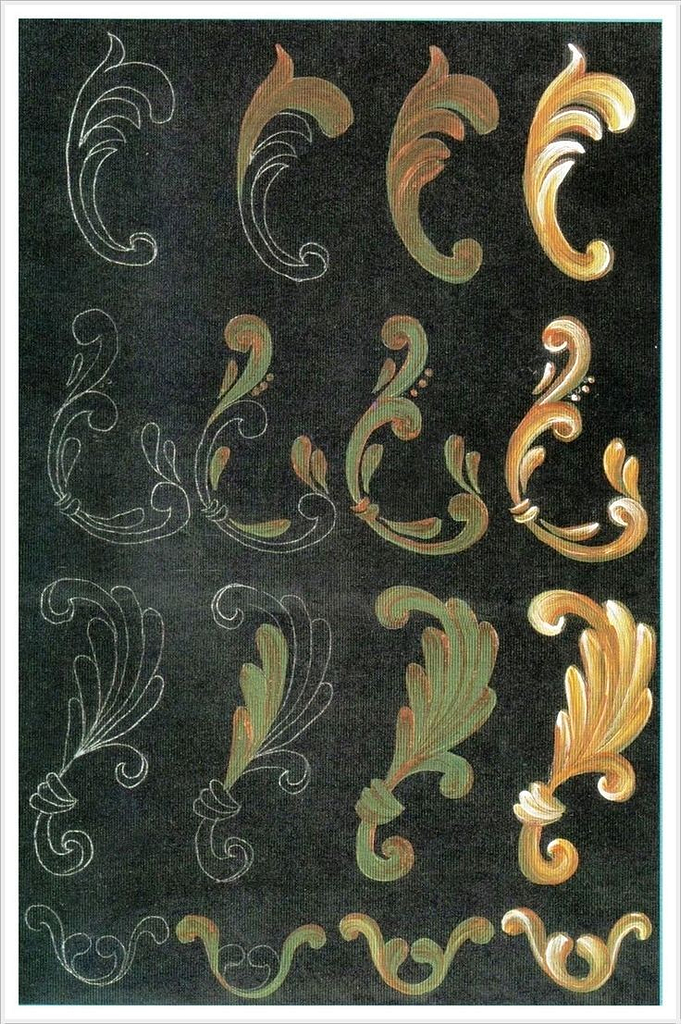
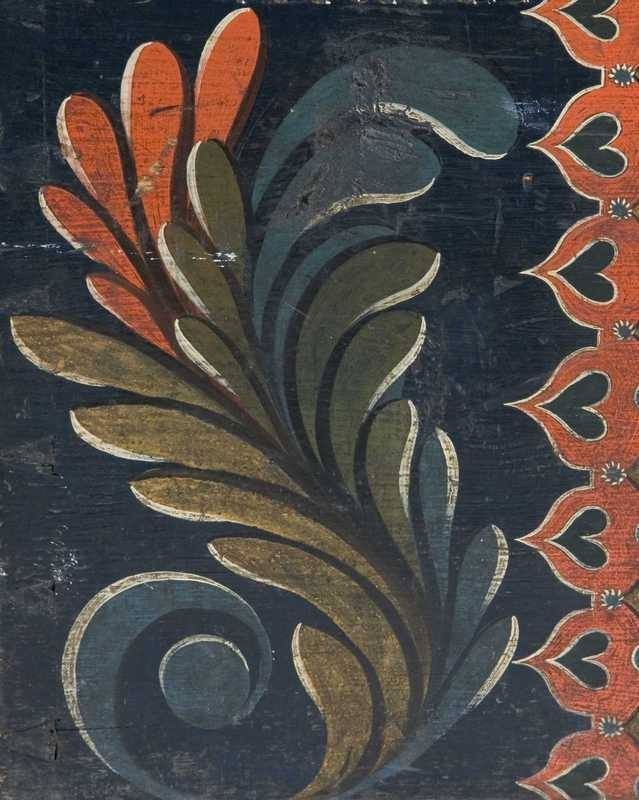
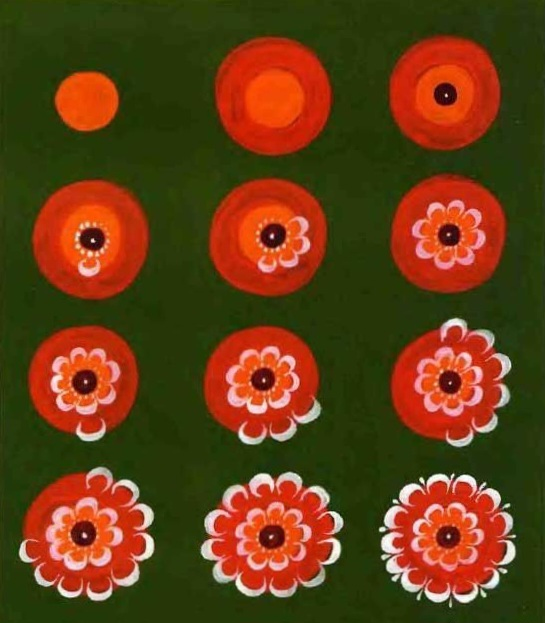
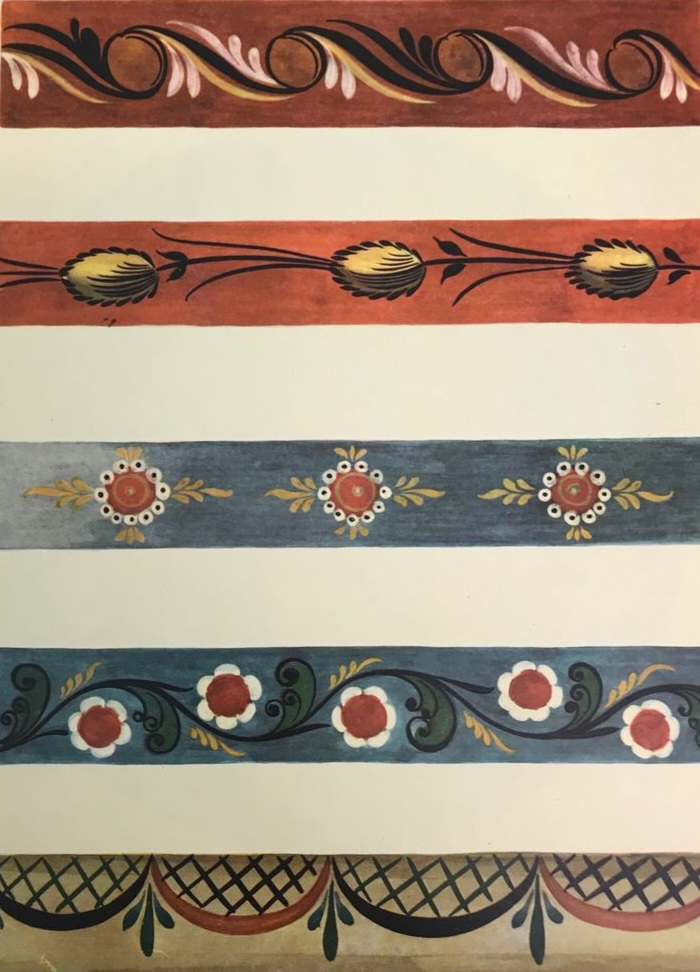
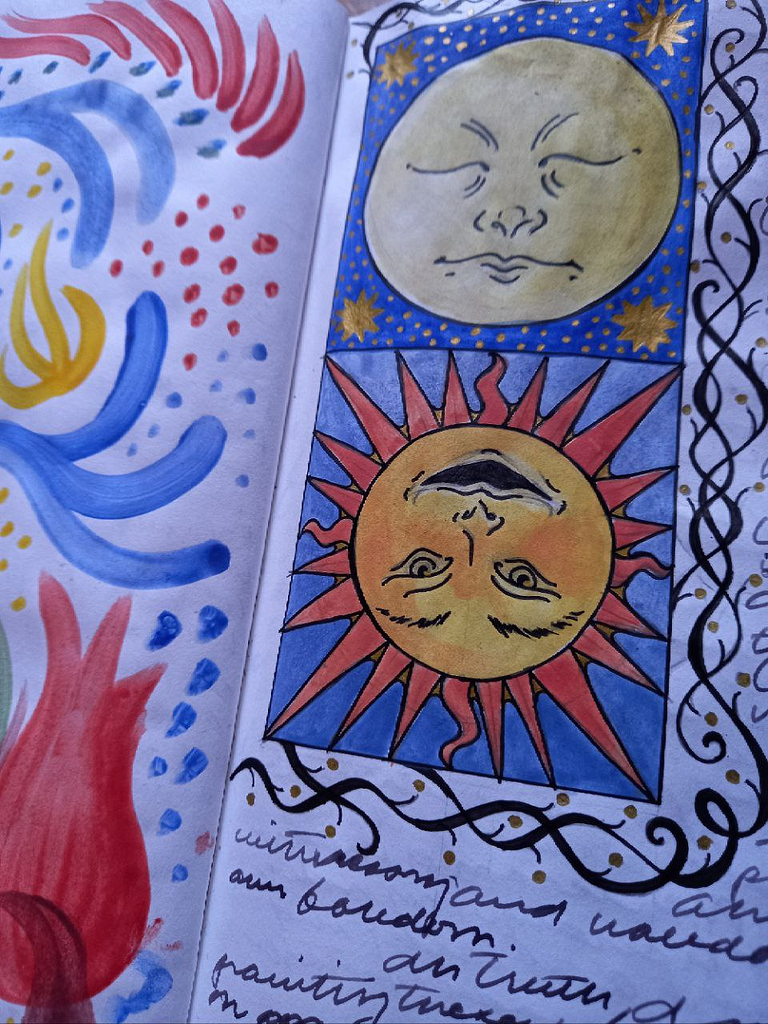
I am also always itching to paint on my furniture (and my walls…as with my altar space) and this seemed like a very good, risk free chance to work on developing my own technique inspired by medieval aesthetics and mimicking various folk styles such as Scandinavian (esp. Norwegian) rosemaling. I also grew up and worked in an area of the US with a lot of old houses that featured strange old paintings in their attics from the folk arts movement – an artistic tradition that included painting folk motifs on furniture as well. Below are some examples that I used as a basic reference as well as a page of my Book of Illuminations where I had some fun practising brush strokes!
Examples of rosemaling style painting – largely uncredited on Pinterest.
So I went to the vintage/antique shopping. Among other treasures such as a white rosary specked with what I assume is years of incense resin and a really beautiful old green glass bottle…I found a black wooden statue base. Bought it, took it home, cleaned it up and worked on designing how to paint it! Yorick was being fussy about the box he had been on anyway. 😉
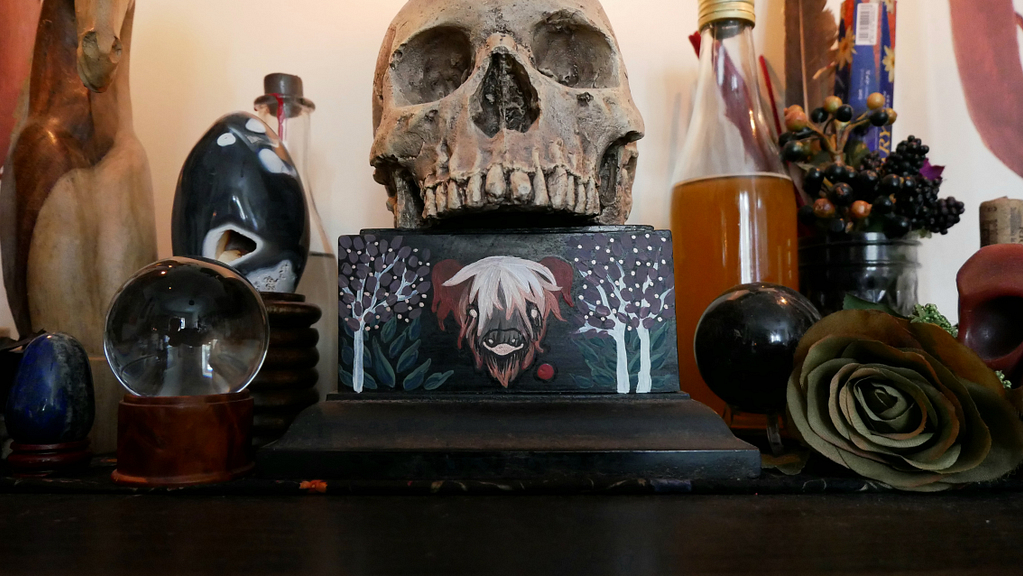
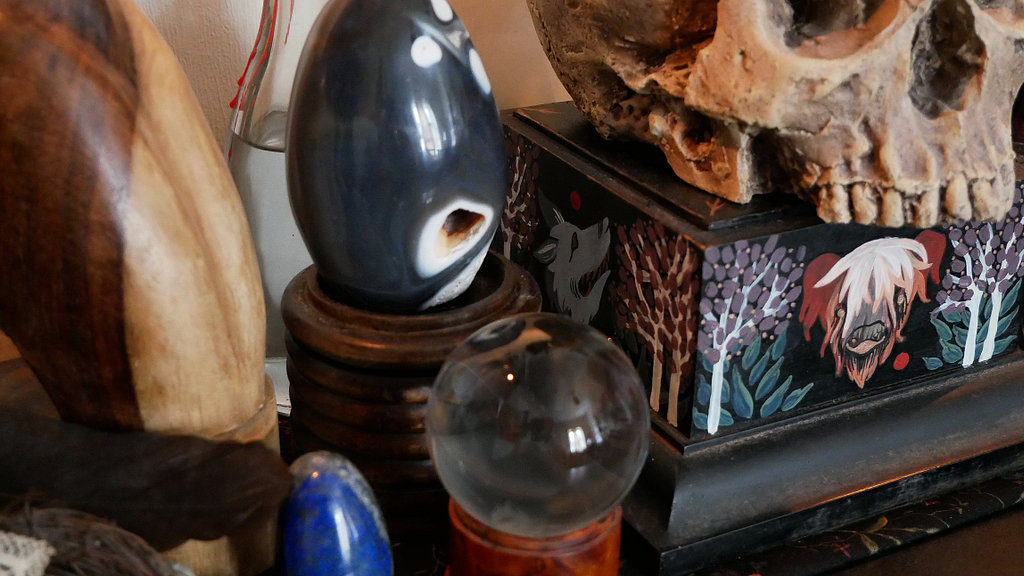
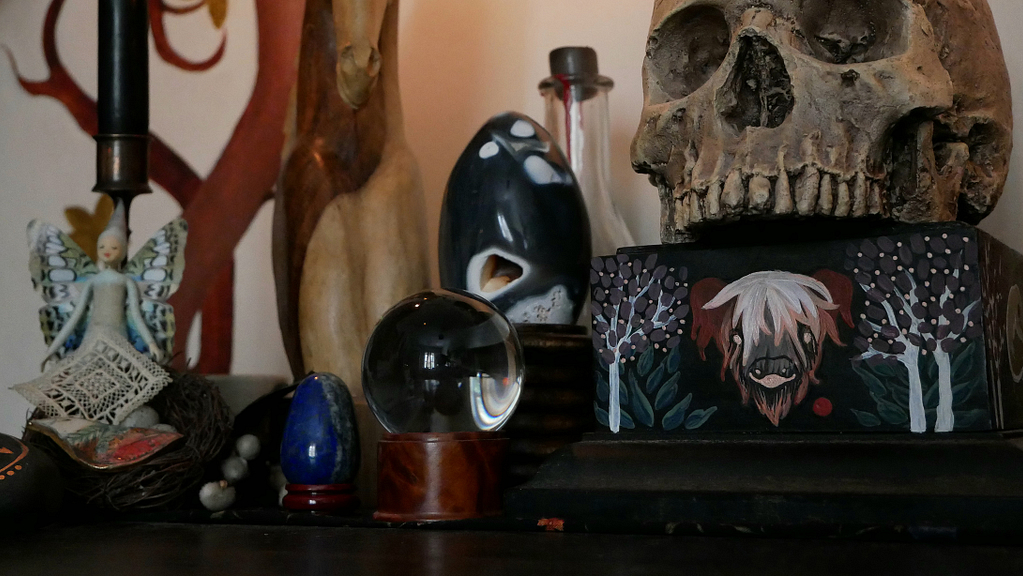
Out of all of this I designed three panels for the statue platform. I incorporated a few William Morris/Arts & Crafts movement/stained glass inspired elements as well (most notably in the birch trees and the leaves behind them.) Note! The cow faces forward and is also somewhat based on modern highland cows… The part of the Táin where the Morrígan takes this form describes Her as a ‘hornless red heifer’. I decided to lighten the colours on her head and keep her ears red as a slight nod to otherworldly cows or cows from the sidhe which are often described as white with red ears. The final product also shows three drops of blood, one for each animal, which are placed spatially in such a way as vaguely indicates where Cúchulainn’s sling shot injured Her in each case. Below are my notes and sketches!
Astral egg symbols abound!Paint experiments.Sketches based on medieval examples – focusing on directionality of brush strokes. Eel modeled loosely on a fresh water species.
The final result up close and in situ! This shrine feels so much more complete now. Best believe the gold of Her eyes lights up in reflected candle light.
A video showing some of this process will follow in a day or so, so stay tuned for that! I will endeavour to update this blog post with the embedded video when it is ready.
As promised, this is Part II of my initial foray into the topic of medieval magic. As a springboard, I will be using a chapter by Mark Williams from the Routledge History of Medieval Magic, titled “Magic in Celtic Lands”. The chapter features examples from Ireland and Wales but, for my purposes, I will focus on Ireland today.
Firstly, what is the impetus for this line of enquiry? The most immediate reason is that I’m obsessed with the middle ages and I function, personally, within ‘the’ Irish mythological framework. Our textual evidence of Irish myth originates or begins in the middle ages in spite of its narrative setting in the Iron Age. Personally, I tend to take the academic view that Irish myth – such as we have it – is medieval literature. More specifically, I’m interested in topics such as the ways in which the format of rosc poetry carries ‘magical’ potency; in Irish mythological tropes around prophecy; the literal singing or chanting component of ‘enchantment’ such as it appears in certain stories; and a certain recurring visual motif involving ‘bird heads’ or bird headed…ness? I’ll get into my thoughts on what this currently means for my magico-spiritual artistic practice toward the end of this post.
Some BRIEF background information… The word “Celtic”, as Mark Williams states, “is a difficult term, precise only when deployed in a linguistic context: it is used in a parallel manner to “Roman” and “Germanic” to denote a major branch of the Indo-European language family.” (123) Scholarship on the topic applies to regions linguistically Celtic whereas popular culture and imagination thinks of places like Ireland and Scotland and so on as ‘celtic lands’ (as Williams words it) or in terms of ‘celtic heritage’. Williams also notes that relating similar motifs between Ireland and Wales and calling them “Celtic” might no longer be done with confidence:
“it is increasingly acknowledged that similarities between the two countries’ literary traditions – formerly taken as evidence for a shared cultural inheritance – may in fact be medieval borrowings or independent innovations. […] The question of what medieval Irish literature in particular owed to the Bible and to the wider European world was a controversial area of critical debate for much of the second half of the last century, and the examination of magic is likely to constellate the issue once again in significant ways. The field of Irish and Welsh magic is therefore excitingly wide open, and a reconsideration of all the surviving records and representations of magical practices is badly needed.” (123)
THAT is exciting!
Dreams of diving headlong into the world of Celtic Magic Academia and never resurfacing aside (for now), I want to discuss some particulars of this chapter that jumped off the page and screamed ‘remember and explore me!’ Firstly, Williams emphasizes the potential for differences between literary magic and historical magical practice. In so doing, he introduces characteristics on the Irish ‘literary druid’ (127) and provides two examples: Cathbad (who we might perceive as ‘good’ or praiseworthy in the the stories, though he tends to get on my nerves) and Mog Ruith, with whom I am less familiar.
“Mog Ruith, in contrast, is a more morally ambiguous figure. In Forbuis Dromma Damghaire, he is Fiachu’s major secret weapon against the forces of Cormac (though Cormac has his own team of druids too), being a miracle-worker possessed of a spectacular repertoire. He can alter his size at will, set things on fire with his breath, cause rains of blood, send people to sleep for long periods and create magical animals which go after enemy champions […] At one point, he puts on a cloak and “bird-headdress” and ascends into the air.” (130)
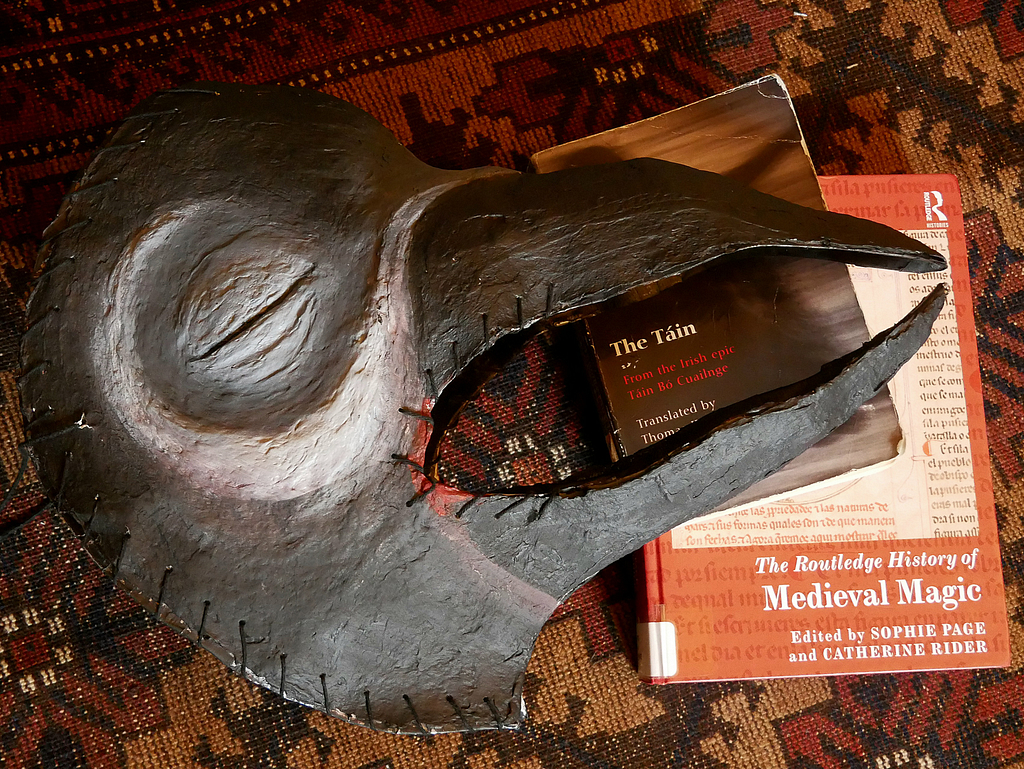
My eyes nearly fell out when I read that last sentence. Those of you familiar with my youtube channel, you may remember the ritual costume I made for Samhain in which I crafted a bird mask and black linen veil (rather in the style of modern folkloric/pagan pageantry) for the purpose of shapeshifting and affecting change in my personal life and spiritual practice.
My video last Samhain, vlogging the #artwitch process…
I got this idea mainly from associations with the crow and the Morrígan*, my personal obsession with shapeshifting motifs, as well as a specific mention in the foretales of the Táin Bó Cuailgne, as translated by Thomas Kinsella. From Cúchulainn’s training in arms:
“[While on raid for Scáthach, his warrioress mentor] he came back the way he had gone, and met a one-eyed hag in his path. She told him to get out of her way. He said that would leave him no room to pass except the sea-cliff below them. But she begged him to get out of her way. So he let her have the path, except where he clung by his toes. She struck at his big toe as she passed him by, to knock him off the path down the cliff. But he saw her in time and gave his hero’s salmon-leap upward. Then he struck off the hag’s head. She was Eis Enchenn, the bird-headed, mother of the three last warriors to die at his hands. It was to avenge their ruin that she lay in wait for him.” (Kinsella, 33)
These stories are hardly a feminist utopia (just read a few paragraphs in either direction from this point) but – in addition to the one-eyed hag which is a descriptor that exists in other stories, including for the Morrígan, Herself – I was particularly interested in this ‘birdheaded’ detail…is it a kenning? An epithet? Was it literal or metaphorical? It seems important, especially as it occurs in a section of Cúchulainn’s stories that involves so many magically potent martial prophetesses. I don’t yet know how it is phrased in the Old Irish or any specifics about Kinsella’s translation choices here.
Thus, as regards Mog Ruith, I had never encountered an explicit mention of donning a birdheaddress for the purpose of shifting shape or flying before. Yet, from an UPG** perspective, you might say this is what I did for Samhain. I like that but I don’t need it to be objectively ‘true’. I DO need to learn Old Irish and research the heck out of this for the rest of my living days. It has also only further cemented my tendency to merge bird-symbolism and artistic practice. The alchemy of art (including costumery and stitchcraft) is that when we have extant primary evidence from our favoured time periods, we can exist in direct artistic dialogue with them. In my opinion, it makes very fertile ground for personal gnosis.
I have more to say on Mark Williams’ chapter – including another juicy tidbit about the Túatha Dé (god-peoples) and their ‘theological knowledge’ allowing them to occupy a similar ontological category to medieval demons… and how that’s born out in other medieval Irish literature… but this blog post is long enough, I think.
Until next time!
Nerdily yours, Sorsha.
* I don’t use the phrase ‘matron deity’ but I guess you could consider me a ‘devotee’ in so far as I live my life & devotional practice ‘under the auspices of Her wing’ (as I often put it.) In this post, I have used her most well known name… but I’m not necessarily only referring to one Morrígan here. ** Unverified Personal Gnosis
Citations:
Kinsella, Thomas. The Táin: From the Irish Epic Táin Bó Cuailgne. Oxford University Press, 2002. A 2002 reissue of the Oxford Universtiy Press 1970 edition, with illustrations by Louis Le Brocquy.
Page, Sophie, et al. “Magic in Celtic Lands.” The Routledge History of Medieval Magic, Routledge, Taylor Et Francis Group, London ; New York, New York, 2021, pp. 123–135.
Perhaps it is the time of year – verging on the vernal equinox and a hushed but stirring feeling in the air. On Imbolc, some say that fine weather means six more weeks of winter: the Cailleach has cleared the clouds so that she may gather dryer firewood for more cold weather. If you see a bird fly by with sticks in its beak, on the day, that’s her! The birds have indeed been gathering with a frenzy of late, the weather gusts cold and wet, and everywhere are light burgeoning shades of green and delicate hints of mauve.
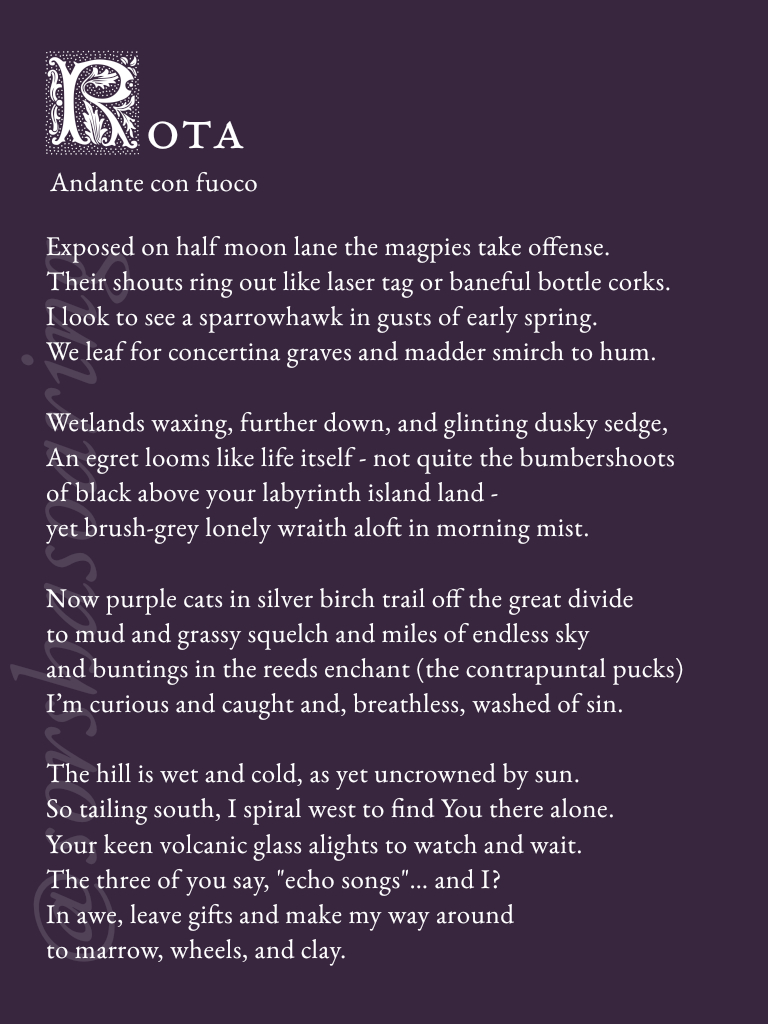
This one felt stuck until this morning…go figure. Note ~ “rota” (wheel…) or “rondellus” is the medieval term for a round. “Andante con fuoco”, also in music, means “at walking pace, with fire”.
I’ve been feeling restless – even anxious – and keenly aware that my priorities need a rearrange. It’s been weeks since I’ve been able to sit at my altar without knocking something over or dropping cinders on the floor – that’s strange. I like to spend most of my time alone and yet the world seems very loud and backlit with blue flickering light – that’s telling. I’ve been losing sense of what I love, what projects I want to work on, feeling anxious to meet deadlines that don’t exist – time to slow down. After all, this year’s motto is: NO RUSH.
Gorse… beautiful and so very sharp. I like it for protection/warding work.
It may not seem like much, but I’m leaving Instagram. I feel I am responsible for my own use of time, my own sense of honesty or personal connection with others (and with the collective!), and my own health. Instagram makes it seem that those who live with flare and authenticity have no trouble documenting that on their platform…but I have not found this to be the case in my life. Instagram also makes it seem as though there is no such thing as agency or artists or social awareness or anything at all without their dicey validation.
When catkins look like corpses… “I’ll cut you in half, while you’re smiling ear to ear/And the freedom that you sought/is drifting like a ghost amongst the trees…” (Magic by Bruce Springsteen)
But there ARE other ways to show process, to document inspiration, and to allow others to partake in the kind of slow quiet beauty I wish to cultivate. Hence, this blog post features some examples of the few moments of quiet that I have recently pursued and remembered to value… none of which were posted on Instagram but that I’m happy to highlight here as a signpost for the future.
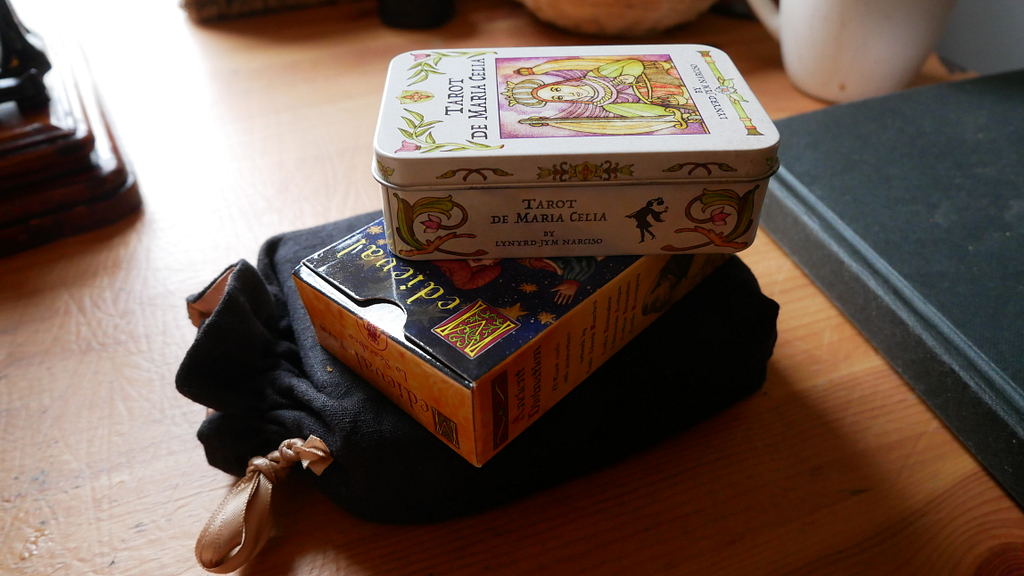
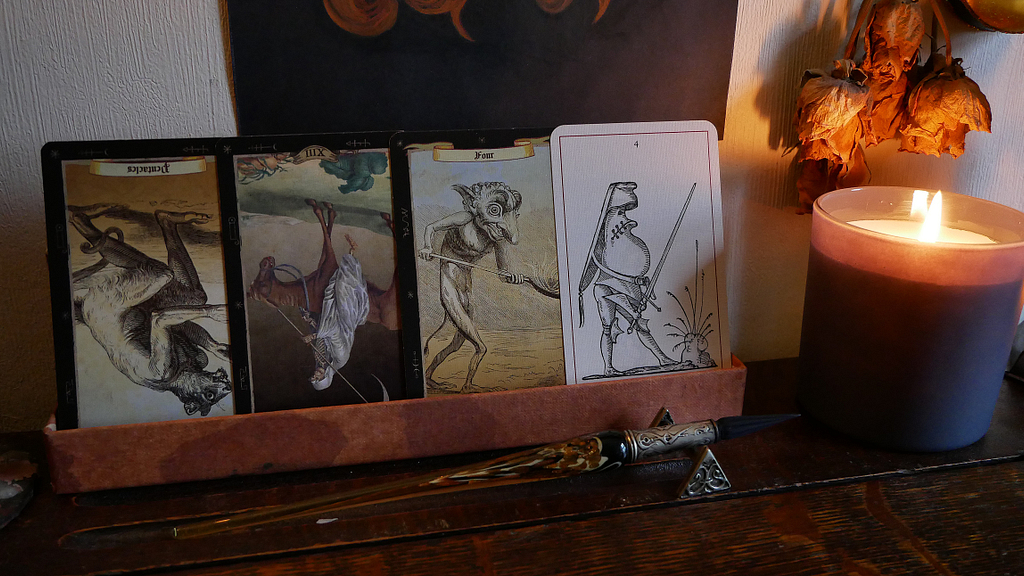
Variations on a theme…Current corset progress…Modded Somnia Tarot.
A thread of red in the labyrinth of life.
Quietly yours,
Sorsha.
*First line of the Morrígan’s prophecy to the Donn Cúailgne, as translated by Thomas Kinsella.
Hm. This does not feel like one of those moments where I may triumphantly declare:
“I made an Oracle Deck!”
As it happens, I did make one …only I didn’t. It’s called “The Dreams of Pantagruel Oracle” and it is part magical tool, part divination method, and part the extended overtures of a rare old book nerd. The ‘book’ in question is “The Drolatic Dreams of Pantagruel” (original French: Les songes drolatiques de Pantagruel) – a public domain reproduction from 1869 of an original volume from 1565. (See introduction/companion booklet below for more!)
Pantagruel is a giant – a character invented by Francois Rabelais in Renaissance France – whose escapades (and those of his father, Gargantua) form a collection of scholastic, social, and religious commentary as well as baudy, irreverent, often inebriated stories…aimed, it seems, at delighting and enraging the social order of 16th century France.
I did not draw these images… Neither did the 19th century publisher (Tross) of the volume from which they were taken… Neither did the 16th century publisher (Breton) of the volume from which that publisher reproduced them… Neither did Rabelais himself, to whom Breton attributed the artistry of these images… Learned discourse suspects it was illustrator/engraver Louis Desprez who produced other work for Breton in a similar style.
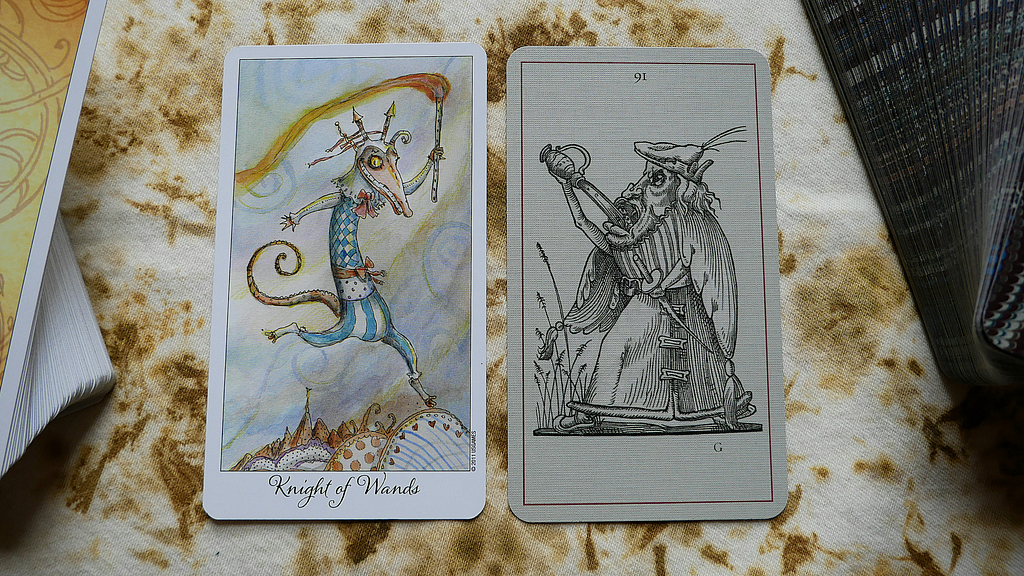
Dreams of Pantagruel with the Joie de Vivre Tarot
The deck has 123 cards in total, measuring 2.75” x 4.75” (70mm x 120mm) in linen card stock and they are now available on MPC.
In the shoplisting I promised a PDF booklet introducing the deck – it includes some basic historical information, some indications of why I made it (other than just wanting it to exist), asks some questions, and leaves the door very wide open for any manner of uses at the total discretion of those who choose to acquire it. It also includes citations!!!
Powered By EmbedPress
What follows are some of my own personal initial thoughts about the deck at this time. My journey in using these cards has only just begun but here goes…
Firstly, I am very interested in the weird ‘Bosch’-like world to be found on the margins of society. I like to ask myself questions about how society asks questions. Having worked in different kinds of archives over time, fulfilling queries for different kinds of researchers on different topics, it’s astounding just how much the assumptions in approach inform (or limit) retrieval and results. Of course, the way information is catalogued can also skew things… as do ‘hidden collections’ – collections that exist but are horribly back-logged, invisible until allocation of resources and social priority allow ‘us’ to ‘see’ them.
Secondly, I’m interested in the shapeshifting nature of personal characteristics but I want to be very clear that, in my opinion, equating moral or social value with physical appearance is unacceptable. There is enough work on our hands to undo tropes around ‘disfigurement = sign of evil’ in fairy tales and fantasy without adding to it through the misuse of our creativity going forward. The characters in this deck are not automatically marginalised or considered unfavourable. The worldview that created them was flawed (for one thing Rabelais, author of the Gargantua/Pantagruel stories was definitely sexist!) and the worldview of ‘curious persons’ who view and respond to these images will create what they bring to the deck… to put it bluntly.
Dreams of Pantagruel with Le Tarot Noir
Thirdly, assessment is on-going…but this deck is one step in the much larger personal aim of seeing the world in terms of the imaginative qualities of its inhabitants. I guess you could say I wanted a deck of ‘friends’ to support me in that work. “Familiars”? “Servitors”? Demon-cohorts whose names are Legion?
Fourthly, I’m SLOWLY going to be learning as much as I can about the historical details in these images. I already recognise certain clothing elements that leave clues as to what some of the jokes or references might be. (Such as pin cushion codpieces…) It’s not immediately clear to me how much of these images are already understood from an (art) historian’s point of view, but I’m eager to see the extent to which whatever details I uncover influence my own self-styled way of being, visually and otherwise.
Fifthly, it’s no fluke that Renaissance imagery should make sense in terms of tarot visuals. I’m enjoying the way this pairs with various decks in my own Oracular Library!
Dreams of Pantagruel with the Magicae Daemonibus Tarot… this morning’s shadow work!
Lastly, within the framework of Irish myth, medieval literature, and various iterations of ‘fairy-faith’ or dealings with the Other Crowd… there is a lot I want to explore about how I perceive denizens of Otherworlds and how that fits into my own mythological/cosmological framework. I’m in the process of exploring and expanding my own astral realm (a place I have been referring to lately as “the little cosmos”) but none of that is solidified and it’s well beyond the scope of this blog post…
I hope my ideas are not too superimposed onto the deck for having shared them a bit here! And I hope very much that whoever decides to buy the deck enjoys it and derives benefit from it in some way. I’m going to explore other ways/platforms of making it accessible in time but, for now, do remember that the images from the 1869 volume are in the public domain! Go check them out too!
I mentioned in last week’s video (“Who Painted the Lion?” or “Medieval Shadows & Cards of the Year”) that I have begun exploring academic perspectives on medieval magic. The first thing of note is a fairly baseline agreement on the historical distinction between ‘magic’ and ‘witchcraft’ (something we see holds true in the early modern period as well through secondary works by the likes of Ronald Hutton etc.) The second thing to highlight is that, as with most things, this is an entire academic discipline and a developing one. My intention is to pursue the points that interest me and then see how it feels to relate some of that back to my own work as a modern practitioner of ‘medieval-infused’ witchcraft and art magic.
The aim of this post and any others like it (e.g. capering treacherously on the border, with historical research or context on one side and personal gnosis or numinous magic on the Other) is simply to show ‘process’:
How do I gather ideas or inspiration?
When, how, and why does that inform my magick and art?
Why might that lead to further UPG (Unverified Personal Gnosis)?
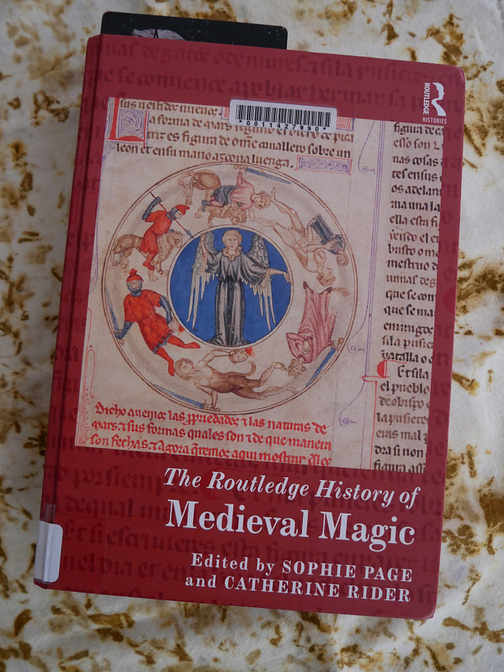
For now, I’ve started with “The Routledge History of Medieval Magic”, edited by Sophie Page* and Catherine Rider and published in 2019. The main goal of the book is to show the current standing of the field but also to illustrate various directions in which it needs expansion. It’s less an overview of what has come before and more an academic call to action with each chapter serving as useful examples, or signposts, for further research. Yes please!!!
Part I, Chapter I: “Rethinking how to define magic” by Richard Kieckhefer presents some interesting ideas surrounding why magic is difficult to define (even for academics! We’ll steer clear of the choppy waters around definitions of magic and witchcraft in modern practice on this blog!)
Concepts that caught my eye came up as he was establishing his main system of “aggregating terms” vs. “constituitive terms” (pp. 15-16) – i.e. the vague umbrella terms like ‘magic’ vs. better defined component parts. He draws a comparison to the term “mysticism”. Like the word magic, ‘mysticism’ resists attempts at explanation and evokes many different ideas or impressions of what it is.
“A comparison may help. It has long seemed to me useful to think of mysticism […] not as a single phenomenon but rather as a cluster of phenomena that may at times be distinct but tend to become intertwined. There is mystical prayer, mystical relationship and mystical consciousness.” (p. 15)
In the medieval Christian context,
mystical prayer – involves “fervent and intense, highly concentrated, focused prayer, cultivated within the setting of the contemplative or monastic life.”
mystical relationship – Kieckhefer represents through Bernard of Clairvaux or “the German sister books that are deeply steeped in “theoerotic” relationship […] with Christ.”** This is the view in which one might ‘burn with love’ for deity.
mystical consciousness – Kieckhefer says can be found in the vernacular sermons of Meister Eckhart “who wants his hearers or readers to gain a lively awareness of God’s presence within herself […] and her own true and eternal presence within God.”
Kieckhefer clarifies that these may all be combined in different ways by a single medieval writer. His example is the writing of Teresa of Ávila. (p.15)
I’m already interested in the murky waters of mystical thinking… not to mention words like “theoerotic” (which, incidentally, might be more readily available to the imaginations of non-Christian devotees of deity or deities).
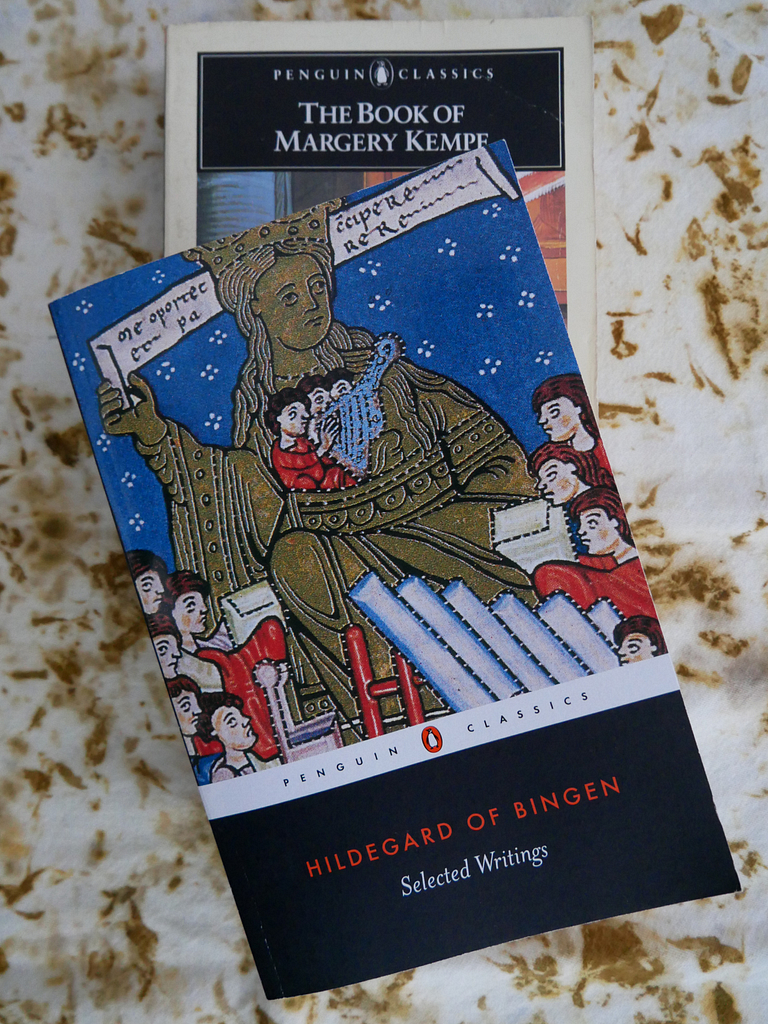
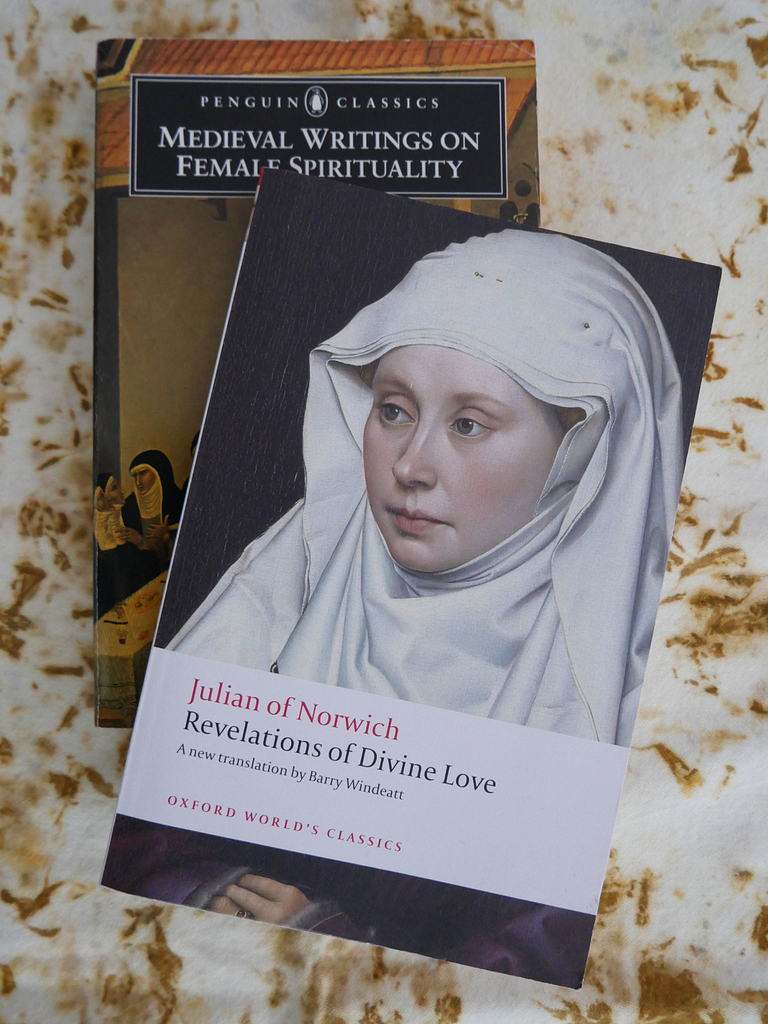
**Some books on my ‘TBR’ taken from my atheist partner’s bookshelf (who’s shelf SHOULD these belong to? Squabbles abound.)
However, coming back to the aggregating term of ‘medieval magic’, Kieckhefer offers at least three options for its constitutive terms: conjuration, symbolic manipulation, and directly efficacious volition. (p. 17-18)
Honing in on symbolic manipulation (hello, art witch here!) Kieckhefer says some really juicy words:
“If a plant shaped like a liver is useful for healing the liver, it is in that sense a sign of what is thought to affect, and the intelligible resemblance is what effects the healing. […] If conjuration is a reprobate branch of religion, symbolic manipulation claims an efficacy like that of science and will be seen by its practitioners as a type of science. The magician who manipulates symbolic links in the natural order might be thought of as tugging on invisible cords that link one level of that order with another. The symbolic links may be articulated in terms of cosmic correspondences and sympathies, at least in sources that provide theoretical grounding for magical practice. If the invisible cords are not thought of as efficacious symbolically, then the process is not magical; the user may not be told explicitly that symbolic links are entailed, and may simply be assured that the results are tried and proven, but in magical operations, the symbolic causality is at least implied by the types of word, ritual and object used.” (p. 17)
Taking this historical analysis and running wild with it in the modern day, I think the analogy of tugging on unseen cords of meaning is just…poetry. This may also provide a very useful visual for what some modern practitioners mean in their discussions of magical correspondences or energetic work. In my view, this perspective posits a model for developing personalised magical symbolism in art as and when it feels creatively powerful to do so. Whether the ‘invisible cords are thought of as efficaciously symbolic’ might be the keystone for agency in that approach. If I were to use the language we have explored here in Kieckhefer’s chapter, then to be an art witch is just as much the work of developing artistic style, an individual (and recognisable) ‘voice’, and recurring visual motifs that – when aggregated – convey an added layer of meaning in the whole that is the finished piece. In other words, they constitute magic.
Art must also speak for itself… but in theory, part of the magick that heightens its efficacy might lie in some of the following: symbolic connections forged by the individual artist; the time spent exploring the meaning of what they want to do or say; practicing techniques for how that might be rendered; and strengthening those motifs (‘correspondences’) over time. Perhaps this is contained in colour choices? Or recurrences in textural play? In different media? Or in more literally repeated visuals like egg symbolism?
I’m reminded of the medieval Irish approach to manuscript illumination and prayer…where the word and all its colours and symbols IS the prayer, IS the presence of the divine in an even more literal sense. (A famous example being the Chi Rho page in the Book of Kells.)
I would very much love to hear your thoughts in the comment sections! How do you feel about the way your creativity or your magick comes together or what that process entails? What do you think about sources of inspiration and how that becomes magickal for you (whether you make art or not!)?
Incidentally, medieval Ireland, medieval Celtic magic, and how that might impact art witchery will be the topic of Part 2 of this post. I’ll leave you with that cliff-hanger – mainly due to space and time constraints – and hope very much to see you there.
Page, Sophie, et al. “Part 1, Chapter 1: Rethinking How to Define Magic.” The Routledge History of Medieval Magic, Routledge, Taylor Et Francis Group, New York, NY, 2019, pp. 15–18.
As some of you will know, I was honoured earlier this year to be able to interview Linnea Gits of UUSI specifically about the art and artistic process of creating her very well known “Pagan Otherworlds Tarot”. As noted below, a copy of the deck has been acquired by the MIT Libraries’ “Distinctive Collections” project but it has also seen multiple print runs over the years. As an indie deck originally released in 2016, it’s a good example of a deck in continuous demand as well as rewarding long-term study, curiosity, and use.
I have kept the transcript below limited to the conversation I had with Linnea. My aim is for this post to function as a companion to the video I made about the interview as well as a reference piece in its own right. However, I have also explored some of my own ideas and personal associations with the POT in a dedicated playlist on my channel.
I hope you enjoy the interview as much as I did!
—
Process / Technique
Sorsha – The Pagan Otherworlds Tarot is well known for the quality of paintings it offers to its readers. Can you tell me a bit about the process for creating the deck?
How did its conception/aims/themes guide your choice of medium or technique?
Linnea – “As with all our work, traditional mediums become the backbone of the artwork as they lend the imagery emotional energy that computer-generated imagery cannot. We chose oil painting for Pagan Otherworlds because we felt traditional oils would give the imagery a richness and depth that is hard to achieve in other mediums. We also loved the long history of this medium’s use in fine art painting and felt it would elevate the work into a powerful space in the imagination.”
Sorsha – For those who are artists or painters themselves, can you tell me a bit about your preferred methods – preliminary sketches, stylistic choices, color palette, brush strokes…
Linnea – “I think the second most important aspect of our creative process is that our work is made with a particular purpose and use in mind and almost always has a strict deadline for its completion. We do not have endless time or money to work with, so each step has to be as efficient as possible. We usually begin with a mood board comprised of images and colors that we are inspired by for the particular project we are creating. For Pagan it was a lot of Renaissance paintings and botanical paintings. There is about a month or two of pushing that imagery, sketches, and ideas around on paper and the computer working out the style, content, techniques, and rough compositions. Once we feel the work becoming fluid, we move into the final hand-sketched pieces and, as with Pagan, the final oil painting once all is roughed out.”
“One thing to note: A lot of people think that the paintings for this deck are on large canvases, but we never work that way with our decks. We generally work in a 9″ x 12″ format as we create work for a 3″ x 5″ card, and working on this scale allows us to move quickly through paintings and keeps the imagery focused on the essential message it is expressing. We also need to be able to scan all the artwork so we can bring it to the computer to set up the files for print. Large canvases would require a much more expensive and time-consuming documentation process to get the imagery into the computer and ready for print files.”
“Are there any digital component to the images? Were the cards approached in a layered fashion (such as background, foreground, suit elements on top?
In terms of possible digital components, I imagine deck creators must face a lot of repetitive imagery across the tarot system. It seems clear that some kind of digital layering would be useful in keeping the minor arcana cards visually consistent with each other. Are there any particular ways in which you approached this?”
“We did not create any of this art digitally, but we do use the computer as a tool to edit, compose, and touch up the paintings in preparation for print files. For Pagan, we started by creating the suit symbols for the deck and a calm, blue-painted background that would be the canvas for all the cards. This working process allowed us to scan the suit symbols, cut them out in the computer, and then arrange them on the simple, painted background. As we moved forward with each painting, we were constantly bringing the artwork into the computer at the very beginning to see how it was reading in its card format. You don’t want to get too far down the road on a painting only to discover you should have moved an object lower in the artwork so it doesn’t compete with the suit symbols or that the forms are too heavy and are overwhelming the card. A lot of this process was felt as I worked, but I have found that keeping an eye on how it looks in its final card format helps me from overworking a composition and also brings a very effective edit on the overall structure of the piece.”
“Whenever possible, we want a complete painting. Still, there are times when we have had to photoshop a painting to remove an unnecessary object, or even in the case of the King of Swords, for example, to cut off his hand in the computer, repaint a better gesture, scan that painting and paste it on to the final painting in the computer. Basically, there are no strict rules on how we work the paintings, as the most important thing is that, in the end, the final piece communicates and expresses the essential meaning of the card.”
Sorsha – A question for Peter Dunham!…What kind of ink and pen did you use for the lettering work?
Linnea – “Peter used Japanese ink with “Brause” pen nibs.”
Art References
[I asked a range of questions that Linnea collated together into a single answer. Below, I have listed some key examples of the questions I asked – to give a sense of the direction I was pursuing – followed by Linnea’s wonderful answer!]
Sorsha – The deck has been chosen as an MIT Distinctive Collections acquisition – which is focused on expansive, socially progressive, inclusive decks; decks that innovate the system of Tarot; and decks that have pushed the boundaries of the publication industry (such as with the development of Kickstarter and crowdfunding). I think it’s also a prime example of an ‘art-literate’ deck… Can you tell us a bit about any possible art historical references in the deck?
*I have mentioned the Vienna Dioscurides bramble online before but I also suspect I see the influence of Ithell Colquhoun in the 2 of Cups (for instance)… are there any other moments like this in the deck?
*What was that process like?
*Was this part of your previous approach to art – either personally or through any particular form of education/career work?
Linnea – “The Vienna Dioscruides bramble!! When I was moving through the artwork on this deck, that work was one of the first inspiration pieces that I pinned on the mood board. It had an incredible feeling of being scientific and incredibly expressive – it was art as its most alchemical.”
“The PO artwork started with the Major Arcana. When I got to the Minor Arcana I had been painting about 6 hours a day for almost four months. But when I started the Court cards, I suddenly felt the whole deck click into place. To me, the Courts defined the look and feel of the deck more than the Major Arcana. The Courts are where it all came together and are some of my favorite paintings in the deck. Re-energized by that work, I moved into the “pip” cards. We had decided to keep people out of the pip cards as we wanted to leave space for nature to shine. We wanted an “ego-less” space that accepted whoever entered it – a place of contemplation that would calm, energize and clarify in that unique way you experience when entering nature.”
“The VD bramble just throbs with this kind of energy. It was a touchstone for this deck, and I knew I had to find a place to slip it in. I wanted to bring something old and magical into the work, but my intention was to recreate it, not collage it. So I dropped it into the 10 of swords composition on the computer as a place-holder and moved onto another composition. However, I was moving so fast at that point through the pip paintings because we had less than a month to complete all the artwork and set it up for print. To make our deadline, I was now working at a speed I was feeling uncomfortable with, and I never did repaint the VD bramble – it ended up in the deck without my realizing it until the deck was being proofed, and by that point, there was no more time left for painting. It felt a little magical, though, that it had snuck its way in, eager to reincarnate in a modern era inside the spiritual object of a tarot.”
“I am unfamiliar with Ithell Colquhoun, but The Two of Cups is another special piece for me in this deck. Many years ago, I read an article in National Geographic about the sandstone arch formation known as the Eye of the Needle. It is located along the upper Missouri River in South Dakota’s Black Hills along Needles highway and was formed by the water and wind of deep time. From where the photographer shot it, you looked through the “eye” down what seemed like an endless stretch of river to a setting? rising? sun. It appeared that the two stones had pressed their heads together and created this beautiful river dream together. The elements passed through and around them, down the shared river dream that reflected the sky in its pale-blue, glass-calm eternity. Enchanted, I cut the photo out of the magazine and placed it in the top corner of our studio mood board. I had no intentions of using it for anything, it just filled me with peace and joy. It was there for over ten years. And then, one day, it asked to be included in the PO tarot and it knew exactly where it what it wanted to be – in the Two of Cups.”
—
I will end with the closing remarks I sent Linnea in our correspondence:
“Personally, I have deeply enjoyed exploring this deck with the aim of asking questions. As the guidebook states, this is part of the purpose not only of this deck but Tarot and mysticism as well. In my opinion, one of the really luxurious and needed aspects of this deck is its open, quiet quality. In a world of fast movement and frenetic decision-making, a little ‘meandering mysticism’ and dreamlike vision is both a tonic against a demanding world but also a challenge – the Otherworld is liminal, we pass through, inhale deeply, walk on, and eventually return somewhat changed. (And of course, the border is never very far away.)”
That’s all for now. Safe travels in your journeys over the border & happy card reading!
~ Sorsha.
Notes – some useful links about the art mentioned in the interview as well as all UUSI related links!
It seems fitting, in the beginning, to acknowledge that no art is created in a vacuum. Here is a small adaptation I made to a poem by Rilke (I,3 from “The Book of a Monastic Life”). I made mine a bit more overtly about my own shadow, void, and devotion to the Morrígan.
'But when I lean over the chasm of myself -
it seems
my Goddess is dark
and like a web: a hundred roots
silently drinking.

This is the ferment I grow out of.

More I don't know, because my branches
rest in deep silence, stirred only by the wind.'

Happy wanderings,

Sorsha.