Get ready for a spat of unstructured posts. As I have said over on my youtube channel, I’m going to prioritise posting less formalised content for a little while. Honestly, everything about my online presence should be approached like that anwyay so this shouldn’t present much difficulty!
Recently, I have been talking to various people in my life about what we expect and value out of friendship (short and long term). We’ve been talking about aging, about appearances, about performance and body horror, and about external pressures and standards… narratives around expectations and control… and just how many people want to see themselves mirrored in others to the point of trying to force others to reflect what they want to see about themselves. It’s a pain to be fascinating to anyone, it seems. But it’s also a pain to be fascinating to no one. In a lot of cases, both result in people telling you what to be and how to be it the way THEY want…
I assume I’m not alone in feeling these pressures or in seeing how they clash with my expectations for healthy relationships. I don’t really think any age group is immune from them but as I get older I allow myself the liberty I always wanted to toy with these expectations. I love glamour magick and, sure, some of that can be maligned as shallow aesthetics and ‘playing dress up’ (if one is inclined to see such things as negative) but I love to subvert those narratives with accents of rebellion. Flowing gown? Sure. But add confronting skull earrings or drape silver bones around your neck. Velvets, sultry necklines, cute little glistening moonstone jewels, and makeup? Fine. But my lips and eyebrows might be painted “frostbite” blue.
Heck, the number of people who are thrown off by a black frock and tattoos is hilarious so it’s not like it takes much.
People can look and project, but *I* like to make the acknowledgement of death and decay a non-negotiable component of what they’re taking in. I don’t really care what their conclusions are, per se, but *I’m* not going to subvert these elements for their comfort.
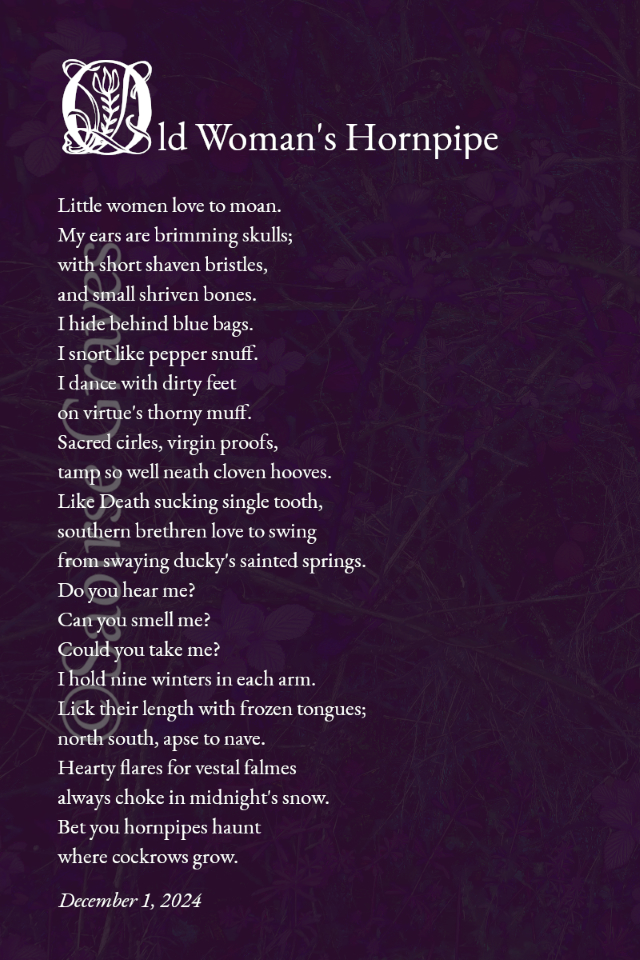
To that effect, I have begun to explore this sort of thing in poetry and so on… and, as is often the case, making the link with other media, like music:
Usually, I’m thinking of many different tunes even if explicitly making reference only to one. Here are some other bits and bobs that have been floating around my head of late:
So far as I can tell, the lyrics are approximately as follows:
LAL LAL ARS’ A’ CHAILLEACH**
(chorus) Lal lal, lal lal, lal lal, ars’ a’ chailleach,
Lal lal, lal lal, lal lal, ars’ a’ chailleach,
Lal lal, lal lal, lal lal, ars’ a’ chailleach,
Ith am bò, thogaidh ò, ith am bò, ars’ am bodach.Am pòs thu fhéin, am pòs thu fhéin, am pòs thu fhéin, ars’ a’ chailleach,
Am pòs thu fhéin, am pòs thu fhéin, am pòs thu fhéin, ars’ a’ chailleach,
Am pòs thu fhéin, am pòs thu fhéin, am pòs thu fhéin, ars’ a’ chailleach,
Pòsaidh mi, pòsaidh mi, pòsaidh mi, ars’ am bodach.Có an tè, có an tè, có an tè, ars’ a’ chailleach,
Có an tè, có an tè, có an tè, ars’ a’ chailleach,
Có an tè, có an tè, có an tè, ars’ a’ chailleach,
Tha thu fhéin, tha thu fhéin, tha thu fhéin, ars’ am bodach.Cuin a thig thu, cuin a thig thu, cuin a thig thu, ars’ a’ chailleach,
Cuin a thig thu, cuin a thig thu, cuin a thig thu, ars’ a’ chailleach,
Cuin a thig thu, cuin a thig thu, cuin a thig thu, ars’ a’ chailleach,
As a’ mhionaid, as a’ mhionaid, as a’ mhionaid, ars’ am bodach.LAL LAL SAID THE OLD WOMAN
Lal lal, lal lal, lal lal, said the old woman
Eat the cow, you will raise, eat the cow, said the old man.Will you marry yourself, will you marry yourself, will you marry yourself, said the old woman…
I will marry, I will marry, I will marry, said the old manWho’s she, who’s she, who’s she, said the old woman…
You are yourself, you are yourself, you are yourself, said the old manWhen will you come, when will you come, when will you come, said the old woman…
In a minute, in a minute, in a minute, said the old man.
And here is a lovely live version of the same tune, sung with Julie Fowlis and Muireann Nic Amhlaoibh! Look at them giggling at the lyrics!
It should be noted that my Irish is terrible but my Scottish Gaelic is non-existent.*** I’m wondering if the ‘rise/lift’ in “thogaidh ò” might have a double meaning in this context? Also, as far as I can tell, it’s possible the reflexive pronoun (“fhéin”) serves a similar function to the corresponding word in Irish – as an intensifier or for emphasis, as in “selfsame”. So “tha thu fhéin” is likely to translate more like “You yourself!” etc. Lastly, “co an tè” translates more literally as “who’s the one?” except that “tè” means ‘one’ in a female or feminine context. It reminds me of “who’s your one” (or “yer wan”) here in Ireland to ask “who’s that” with reference to women… but I’m only assuming there’s a link.
Finally, musically speaking, I want to end on a note that packs a more magical and otherworldly punch to these themes I’m exploring. It should be no surprise that, as a devotee of the Morrígan (UPG), I appreciate a good ‘otherworldly woman pursues mortal man’ narrative. Whether she’s rejected or not, it’s an appealing vehicle for commentary!
The lyrics for Sir Mannelig**** are as follows:
Swedish
Bittida en morgon innan solen upprann
Innan foglarna började sjunga
Bergatrollet friade till fager ungersven
Hon hade en falskeliger tungaHerr Mannelig Herr Mannelig trolofven I mig
För det jag bjuder så gerna
I kunnen väl svara endast ja eller nej
Om I viljen eller ej.Eder vill jag gifva de gångare tolf
Som gå uti rosendelunde
Aldrig har det varit någon sadel uppå dem
Ej heller betsel uti munnenEder vill jag gifva de qvarnarna tolf
Som stå mellan Tillö och Ternö
Stenarna de äro af rödaste gull
Och hjulen silfverbeslagnaEder vill jag gifva ett förgyllande svärd
Som klingar utaf femton guldringar
Och strida huru I strida vill
Stridsplatsen skolen I väl vinnaEder vill jag gifva en skjorta så ny
Den bästa I lysten att slita
Inte är hon sömnad av nål eller trå
Men virkat av silket det hvitaSådana gåfvor jag toge väl emot
Om du vore en kristelig qvinna
Men nu så är du det värsta bergatroll
Af Neckens och djävulens stämmaBergatrollet ut på dörren sprang
Hon rister och jämrar sig svåra
Hade jag fått den fager ungersven
Så hade jag mistat min plågaEnglish
Early one morning before the sun rose up
Before the birds began to sing
The mountain troll proposed to the handsome young man
She had a false tongueHerr Mannelig, herr Mannelig, will you be betrothed to me?
For that, I offer you gifts very gladly
Surely you can answer only yes or no
If you wish to or not.To you I wish to give the twelve horses [palfreys]
That go in the grove of roses
Never has there been a saddle upon them
Nor a bridle in their mouthsTo you I wish to give the twelve mills
That are between Tillö and Ternö
The stones are made of the reddest gold
And the wheels are covered in silverTo you I wish to give a gilded sword
That chimes of fifteen gold rings
And fight however you fight [well or badly]
The battle site you would surely winTo you I wish to give a shirt so new
The best you will want to wear
It was not sewn with needle or thread
But worked of white silkSuch gifts I would surely accept
If thou wert a Christian woman
However, thou art the worst mountain troll
The spawn of the Neck and the DevilThe mountain troll ran out the door
She shakes and wails hard
If I had got the handsome young man
I would have got rid of my plight
The narrative structure here bears a lot of similarity to an old favourite of mine, “The Loathly Lady” … a version of which is called “King Henry” by Steeleye Span. Steeleye Span also sings a version of “Allison Gross” and so on. There are many traditional variations on the theme of promising/demanding gifts and goods. Sometimes it’s in the hopes of lifting a curse, other times in bestowing one, all of which can occur with or without ‘conjugal felicities’ at the end.
I feel especially drawn towards wondering about “between states” though… so much of the media available to us either focuses almost entirely on young women (with what is subjectively for me an uncomfortable current trend towards childlike china-doll makeup styles) or much older fully grey women (if any older women at all). What about the process of *becoming*? Neither young nor old but anything and everything in between? Are we not shapeshifters?
Aren’t these divisions all rather broadly brushed in the end? Who does ‘maiden, mother, crone’ apply to anyway… I’m not aware of there being a straightforward “maiden” component to the Morrígan, for example, and I think her “motherhood”-relevant narratives are deeply complicated. Ultimately – at least from my lived perspective and my own religious Unverified Personal Gnosis – that’s not really a paradigm that illuminates much. Aging is interesting but dividing it according to sexual reproductive function as a marker of social development and value? …Perhaps only with biting sarcasm. At best it’s one variable with rather limited pre-conditions.
Hence the reference to my current age in the poem.
Sincerely,
Saoirse.
* This Baltimore Consort recording seems to be the only one I can find of this tune. Incidentally, I did have this album growing up and I have mixed feelings about it. For example, the vocalist is American and she mispronounces “cailín” in “Pretty Maid Milking Her Cow” at one point…
** Here’s some info on Rona Lightfoot! ~ https://projects.handsupfortrad.scot/hall-of-fame/rona-lightfoot/
*** I’m really thrown by Scottish accent marks. I’m used to Irish having only the fada!
**** Erik Ask-Upmark is as well known Swedish folk musician and performer of various traditional and historical nordic music. His main musical groups are Dråm, Svanevit, and Falsobordone. I have had the great privilege of meeting him as well as hearing him lecture and perform (including Sir Mannelig!) Also, here is the wiki article for Herr Mannelig ~ https://en.wikipedia.org/wiki/Herr_Mannelig
The header image is a Portrait of Christina of Denmark (incidentally ca. 36-37 years old :P), Duchess of Milan and of Lorraine, dated 1558, by François Clouet … There is another more famous Holbein portait of Cristina done when she was as teen widow.
PLEASE NOTE ~ I didn’t do a great job of diversifying my language in this post. It may come across as specific to cis-gendered female experiences but I want it to be clear that I think these pressures apply to all genders… and to the extent that the cis-gendered experience differs from others, I see that mainly as part of the over-arching problem of external – often valueless – pressures.