It’s great how things come together sometimes. When a combination of planning plus serendipity collides to make something really *work*, it’s deeply gratifying. That’s how Lá Bealtaine was this year.
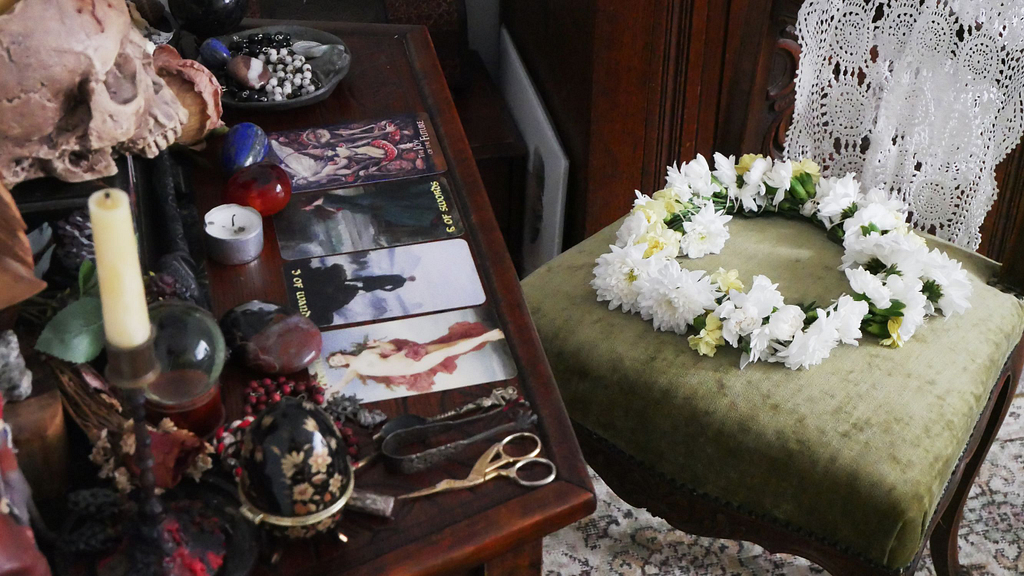
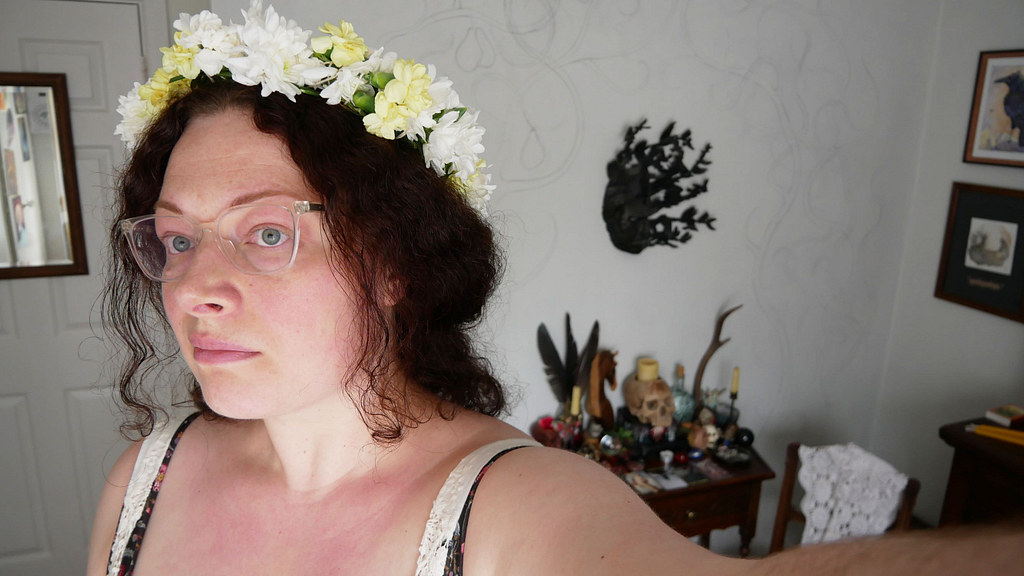
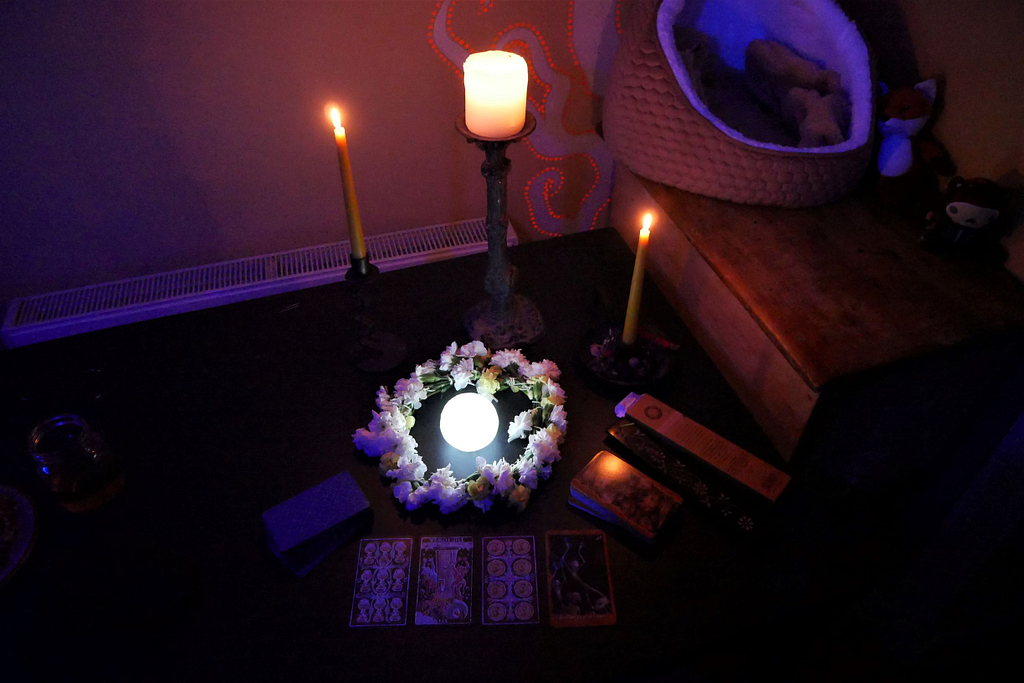
First in the new house. It is my habit most years to make a flower crown in May Day colours (yellow and white) for the day itself and then dry it out and hang it on my wall somewhere. The number of crowns grows as the years pass. Intentionally, however, I did not bring any of the flower crowns from the old apartment into the new house. So this year, the first crown has now officially been made, used in art, used in collective spellwork, and is drying in preparation to take it’s place on a fresh new wall.
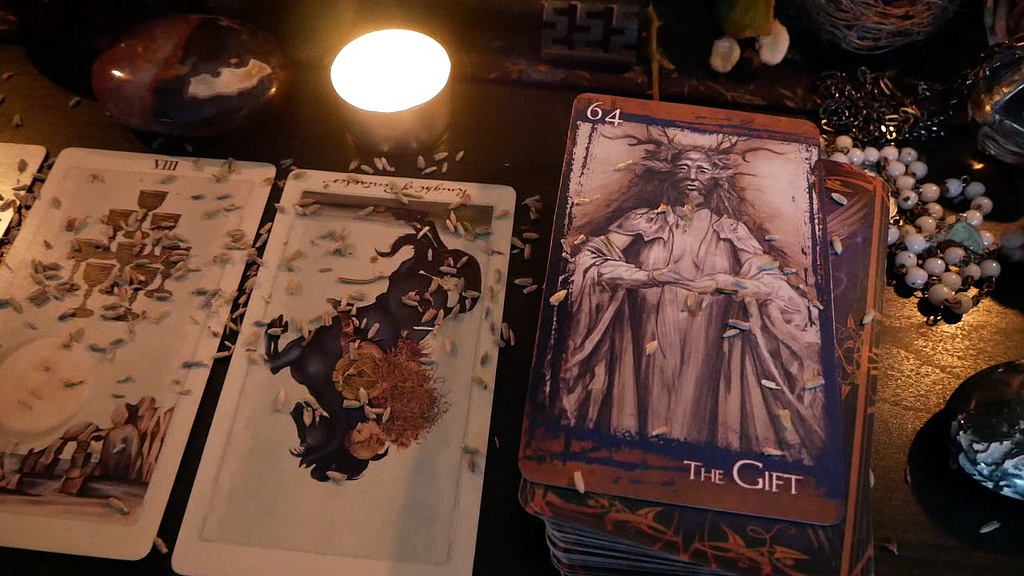
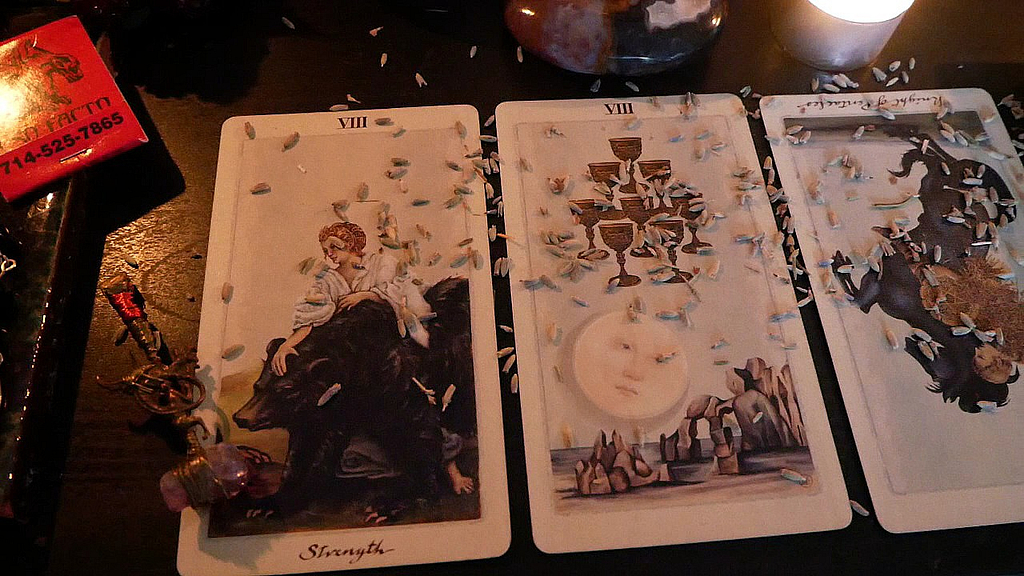
That “Joy of the Future” card from the Heart of the Faeries Oracle is proving HILARIOUSLY CHALLENGING!!! Da fuq!?
I have been going through a really…interesting… time lately with old baggage and insecurity. It’s a good thing I’m a witch who knows how to eat their old skins. I’ve been reading the cards (and asking friends) repeated questions over and over, from different angles… really trying to go the distance with a few snags in the ball of twine that is my life. Pull on one thing, find it loops back to a shadow wiggling behind you, journal about it, cry about it (a LOT), feel it begin to process, rinse, repeat. I am aware that having the good fortune to finally feel safe in my living environment has provided the perfect setting for this kind of work – it’s in the safety and quiet that you finally realise… it’s just you now, bitch. Do you even KNOW how to be happy!?
The answer is yes…or more accurately, that I can learn. If there’s one thing I KNOW I’m good at, it’s learning…and beginning to learn… and beginning to begin.
So May Day. Full moon. Time to let some shit go. Also the first day of my period such as it exists. Other than emotional dysregulation (grrrreat), my chief symptom is swelling… waxing full and round just like the fucking moon. Good for shadow work though. And I guess it means I’m sloughing more than just metaphors…
I went a bit quiet in the days preceding. Journaling, reading cards, squirming at the answers, and resting. Then May Day came and despite the swelling, I wore all cream and white. All handmade. Two petticoats with lace trim. A handmade corded bust support based on the top half of the famous Symington “Pretty Housemaid” pattern. A corset cover inspired camisole made from the same wide lace trim that’s gathered into the hem of one of my petticoats. I had intentionally left my hair unwashed (but *not* uncleaned or untended) for over a month (May Day was day 35) and my roots were growing in like crazy (half an inch in a single month! weee!!!). Then I attended Mixtress Rae’s radio show to dance with my shadows and expel evil. I took part in a planned collective spell she lead during the show – 5 people working the spell including me, I think… across 3 continents. She followed up the spell with Kate Bush’s “Get Out of My House” which was very cathartic and effective.
I kid you not, that Faeries Oracle card is “A Collective of Pixies” which was not only perfect for the show, for dancing, and for May Day but ALSO for the precise thing I’ve been asking the cards over and over again. For those of you who own the deck, go read the guid book entry for that card!!!
I took all of this very seriously (amidst the joy of dancing and so on). I mulled my readings over and did follow up readings through the course of the weekend. I also finally fully washed and re-henna’d my hair. I haven’t used shampoo or conditioner in 3 years… or anything soap-like on my hair in 2.5 years… what I use varies a little but it’s mainly a hand-prepared clay mixture followed by a diluted vinegar wash about once a month at the moment. I like that I have to pay attention to it. I followed this up with some ‘home-spa’ style care. It was good. Medicinal. Needed.
“One morning, one morning, one morning in May, I saw a young lady all wrapped in white linen. All wrapped in white linen and cold as the clay.”
I’m not done processing things, of course. Who is? Ever? But this is ultimately what witchcraft is about for me… I’m grateful to have it. None of it’s my first rodeo but *that* feels pretty fucking cool!
As with so many things, a simple mental association double checked through the lens of a ‘quick Google’ yields a seriously mind-boggling rabbit hole. This blog post serves as a contextual supplement to this video:
I have had the topic of names on my mind for a long time. Anyone who plays traditional music will know that the name of any given tune is, shall we say, flexible. The way in which a lot of trad music works is that any given player or performer and certainly the more reputable recording artists will cite who’s version of a tune they play, where they have introduced changes, and will often also indicate if their own regional style has affected their playing or not, etc. A living folk tradition needs both that kind of flexibility as well as that kind of connectivity and accountability.
Recently, I decided to approximate a version of Shady Grove, pilfering most of my style and technique from this OLD video by “Gretchenman” (just look at his fingers fly!!!):
In doing so, I did a quick search online to refresh my memory about the lyrics (because I do sing along sometimes when I play) and check in on some basic background information on the song. Shady Grove (Roud 4456) is mostly considered an Appalachian tune [1,2] and there is a possible link with the English/Scottish tune Matty Groves (Roud 52; a famous version of which was recorded by Fairport Convention, for example) [3]. The two songs share the same melody and the fact that one is a murder ballad and the other a song in which a woman’s name has seemingly toponymic qualities interested me from a personal gnosis perspective. Drawing wild and highly metaphorical connections in my own head, I liked the familiarity of something that sounds like a place having an almost euhemerised quality… certainly Ireland abounds with such locations and its medieval literature/mythology has whole genres and stories centered on naming places after people and people after places, or just blending the two entirely.
Now, I’m NOT claiming that there is any such analogy to be drawn in historically viable or collectively verified ontological* terms. It’s just a fun poetic exercise. Creative license, as it were.
However! The rabbit hole referred to earlier drew me from link to link: first investigating the lyrical content of Shady Grove; then to it’s Roud Index Number and associated articles about the development of the song over time (including various collections in which it is annotated as well as different known recordings of it); then to re-acquainting myself with some of the basics on Cecil Sharp (because it’s been a while). Lo and behold… I forgot a) about his nationalism and the troubled legacy of his methodology in seeking out ‘Englishness’ in music, especially in Southern Appalachia [5] but also b) that he was in other ways influenced by William Morris’ socialist lectures and …potentially also approached his work through the lens of spiritualism at some point!? 🤯
This last bit seems totally unclear to me and I am finding it hard to validate until I can actually access some of the academic articles I’ve found online [6]. (This is where I am REALLY happy to have a free external reader’s card with UCC Library…ah, the perks of living in a Uni town!) But in scrolling through the Roud listings on Matty Grove, I saw they had an entry in Sharp’s diary from the 29th of August, 1916 in which he makes use of the word “séance”.
It’s strikes me that it’s possible this word has some other meanings or context of which I am not aware (I yielded no obvious or immediate answers from a quick search online) but it would seem there are a few articles out there at least that might make this clear once I’ve had a chance to read them. In theory, it doesn’t strike me as too unreasonable because this IS a time period in which a lot of academia (especially those with nationalist or otherwise politicised interest in folk movements) drift in and out of spiritualist circles and ‘methods’ of inquiry**.
I am not sure how all of that will go yet but I also hope to read a few more recent assessments of the problems in Sharp’s legacy.
Magickally, one of the things I am doing in playing such a tune (in which I usually face my altar, by the way) is reshaping identity. Drawing creative connections on the euhemerization of names, of nouns as names/names as nouns, and asking questions of my own anthropopathism and ‘pathetic fallacy’***.
At this point, the choice to play “Flatlands” by Chelsea Wolfe and Mark Lanegan over the first part of my video should begin to make added sense.
It all comes back around to walking the razor edge between what seems appealing as a creative or metaphorical idea and what is actually academically and historically viable work. We have to be okay with their inherent dissonance. You might even call it… an art.
* Here I am using the philosphical defintion of ‘ontological’ rather than the metaphysical one!
** Giving the Golden Dawn, Theosophists, and soooo many 19th and early-20th century artists and thinkers bombastic side-eye. Criminal offensive side-eye.
*** Oop! Hello, Ruskin!
§ 9. And thus, in full, there are four classes: the men who feel nothing, and therefore see truly; the men who feel strongly, think weakly, and see untruly (second order of poets); the men who feel strongly, think strongly, and see truly (first order of poets); and the men who, strong as human creatures can be, are yet submitted to influences stronger than they, and see in a sort untruly, because what they see is inconceivably above them. This last is the usual condition of prophetic inspiration.
§ 10. I separate these classes, in order that their character may be clearly understood; but of course they are united each to the other by imperceptible transitions, and the same mind, according to the influences to which it is subjected, passes at different times into the various states. Still, the difference between the great and less man is, on the whole, chiefly in this point of ‘alterability‘. […]
§ 11. Now so long as we see that the ‘feeling‘ is true, we pardon, or are even pleased by, the confessed fallacy of sight which it induces: we are pleased, for instance, with those lines of Kingsley’s, above quoted, not because they fallaciously describe foam, but because they faithfully describe sorrow. [7]
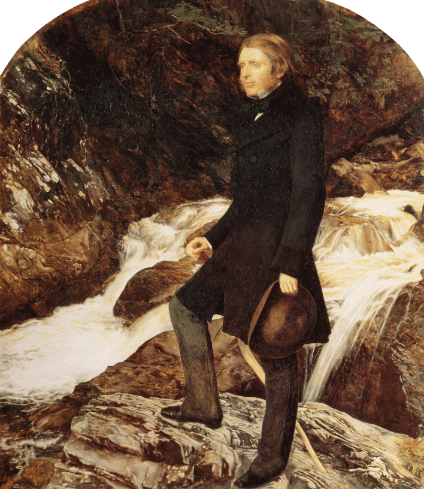
John Ruskin at Glen Finglas by John Everett Millais, 1853-1854 (Public Domain)
(1) Shady Grove (Roud 4456), Mainly Norfolk: English Folk and Other Good Music, mainlynorfolk.info/folk/songs/shadygrove.html. Accessed 6 Feb. 2024.
(2) “Vaughan Williams Memorial Library: Shady Grove.” English Folk Dance & Song Society, http://www.vwml.org/search?q=Shady%20Grove&is=1. Accessed 6 Feb. 2024. (Of note, the English Folk Dance & Song Society owns the Cecil Sharp House.)
(3) Spiegel, Max. “Origins: ‘shady Grove’ a Mondegreen ?” The Mudcat Cafe, mudcat.org/thread.cfm?threadid=131461. Accessed 6 Feb. 2024. (“Mondegreen” is my new favourite word now. Story of my hearing impaired life!)
(5) “Cecil Sharp.” Wikipedia, Wikimedia Foundation, 26 Jan. 2024, en.wikipedia.org/wiki/Cecil_Sharp#Political_Views. (Yes, its Wikipedia ~ but the citations at the bottom of the article look like they’re worth exploring.)
(7) Ruskin, John. “Of the Pathetic Fallacy from ‘modern Painters’ (Volume III, Pt. 4, 1856) by John Ruskin.” The Pathetic Fallacy, Ruskin (1856), http://www.ourcivilisation.com/smartboard/shop/ruskinj/index.htm. Accessed 6 Feb. 2024. (I have no interest or affiliation with the author of this site as a whole, this link is simply where I have accessed an online free readable copy of Ruskin’s writings on the Pathetic Fallacy.)