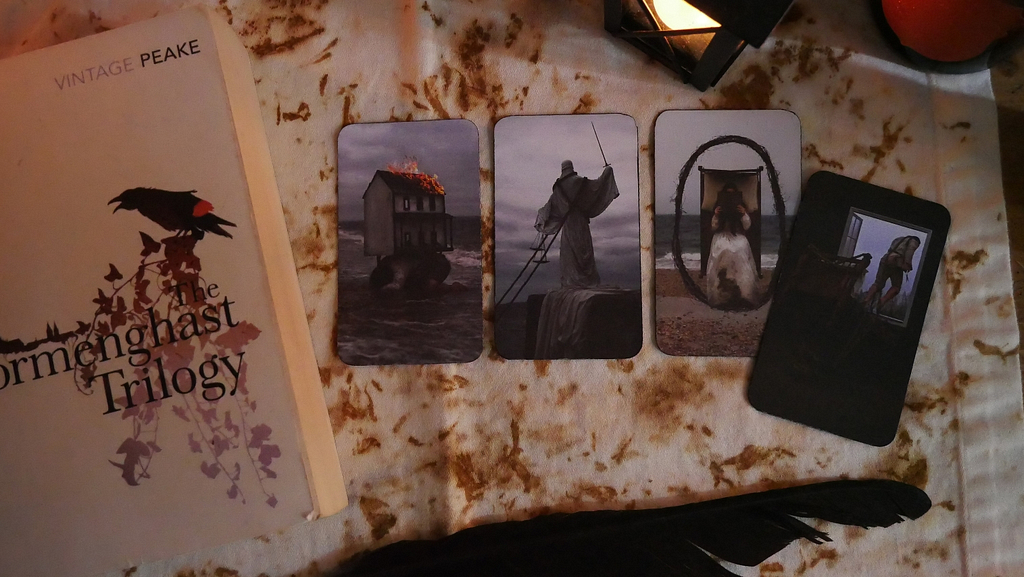
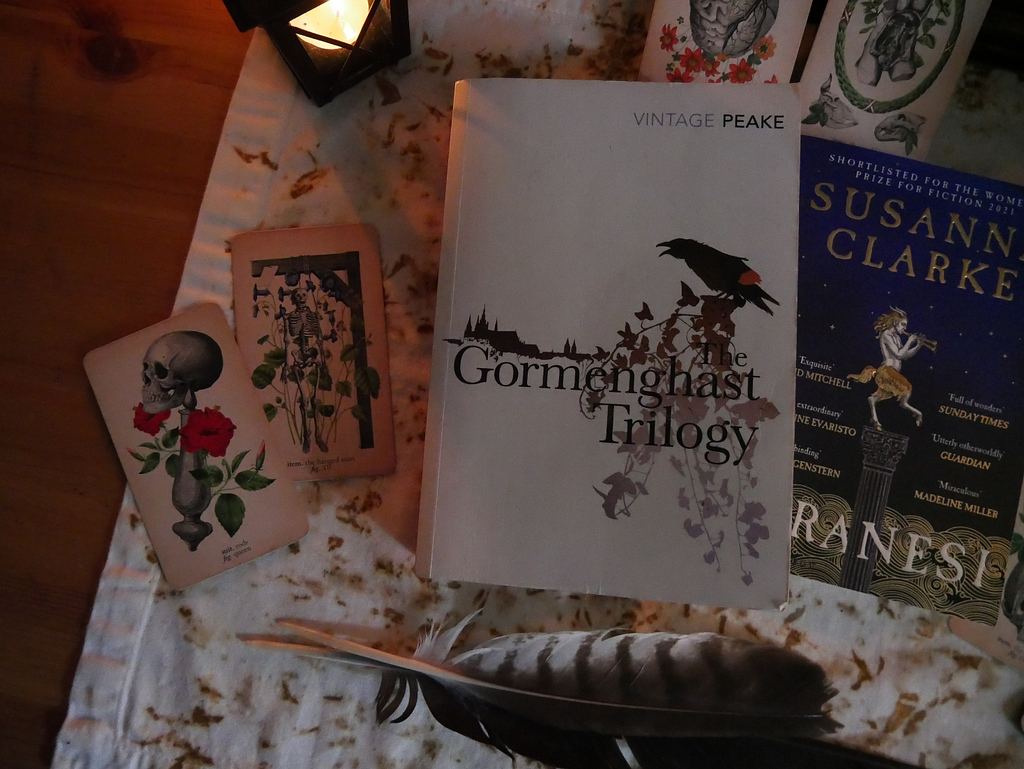
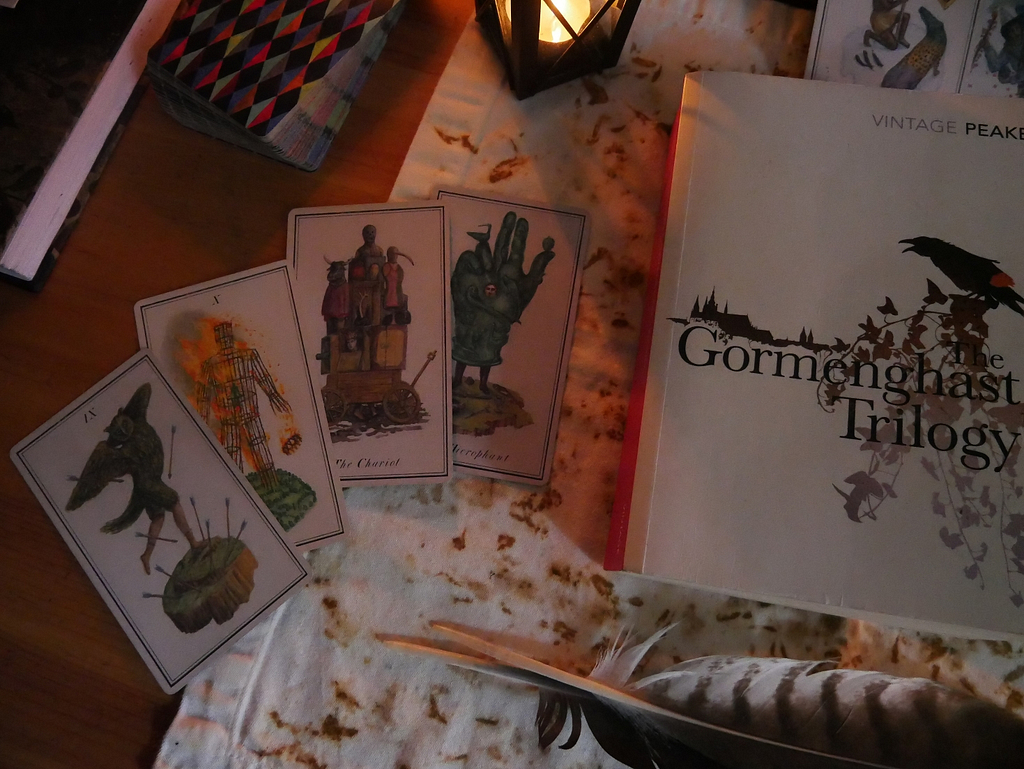
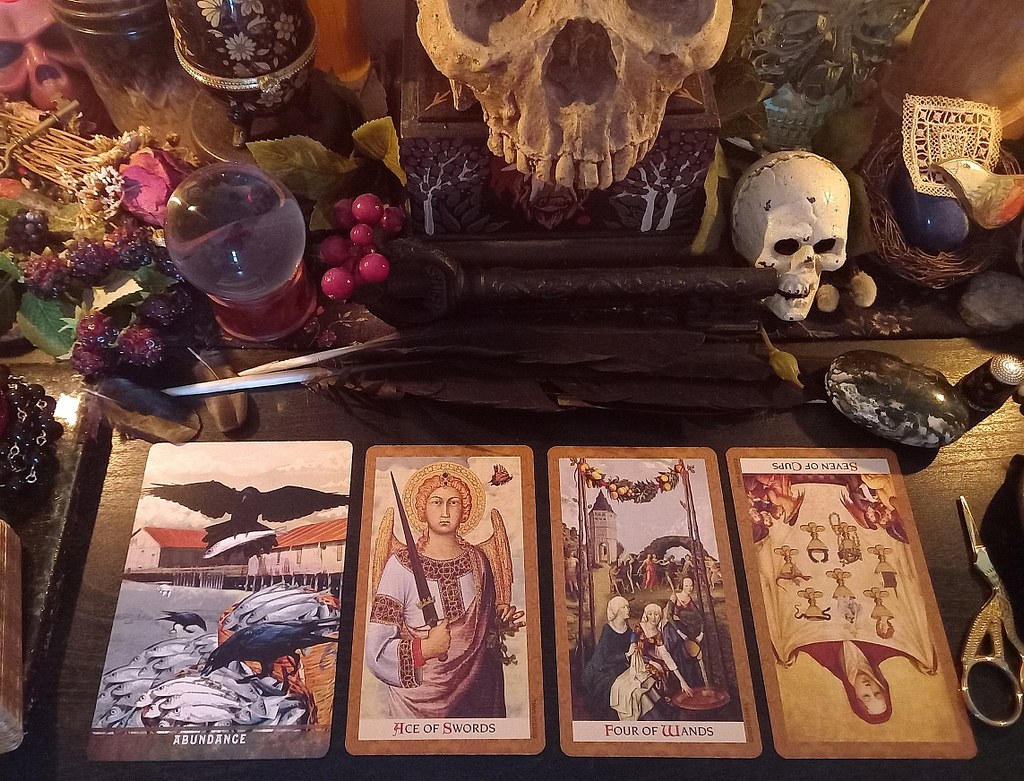
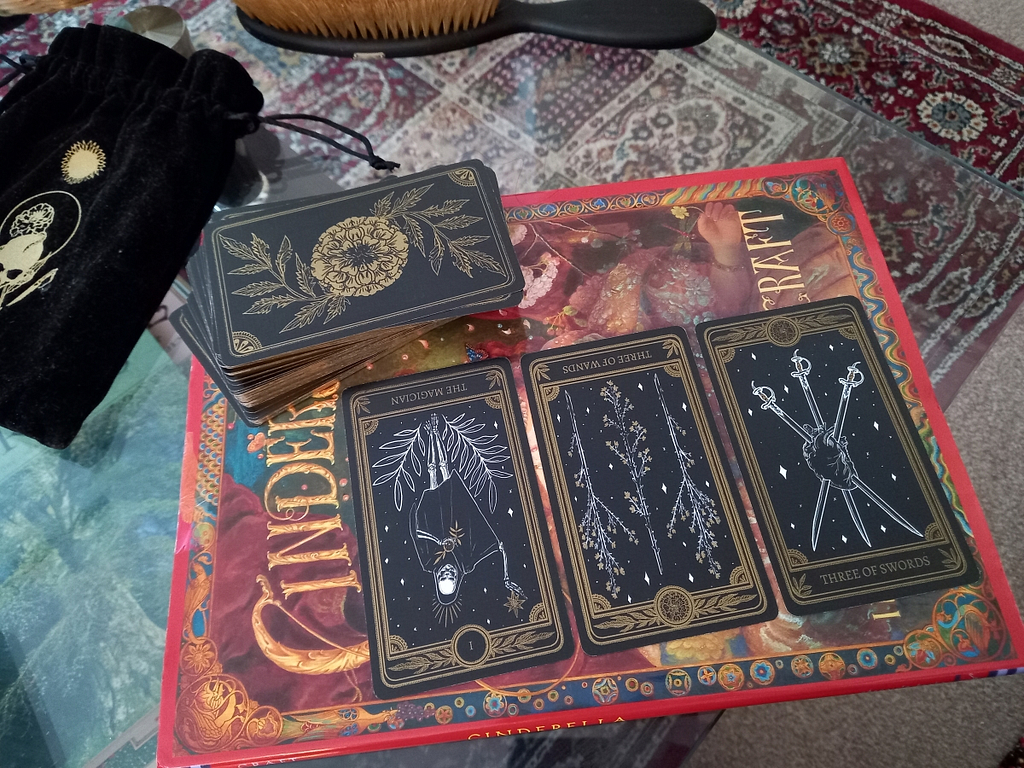
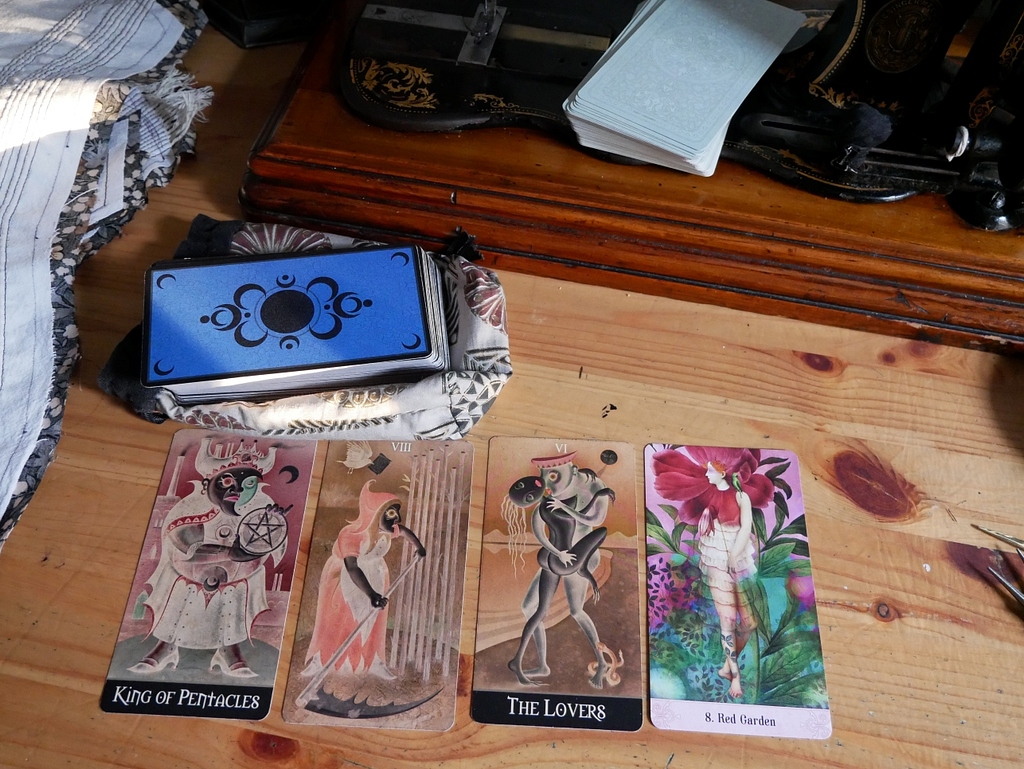
A selection of (some) favourite quotations – read or re-read in the last calendar year.
“One of the blotches of reflected sunlight swayed to and fro across the paunch. This particular pool of light moving in a mesmeric manner backwards and forwards picked out from time to time a long red island of spilt wine. It seemed to leap forward from the mottled cloth when the light fastened upon it in startling contrast to the chiaroscuro and to defy laws of tone. This ungarnished sign of Swelter’s debauche, taking the swollen curve of linen, had somehow, to Mr Flay’s surprise, a fascination. For a minute he watched it appear, and disappear to reappear again – a lozenge of crimson, as the body behind it swayed.”
(Peake, Mervyn. “Swelter.” Titus Groan, Gormenghast Trilogy.)
“She tossed her long hair and it flapped down her back like a pirate’s flag. She stood in about as awkward a manner as could be conceived. Utterly un-feminine – no man could have invented it.”
(Peake, Mervyn. “Fuschia.” Titus Groan, Gormenghast Trilogy.)
“Once, long ago, traveling among the marbles of Rome and Florence, he had seen women like this, kept in stone instead of ice. Once, wandering in the Louvre, he had found women like this, washed in summer color and kept in paint. Once, as a boy, sneaking the cool grottos behind a motion picture theater screen, on his way to a free seat, he had glanced up and there towering and flooding the haunted dark seen a woman’s face as he had never seen it since, of such size and beauty built of milk-bone and moon-flesh as to freeze him there alone behind the stage, shadowed by the motion of her lips, the bird-wing flicker of her eyes, the snow-pale-death-shimmering illumination from her cheeks.
So from other years there jumped forth images which flowed and found new substance here within the ice.
What color was her hair? It was blond to whiteness and might take any color, once set free of cold.
How tall was she?
The prism of the ice might well multiply her size or diminish her as you moved this way or that before the empty store, the window, the night-soft rap-tapping ever-fingering gently probing moths.
Not important.
Far above all – the lightning rod salesman shivered – he knew the most extraordinary thing.
If by some miracle her eyelids should open within that sapphire and she should look at him, he knew what color her eyes would be.
He knew what color her eyes would be.”
(Bradbury, Ray. Something Wicked This Way Comes)
“But what word shall I speak?”, asked the Lady Amalthea. “I have said nothing to him, yet every day he comes to me with more heads, more horns and hides and tails, more enchanted jewels and bewitched weapons. What will he do if I speak?” […]
“No, he does not want my thoughts,” she said softly. “He wants me, as much as the Red Bull did, and with no more understanding. But he frightens me even more than the Red Bull, because he has a kind heart. No, I will never speak a promising word to him.”
The pale mark on her brow was invisible in the gloom of the scullery. She touched it and then drew her hand away quickly, as though the mark hurt her. “The Horse died,” she said to the little cat. “I could do nothing.”
(Beagle, Peter S. The Last Unicorn)
“Bioy Cesares had had dinner with me that evening and we became lengthily engaged in a vast polemic concerning the composition of a novel in the first person, whose narrator would omit or disfigure the facts and indulge in various contradictions which would permit a few readers – very few readers – to perceive an atrocious or banal reality. From the remote depths of the corridor, the mirror spied upon us.
(Borges, Jorge Luis. “Tlön, Uqbar, Orbis Tertius”. Labyrinths.)
I have collected these quotations here in the same manner in which one writes quotations down in a notebook or journal. I want to look at them from time to time… and turn some things over in my head. I hope to make a modest series of quotations arranged each around a theme… ideally, with as little explanation as possible.
So to close, another quotation from The Last Unicorn:
“One eye opened slowly, green and gold as sunlight in the woods. The cat said, “I am what I am. I would tell you what you want to know if I could, for you have been kind to me. But I am a cat, and no cat anywhere ever gave anyone a straight answer.”
Sincerely,
Saoirse.
The header image (in public domain) is a study of Jane Morris for ‘Dante’s Dream’ by Dante Gabriel Rosetti. A bit on the nose, perhaps, with all the Beatrices, Pygmalions, (and even ‘My Fair Lady’s’) being tossed around… The word “gauche” is used above. I will invoke it again here.
Get ready for a spat of unstructured posts. As I have said over on my youtube channel, I’m going to prioritise posting less formalised content for a little while. Honestly, everything about my online presence should be approached like that anwyay so this shouldn’t present much difficulty!
Recently, I have been talking to various people in my life about what we expect and value out of friendship (short and long term). We’ve been talking about aging, about appearances, about performance and body horror, and about external pressures and standards… narratives around expectations and control… and just how many people want to see themselves mirrored in others to the point of trying to force others to reflect what they want to see about themselves. It’s a pain to be fascinating to anyone, it seems. But it’s also a pain to be fascinating to no one. In a lot of cases, both result in people telling you what to be and how to be it the way THEY want…
I assume I’m not alone in feeling these pressures or in seeing how they clash with my expectations for healthy relationships. I don’t really think any age group is immune from them but as I get older I allow myself the liberty I always wanted to toy with these expectations. I love glamour magick and, sure, some of that can be maligned as shallow aesthetics and ‘playing dress up’ (if one is inclined to see such things as negative) but I love to subvert those narratives with accents of rebellion. Flowing gown? Sure. But add confronting skull earrings or drape silver bones around your neck. Velvets, sultry necklines, cute little glistening moonstone jewels, and makeup? Fine. But my lips and eyebrows might be painted “frostbite” blue.
Heck, the number of people who are thrown off by a black frock and tattoos is hilarious so it’s not like it takes much.
People can look and project, but *I* like to make the acknowledgement of death and decay a non-negotiable component of what they’re taking in. I don’t really care what their conclusions are, per se, but *I’m* not going to subvert these elements for their comfort.
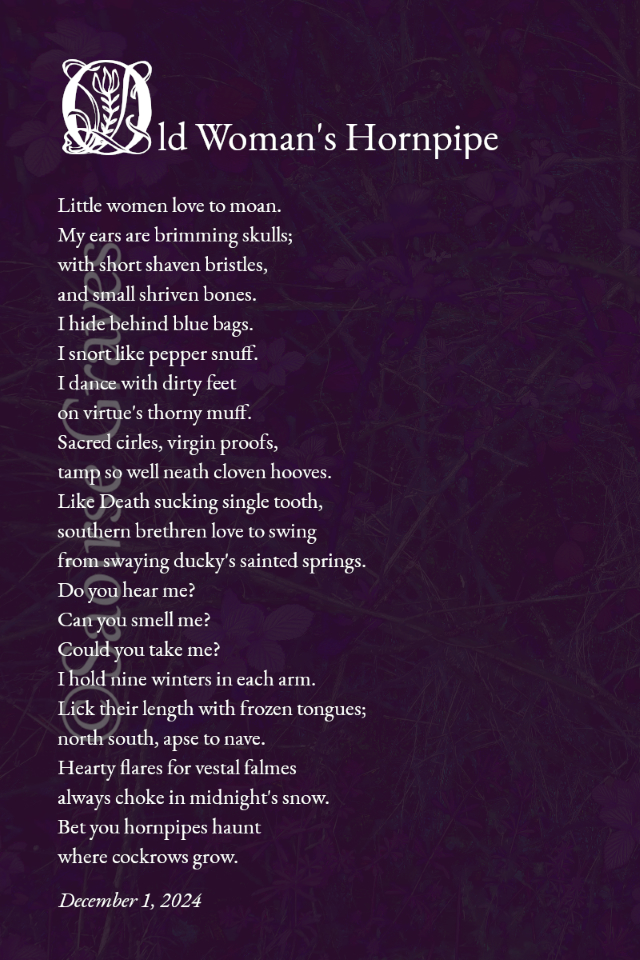
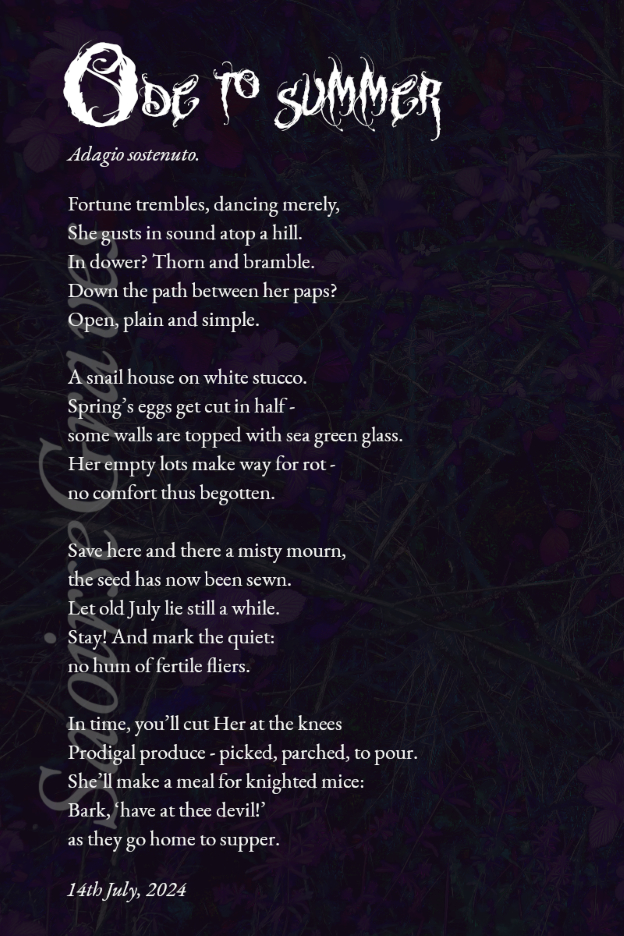
To that effect, I have begun to explore this sort of thing in poetry and so on… and, as is often the case, making the link with other media, like music:
You will note the music reference in the title*. Also, for those who are not aware, a hornpipe is a type of Irish dance tune in 4/4 time. It is also intended in this poem to have a double meaning.
Usually, I’m thinking of many different tunes even if explicitly making reference only to one. Here are some other bits and bobs that have been floating around my head of late:
So far as I can tell, the lyrics are approximately as follows:
LAL LAL ARS’ A’ CHAILLEACH** (chorus) Lal lal, lal lal, lal lal, ars’ a’ chailleach, Lal lal, lal lal, lal lal, ars’ a’ chailleach, Lal lal, lal lal, lal lal, ars’ a’ chailleach, Ith am bò, thogaidh ò, ith am bò, ars’ am bodach.
Am pòs thu fhéin, am pòs thu fhéin, am pòs thu fhéin, ars’ a’ chailleach, Am pòs thu fhéin, am pòs thu fhéin, am pòs thu fhéin, ars’ a’ chailleach, Am pòs thu fhéin, am pòs thu fhéin, am pòs thu fhéin, ars’ a’ chailleach, Pòsaidh mi, pòsaidh mi, pòsaidh mi, ars’ am bodach.
Có an tè, có an tè, có an tè, ars’ a’ chailleach, Có an tè, có an tè, có an tè, ars’ a’ chailleach, Có an tè, có an tè, có an tè, ars’ a’ chailleach, Tha thu fhéin, tha thu fhéin, tha thu fhéin, ars’ am bodach.
Cuin a thig thu, cuin a thig thu, cuin a thig thu, ars’ a’ chailleach, Cuin a thig thu, cuin a thig thu, cuin a thig thu, ars’ a’ chailleach, Cuin a thig thu, cuin a thig thu, cuin a thig thu, ars’ a’ chailleach, As a’ mhionaid, as a’ mhionaid, as a’ mhionaid, ars’ am bodach.
LAL LAL SAID THE OLD WOMAN Lal lal, lal lal, lal lal, said the old woman Eat the cow, you will raise, eat the cow, said the old man.
Will you marry yourself, will you marry yourself, will you marry yourself, said the old woman… I will marry, I will marry, I will marry, said the old man
Who’s she, who’s she, who’s she, said the old woman… You are yourself, you are yourself, you are yourself, said the old man
When will you come, when will you come, when will you come, said the old woman… In a minute, in a minute, in a minute, said the old man.
And here is a lovely live version of the same tune, sung with Julie Fowlis and Muireann Nic Amhlaoibh! Look at them giggling at the lyrics!
It should be noted that my Irish is terrible but my Scottish Gaelic is non-existent.*** I’m wondering if the ‘rise/lift’ in “thogaidh ò” might have a double meaning in this context? Also, as far as I can tell, it’s possible the reflexive pronoun (“fhéin”) serves a similar function to the corresponding word in Irish – as an intensifier or for emphasis, as in “selfsame”. So “tha thu fhéin” is likely to translate more like “You yourself!” etc. Lastly, “co an tè” translates more literally as “who’s the one?” except that “tè” means ‘one’ in a female or feminine context. It reminds me of “who’s your one” (or “yer wan”) here in Ireland to ask “who’s that” with reference to women… but I’m only assuming there’s a link.
Finally, musically speaking, I want to end on a note that packs a more magical and otherworldly punch to these themes I’m exploring. It should be no surprise that, as a devotee of the Morrígan (UPG), I appreciate a good ‘otherworldly woman pursues mortal man’ narrative. Whether she’s rejected or not, it’s an appealing vehicle for commentary!
The lyrics for Sir Mannelig**** are as follows:
Swedish
Bittida en morgon innan solen upprann Innan foglarna började sjunga Bergatrollet friade till fager ungersven Hon hade en falskeliger tunga
Herr Mannelig Herr Mannelig trolofven I mig För det jag bjuder så gerna I kunnen väl svara endast ja eller nej Om I viljen eller ej.
Eder vill jag gifva de gångare tolf Som gå uti rosendelunde Aldrig har det varit någon sadel uppå dem Ej heller betsel uti munnen
Eder vill jag gifva de qvarnarna tolf Som stå mellan Tillö och Ternö Stenarna de äro af rödaste gull Och hjulen silfverbeslagna
Eder vill jag gifva ett förgyllande svärd Som klingar utaf femton guldringar Och strida huru I strida vill Stridsplatsen skolen I väl vinna
Eder vill jag gifva en skjorta så ny Den bästa I lysten att slita Inte är hon sömnad av nål eller trå Men virkat av silket det hvita
Sådana gåfvor jag toge väl emot Om du vore en kristelig qvinna Men nu så är du det värsta bergatroll Af Neckens och djävulens stämma
Bergatrollet ut på dörren sprang Hon rister och jämrar sig svåra Hade jag fått den fager ungersven Så hade jag mistat min plåga
English
Early one morning before the sun rose up Before the birds began to sing The mountain troll proposed to the handsome young man She had a false tongue
Herr Mannelig, herr Mannelig, will you be betrothed to me? For that, I offer you gifts very gladly Surely you can answer only yes or no If you wish to or not.
To you I wish to give the twelve horses [palfreys] That go in the grove of roses Never has there been a saddle upon them Nor a bridle in their mouths
To you I wish to give the twelve mills That are between Tillö and Ternö The stones are made of the reddest gold And the wheels are covered in silver
To you I wish to give a gilded sword That chimes of fifteen gold rings And fight however you fight [well or badly] The battle site you would surely win
To you I wish to give a shirt so new The best you will want to wear It was not sewn with needle or thread But worked of white silk
Such gifts I would surely accept If thou wert a Christian woman However, thou art the worst mountain troll The spawn of the Neck and the Devil
The mountain troll ran out the door She shakes and wails hard If I had got the handsome young man I would have got rid of my plight
The narrative structure here bears a lot of similarity to an old favourite of mine, “The Loathly Lady” … a version of which is called “King Henry” by Steeleye Span. Steeleye Span also sings a version of “Allison Gross” and so on. There are many traditional variations on the theme of promising/demanding gifts and goods. Sometimes it’s in the hopes of lifting a curse, other times in bestowing one, all of which can occur with or without ‘conjugal felicities’ at the end.
I feel especially drawn towards wondering about “between states” though… so much of the media available to us either focuses almost entirely on young women (with what is subjectively for me an uncomfortable current trend towards childlike china-doll makeup styles) or much older fully grey women (if any older women at all). What about the process of *becoming*? Neither young nor old but anything and everything in between? Are we not shapeshifters?
Aren’t these divisions all rather broadly brushed in the end? Who does ‘maiden, mother, crone’ apply to anyway… I’m not aware of there being a straightforward “maiden” component to the Morrígan, for example, and I think her “motherhood”-relevant narratives are deeply complicated. Ultimately – at least from my lived perspective and my own religious Unverified Personal Gnosis – that’s not really a paradigm that illuminates much. Aging is interesting but dividing it according to sexual reproductive function as a marker of social development and value? …Perhaps only with biting sarcasm. At best it’s one variable with rather limited pre-conditions.
Hence the reference to my current age in the poem.
Sincerely,
Saoirse.
* This Baltimore Consort recording seems to be the only one I can find of this tune. Incidentally, I did have this album growing up and I have mixed feelings about it. For example, the vocalist is American and she mispronounces “cailín” in “Pretty Maid Milking Her Cow” at one point…
*** I’m really thrown by Scottish accent marks. I’m used to Irish having only the fada!
**** Erik Ask-Upmark is as well known Swedish folk musician and performer of various traditional and historical nordic music. His main musical groups are Dråm, Svanevit, and Falsobordone. I have had the great privilege of meeting him as well as hearing him lecture and perform (including Sir Mannelig!) Also, here is the wiki article for Herr Mannelig ~ https://en.wikipedia.org/wiki/Herr_Mannelig
The header image is a Portrait of Christina of Denmark (incidentally ca. 36-37 years old :P), Duchess of Milan and of Lorraine, dated 1558, by François Clouet … There is another more famous Holbein portait of Cristina done when she was as teen widow.
PLEASE NOTE ~ I didn’t do a great job of diversifying my language in this post. It may come across as specific to cis-gendered female experiences but I want it to be clear that I think these pressures apply to all genders… and to the extent that the cis-gendered experience differs from others, I see that mainly as part of the over-arching problem of external – often valueless – pressures.
I have been working on categorising my poetry. I knew there were a few themes that, in general, a lot of my poetry might fall under… but I have spent the last week or so slowly charting, dating, accounting for and making sure I had back ups of my poetry and the first realisation that came out of this is that I have written over 70 poems since the beginning of 2021.
There are almost no poems before that until you travel back about 10 years.
Turns out field-working autistic burnout and shuffling personal care away from heavily medicated *misdiagnoses* brings the poet back out in a person… but I digress.
What is challenging about assigning organised and uniform categories to my poetry is that, of course, there is organic overlap. This is precisely what it is to be an archivist (i.e. why we don’t rearrange physically what we categorise intellectually) …Or if I were to try and write up a descriptive summary of each poem and derive collection schema from there… THAT would be more like the work of a rare books librarian wrangling unique/historic items into DCRM(B) and MARC-XML friendly formats.
…I digressed again.
The point is, it’s tough but I LOVE doing this sort of thing… ad infinitum, it seems.
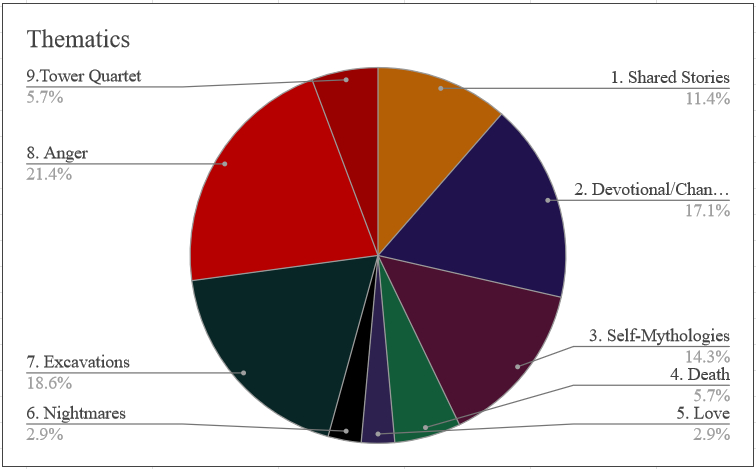
Here is a pie chart I have constructed and colour-coded to represent the themes and distribution of my poetry as of right now. Representing 71 poems written between January 9th, 2021 and October 15th, 2024. (I’ve written a few more but for various reasons they are not included on this list.)
(Interestingly, there are a few I cannot find copies of though I know I at least have physical copies somewhere. Bad LIS-professional! No cookie!!!)
The colours are loosely significant but the important thing to absorb here is that a) poetry is one of the main ways I channel my anger… especially as an autistic who goes largely non-verbal under social/interpersonal duress and b) I actually think of the Tower Quartet and (Channeled) Anger as subsets of a larger intellectual fonds …which is called “Excavations”. You will see that title in the pie chart as pertaining to a single slice, but really you can also view “Excavations” more broadly as occupying just over 45% of the chart! …The unifying emphasis is on digging deep, getting into the chthonic, and shadow-working my shit… oh, and a little revenge poetry here and there.
The thematics in the rest equally relate to each other pretty intensely. My poetry is always devotional in nature but some poems are more direct forms of near-audible gnosis. This makes sense to me from a mythic perspective as it is (personally) derived from the function of verse, alliteration, sorcery, ‘supplication’, evocation, and so on in medieval Irish literature.
I have made “Death” green mainly to evoke a #deathpositive association – ‘verdure from void’. I could equally (and perhaps should) have made it some kind of gold colour:
“I know you’ll remember me when I’m gone
remember my stories, remember my songs
I’ll leave them on earth, sweet traces of gold
oh, they’re calling me home, they’re calling me home.”
~ “They’re Calling Me Home”, Rhiannon Giddens
I will likely include little blurbs illuminating each category on a basic level whenever I manage to post them.
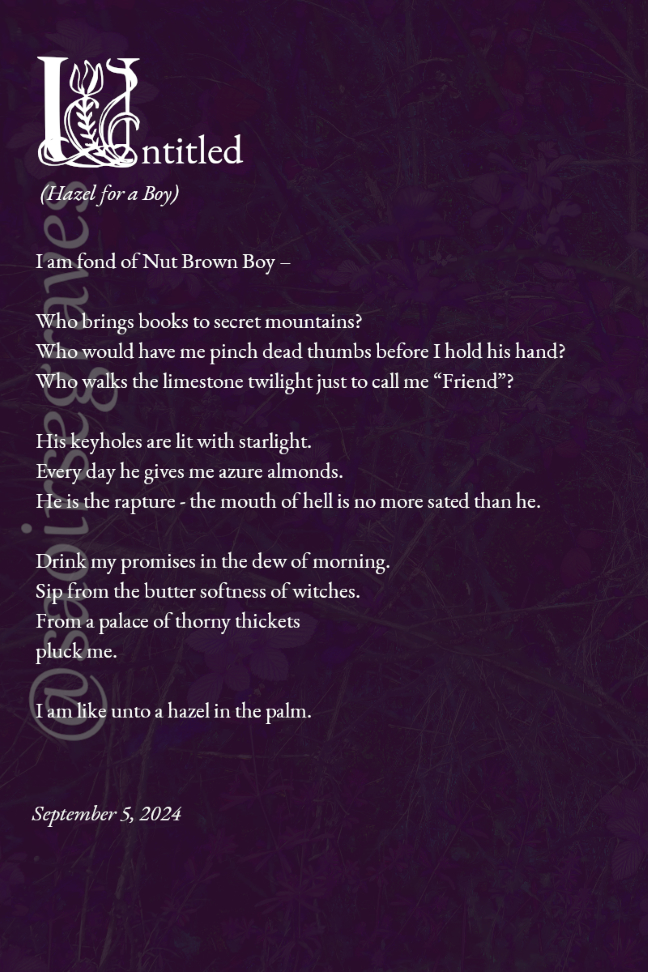
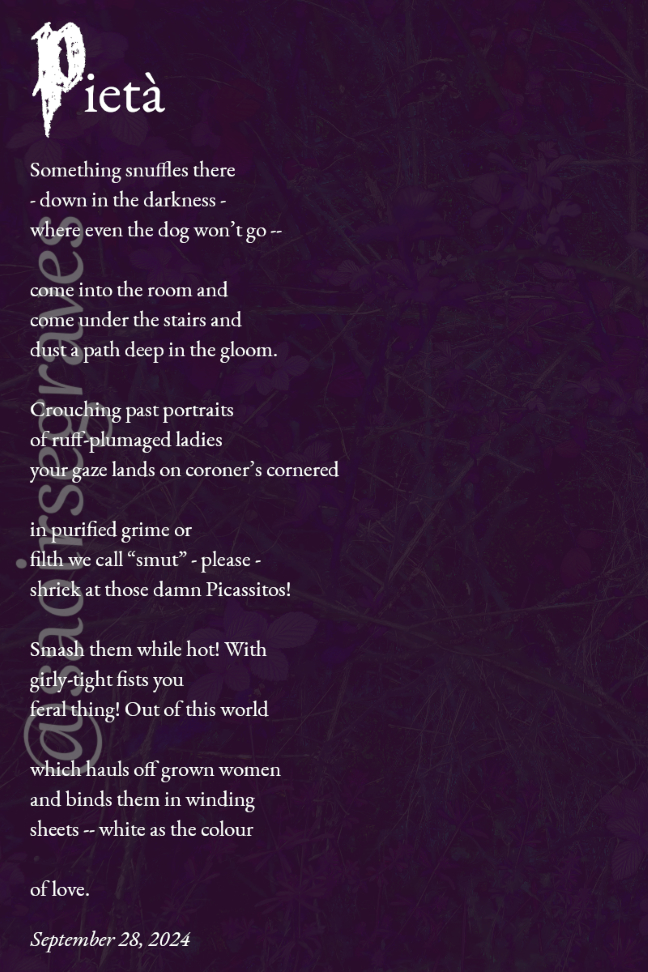
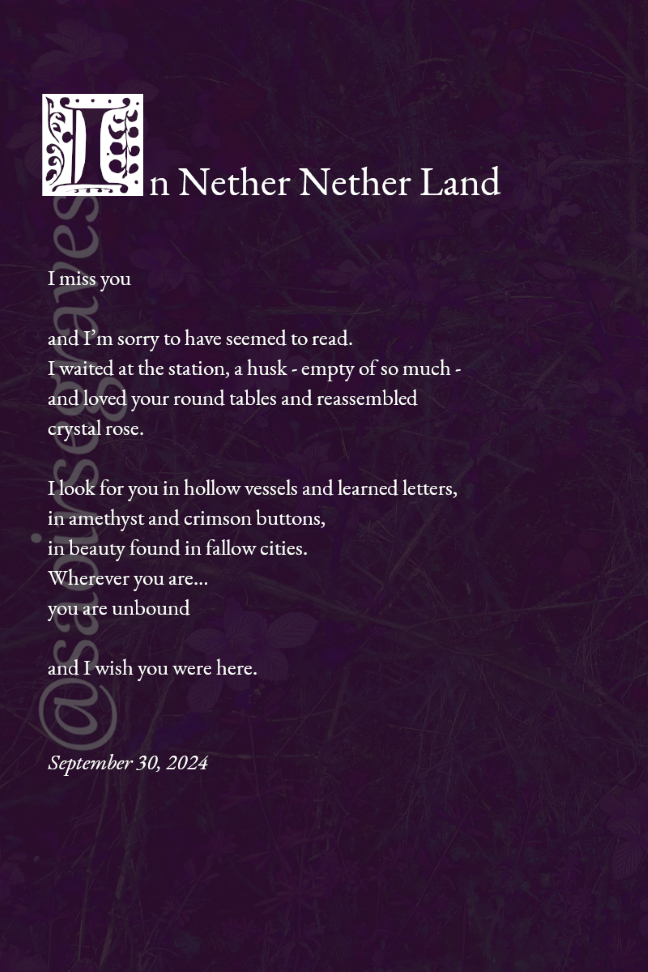
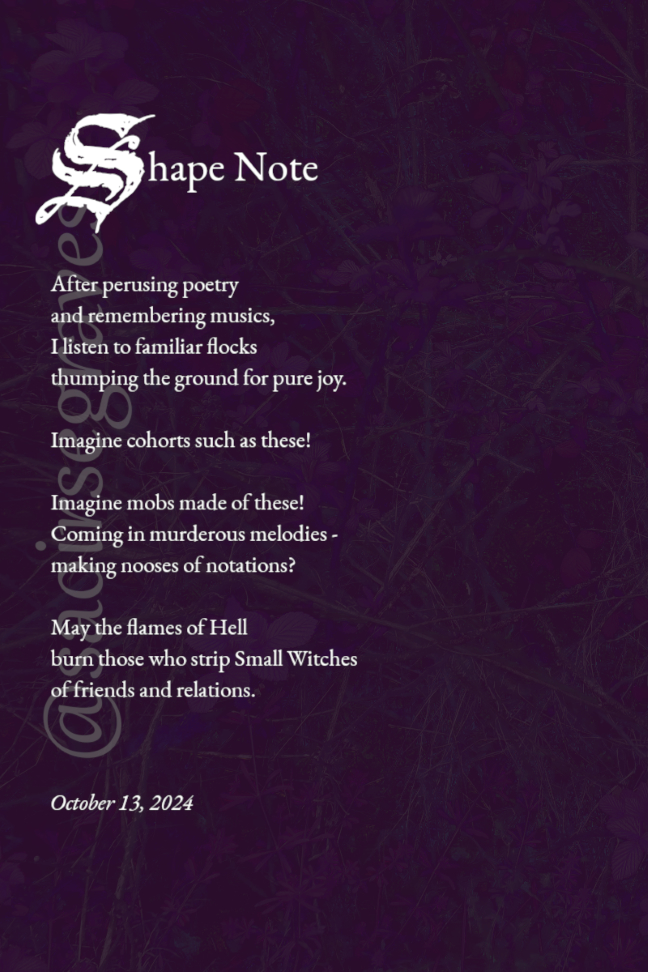
At any rate, I still need to figure out how to create a poetry gallery where poems that can’t occupy a single slide might appear… Until then, here are some of the poems I’ve written in September and October (minus “Athame”… which I have posted already.)
I suppose this set is all rather on the nose, but the themes of each are as follows: Love, Excavation, Death, Anger, and Anger.
For what it’s worth, I guess.
~ Saoirse.
* Get it? Theme-attics and Scheme-attics? Because it’s a post about poetry thematics and schematics? And I have a thing for sad attics? Ba-dum-tssshhh!!! Genius at it’s finest. I kill me.
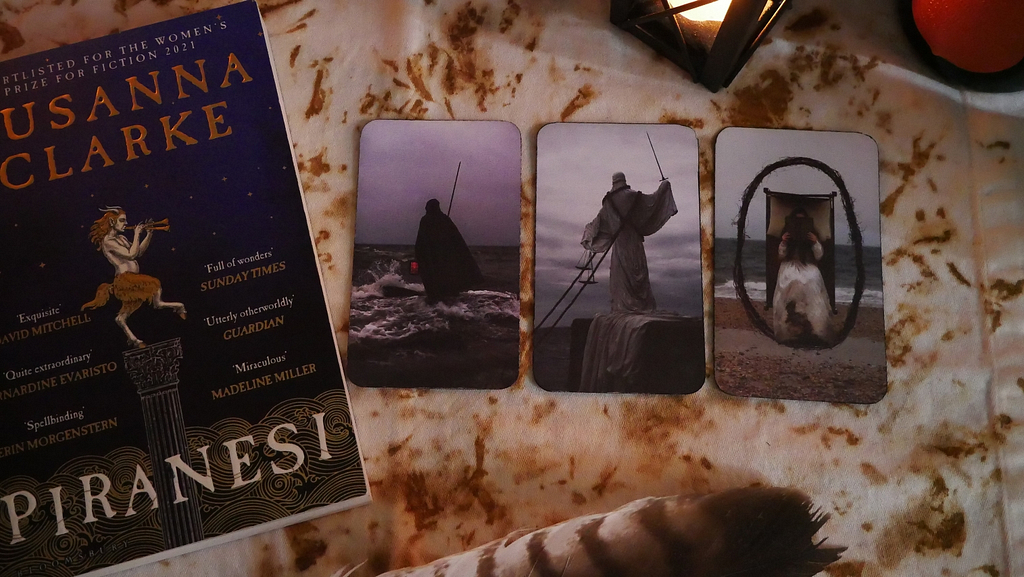
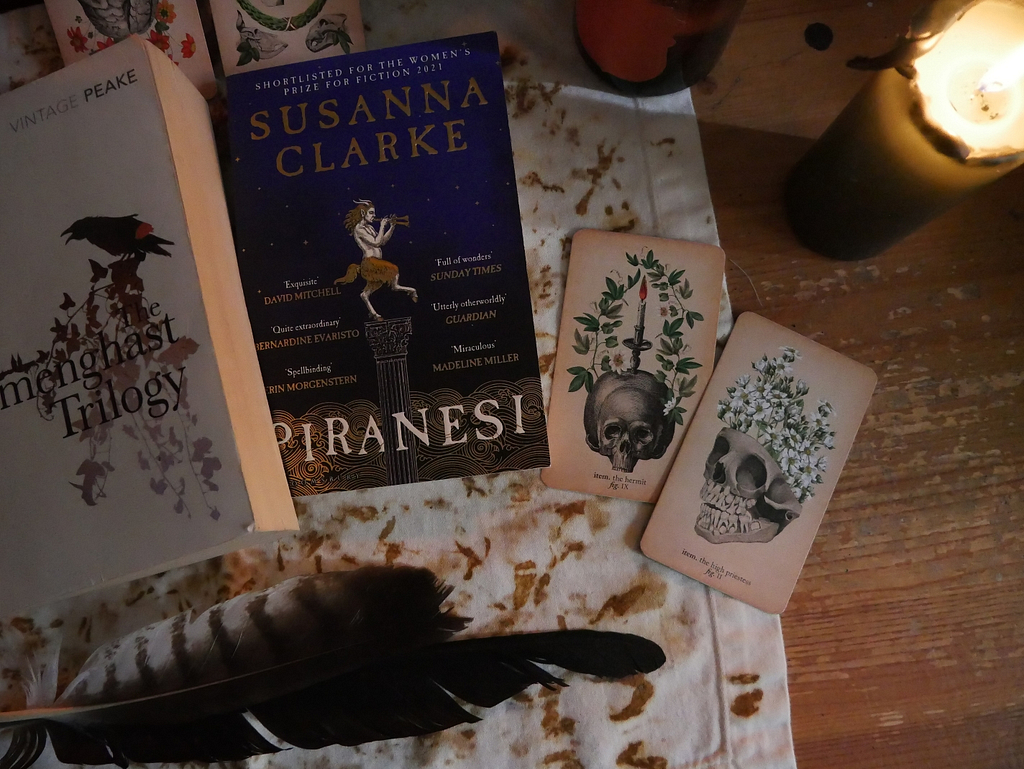
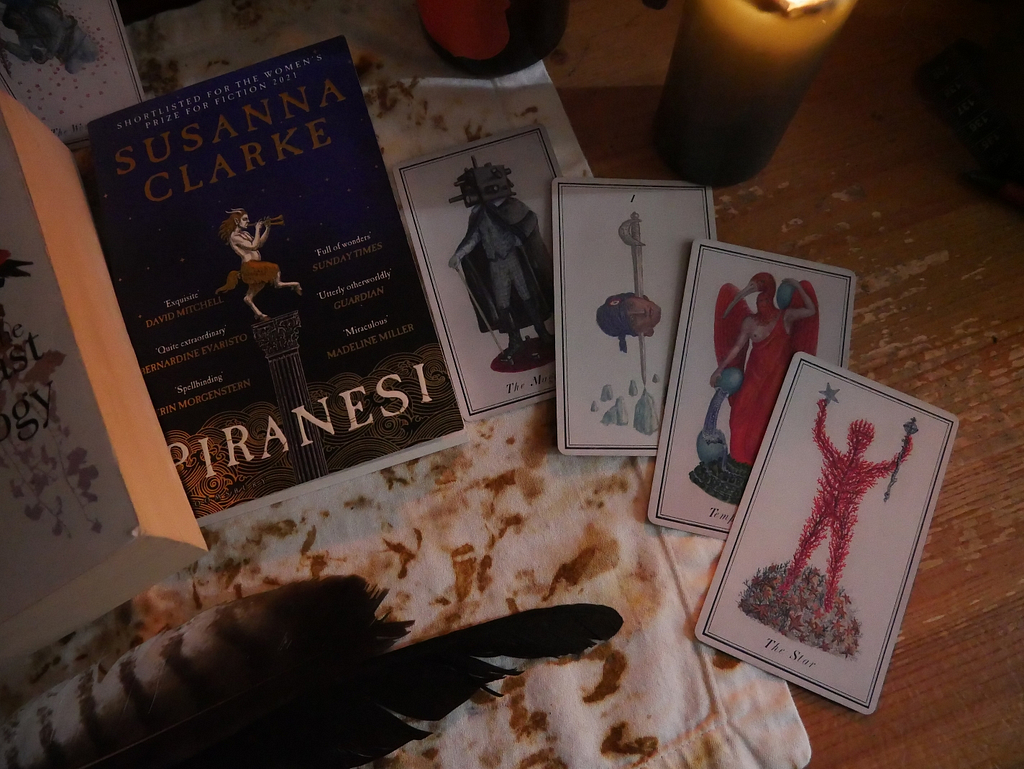
Two books that strike me as worth reading in tandem with tarot are “Piranesi” by Susanna Clarke and “Titus Groan” by Mervyn Peake. It would be tempting to consider picking a specific deck to work with in each case but there might be the risk of over associating that deck with those books afterwards. An idea to be approached with caution, perhaps.
I seem to have regained my ability to read fiction for the first time, properly, in over a decade! There are many reasons for this but paramount for the purpose of this blog post is that I have been allowing myself to define my own terms for my taste. I know what I’m looking for in a work of fiction at this current stage in my life and I am allowing myself to articulate that and pursue it.*
Titus Groan
I can’t vouch yet for the further Gormenghast novels (the rest in the trilogy or any of the further works – short stories, the ‘rediscovered’ book written by Peake’s wife and so on) but I suspect they would all make an interesting study with tarot.
As I finished Titus Groan one specific card leaped to mind: Justice. Justice, in any system (meaning whether you see it at the 8th or 11th Major Arcanum, I think it would apply).
From my admittedly limited experience, the Justice card will often get described as cosmically neutral. It’s not automatically synonymous with legal justice, or social justice, or anything anthropocentric in nature. It’s often viewed as possessing the kind of neutrality that registers to the subjective human mind (and the collective) as “cruel”… unfeeling.
What is interesting about that, however, is that in any given reading where we receive the Justice card, we rely on the cards surrounding it to provide context. In Titus Groan there is a bewildering amount of heavily detailed (deliciously rotten) context. There is a total pointed stylistic preoccupation with the minutiae of a given moment from many vantage points. The book doesn’t really have chapters as such but the manner in which it is structured seems aimed at giving the reader a very specific kind of whiplash…and gaslights you about it too. It oscillates between the estate/house of Gormenghast occupying all our ideas and definition of ‘the world’ or ‘the cosmos’… gets us deeply invested even in the movements of its motes of dust (so often likened to starlight) let alone the emotional landscape of it’s morose and Bosch-like characters… only to zoom far out, like a choppy jump cut, to the world outside the walls; full of archetypal passion plays, journeys, trade routes, forests, and mythic relationships. Every switch takes only a page or so to re-frame your sense of perspective and proportion. It warps your sense of time and space in a deeply compelling way. To be back inside the walls of Gormenghast is almost to forget the narrative of only a few pages prior.
And none of this sense of “loyalty” that you develop in the reading is particularly well rewarded if what you’re hoping for is Justice in its more desirable or “fair” aspects. “Loyalty” is actually an explicit theme in the book but it’s presented as a lived reality, an arch concept, and a dysfunctional source of festering rot. Justice lurks behind it all. Past a certain point, every page feels like a waiting game and you, the reader, bear witness to sociopathic plots and action with no clear idea of the deeper motivations or drive behind specific characters …other than as projection of the rotten dysfunction of Gormenghast itself. Gormenghast (with its own societal ideas of “Justice”) is the living breathing house that is THE world but is also only one small estate inhabited by the rigid seemingly endless loyalty to pattern, ritual, and heritage. What is structurally integral and societally established IS ‘just’ and ‘good’… right?
If this rendering of Justice makes you feel rather enclosed and sweaty, I think its supposed to. It’s also weirdly sympathetic though. I felt continually rather caught and called out!
In Gormenghast, Justice is communicated through sensory experience… a pendulous blotch of wine on white linen flashing in and out of the shadows… its details never relent but that’s the point: perspective becomes acrobatic!
All of this is enhanced, of course, by the fact that Titus Groan is only the first book – as far as I am aware – for the convenience of publication. Weren’t the Gormenghast materials intended as one long work of fiction? As the book opens and closes it feels very much like you have only read a near 400 page ‘first act’.
The Justice card stood out to me throughout not, per se, in its conspicuous absence (though… kind of) but more because the book just screams out that you don’t even know what Justice IS. You are just as limited and ridiculous and totally absurd and strange as any other character in this narrative.
Piranesi
With its overt thematic play on labyrinths, Piranesi feels similar in genre to Gormenghast. The writing is much more direct, the method for telling the story is totally different than Gormenghast. But the tarot also would make a great tool for exploring the book. And the book would do the same for exploring tarot.
What is our concept of Justice in Piranesi? I’m reminded in a way of the development of mind, voice, and perspective in the works of Albert Camus: the Stranger, the Plague, and the Fall. Each has their sort of hints at the next, archetypal touchstones… anchor points.
In Piranesi there are many deliberately archetypal presences. The albatross is a purposeful one, both real and full of reference. The point, perhaps, is that the literary reference is what makes it real to begin with. The statues take on roles almost of silent guides, warnings, or companions. Popes, charioteers, cloaked figures shining lamps in the dark or perpetually pouring vessels of water, nature goddesses, fauns, personifications of becoming, personifications of time or of youth and innocence and so on. There is explicit divination in the book too of course which I found totally riveting… “ornithomancy”.
I loved the book SO intensely and, as is often the case with me when I really get into something, I read it in a single evening. It’s not long and it’s characterised by a clear and open writing style (unlike Gormenghast) so it wasn’t difficult to just sort of… flow through it. It’s also very deliberately structured and that the reader might ‘flow’ through it’s clear and segmented ‘structure’ is VERY apropos and clearly purposeful.
The way it depicted divination, spiritiual knowing, and total quietude felt uncanny in that it reflected so well how I think and feel about these things. Even down to the use of certain phrases – which, of course, to my mind is the act of affirming the efficacy of witchcraft… To me, it’s not a “what are the chances!?” perspective. It’s a “but of course” perspective. If you’re engaging with it and pursuing what you care about than many aspects of it will feel shared even as they differ in various details.
That’s how we get to talk about things like thought forms, egregores, shared culture, collective gnosis, and build systems like tarot!
But the book also shows us the dark abusive side of this. In my opinion, it makes for GREAT reading if you are already a little familiar with the history of Western Occultism… some of the specifics of societies like the Golden Dawn, figures like Aleister Crowley and so on. I’m sure the more you know the more you’d notice is snuck into the pages of Clarke’s fiction, but a baseline acquaintance will do! The book absolutely ‘goes there’ in looking at the dark underbelly of magic and the occult, particularly in its collective iterations. It asks what each of us become, what ‘being’ is vs what ‘doing’ is… What the evil, the ambiguous, the perpetrator, the victim, the isolated neutral, and the open work of having curiosity all are.
Justice sits behind all of this too. And both books don’t ‘answer’ our feelings on it, in my opinion, mainly because the Justice card/archetype isn’t a question. A tarot reading is often predicated on the formation of a question but, paradoxically, Justice isn’t an answer without that subjective context… the role of the reader and/or querent.
Neither of these books answer anything or even exist unless it be in the moment of interaction with their reader(s) and in so far as their readers share how they experienced them.
Okay, so maybe …two Major Arcana: Justice… and the World. But again, no answers. Only contemplation after the provision of context.
Have you read either of these books?
If you have (or if you haven’t and you don’t mind spoilers) let me know what you think! Would you pick the same cards or something else entirely?
~ Saoirse.
* I think the proliferation of blogs, aesthetic terms, and the existence of booktube have helped with this. As a ‘fantasy lover’, back in the day, there was a lot of pressure to ‘read everything you can get your hands on’ … which has never possible for me. Now I feel more able to just say what I’m aiming to read and why!
With the recent spike in subscription prices over on Youtube and with their prohibition of ad blockers and so on getting out of control, I will now also be sharing each video here as an embedded link.
I’m going to work on uploading what I care to keep of my back-catalogue as well.
Videos will continue to be uploaded to Youtube but I wanted there to be an option for people who cannot or don’t want to afford Youtube Premium to be able to watch whatever they find interesting in my content for free without ad interruptions.
It’s only a small form of rebellion but it feels important to provide viewers/audiences with options.
Let me know if there are any specific videos you would like me to prioritise uploading!!!
At the moment, I’m in the midst of a massive change. Posts and so on are going to be sparse for a little while…
However, I want to offer some thoughts and updates on how I have been interfacing with the world and raise some perspectives that, honestly, I’ll never be ‘finished’ exploring.
The best feeling of sanctuary is well before sunrise.
Ever since I was little I have been obsessed with the minutiae of what it’s like to live creatively. Have you ever read a favourite book (in my case, mostly fantasy) and then seen a photo (sometimes at the back of the book with a short bio) of ‘the author at home’. Or perhaps you have stumbled across a photograph, blog post, or a short video essay that portrays ‘the artist in studio’. Have you ever seen this and thought I need to know how they got to that point in their life?
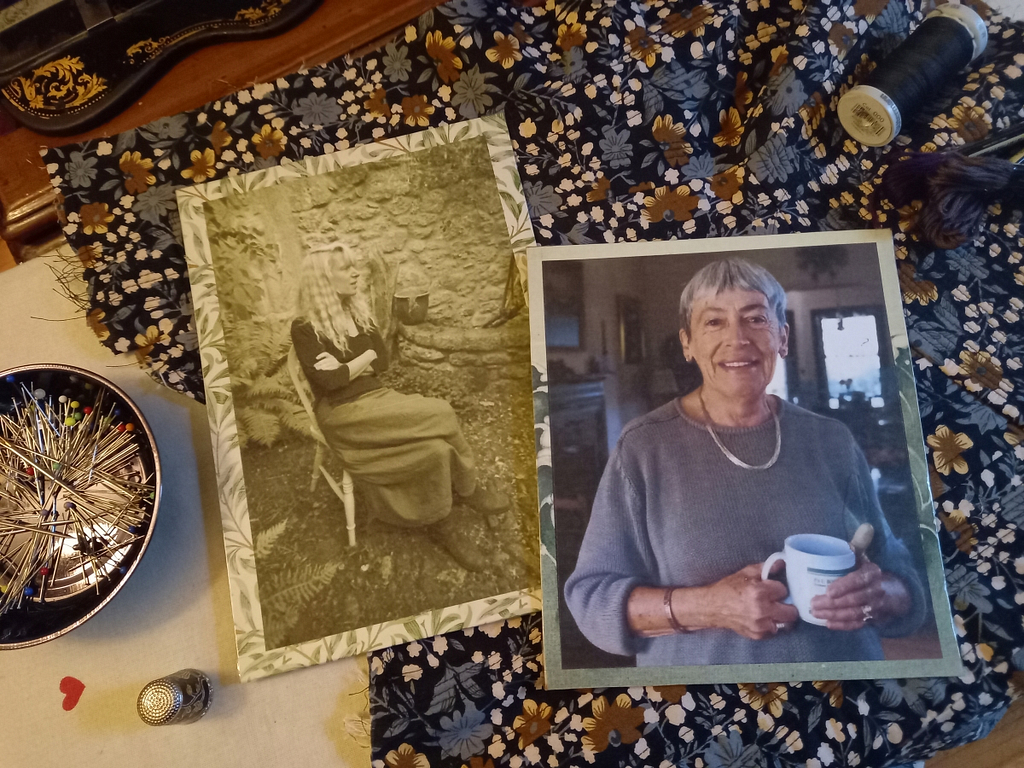
Cardboard cutouts I made years ago of Terri Windling and Ursula K. Le Guin. I used to tuck them in my planner and bring them with me everywhere!
I don’t mean ‘art for art’s sake’ but rather something very much embodied in the world and part of it’s extended network of sensibilities. Something that interfaces with real ecosystems or socio-economic environments and real time periods.
Is there any purer form of magic than the little glimpses you get of those lives? I don’t think they require endless descriptive detail because the idea is not to replicate them. You have to make your own for it to work and that’s what witchcraft *feels* like to me. It’s what I spend most of my youtube channel, this blog, my whole life pursuing.
Recent reading right before a VERY intense first time experience.
In my case, it has output that others can experience because I feel the creativity must go somewhere but I’ve never been the best at keeping track of my portfolio (and, indeed, I was always rubbish at tracking my repertoire when I was a performing violinist too. #myexecutivefunctionsucks)
But this is why I’ll so often mention something in detail, something relatively mundane but *just* off the beaten track (debatable) and then go “see? Witchcraft!”
And the reading AFTER that experience to get a sense of where it was going.
I love scenes in fantasy stories** that describe the seemingly mundane elements of a witch’s living space. Let’s say you’re in the Brooklyn apartment belonging to your aunt (umpty times removed). She has a gas hob that she lights with matches. There’s a colourful pot of coffee on. A fruit bowl sits on the coffee table below a daffy painting of old lovers in clashing robes. You wonder why their necks are so long… A cat lounges near an old pile of yarn or perhaps on a tatty armchair tucked in the corner. You look out the kitchen window to see she’s let the black-eyed susan vine overtake the fire escape …something looks different about the city though. “Honey, pick a different window” or “Sweetheart, come look at this old book of poems… people go mad looking out there too long.”
A reading about a specific… quandary and lived/sensory question.
Is it just because of the city chaos? Or is that the road to an Otherworld? What’s the difference between personal eccentricity and a real witch? Who gets to make that call?
… I’ve taken to washing my hair once every three weeks now instead of the usual two. I’m combing it, which I never thought possible with curls, but it seems that the key lies in using a wooden comb. I oil it with olive oil mixed with peppermint, fenugreek seeds, and rosemary (which I cooked in it myself. Magical intentions included.) Recently, I changed up my henna mixture for colouring too… the henna kept oxidizing far too dark and I prefer a lighter pinker red. I did a whole bunch of research on it and ended up with henna, catnip, and madder root! There are medieval recipes for colouring hair but I went with modern recommendations made by those interested in retaining length. Just in case.
So now I’ve got even more of a medieval-inspired head! Though I have no idea if it will register on camera over time, I’m very happy with the difference.
I’m making myself a new (to me) type of corset. And I’m going so very slow with it … partly because most of my time is eaten up with something else non-negotiable at the moment. But progress is happening! Hopefully, I’ll like it? I’m learning so much in the process though.
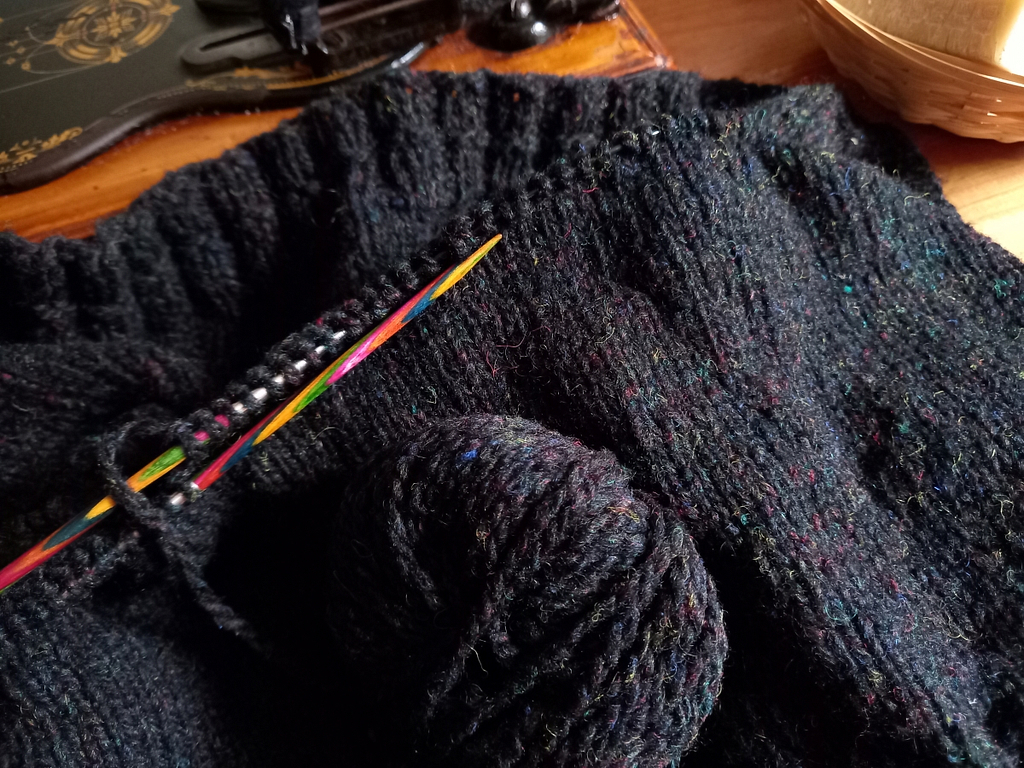
I’m still working on my current jumper project… historically inspired with billowing sleeves. And yarn the colour of crow feathers (black, but with many tiny multicolour fibres within so it has the optic effect of shimmering.) I can’t wait to finish it!!!
In other lights it looks more blue green!
I’ve also migrated over to the dumb phone life. I’d wanted to do this for a long time and had steadily uninstalled as much as I could from my old Samsung (having left a certain soul-sucking fruit-named empire behind years ago!) But the thing was still such a drain on my life.
My internet is based in my hotspot so my dumphone does have that capability. It’s the Matrix phone, for anyone wondering. A Nokia 8110 4G – and oddly it’s WAY faster than the old hotspot. I theorised to my techie BIL it might be that I couldn’t entirely keep my smartphone from doing other things in the background. He agreed.
In the absence of so much stimulation elsewhere, I have been getting better at aimlessly browsing less. And my witchcraft has immediately felt more real. More present. It’s colours are more vibrant. My relationship with deity has been reviving. Not that it was ‘dead’ but I had felt like I was fighting some kind of film that lay over it before I could really access it. That is much less the case now and I anticipate it changing further.
I mean, for example, Macha and Badb make an appearance masquerading as artists and tarot readers… They call themselves ‘Melodie Moonlight’ and ‘Breda Fairfoul’. One has blue hair, the other red. They ride a motorbike. They chew tobacco and smoke cigars. They file enamel handcuffs with their teeth and cry acid tears! What more could you want!
The way I keep describing it is, “I feel like I can see things better.” It’s not the best analogy but it will suffice for now.
Which brings us back to the magic in the mundane. Call it aesthetics, but I want to make real what I feel and perceive to be important. It takes sketches, notes, and even pin boards just as much as it takes altar work, moon phases, or wax drippings. Magic is art, art is sensory, and art and magic are visual-tactile-aural living.
The end.
(Or the beginning?)
~ Saoirse.
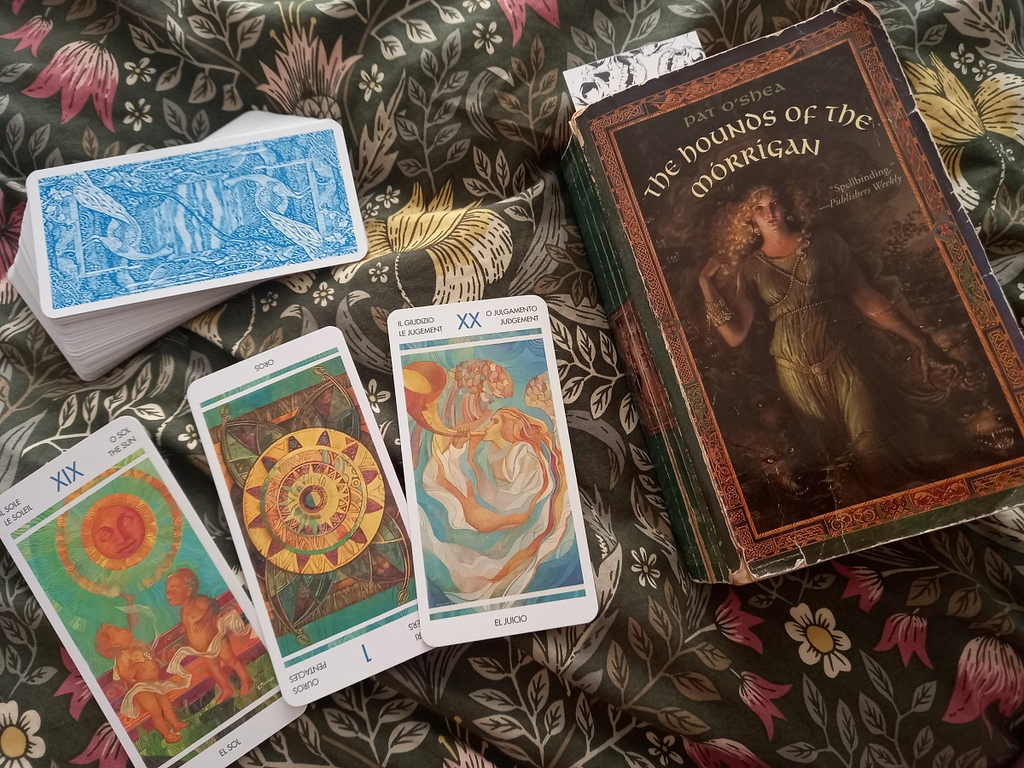
PS. I’ve been re-reading a lot of old favourites… Hounds of the Morrigan, The Left Hand of Darkness and so on… but I’ve also been embarking on a shocking amount of new stuff for me! Movies I’d never seen… The Crow (1994), What We Do In the Shadows, Witches of Eastwick, Beetlejuice (1988)****. I have THOUGHTS about all of this that links into what I’ve laid out above. Hopefully, I’ll get to post again soon!
** Urban fantasy is great for this but I can think of a few Patricia A. McKillip moments or Patricia C. Wrede moments and many others that do this really well too.
*** The header image is just a bunch of old photos of me aged approx. 16-21.
What if Madame Nostradamus, our “witty little knitter”, wanted her OWN scarf? Things are gonna get properly nerdy with this one. Strap in – I have no chill!
Note ~ my knit gauge was a little tighter than called for in the double knit weight, so I used the inches chart. I preferred the slightly denser look so I didn’t bother adjusting my gauge too much.
Paintings featured (anti-clockwise):
The Arnolfini Wedding by Jan van Eyck, 1434
Portrait of Christina of Denmark by Hans Holbein the Younger, 1538
Portrait of a Young Woman/Isabella of Spain and Denmark by Jan Gossaert, 16th c.
Portrait of a Lady by Rogier van der Weyden, c. 1460
Cornelis Aerentsz van der Dussen by Jan van Scorel, c. 1535
The Wedding Dance by Pieter Bruegel the Elder, 1566
A Young Princess (Possibly Dorothea of Denmark) by Jan Gossaert, 1530
Music featured:
Je suis d’Allemagne – Je suis trop jeunette by Ensemble Unicorn (Album ~ “Art & Music: Raphel – Music of his Time”)
Comment qu’a moy lonteinne by Falsobordone (Album ~ “1350 Music for a Plague”)
The issue of lacking social terminology to define my own sexual identity and preferences for expression is pretty perennial for me. For some context, I grew up in a town known (at least in that general set of townships) for being a *relatively* inclusive place… we were one of the early towns in our part of the state to have a rainbow painted crosswalk etc. However, the language of most parents and highschoolers I encountered was not only highly heteronormative but also rather homophobic and … honestly well ignorant of anything resembling fluiditiy of identity, expression, or lived experience. I and my friends spent a lot of time watching and attending Rocky Horror but didn’t have access to too much else… and most understandings of sexual expression were contextualised along lines of ‘promiscuity’ rather than a more sex-positive outlook.
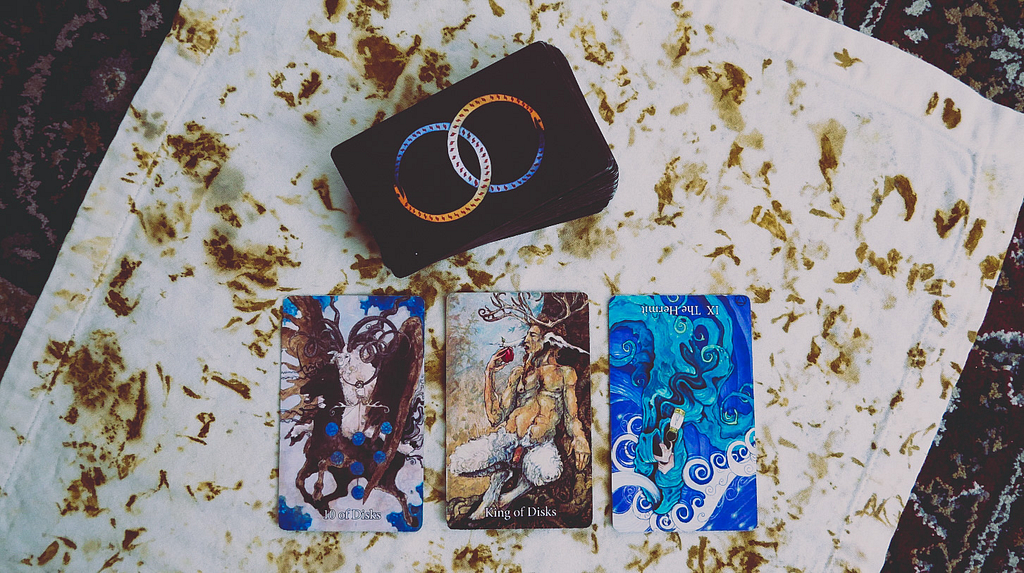
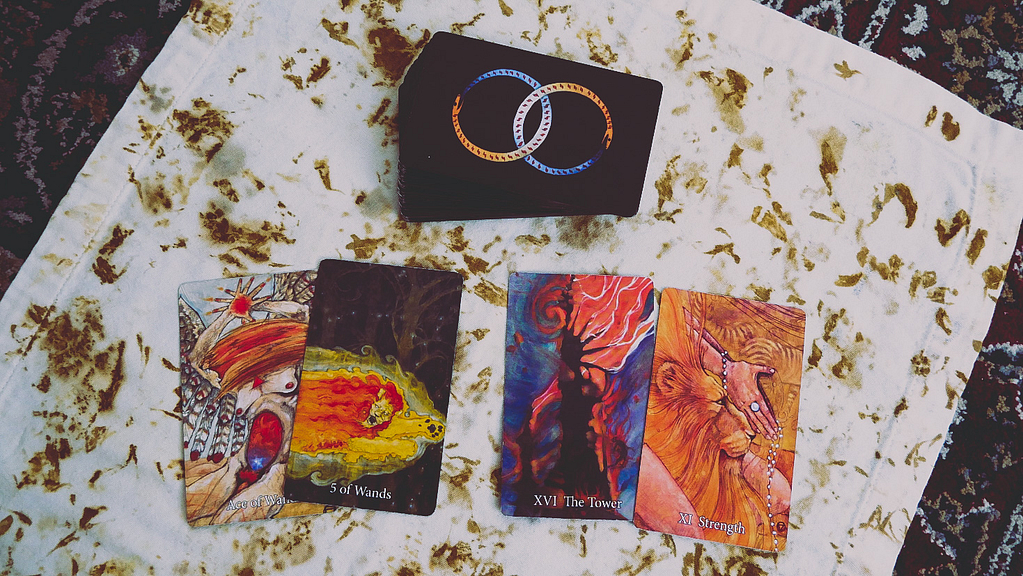
This was this morning’s tarot reading… It’s what inspired me to write this post.
My college – at least at that time – was fairly unusual in that there were no bathrooms segregated by gender identity. All dorms, bathrooms, and shower areas were gender neutral. Asking for pronouns was considered a totally run of the mill polite thing to do. People had classes to go to and life to explore and nobody gave a shit whether you were prone to monogamy or followed any specific paradigm of any kind at all. Coming back to my home town/area for work after college was a massive culture shock.
Years later, I remember having a conversation with my BIL over pints about how the secondary school one of his kids was attending was talking to the parents about possibly introducing gender neutral bathrooms and (at the time) he was really against it for a man who seemed only to have unanswered questions. A lot of ‘what if’s’… to which I was able to say, ‘Well, I can tell you from personal experience [insert anecdotal answer here]… and that was 10 years ago.”
The same night (over more pints) the discussion around consent came up. It was a topic newly in circulation at the time (the #metoo movement had arrived in the awareness of the slightly older generation in Ireland by then) and I heard the usual stock answers of ‘Isn’t it a huge turn off to just ask someone if you can kiss them?”
Jesus CHRIST on a split banana, I had things to say.
So here’s my perspective on the benefits of promoting diversified vocabulary along with some musings on my own identity.
Personal preference is like a favourite colour. We don’t have bathrooms only for those who pick green. We don’t care if someone used to be purple but now they’re silver. We don’t have to have full blown personal crises if ‘suddenly’ we don’t get to assume everyone loves blue. You can ask or be interested in the world… and you will find that some people *do* love blue. Just blue. Nothing but blue. Other people don’t care about blue but they’ve noticed they like blue things… blueberries (with a purple tinge), the sky in late summer, the dark slate blue of the glistening sea. Other people will verge more toward periwinkle. Other people will swear that they don’t mind blue but they’d NEVER wear it… and still other people will be somewhere else in the colour wheel entirely and, as a matter of fact, don’t engage with cool colour shades at all.
What matters (of course, this is not revolutionary) is that we give people language and vocabulary while also communicating that words are allowed to be an approximation.
So, personally, I find very little terminology to express what I feel I am in social terms. Usually this doesn’t bother me – I benefit from a lot of intersectional forms of privilege. But it really irks me when it comes to the erasure of daily lived nuance.
In the past, lacking better words, I would have described myself as a ‘nympho’ or ‘hypersexual’. I’ve been ‘boy crazy’ since I was 5 but my understanding of (loosely speaking socially male or socially masculine) beauty is highly sensory in nature. I love line, texture, movement, colour. I love expression. I love embodiment. And I love these things physically and sexually… My creative impulse is strong, constant, and sexually expressive. It’s amazing I’ve ever been called a ‘tease’ given that I am and always have been ‘easy’ as fuck.
As a teen, there were certain partners (and especially one particular individual) who would have used this term ‘tease’ but at the same time were operating on the assumption that there was no such thing as a ‘woman’ who just said ‘yep! let’s go’ if you asked her directly if she’d be down for various things. They’d resort to indirect forms of emotional manipulation – verging on coersion (pouring my drinks etc.) – to get me to ‘put out’…when all they had to do was just ask and we’d have gotten there already. If anything, messing with my boundaries made me clam up. Once, I can remember literally already being naked by the time someone felt they needed to get me more drunk…which had the effect of making me put my clothes back on and call my mother to come pick me up. For the record, we still did it generally, just not that night. My attitude has always been – don’t insult my intelligence, it’s a turn off.
I struggled to find concise terminology for my own identity. I have a long and dark history of ED so some of this is complicated by learned shame around my natural embodied reality. In a recent google search, trying to find something other than ‘hypersexual’ (which comes with connotations of compulsion and addiction in the clinical sense, which doesn’t apply to me) I came across an article where someone invented the term “flammasexual” to imply easily ignited and with gusto. Like, frequently and merrily aflame with sexual impulse and desire. Sex like spiritual fire in the solar plexis. Sensory experience like visionary ecstasy in the finger tips. Magic pouring from carnal portals.
If we think of that in ‘Wands’ terms, I think that makes excellent sense. It makes for a good descriptor.
However, if we then turn to qualifying identity in ‘romantic’ terms… I’m not sure I have a suitable word yet. I don’t always know what ‘romantic’ means. For me, it’s never been proposals, rings, monogamy by default, roses and candlelit dinners. I’m more of a ‘explore an old crypt with a loved one and talk enthusiastically about medieval mysticism over pints later’ kind of person. A let’s live through things together and have fun kind of person. These are things one can do with friends. So, for me, my ‘romantic’ relationship is down to longevity of closeness, dedication to mutual development and growth, shared language, and… sex! Certainly I think there is a romanticism to how friendship at least *can* work. I really enjoy seeing the sensory beauty of my friends. I love seeing the colour and temperature in someone’s face or the way their hair sticks up in the wind. I love the suddenness of some people’s humour or the gentle slow burn of a joke that takes ages to be gotten in full. And the level of disappointment I feel when someone I thought was a friend turns and all but says “yea we share interests but I’ve decided to be mean to you about something or to forget that you matter” cuts deep… Perhaps, I romanticise friendship too much then?
So, personally, I understand a romantic perspective on life… I understand romanticism… but I’ve never overtly linked them with sexual interaction and expression. They can and do co-occur but they’re not interdependent. Would that be… ‘aroflux’? Or ‘abroromantic’? One term seems to emphasise the fluctuation and the other the romanticism… Neither have ever been as constant a part of my identity as sexual desire, attraction, expression, and sensory experience.
I’ve been romantically in love with fictional characters (‘fictoromantic’) with whom I can’t ‘consummate’ anything except on the astral so… Thoughts in the comments if you know terms that approximate what I’m trying to get at here!
Is ‘Gomez & Morticia/Laszlo & Nadja with a healthy dose of Leonard Cohen’s carnal mysticism thrown in’ a sexual/romantic identity? Because if so, that’s what I’d align with best.
Lastly, the emphasis for me has always been on clear, useful, and honest communication. On not pushing boundaries where they aren’t willing to go. Perhaps this is because I am autistic and am oriented toward seeking clarity over hoping I can risk passing something off as smooth and cool.
A final example of what I mean. I had a conversation recently around the lack of opportunity and cultural permission to speak openly about things – especially as a non-binary* person with what is often perceived as a feminine style of dress. (I was assigned female at birth and I allow those pronouns only as an approximation and out of vestigial/uncomfortable social inertia. I struggle with the awareness that other people hear things I don’t mean if I use female pronouns. The binary is a system very few benefit from, if anyone really, so for clarity my pronouns are currently she/they.) As an introvert who has been in a monogamous sexual relationship for over 16 years and is now socially perceived as an ‘ageing woman’… there aren’t many people who get to hear the way I talk about things on a natural daily level or understand that my worldview doesn’t necessarily match their assumptions.
In this example, a person was surprised to hear that I don’t emphasise monogamy by default and that I see no practical use for society being so rigidly founded on monogamous partnership. The ‘polyamory is just an excuse to cheat’ clause came up and I said NO – polyamory [or any other non-monogamous relationship structure] is not cheating because it’s founded on open communication and consent.’ If a person enters, say, in to a relationship on the explicit understanding that their consent is founded on a condition of exclusivity, then their partner ‘cheats’ in so far as they violate those terms for consent. In this case, if ‘the lads’ (mates of the person I was talking to) have sex with someone else (sticking with the sex-based example here) knowing their wives are not okay with it and then return home to conceal that truth… they are tampering with the conditions of her consent. Could not this kind of problem be avoided if we placed less automated emphasis on ‘everyone should get married, in specifically this kind of ceremony, in this one kind of partnership, spending this certain amount of money, within this narrow range of ages regardless of inclination or practical maturity…so we can all complain of the ball and chain later like it’s some kind of rite of passage!?”
I value art and card based divination. I value witchcraft… I value the power and embodiment that witchcraft and paganism have helped me teach myself. At some point I may talk explicitly about how my devotion to the Morrígan plays a role in this. But I do not value exclusively ‘sanitised’ imagery, absence of physical diversity, rigid gender essentialism and so on. People of course do their shadow work and come to terms with different worldviews at difference paces and on their own journeys… Tarot meanings and symbolism must reflect that if it really is to be ‘the book of life’.
Is the tarot capable? Only as capable as we think we are…
Recently, I have been trying to give form to certain ideas. At a snail’s pace, my kind of speed. One of these ideas has to do with a burgeoning awareness that something I have always been able to feel and certainly always yearned for is taking shape… Simply put, it can be called ‘lifestyle’ or ‘vocation’. It’s about the sensory experience of every day. It’s about how that intermingles with the hopes and dreams of the past. It’s even about certain life goals that have recently become a little more tangible.
It can be glimpsed in my thoughts about ‘between’ spaces. I’ve been calling this place ‘the Labyrinth’.
In the Labyrinth, rooms are often arranged according to discipline or genre. Style of activity. Or by medium. It has places that are dominated by memory. Or by myth. Rooms and halls devoted to presence. It has a rotting fairy Versaille, sidhe mounds lie just beyond the walls of it’s outer gardens. I know what grows in it’s crevices. I know what areas get built vs. which simply materialise and I know why – I know what I’m trying to do there. It can only be entered or exited from this side of reality… on the far side it might be infinite. I have not checked.
Though Hilary’s performance style isn’t my favourite now, her work & THIS ALBUM were deeply formative… This cannot be overstated.
In the Labyrinth are all the scariest saddest most soul crushing things I have ever personally encountered. In the Labyrinth are also the scariest saddest things my loved ones have encountered…
In certain rooms in the Labyrinth, it has windows to Nazi Germany. To two little girls in the rubble of Cologne. In other rooms hang portraits of Sarah Chang, Ani Kavafian, Hilary Hahn, Nathan Milstein, Andrew Manze – the violin room. In another, Carter Brey, Andre Emilianoff, Rostropovich, and Jacqueline Du Pré… though I hasten to say the cello room is much scarier than the violin room. More horror and shadow. In the violin room, baroque music echoes from an old scratched record player that I can’t find. It floats between sage green curtains with gold fringe, it gathers in gusts of dusty leaves strewn along the floor. It’s faded tiles are arranged a little like a chess board (but not quite). The violin room has a fallen wall that leads outside. It’s almost always Autumn from that vantage point.
Imagine… Sibelius echoing through the ghostly gallery of memory.
There is joy in the Labyrinth. Some of the most beautiful sunlit gardens I have ever seen. Bright and fresh of a cool morning. In some parts of it I have lots of little demon fairy friends… absolutely inspired by the work of Brian and Wendy Froud, Jim Henson, and others.
“Step out of the page into the sensual world.” ~ Kate Bush
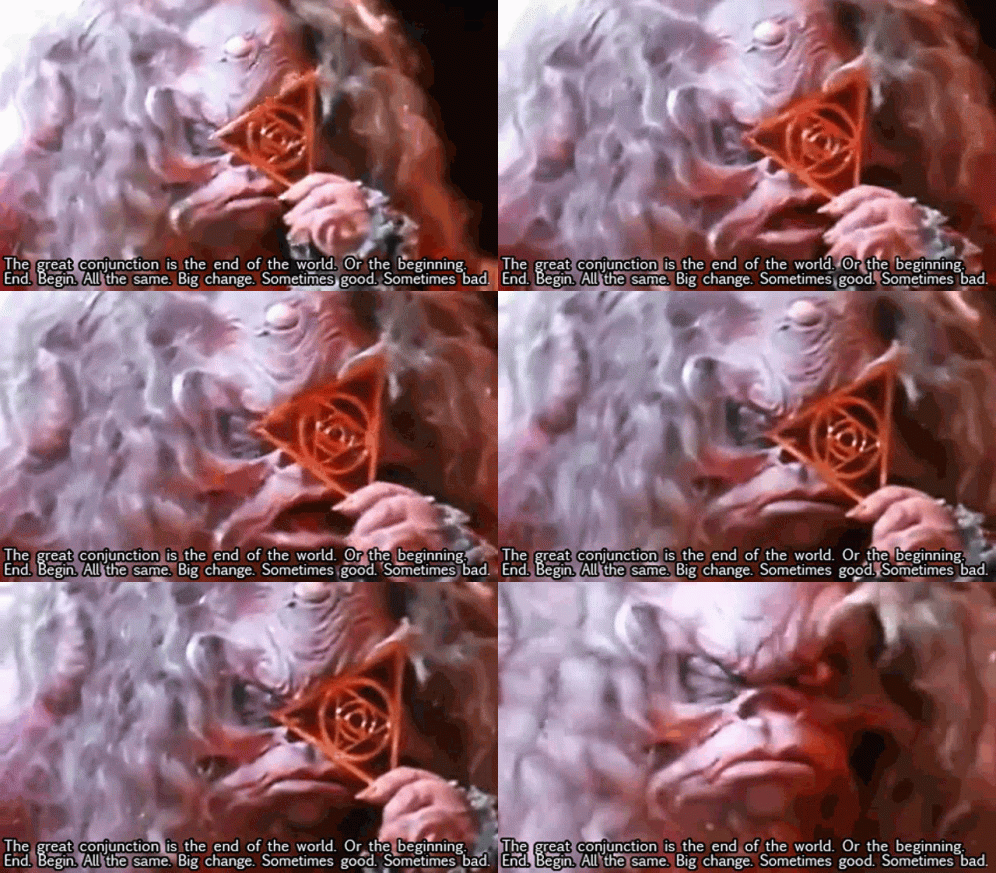
Many parts of the Labyrinth give me the eerie feeling I have seen them before. If you have seen The Storyteller series with John Hurt (and Brian Henson as his dog!) you’ll recognise much of the look of my Labyrinth – including the way a room filmed from a different angle looks like a different story.
If I have something big and overwhelming to face, I walk the number of steps and turns and corridors and gardens it takes to get there. And then I come back.
And therein lies an important nuance – Big and Overwhelming Things. These are not just bad things. Not just lost things.
Yesterday, I sat down to work on sketching out wardrobe ideas. The goal has been taking shape in my mind for quite some time of what colour palette I want. What silhouettes I like that also work on my body and my sensory preferences. What works where I live and what I can have ethically shipped or acquired? What layering? What technique? What cheeky little references? How shall I paint myself? Where will I hide symbols & sigils? Which tattoos will I allow people to see? How semi-permeable do I want my persona to be? What kind of variations do I want to build into that without always causing getting dressed to be such a cognitive burden (as fun as it ALWAYS is – I even enjoy pjs!)
JEEZUZ! 7 of Cups, this is getting personal!
It’s hard to go from basic learning to a cohesive finished result. I’m convinced a practiced artist is able to make something and 51% of the time say to themselves, “that was deliberate”. >_< In performance, they always said that the true masters spend their whole lives practicing to make the hardest things seem easy. No one wants their audience to wince in anticipation of a famously difficult passage!
But if I have a flare for aesthetics and a knack for getting my hands to make what I envision, that’s all I have. “Flare” and “Knack”. Good fairy names, to be sure… good to have on side, but not synonymous with a finished project. Not yet the bit where I’ve crafted and lived in my visions. Not yet corporeal. And the tension or dissonance of this arises in a few key places:
Clarity of vision requires honing and specification. Decisions in favour of one thing at the expense of another. Do I have ‘talent’ for this kind of executive functioning?
NO. (It’s one of my specific autistic ‘traits’ that I suck at this.) It will not just take practice. It will require a lot of frustration, erasing (::gasp!::), paper with pencil dents in it that won’t erase any more, bad stitching… and quite literal ‘blood, sweat, and tears’ because I really shouldn’t be trusted with so many sharp implements.
Do I know how to manage my fabrics to minimise waste without being over precious?
Ehhhhhhh… always a question, never an answer to that one.
What happens if I change my mind?
What happens if my tastes change?
What if my body changes?
Should I plan contingency into these patterns?
Could I remake them into something else?
Where should I store repair-remnants so they don’t get eaten by moths?
Shit, I ripped something… again.
But if I draw something after a lot of work and swear words (while also being happy and absorbed in the process) and I show that sketch online and “it looks well enough to the untrained eye” (as it has been drawn by an untrained person!) and some people like it… is that ‘talent’? Or is it burgeoning skill. Is it diligence? Or is it bare minimum that I managed to draw it at all…
Found some old stuff!Self-portraits. 2021 & 2023?Experiments – derivative but useful!
What then if the drawings truly do become clothes. (Doesn’t that sound like magic!?) Is THAT talent? Or is it… propensity? Am I pretentious? Am I ‘talented’ or am I just a fucking handful? Who’s gonna hoover up the trail of threads and linen dust…
Maybe I have a talent for being a handful!
If I share process online, who is my audience?
I literally have no idea… but I HAVE always felt that documentaries about creative process, textbooks and lectures about the preparatory sketches and intentional symbolism of art, and old photographs of ‘artist in studio’ were the most magical Otherworldly thing on the planet.
I want to make the clothes I find in The Labyrinth. I want to come back along those corridors still wearing what I saw there. I want to help that stuff cross the divide – not just the clothes but the air quality, the poetry, the paintings, the furnishings, the music, the ideas.
It’s a stormy yellow-green coloured day today. Deeply blustry and misting with rain. I have a massive headache. But I want to build Otherworlds and I want to learn what it takes to do that.
The word ‘talent’ is a value judgement that has no objective significance at all. In my experience, ‘talent’ is a word used to diminish not only the hard work of others but also the reality of what it is to try something and kind of suck at it until you kind of suck a little less! Perhaps people accidentally sabotage themselves in using this word. If it’s always someone else that is so talented… What do we think their talent is? Is it the same as what they want it to be or thought it was? Have we ever seen what their work looked like not just when they started but at every point along the way? Good days? Bad days? Days where they had a dentist appointment and forgot to cover their paints so everything dried up? Days where they’ve LOVED baking until they realised they mis-measured their yeast …or the oven stopped working but the light stayed on? Days where the internet told them they were great but a favourite family member grimaced at their ideas?
What if you’re a 60 year old man who wants to learn to swim after years of being body shamed. What if you used to dream of talking to fish and you want to explore that again in the physical realm? I bet you could become an expert at loving water – not just a ‘talented’ swimmer.
Some people have opportunity, privilege, & support. Too many people don’t. Maybe most people have an incorrigible mix of these things. A pervasive paradox.
Culturally agreed upon standards for what looks like talent totally exist… but they are relative at best. Not very nice and of limited use. Picasso, Dante Gabriel Rossetti and other such humans dwell in the realm of talent and genius only because they deny entry to others. Sabotaging others with jealousy and aggression. Their work is good, just not THAT good. The idea of ‘inherent talent’ (to me) just screams ‘big fish, little pond’.
The concept of ‘perseverance’ exists but I think it gets misapplied to the point of losing a lot of what’s useful about it. Can you persevere at being scatter brained? Do we value that word internally or are we waiting for it to be applied externally?
Play TOTALLY exists. But if ‘play’ is ‘talent’, then can talent be ‘lost’? And if talent can be lost, then I think it must not be inherent. Which, to me, means you could be 96 years old and still decide to redevelop it if you chose… just because you can. That sounds more like curiosity and skill-building! Achievable things! Real magic.
If ‘talent’ exists, then everyone must have it. I think it’s down to the inherent tension and dissonance of asking yourself what yours are… and inventing them when necessary!
~ Saoirse.
P.S. It’s a total joke that I put my own work next to all these amazing true geniuses. I laugh at myself, not them!