[CW – there will be reference to symptoms of trauma but I will not discuss details nor will I indicate any specific type of experience other than to discuss how it affects my magico-spiritual process.]
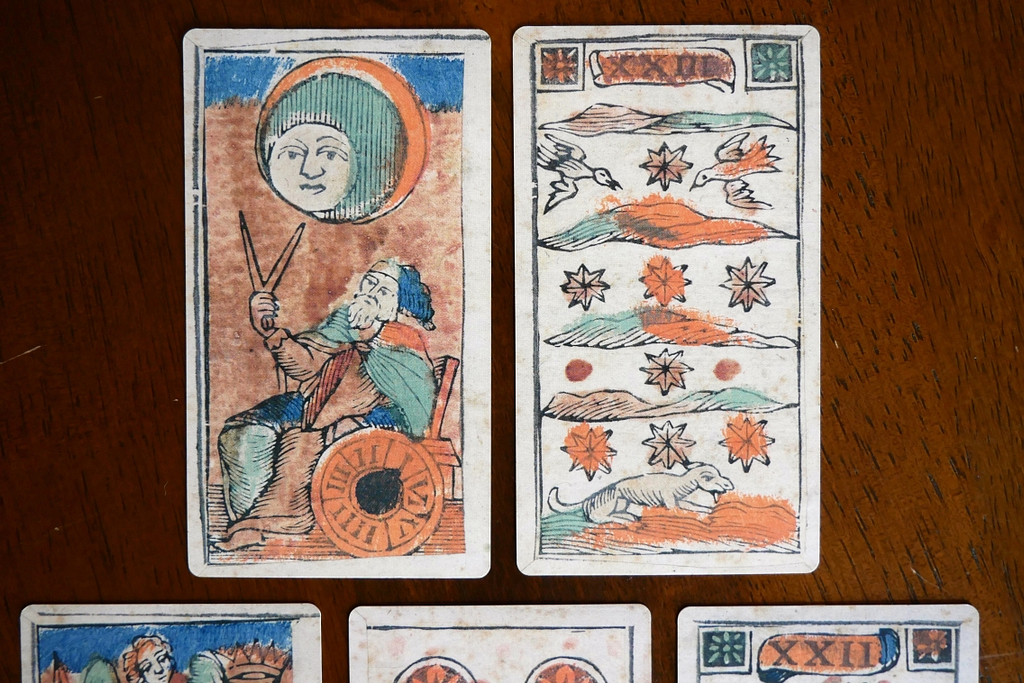
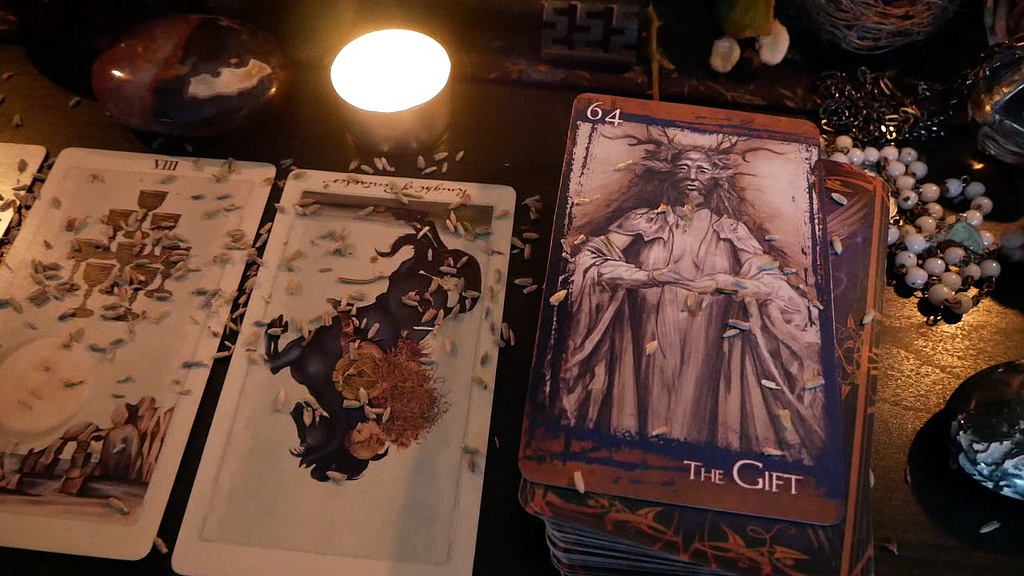
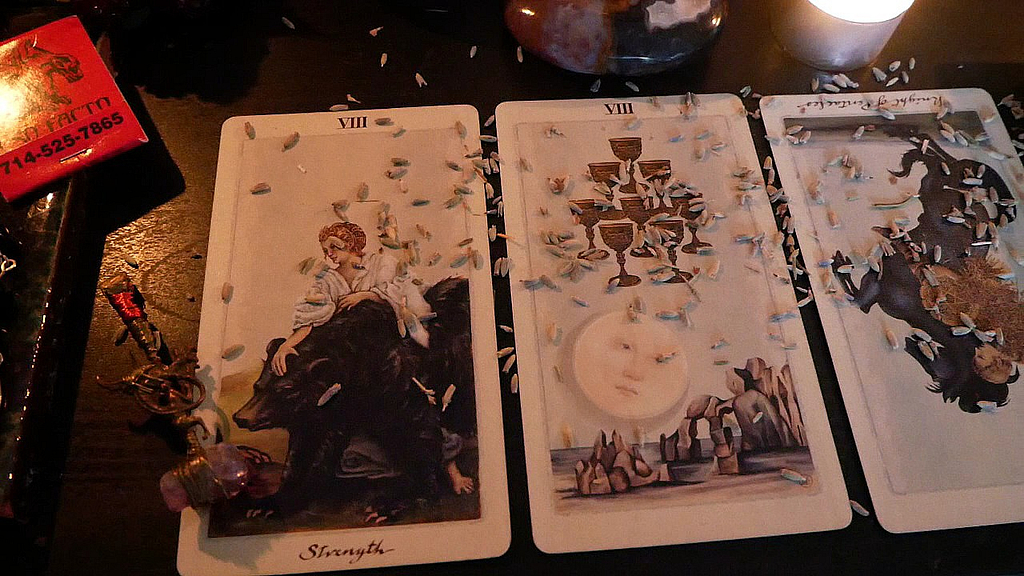
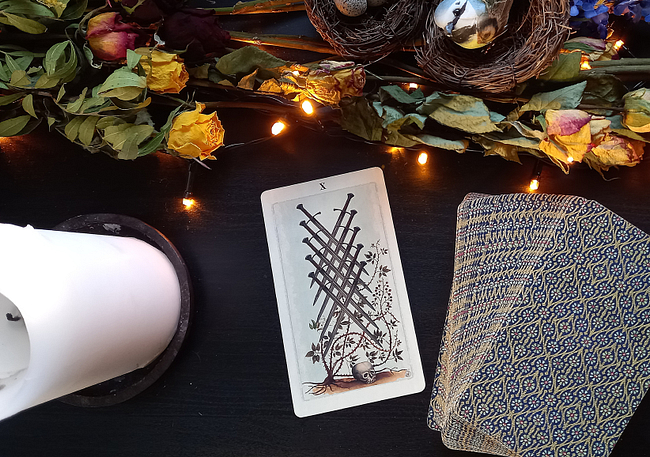
Half moon this morning. Waxing gibbous. Serendipitously, this is the card I received in a single draw from the Pagan Otherworlds Tarot. How apt.
I have been posting a bit more openly about music lately. Mostly here on the blog. I want to talk a little more specifically about why this – for me – constitutes witchcraft and deep magical healing work.
If anyone wants a recommendation for an amazing young musician and singer coming out of the American ‘Old Timey’ Trad world (as distinct from modern bluegrass!) they should check out Nora Brown. Holy shit her work is good. She’s currently collaborating with a fiddler named Stephanie Coleman and equally her style is deep, rhythmic, and rooted.
I’ve known of Nora Brown for a few years now but yesterday I made an attempt to watch the Tiny Desk concert above. I say ‘attempt’ because by the time they started into ‘The Old Blue Bonnet’ I was shaking, hyperventilating and so on. Having too many visceral and deeply loved memories of American-specific experiences… looking up at the moon through pine needles… fireglow shining through a cabin window at the bottom of a mountain valley… a small trickling stream beneath my feet… elk in the morning, bears on a walk. The music of the unassuming – jeans and t-shirts – trading information, laughing, and the deep heartbeat of boots on a floor keeping the tunes flowing. People talking with their feet and singing with their hands…
I couldn’t do it yesterday.
I told my partner it felt like a world had vanished but that I (and only I among anyone I know now) could hear faint echoes of it calling out “Goodbye! Goodbye!”*
So today is the half moon and I drew the half moon card. To me, the card says ‘Now you can do it and I will help.’ I took slooooow breaths, clutching the deck (my bridge between worlds), listened to this gem of a video and let what once was run its course through the channel of my emotions. Tears again but more manageable this time.
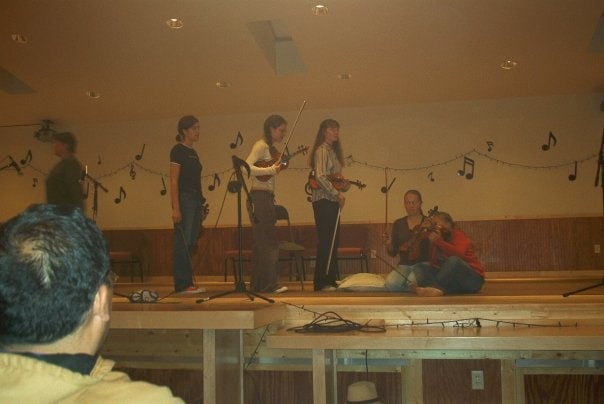
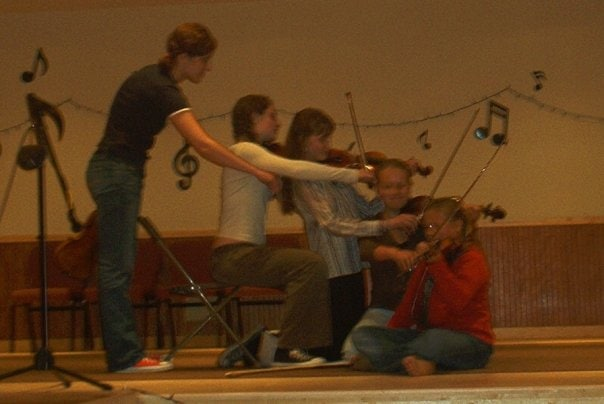
Old grainy photos of a good party trick…if you have lots of fiddlers!
It is, of course, not at all accidental that so much of American trad songs are fixated on war, death, loss, poverty, jail time, labour, loneliness. (The backbone of the ‘American dream’?) When people move too fast over land that isn’t theirs their own pre-existing problems grow with them. I don’t find much to ‘redeem’ about this… but I do find subtlety and nuance, I guess. The tunes I like the most have the least pretense – they’re tunes by and for flawed people. Maybe even the damned (depending on your worldview… I use demonic imagery in my witchcraft for many reasons). They carry no false promises and their dogma sounds tired.
I don’t know if I will ever use my violin for fiddle music again… I have no idea how that would feel in the body. Playing music, by definition, replicates the movements and bodily experiences of the past. That’s what practice IS… taking what you have already done and keeping it alive. Maybe that’s what makes it so hard and so rewarding at once. I am comforted by the knowledge I have of different forms of music and the fact that deep down I am fortunate to have some access to those skills and worlds… but I tend to feel shattered by the awareness that I come from a world in which I did not fit and I live now in a world that doesn’t know about any of that – at all. And I still do not fit.
This, incidentally, is how trad music is formed. Traditions carried. Stories retold and reworked. Sources cited (as is done so amazingly in the Tiny Desk video!)
To be a witch for me (among many other things) is to go to the altar and lay my music at Her feet. To carve a space that is mine… with bits and bobs of my story – the stuff that makes me howl and cry; the stuff that makes me dance; and the stuff that I know emerges syncretic and flawed… and to let it emerge and take its new form anyway. I take it all with me. These things are in my satchel. It’s painful to perceive, now, that no one around me knows it. I’m a person with no context. It must be enough that I know it.
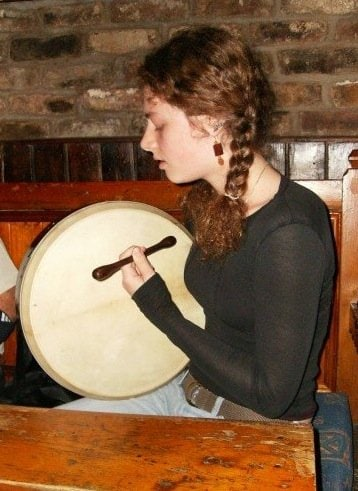
Baby-face Saoirse playing the bodhrán in Ireland. Think this might even have been in Cork!
The half moon will help me see that and shift my perspective back towards joy. And, I’m not totally alone… I can still light a bonfire on occasion and surround myself with other music makers. I know I’ve left things behind for a reason and I guess I’ll keep the practice of fitting into nowhere at all. Chronically transatlantic like so many before me… but hopefully reckoning a bit better with empathy and collective responsibility!
Below, a couple poems I wrote a few years ago, during an earlier phase of processing these things:
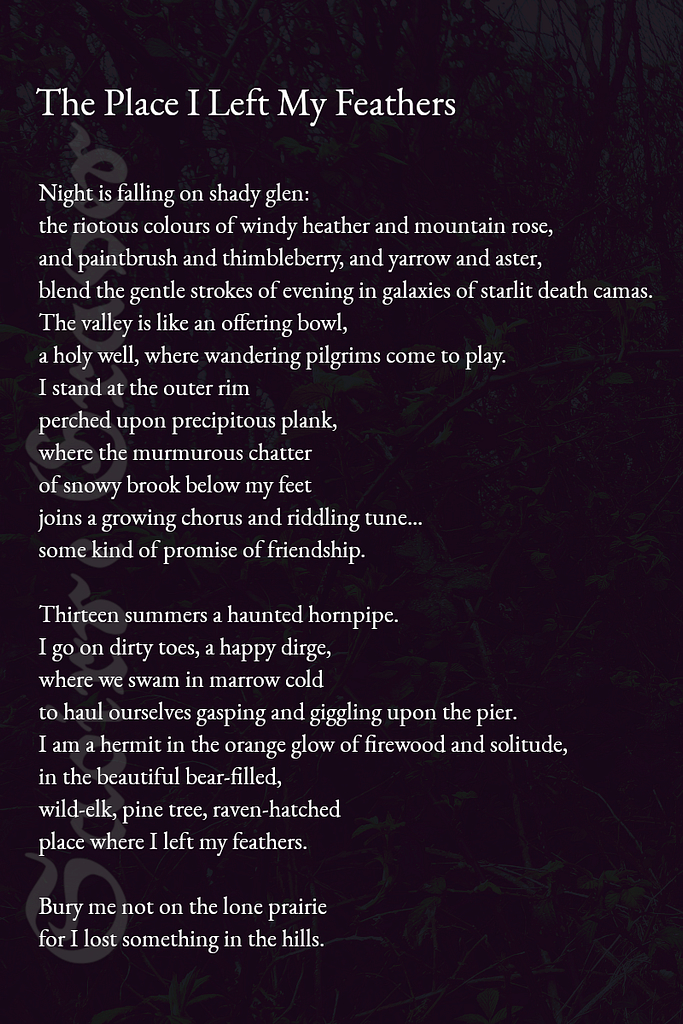
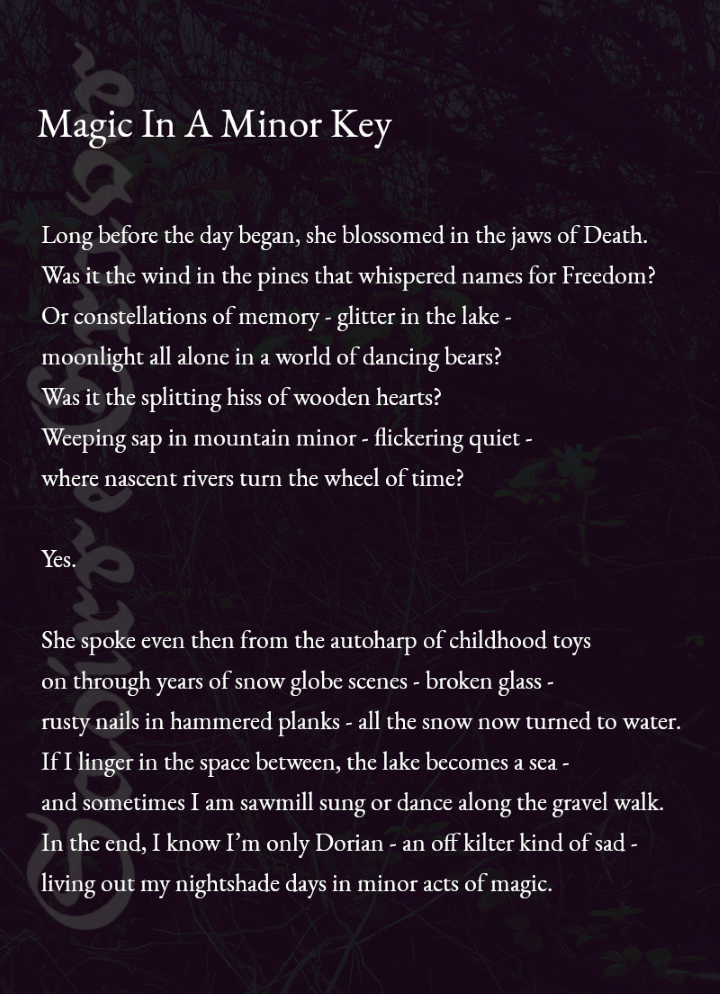
The Morrígan often ‘speaks’ to me through verse (UPG) and the following poem felt like an answer to wondering if she was there ‘even then’.
From 2022, it makes reference to John Prine as well as “Blackbird” performed by the Lonesome Sisters (written by Debra Clifford about her mother… Debra herself passed away in 2022.)
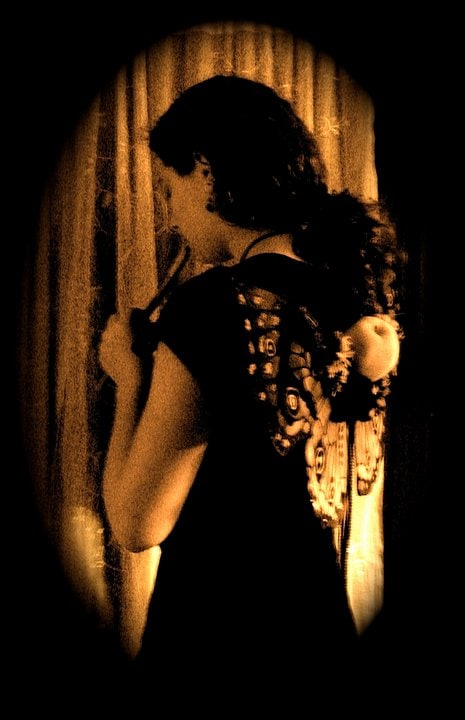
Another old photo. Wistful whistle tunes and homemade wings…
~ Saoirse.
* Rayna Gellert*** has composed some great songs out of this tradition that capture many of these feelings for me – “Strike the Bells” from her album ‘Workin’s Too Hard’ and “Nothing” from her album ‘Old Light: Songs from my Childhood and Other Gone Worlds’ come immediately to mind. Whew!
** This link is to a live performance (including the only mistake I’ve ever heard him make! ^_^) This is important firstly because I think his live renditions have a more dirge-like quality than his recorded version (which is on his album ‘Soon Be Time’) and secondly because he performed this song live for the first time one night at my college (a few years after I had stopped going to the mountains each summer to a camp where he and others taught) … I was talking to him after the gig and he asked me how the tune came across. I told him it was beautiful and made me cry and he told me it was the first time he’d done it on stage!!!
*** Incidentally, the same summer location was where I first had the privilege of meeting Dan Gellert, Rayna’s father. Holy shit that man can play and on the most gorgeous fretless banjo to boot!
I would love to hear your responses, thoughts, etc. in the comments. But please note, I’m not soliciting for comfort or validation. I’m wary of encouraging what I so often interpret in comments as codependent language. I’m fine! I am me and you are you. Concepts & practices such as witchcraft are shared but also truly individual – this is what makes them so potent! 🙂
Something that has gripped my imagination my entire life is the idea of ‘Building Other Worlds’. Importantly, I don’t mean only as ‘substance behind narrative genres’. World-building for a fantasy novel or for game play, though deeply interesting, is only one popular iteration of a much broader interdisciplinary creative drive to make and experience other worlds. What of Art? Architecture? Costume? Music? Theatre? Ecological experience? Folklore? What of symbolism or spacial awareness? Where do we get ideas for what our worlds look like and what tools do we use to build them?
I have been wanting to write about this for a long time but have been puzzled about where to start. Do I start by explaining some things about art history? About perspective, image composition, numerology? Do I dig into how tiered worlds in late medieval and renaissance literature make their way into contemporary visual language? What about modern art? What about tarot or oracle? Witchcraft, sewing, or poetry? Would tracing themes of port cities and their proximity to marshland or wetland habitats get the message across? What about folkloric recordings of Victorian vs. Medieval streets in Irish town centres!? Ultimately, I realised I’m going to have to start where I am and, if you wish, you can follow me down each corridor as and when I get there.
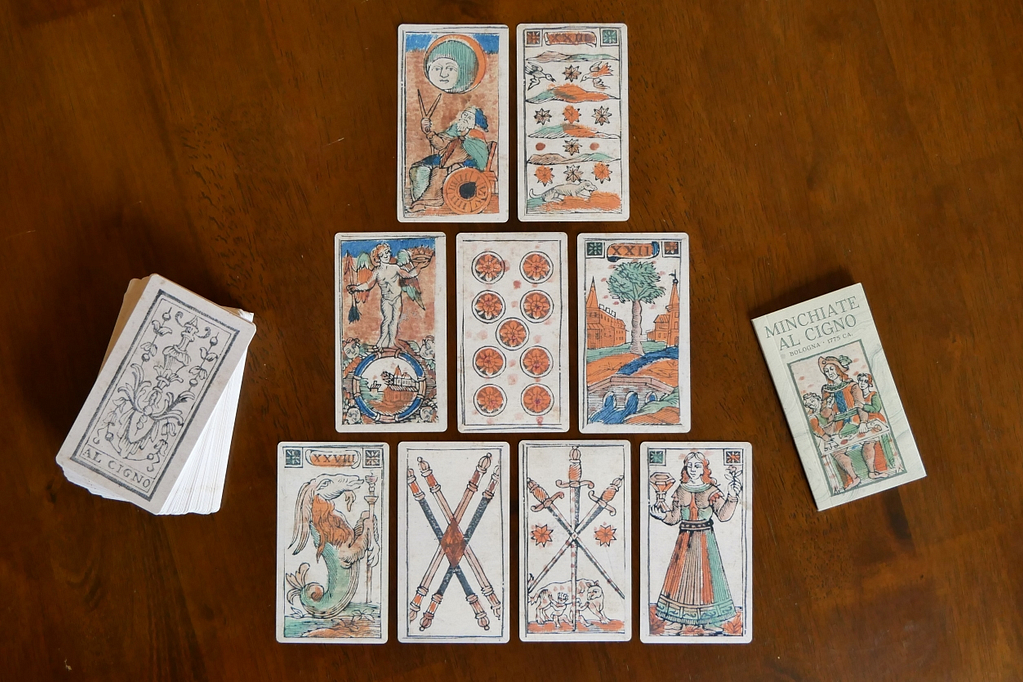
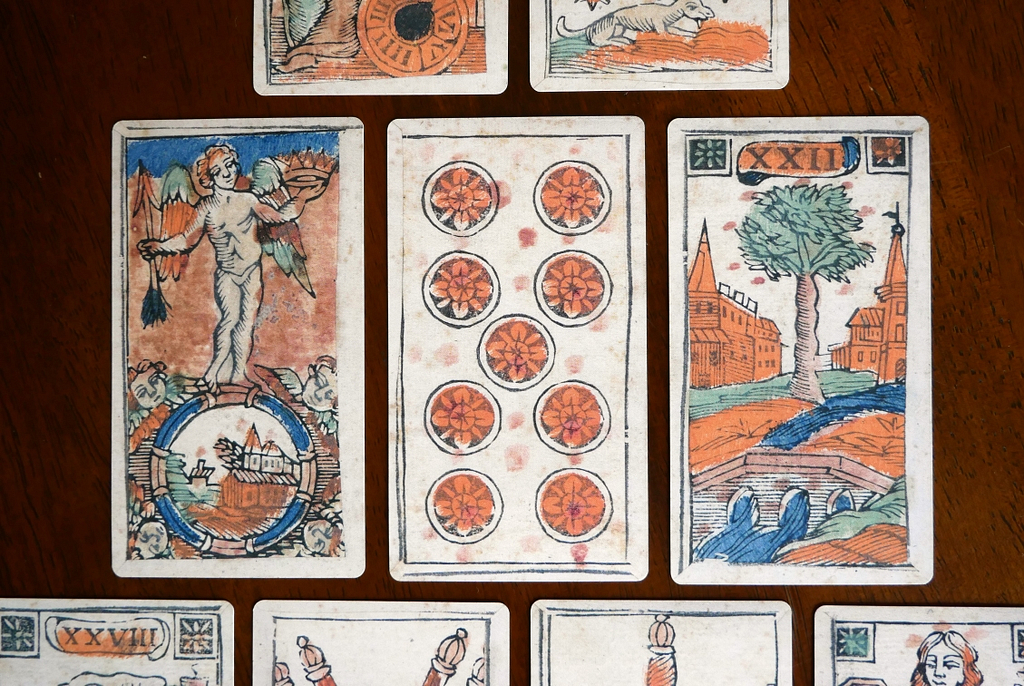
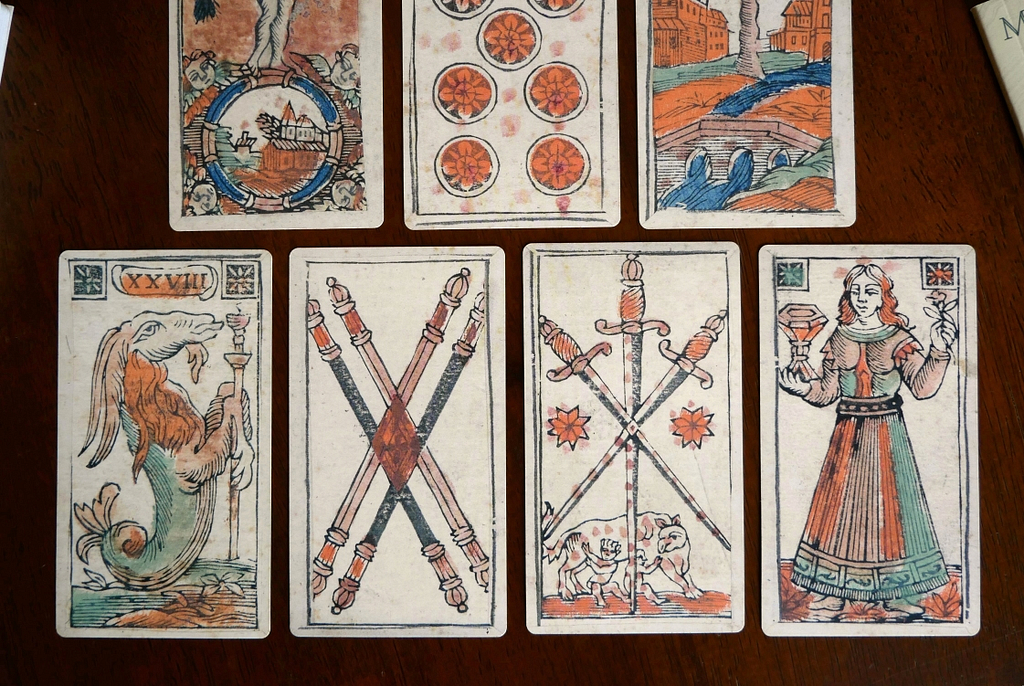
Here are some purposefully drawn 18th c. Minchiate cards illustrating how card visuals can help you construct doors to Otherworlds and populate them in turn with architecture, characters, and landscape …with pips for ‘scaffolding’!
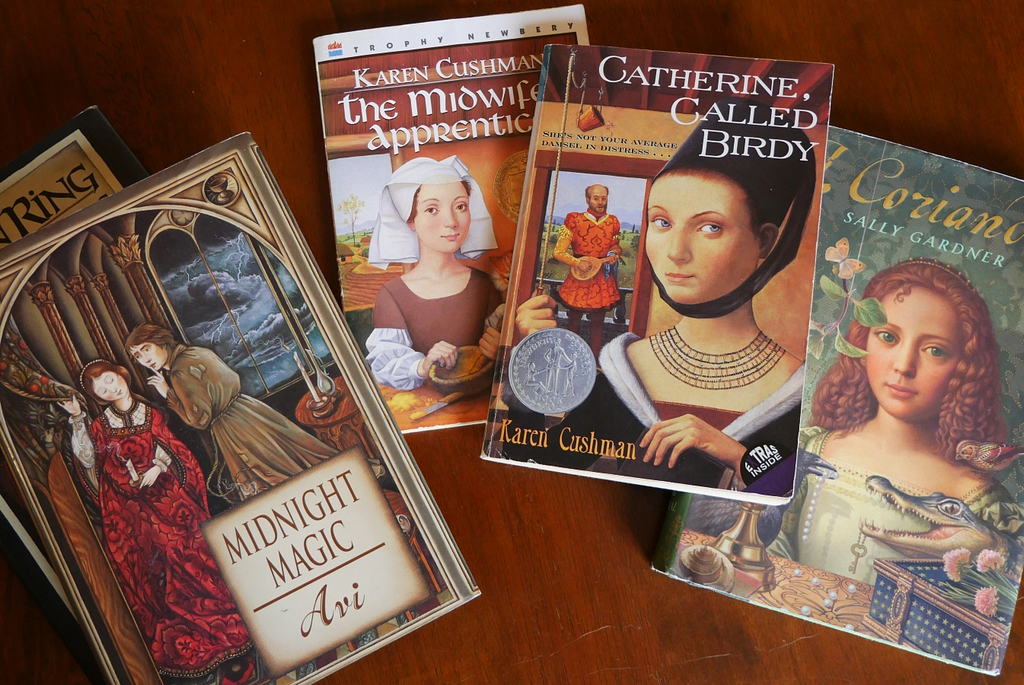
Recently, I revisited some books that were instrumental in helping me to identify myself when I was young. These follow very much in a similar vein to other favourites of mine such as Pish Posh, Said Hieronymus Bosch, The Books of Earthsea, The Chronicles of Prydain, The Hounds of the Mórrígan, or Jonathan Strange & Mr Norrell… and I took special care to obtain secondhand copies of the specific covers I grew up with as well.
I have yet to re-read The Raven Ring although I know I will love it as I can’t remember how many times I would have read it growing up.
There are five books in all (for now) – each of which features scenes relating to tarot, tarocchi, or otherwise emphasise attention to historical detail within their fictional plots.
* Midnight Magic by Avi (part of a series that didn’t exist yet when I was younger. I won’t talk about this one much because – as it turns out – it wasn’t as good as I remembered and it’s representation of tarot is tangential to the plot and seems fairly ignorant of what tarot is. I still LOVE the cover though!)
* Catherine, Called Birdy by Karen Cushman (no, I am not going to watch the new film abomina…I mean, adaptation of this beautiful wonderful highly intelligent book.)
* The Midwife’s Apprentice by Karen Cushman
* I, Coriander by Sally Gardner
* The Raven Ring by Patricia C. Wrede (part of the Lyra series but I have not read any of the others.)
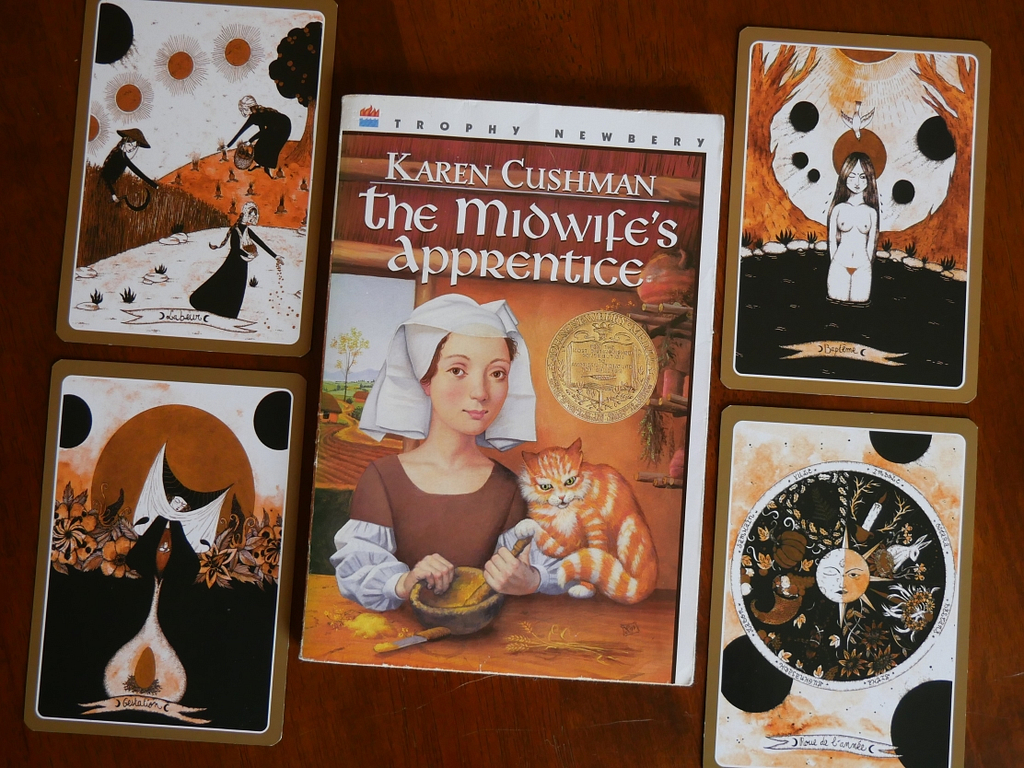
The Midwife’s Apprentice is pictured here with selected plot-relevant cards from Oracle Médiéval et Merveilleux by Gulliver l’Aventurière & Julien Miavril. (No spoilers!)
For one thing, all of these books (except Midnight Magic) were aimed, perhaps, at Young Adult readers generally socialised as feminine but at no point did they talk down to them. They were an excellent foray into how creative and narrative detail coexists wonderfully with good historical enquiry. There is an emphasis on trade and commerce. Some of these feature port cities or otherwise thriving commercial principalities and their conflicts with rural living and tradition. They discuss textiles as if their readers can and will care about how they affect plot. And they treat Otherworlds and/or magic with the same expectation: that readers are curious to know detail and will put in the imaginative effort. To me, this is how the imagination grows.
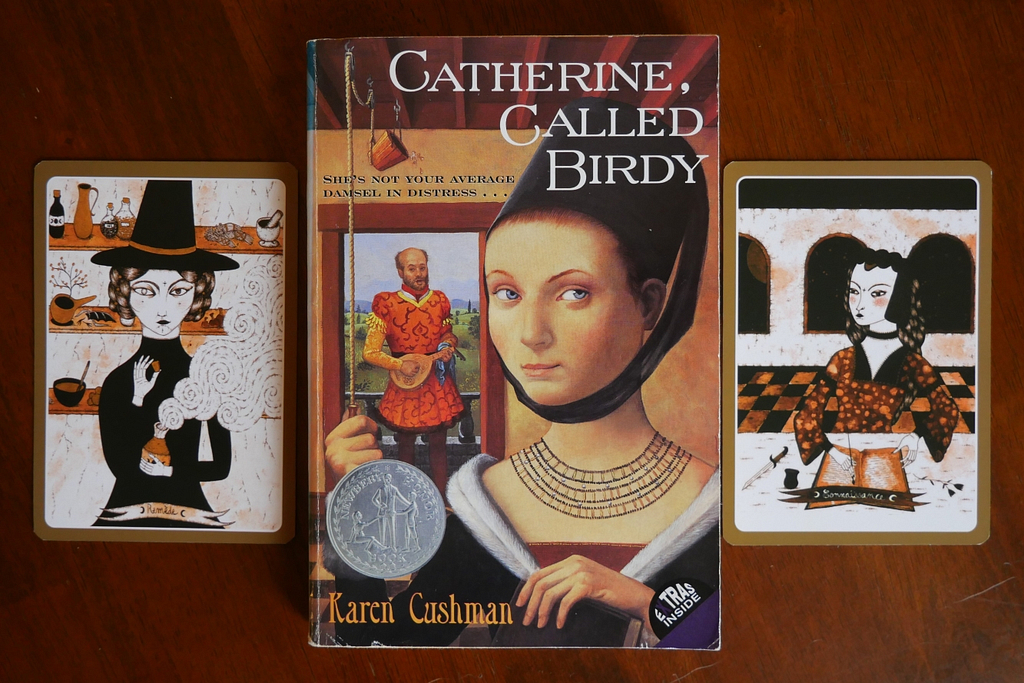
Catherine, Called Birdy is pictured here with two cards from the Oracle Médiéval et Merveilleux that are… relevant to the story. 😉
Artistically, a glance at these covers will possibly explain a thing or two about my own preference for facial portraiture and the art of the late middle ages and early renaissance. The time periods in the books vary a little more widely than the covers. I, Coriander, for example, is set mostly in Cromwellian England and the time period represented art historically on Catherine, Called Birdy is about 200 years later than the setting of the book (i.e. 15th century visuals [1] vs 1290-1291 book setting.) I was lucky enough, however, to have an aunt who overlooked things like that. For example, she focused instead on showing me how the play in perspective with the rope and bucket and the figural proportions on the cover of Catherine, Called Birdy were all little art historical jokes that the artist had borrowed from real historical painters. The implication was that if I was clever and curious, I could find them out …and I did!
Obviously there is so much to say even just about these books… so for now I will draw a few connections between I, Coriander and a few tarot and oracle decks that I have.
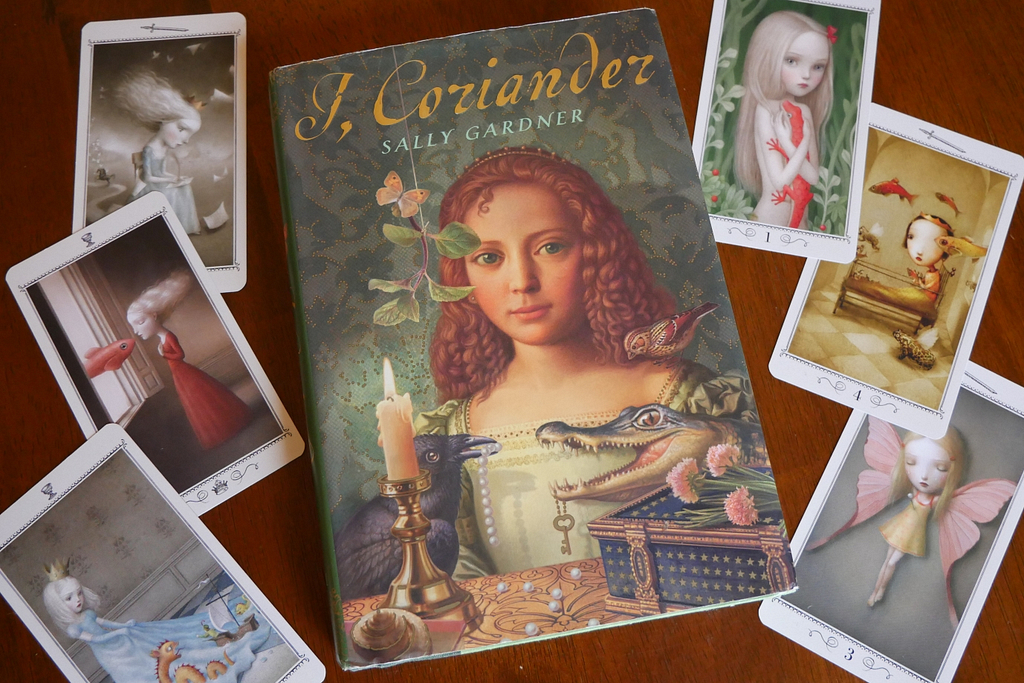
I, Coriander pictured here with selected cards from the Nicoletta Ceccoli Tarot. Once again, the penchant for strange emotionally intelligent portraiture!
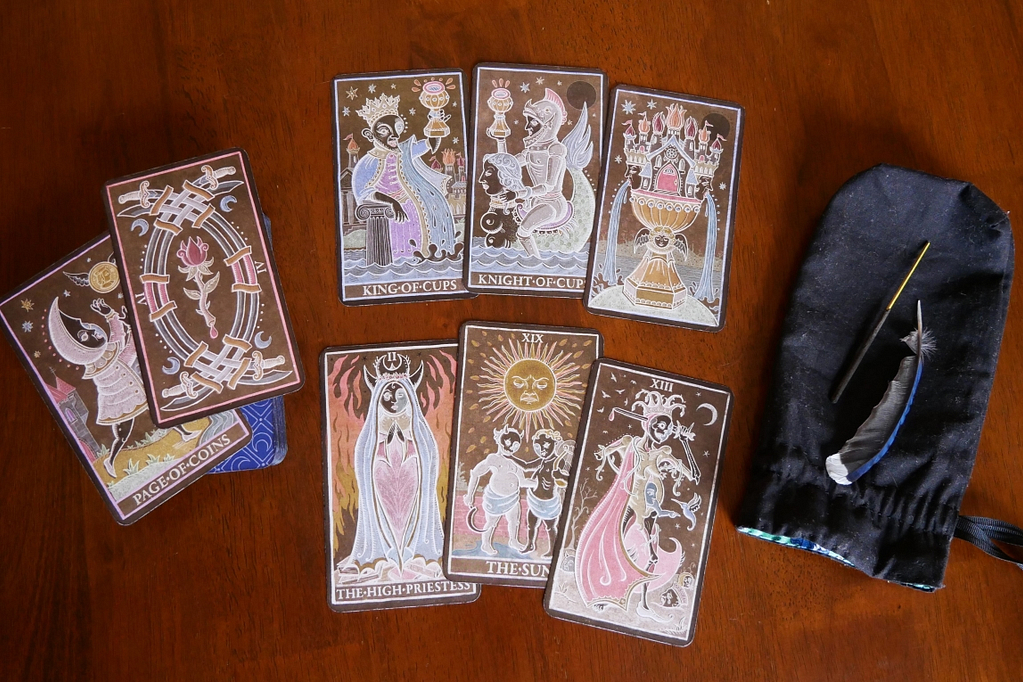
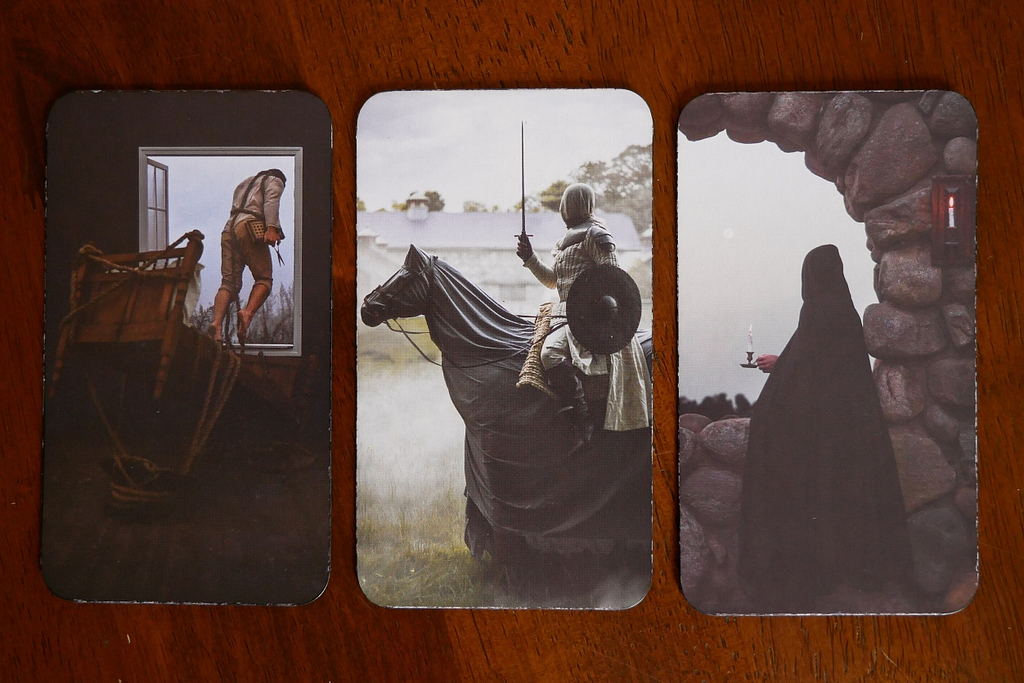
In the first place there is reference to a pair of wedding portraits in I, Coriander …a woman in the foreground holding an oak-leaf, a tiny hunting scene nearly hidden in the wooded middle-ground behind her, and a citadel in the distance. Her spouse is positioned in front of a fantastical city with a river or estuary intended (thematically) to mirror his connection with trade and the Thames. But in this city, there are mermaids and fantastical boats in the water among other things… I couldn’t help but picture certain cards from the Trionfi della Luna (paradoxical pictured below.) Or perhaps wander into a landscape just beyond the borders of such a city… might we find the world of the Somnia tarot there? People in old robes and linen shifts wandering in among the wetlands and sedge grasses gazing at the stars or riding silent sad horses?
Cards chosen from the Trionfi della Luna to mirror aspects of the story in I, Coriander… along with various imaginings of my own about the space we inhabit in the Somnia Tarot.
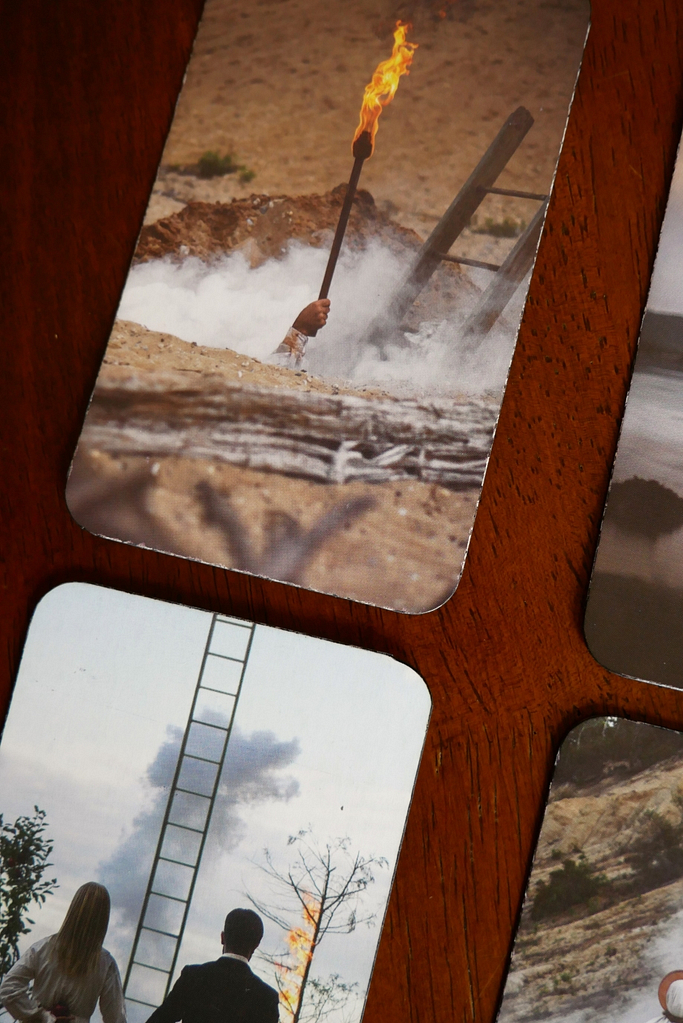
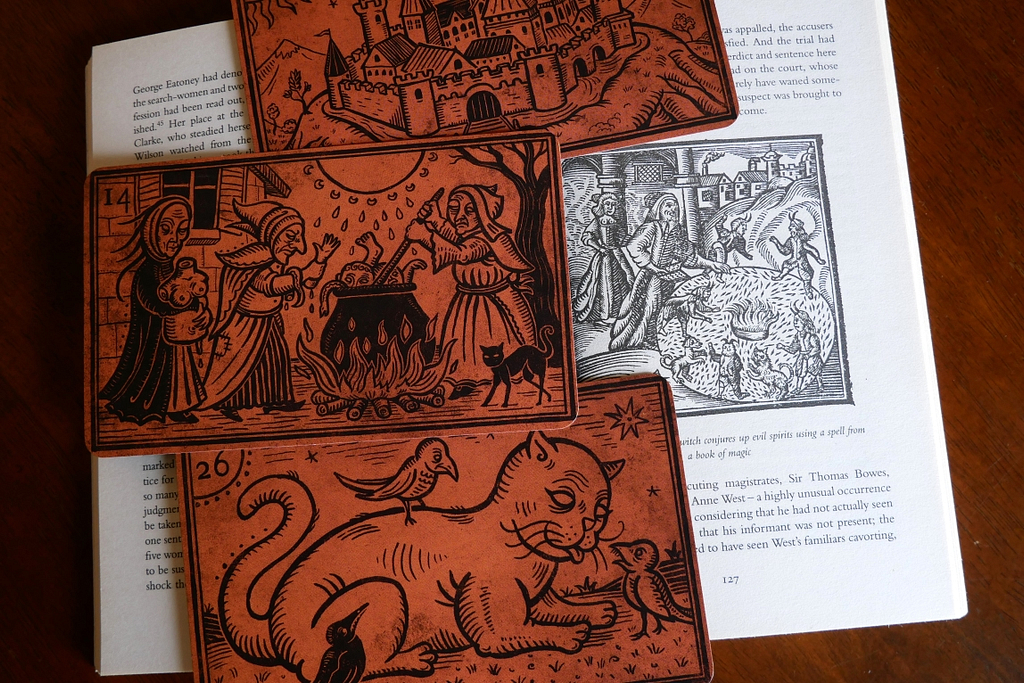
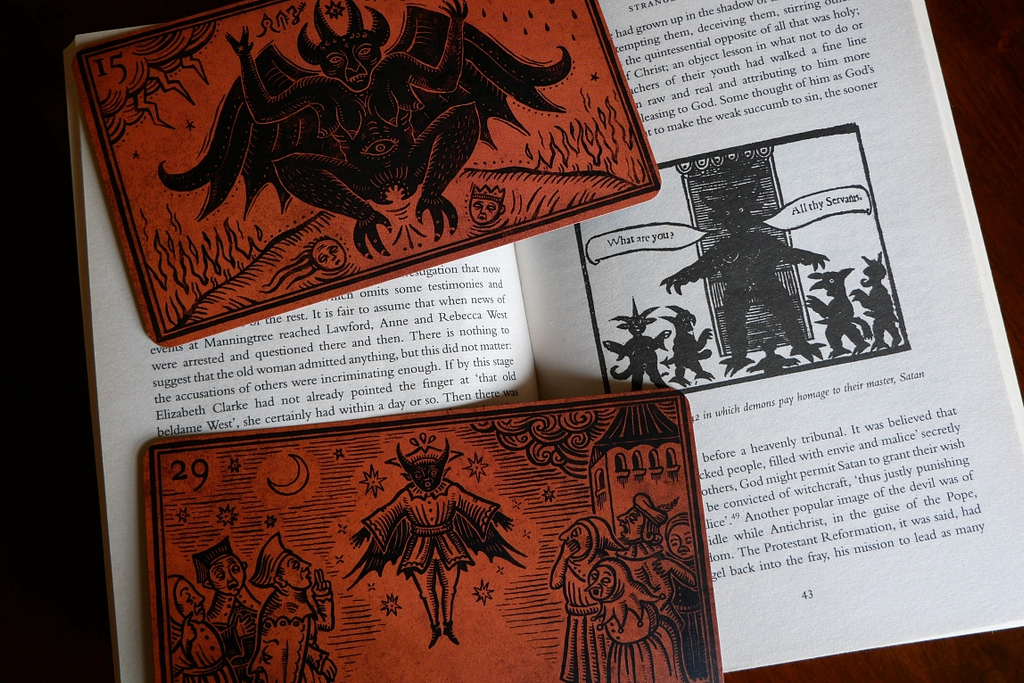
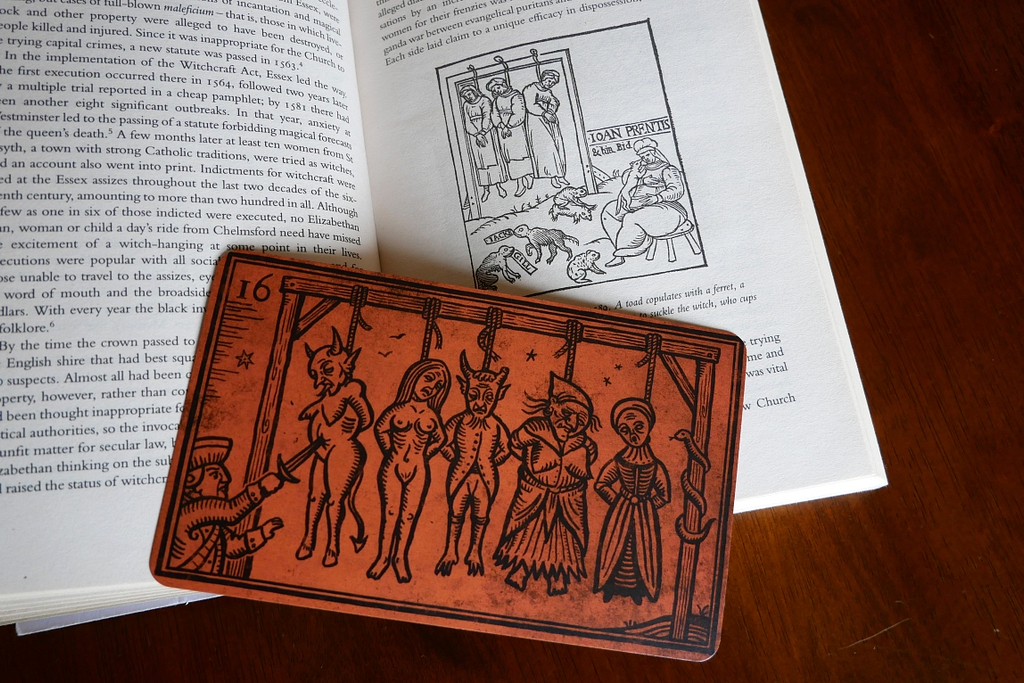
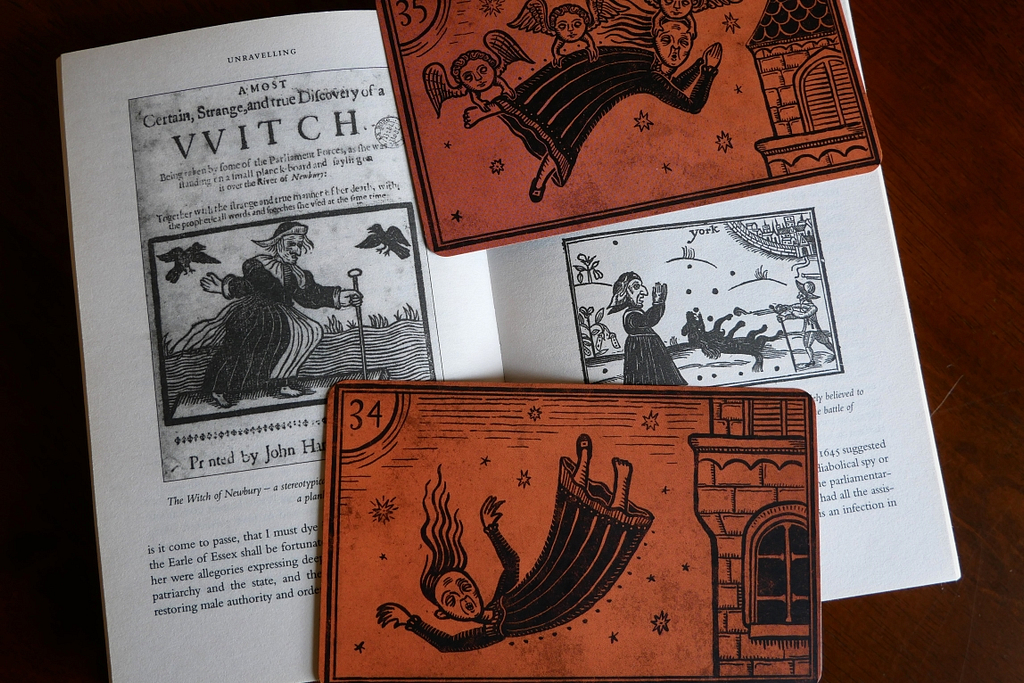
I should note I have also recently read Witchfinders by Malcolm Gaskill and am currently working my way through The Witch: A History of Fear from Ancient Times to the Present by Ronald Hutton… Of course, in so far as witch hunts in England overlapped with civil war tensions between Royalists and Parliamentarians (and occurred along Puritan vs ‘Popish’ lines), I, Coriander made for an excellent fictional backdrop! Also, I really enjoyed drawing cards from the Oracle of Black Enchantment (also by Deviant Moon Inc.) while reading Witchfinders as a visual processing exercise*.
Pages from Malcolm Gaskill’s Witchfinders featured here with various cards from the Oracle of Black Enchantment (Samhain edition.) Patrick Valenza’s art historical source material (at least in part) should be fairly evident…
Lastly, this emphasis on the detail of Otherworlds – their textiles, buildings, landscapes, emotional experiences, social relationships, flora and fauna etc. – is playing a huge role in my current artistic endeavours. I tend to see pip decks as decks full of concepts/characters (in the majors and courts) and their scaffolding and architectural surroundings (in the pips). Sometimes this visual architecture is metaphorical and sometimes it is fairly literal. It depends on the reading. But it’s also helping me to tease out what it feels like to think of tarot decks in this way and what that might mean for creating a tarot deck of my own. Furthermore, I have been rebuilding a former world of mine and have recently begun sewing some clothing that I envisioned there…
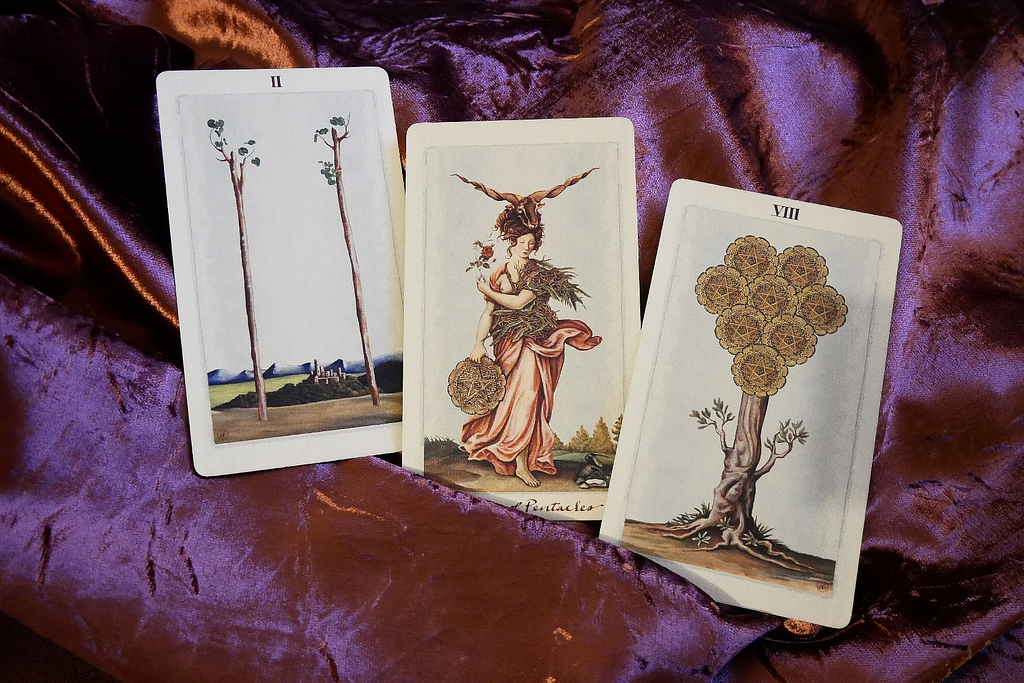
And, of COURSE, the Pagan Otherworlds Tarot… featured here over (deadstock) cognac red crushed velvet ::drool::
Perhaps the act of sewing my own clothes is really the process of bringing fairy clothes over the divide? It would explain the time traveler vibes, don’t you think? 😉
So… this post has mostly been about my own personal explorations and impressions. I plan to return soon, however, with some better grounded and CITED analytical material about art history and technique.
Sincerely,
Saoirse.
* Please note! Literally any deck will aid in visual processing or reinforcing thematic content for literally any book. There is no need to acquire any deck not already within your means or comfort zone. Decks/products/material items are mentioned here for illustrative purposes only! It’s PRAXIS that matters.
** All decks featured here of my own volition and arising from my own use of them. I have neither been invited nor commissioned to do so and I have no affiliation with any of their creators. The TdL (paradoxical) was a private gift from a friend. All others were purchased by me.
[1] See images by artists like Petrus Christus (especially ‘Portrait of a Young Girl’, 1460s) and his contemporaries. The cover here has a very Burgundian look with a single truncated hennin among other distinguishing features…
As with so many things, a simple mental association double checked through the lens of a ‘quick Google’ yields a seriously mind-boggling rabbit hole. This blog post serves as a contextual supplement to this video:
I have had the topic of names on my mind for a long time. Anyone who plays traditional music will know that the name of any given tune is, shall we say, flexible. The way in which a lot of trad music works is that any given player or performer and certainly the more reputable recording artists will cite who’s version of a tune they play, where they have introduced changes, and will often also indicate if their own regional style has affected their playing or not, etc. A living folk tradition needs both that kind of flexibility as well as that kind of connectivity and accountability.
Recently, I decided to approximate a version of Shady Grove, pilfering most of my style and technique from this OLD video by “Gretchenman” (just look at his fingers fly!!!):
In doing so, I did a quick search online to refresh my memory about the lyrics (because I do sing along sometimes when I play) and check in on some basic background information on the song. Shady Grove (Roud 4456) is mostly considered an Appalachian tune [1,2] and there is a possible link with the English/Scottish tune Matty Groves (Roud 52; a famous version of which was recorded by Fairport Convention, for example) [3]. The two songs share the same melody and the fact that one is a murder ballad and the other a song in which a woman’s name has seemingly toponymic qualities interested me from a personal gnosis perspective. Drawing wild and highly metaphorical connections in my own head, I liked the familiarity of something that sounds like a place having an almost euhemerised quality… certainly Ireland abounds with such locations and its medieval literature/mythology has whole genres and stories centered on naming places after people and people after places, or just blending the two entirely.
Now, I’m NOT claiming that there is any such analogy to be drawn in historically viable or collectively verified ontological* terms. It’s just a fun poetic exercise. Creative license, as it were.
However! The rabbit hole referred to earlier drew me from link to link: first investigating the lyrical content of Shady Grove; then to it’s Roud Index Number and associated articles about the development of the song over time (including various collections in which it is annotated as well as different known recordings of it); then to re-acquainting myself with some of the basics on Cecil Sharp (because it’s been a while). Lo and behold… I forgot a) about his nationalism and the troubled legacy of his methodology in seeking out ‘Englishness’ in music, especially in Southern Appalachia [5] but also b) that he was in other ways influenced by William Morris’ socialist lectures and …potentially also approached his work through the lens of spiritualism at some point!? 🤯
This last bit seems totally unclear to me and I am finding it hard to validate until I can actually access some of the academic articles I’ve found online [6]. (This is where I am REALLY happy to have a free external reader’s card with UCC Library…ah, the perks of living in a Uni town!) But in scrolling through the Roud listings on Matty Grove, I saw they had an entry in Sharp’s diary from the 29th of August, 1916 in which he makes use of the word “séance”.
It’s strikes me that it’s possible this word has some other meanings or context of which I am not aware (I yielded no obvious or immediate answers from a quick search online) but it would seem there are a few articles out there at least that might make this clear once I’ve had a chance to read them. In theory, it doesn’t strike me as too unreasonable because this IS a time period in which a lot of academia (especially those with nationalist or otherwise politicised interest in folk movements) drift in and out of spiritualist circles and ‘methods’ of inquiry**.
I am not sure how all of that will go yet but I also hope to read a few more recent assessments of the problems in Sharp’s legacy.
Magickally, one of the things I am doing in playing such a tune (in which I usually face my altar, by the way) is reshaping identity. Drawing creative connections on the euhemerization of names, of nouns as names/names as nouns, and asking questions of my own anthropopathism and ‘pathetic fallacy’***.
At this point, the choice to play “Flatlands” by Chelsea Wolfe and Mark Lanegan over the first part of my video should begin to make added sense.
It all comes back around to walking the razor edge between what seems appealing as a creative or metaphorical idea and what is actually academically and historically viable work. We have to be okay with their inherent dissonance. You might even call it… an art.
* Here I am using the philosphical defintion of ‘ontological’ rather than the metaphysical one!
** Giving the Golden Dawn, Theosophists, and soooo many 19th and early-20th century artists and thinkers bombastic side-eye. Criminal offensive side-eye.
*** Oop! Hello, Ruskin!
§ 9. And thus, in full, there are four classes: the men who feel nothing, and therefore see truly; the men who feel strongly, think weakly, and see untruly (second order of poets); the men who feel strongly, think strongly, and see truly (first order of poets); and the men who, strong as human creatures can be, are yet submitted to influences stronger than they, and see in a sort untruly, because what they see is inconceivably above them. This last is the usual condition of prophetic inspiration.
§ 10. I separate these classes, in order that their character may be clearly understood; but of course they are united each to the other by imperceptible transitions, and the same mind, according to the influences to which it is subjected, passes at different times into the various states. Still, the difference between the great and less man is, on the whole, chiefly in this point of ‘alterability‘. […]
§ 11. Now so long as we see that the ‘feeling‘ is true, we pardon, or are even pleased by, the confessed fallacy of sight which it induces: we are pleased, for instance, with those lines of Kingsley’s, above quoted, not because they fallaciously describe foam, but because they faithfully describe sorrow. [7]
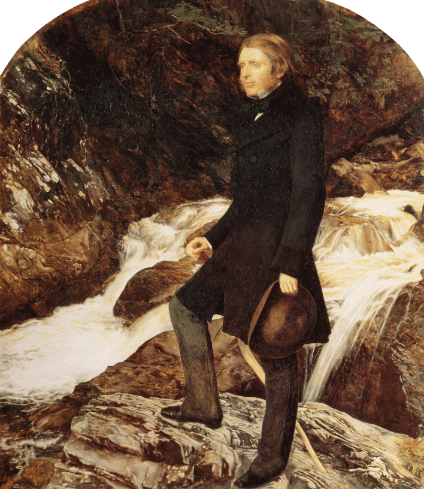
John Ruskin at Glen Finglas by John Everett Millais, 1853-1854 (Public Domain)
(1) Shady Grove (Roud 4456), Mainly Norfolk: English Folk and Other Good Music, mainlynorfolk.info/folk/songs/shadygrove.html. Accessed 6 Feb. 2024.
(2) “Vaughan Williams Memorial Library: Shady Grove.” English Folk Dance & Song Society, http://www.vwml.org/search?q=Shady%20Grove&is=1. Accessed 6 Feb. 2024. (Of note, the English Folk Dance & Song Society owns the Cecil Sharp House.)
(3) Spiegel, Max. “Origins: ‘shady Grove’ a Mondegreen ?” The Mudcat Cafe, mudcat.org/thread.cfm?threadid=131461. Accessed 6 Feb. 2024. (“Mondegreen” is my new favourite word now. Story of my hearing impaired life!)
(5) “Cecil Sharp.” Wikipedia, Wikimedia Foundation, 26 Jan. 2024, en.wikipedia.org/wiki/Cecil_Sharp#Political_Views. (Yes, its Wikipedia ~ but the citations at the bottom of the article look like they’re worth exploring.)
(7) Ruskin, John. “Of the Pathetic Fallacy from ‘modern Painters’ (Volume III, Pt. 4, 1856) by John Ruskin.” The Pathetic Fallacy, Ruskin (1856), http://www.ourcivilisation.com/smartboard/shop/ruskinj/index.htm. Accessed 6 Feb. 2024. (I have no interest or affiliation with the author of this site as a whole, this link is simply where I have accessed an online free readable copy of Ruskin’s writings on the Pathetic Fallacy.)
As some of you will know, I was honoured earlier this year to be able to interview Linnea Gits of UUSI specifically about the art and artistic process of creating her very well known “Pagan Otherworlds Tarot”. As noted below, a copy of the deck has been acquired by the MIT Libraries’ “Distinctive Collections” project but it has also seen multiple print runs over the years. As an indie deck originally released in 2016, it’s a good example of a deck in continuous demand as well as rewarding long-term study, curiosity, and use.
I have kept the transcript below limited to the conversation I had with Linnea. My aim is for this post to function as a companion to the video I made about the interview as well as a reference piece in its own right. However, I have also explored some of my own ideas and personal associations with the POT in a dedicated playlist on my channel.
I hope you enjoy the interview as much as I did!
—
Process / Technique
Sorsha – The Pagan Otherworlds Tarot is well known for the quality of paintings it offers to its readers. Can you tell me a bit about the process for creating the deck?
How did its conception/aims/themes guide your choice of medium or technique?
Linnea – “As with all our work, traditional mediums become the backbone of the artwork as they lend the imagery emotional energy that computer-generated imagery cannot. We chose oil painting for Pagan Otherworlds because we felt traditional oils would give the imagery a richness and depth that is hard to achieve in other mediums. We also loved the long history of this medium’s use in fine art painting and felt it would elevate the work into a powerful space in the imagination.”
Sorsha – For those who are artists or painters themselves, can you tell me a bit about your preferred methods – preliminary sketches, stylistic choices, color palette, brush strokes…
Linnea – “I think the second most important aspect of our creative process is that our work is made with a particular purpose and use in mind and almost always has a strict deadline for its completion. We do not have endless time or money to work with, so each step has to be as efficient as possible. We usually begin with a mood board comprised of images and colors that we are inspired by for the particular project we are creating. For Pagan it was a lot of Renaissance paintings and botanical paintings. There is about a month or two of pushing that imagery, sketches, and ideas around on paper and the computer working out the style, content, techniques, and rough compositions. Once we feel the work becoming fluid, we move into the final hand-sketched pieces and, as with Pagan, the final oil painting once all is roughed out.”
“One thing to note: A lot of people think that the paintings for this deck are on large canvases, but we never work that way with our decks. We generally work in a 9″ x 12″ format as we create work for a 3″ x 5″ card, and working on this scale allows us to move quickly through paintings and keeps the imagery focused on the essential message it is expressing. We also need to be able to scan all the artwork so we can bring it to the computer to set up the files for print. Large canvases would require a much more expensive and time-consuming documentation process to get the imagery into the computer and ready for print files.”
“Are there any digital component to the images? Were the cards approached in a layered fashion (such as background, foreground, suit elements on top?
In terms of possible digital components, I imagine deck creators must face a lot of repetitive imagery across the tarot system. It seems clear that some kind of digital layering would be useful in keeping the minor arcana cards visually consistent with each other. Are there any particular ways in which you approached this?”
“We did not create any of this art digitally, but we do use the computer as a tool to edit, compose, and touch up the paintings in preparation for print files. For Pagan, we started by creating the suit symbols for the deck and a calm, blue-painted background that would be the canvas for all the cards. This working process allowed us to scan the suit symbols, cut them out in the computer, and then arrange them on the simple, painted background. As we moved forward with each painting, we were constantly bringing the artwork into the computer at the very beginning to see how it was reading in its card format. You don’t want to get too far down the road on a painting only to discover you should have moved an object lower in the artwork so it doesn’t compete with the suit symbols or that the forms are too heavy and are overwhelming the card. A lot of this process was felt as I worked, but I have found that keeping an eye on how it looks in its final card format helps me from overworking a composition and also brings a very effective edit on the overall structure of the piece.”
“Whenever possible, we want a complete painting. Still, there are times when we have had to photoshop a painting to remove an unnecessary object, or even in the case of the King of Swords, for example, to cut off his hand in the computer, repaint a better gesture, scan that painting and paste it on to the final painting in the computer. Basically, there are no strict rules on how we work the paintings, as the most important thing is that, in the end, the final piece communicates and expresses the essential meaning of the card.”
Sorsha – A question for Peter Dunham!…What kind of ink and pen did you use for the lettering work?
Linnea – “Peter used Japanese ink with “Brause” pen nibs.”
Art References
[I asked a range of questions that Linnea collated together into a single answer. Below, I have listed some key examples of the questions I asked – to give a sense of the direction I was pursuing – followed by Linnea’s wonderful answer!]
Sorsha – The deck has been chosen as an MIT Distinctive Collections acquisition – which is focused on expansive, socially progressive, inclusive decks; decks that innovate the system of Tarot; and decks that have pushed the boundaries of the publication industry (such as with the development of Kickstarter and crowdfunding). I think it’s also a prime example of an ‘art-literate’ deck… Can you tell us a bit about any possible art historical references in the deck?
*I have mentioned the Vienna Dioscurides bramble online before but I also suspect I see the influence of Ithell Colquhoun in the 2 of Cups (for instance)… are there any other moments like this in the deck?
*What was that process like?
*Was this part of your previous approach to art – either personally or through any particular form of education/career work?
Linnea – “The Vienna Dioscruides bramble!! When I was moving through the artwork on this deck, that work was one of the first inspiration pieces that I pinned on the mood board. It had an incredible feeling of being scientific and incredibly expressive – it was art as its most alchemical.”
“The PO artwork started with the Major Arcana. When I got to the Minor Arcana I had been painting about 6 hours a day for almost four months. But when I started the Court cards, I suddenly felt the whole deck click into place. To me, the Courts defined the look and feel of the deck more than the Major Arcana. The Courts are where it all came together and are some of my favorite paintings in the deck. Re-energized by that work, I moved into the “pip” cards. We had decided to keep people out of the pip cards as we wanted to leave space for nature to shine. We wanted an “ego-less” space that accepted whoever entered it – a place of contemplation that would calm, energize and clarify in that unique way you experience when entering nature.”
“The VD bramble just throbs with this kind of energy. It was a touchstone for this deck, and I knew I had to find a place to slip it in. I wanted to bring something old and magical into the work, but my intention was to recreate it, not collage it. So I dropped it into the 10 of swords composition on the computer as a place-holder and moved onto another composition. However, I was moving so fast at that point through the pip paintings because we had less than a month to complete all the artwork and set it up for print. To make our deadline, I was now working at a speed I was feeling uncomfortable with, and I never did repaint the VD bramble – it ended up in the deck without my realizing it until the deck was being proofed, and by that point, there was no more time left for painting. It felt a little magical, though, that it had snuck its way in, eager to reincarnate in a modern era inside the spiritual object of a tarot.”
“I am unfamiliar with Ithell Colquhoun, but The Two of Cups is another special piece for me in this deck. Many years ago, I read an article in National Geographic about the sandstone arch formation known as the Eye of the Needle. It is located along the upper Missouri River in South Dakota’s Black Hills along Needles highway and was formed by the water and wind of deep time. From where the photographer shot it, you looked through the “eye” down what seemed like an endless stretch of river to a setting? rising? sun. It appeared that the two stones had pressed their heads together and created this beautiful river dream together. The elements passed through and around them, down the shared river dream that reflected the sky in its pale-blue, glass-calm eternity. Enchanted, I cut the photo out of the magazine and placed it in the top corner of our studio mood board. I had no intentions of using it for anything, it just filled me with peace and joy. It was there for over ten years. And then, one day, it asked to be included in the PO tarot and it knew exactly where it what it wanted to be – in the Two of Cups.”
—
I will end with the closing remarks I sent Linnea in our correspondence:
“Personally, I have deeply enjoyed exploring this deck with the aim of asking questions. As the guidebook states, this is part of the purpose not only of this deck but Tarot and mysticism as well. In my opinion, one of the really luxurious and needed aspects of this deck is its open, quiet quality. In a world of fast movement and frenetic decision-making, a little ‘meandering mysticism’ and dreamlike vision is both a tonic against a demanding world but also a challenge – the Otherworld is liminal, we pass through, inhale deeply, walk on, and eventually return somewhat changed. (And of course, the border is never very far away.)”
That’s all for now. Safe travels in your journeys over the border & happy card reading!
~ Sorsha.
Notes – some useful links about the art mentioned in the interview as well as all UUSI related links!