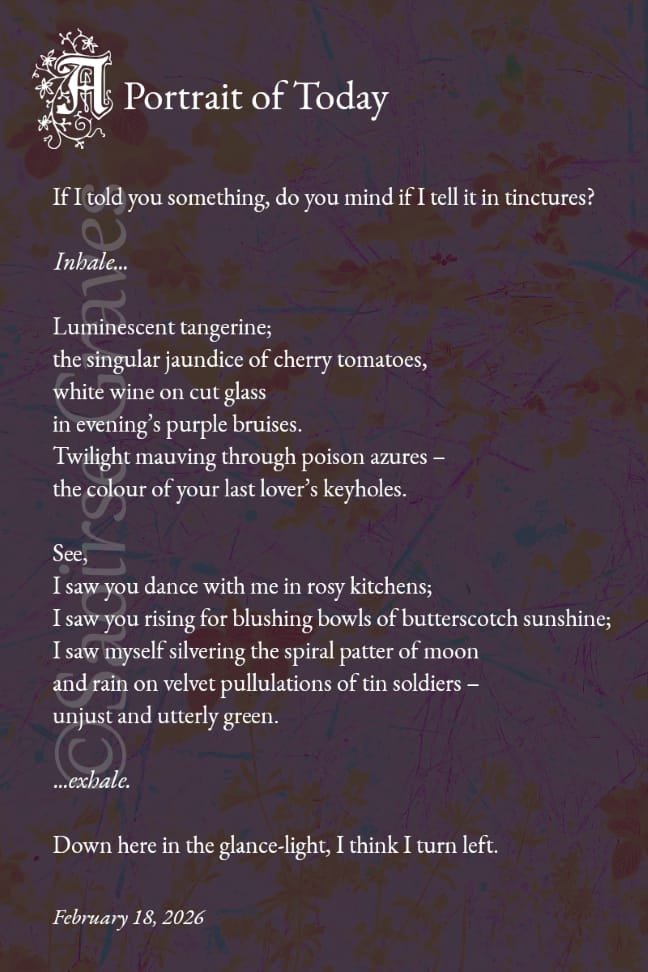
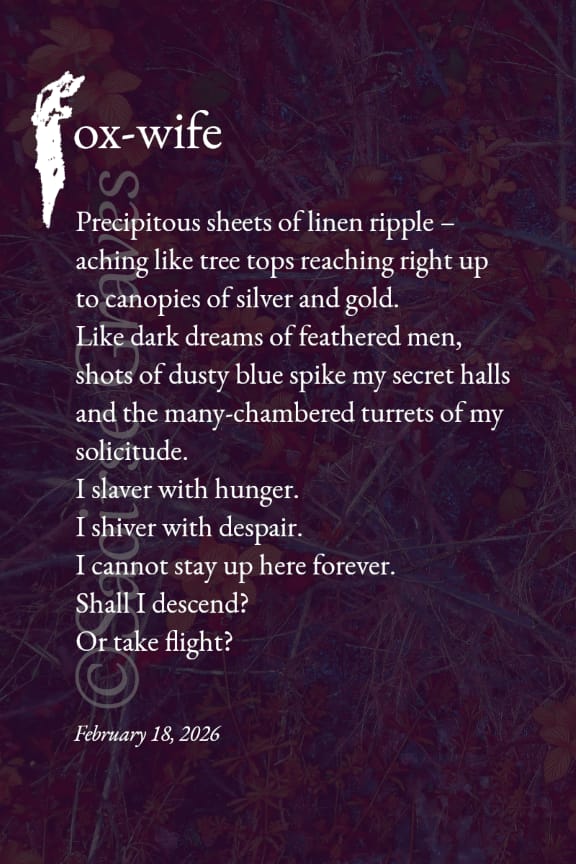
Sitting in my weedy lair, thinking over creative ambition, doors between worlds, and the way witchcraft works wonders – staring out at blackbirds, hooded crows (and a wren!) flitting between drifting spells of rain – I finally finished two poems.
The first, paradoxically, took over a month.
If fantasies are fractals, then Death is periwinkle.
The second was a classic case of how most of my poems emerge… “No-facing” them up from the gut and barfing them all over the page like so much ectoplasm.
The winter weather continues but I’m not sad about it. On Imbolc, I went for a river-side walk for several hours. Starting in the morning mist and ending in the midday sun through fields and several different woods, my partner and I saw two grey herons fly overhead with sticks in their beaks. The Cailleach gathers firewood! Six more weeks of winter. As it happened, we also saw their nesting place: five full grown grey herons perched in the tree tops overhanging the edge of the river… uncanny in their beauty.
~ Saoirse.
(Decks shown: “Trionfi della Luna (Paradoxical)” – 3 of Coins, Knight of Wands, 2 of Coins – and “Oracle médiéval et merveilleux” – “Colère” – in inverted blacklight)
PS. A personal reminder, “Eviscerate” by Faetooth playing as I post this <3
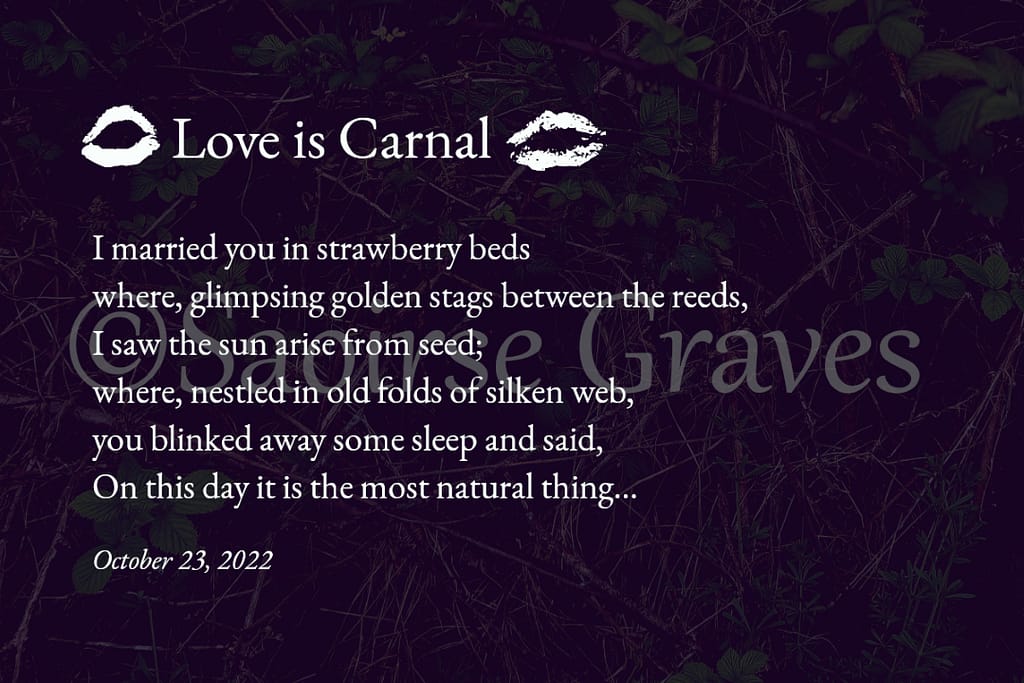
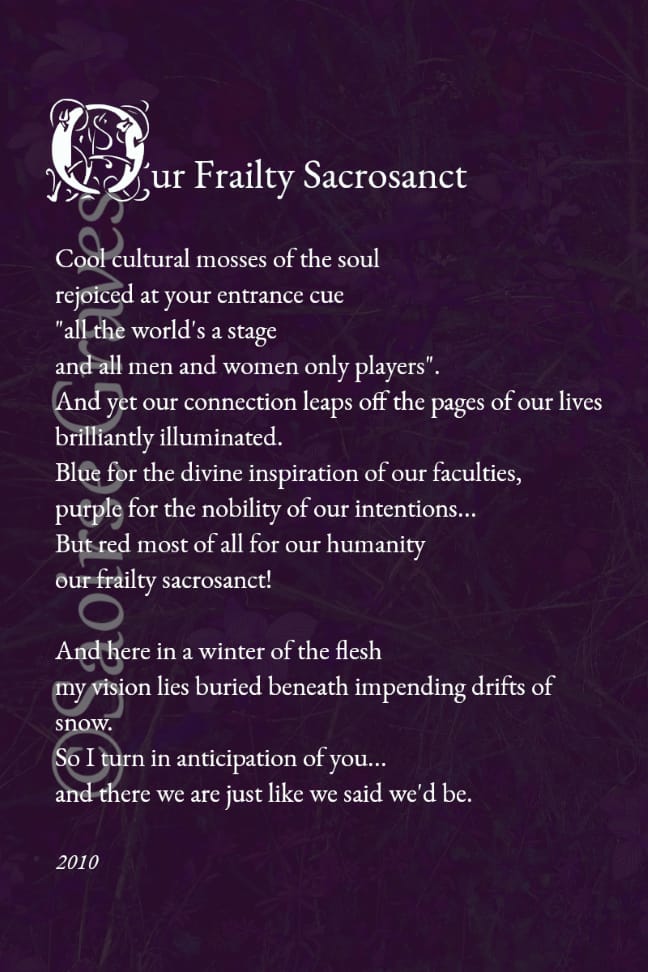
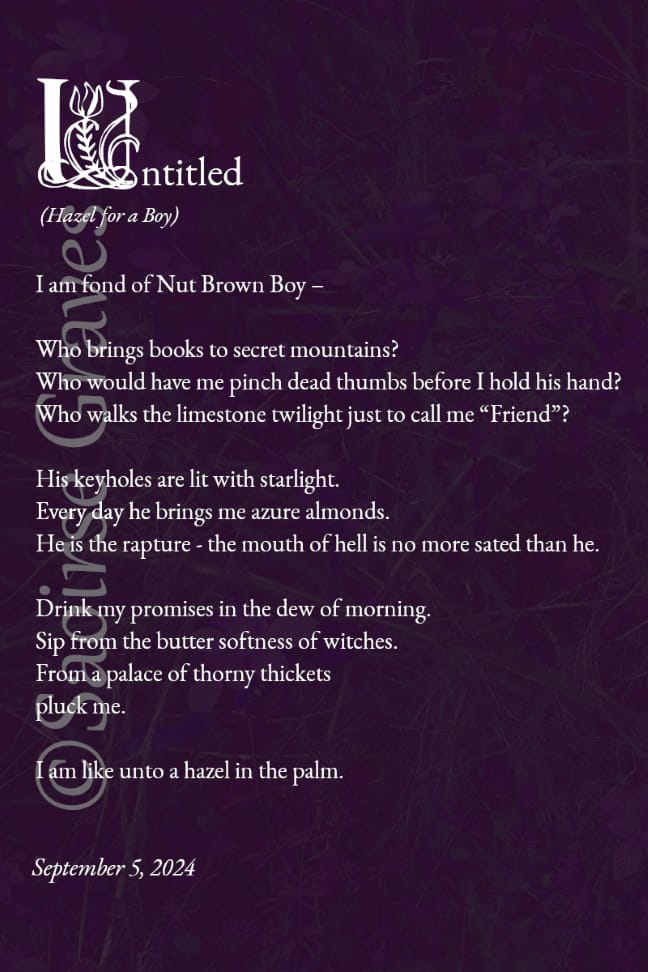
Love poems are undoubtedly the hardest for me to write. I have composed only a handful that I consider successful in my life time. Here are three of those, all about the same person ^_^ You may note the ‘marriage’ of medieval mysticism and Pagan Otherworlds.
Poetry is such a meandering thing. I can’t say I’m the sort who works on the art of writing poetry or who reads widely or consistently to better acquaint myself with the source material… at least, I don’t do this with the kind of structure or consistency that makes sense to declare anywhere on the internet! But I care very intensely about developing a style, voice, and a sensory reality.
My sister writes BEAUTIFUL poetry that is much like her dreams – often in the style of epic narrative. With a temporal flow and an arc of completion. She once pointed out that my poetry evokes vignettes of mood and sensory experience. A window into a brief mystical moment. This is incidentally also very much like my dreams (albeit with the added potential for positivity since my dreams are almost exclusively terrible & terrifying… horrific, gothic, sublime.)
I am firmly of the view that poetry should be read aloud. At least, MINE should be… with breaks (or ‘rests’?) only as dictated by punctuation, rather than (GASP! HORROR!) at the end of every line. If you take into consideration that much of what I’ve written has included direct musical reference (in addition to those that can already be achieved through metre and so on), you may see that I *try* to extend the audio-visual to include music and dance.
Thus, in the poem “Untitled (Hazel for a Boy)” the hazel in the palm is a reference to the writings of Julian of Norwich on the nature of love… and I have layered this with a common trad descriptor of young beloveds: (nut) brown boy/girl. One long standing favourite of mine is “Ille Dhuinn, S’ Toigh Leam Thu”
The Scottish Gaelic lyrics are as follows:
’Ille dhuinn, ’s toigh leam thu,
’S toigh leam fhìn thu, laochain;
Mas toigh leat mi, is toigh leam thu ‑
’S gur òg a thug mi gaol dhut.

Dh’fhalbh mi mar a b’ àbhaist dhomh
Air sàillibh coimhead chaorach ‑
’S beag a bha dhem fhor orra,
’S mo leannan air a’ chaolas.

Nuair dhìrich mi suas Criongrabhal,
’S e m’ inntinn nach robh aotrom ‑
Bha ’m bàta mach gu Saighdeanais,
’S i toidhdidh fo cuid aodaich.

’S ann a their mo phàrantan
Gur tàmailt leotha m’ fhaoineas ‑
Gum faighinn fear na b’ fheàrr na thu
Le bàtaichean ’s le birlinn.

Ged gheibhinn fear na b’ fheàrr na thu
Le bàtaichean ’s le birlinn,
Gum b’ fheàrr leam fhìn an gille donn
Is e gun bhonn dhen t‑saoghal.

Ged gheall mi dhut gun leanainn thu
’S gun dealaichinn ri mo dhaoine,
Cha d’ rachainn dha Na Hearadh leat
Air cheannachd air an t‑saoghal.

Ged a bhithinn pòsta riut
Is còir agam air d’ fhaotainn,
Cha b’ fhada bhithinn beò agad
’S an Dòmhnallach às m’ aonais.
In English:
Brown-haired lad, I’m fond of you,
I’m really fond of you, boy;
If you’re fond of me, I’m fond of you-
I’ve loved you since I was young.

I set off as usual
to look for the sheep
but scant attention gave I to them,
knowing my beloved was in the strait.

When I climbed Criongrabhal,
my spirits were low –
the ship, with well-trimmed sails,
was out near Saighdeanais.

My parents say that
my foolishness is a source of shame to them –
that I could attract a better man than you,
an owner of ships and galleys.

Though I could have a better man than you,
an owner of ships and galleys,
I would much prefer the brown-haired lad
though he hadn’t a penny in the world.

Though I promised you I’d follow you
and part company from my people,
nothing in the world
could induce me to go to Harris.

I wouldn’t survive long if married to you,
while pining for MacDonald.
Note that in Scottish Gaelic as well as in Irish the manner of describing hair colour is to pair the colour with the type of person directly, e.g. brown boy. The translation above opts for the “brown-haired” descriptor to make it clearer in English.
There are many other examples of songs that make reference to a nut-brown colour (many of which are super cringe tourist favourites here in Ireland) but this is the one that I have most often in mind due to it’s melancholy sound and its emphasis on the difficulties of separation and limited finances. Having formed and kept a bond across the Atlantic … between worlds, over nine waves, across time and space… lends itself quite well to the shared lore of our relationship. Indeed, this kind of poetic layering also lends itself to the spellbound witchy otherworldly quality of being fascinated and devoted to any human person other than myself. <3
Another such colour symbol, of course, is the azure blue… the medieval link with lapiz lazuli and text illuminations. Or the blue-grey/blue green (glás!) of the sea. The list goes ever on and on.
To my chosen person: “I have walked the world to find you. I’ve worn out the soles of three pairs of iron shoes and my hair is no longer red. But I come to claim you…”*
~ Saoirse.
*From “Hans, My Hedgehog” in Jim Henson’s The Storyteller
I mentioned in last week’s video (“Who Painted the Lion?” or “Medieval Shadows & Cards of the Year”) that I have begun exploring academic perspectives on medieval magic. The first thing of note is a fairly baseline agreement on the historical distinction between ‘magic’ and ‘witchcraft’ (something we see holds true in the early modern period as well through secondary works by the likes of Ronald Hutton etc.) The second thing to highlight is that, as with most things, this is an entire academic discipline and a developing one. My intention is to pursue the points that interest me and then see how it feels to relate some of that back to my own work as a modern practitioner of ‘medieval-infused’ witchcraft and art magic.
The aim of this post and any others like it (e.g. capering treacherously on the border, with historical research or context on one side and personal gnosis or numinous magic on the Other) is simply to show ‘process’:
How do I gather ideas or inspiration?
When, how, and why does that inform my magick and art?
Why might that lead to further UPG (Unverified Personal Gnosis)?
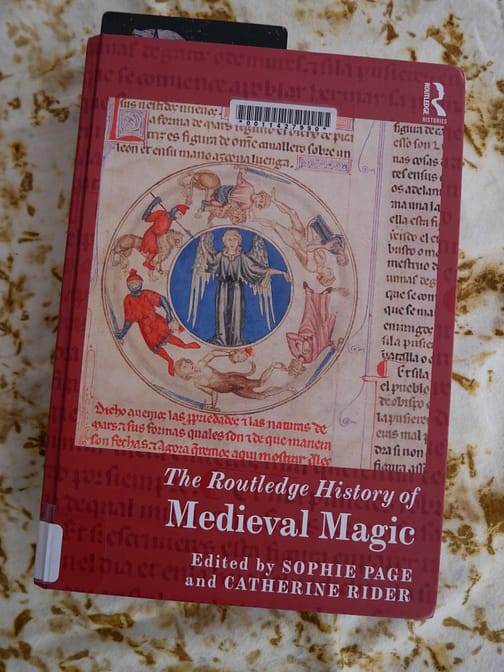
For now, I’ve started with “The Routledge History of Medieval Magic”, edited by Sophie Page* and Catherine Rider and published in 2019. The main goal of the book is to show the current standing of the field but also to illustrate various directions in which it needs expansion. It’s less an overview of what has come before and more an academic call to action with each chapter serving as useful examples, or signposts, for further research. Yes please!!!
Part I, Chapter I: “Rethinking how to define magic” by Richard Kieckhefer presents some interesting ideas surrounding why magic is difficult to define (even for academics! We’ll steer clear of the choppy waters around definitions of magic and witchcraft in modern practice on this blog!)
Concepts that caught my eye came up as he was establishing his main system of “aggregating terms” vs. “constituitive terms” (pp. 15-16) – i.e. the vague umbrella terms like ‘magic’ vs. better defined component parts. He draws a comparison to the term “mysticism”. Like the word magic, ‘mysticism’ resists attempts at explanation and evokes many different ideas or impressions of what it is.
“A comparison may help. It has long seemed to me useful to think of mysticism […] not as a single phenomenon but rather as a cluster of phenomena that may at times be distinct but tend to become intertwined. There is mystical prayer, mystical relationship and mystical consciousness.” (p. 15)
In the medieval Christian context,
mystical prayer – involves “fervent and intense, highly concentrated, focused prayer, cultivated within the setting of the contemplative or monastic life.”
mystical relationship – Kieckhefer represents through Bernard of Clairvaux or “the German sister books that are deeply steeped in “theoerotic” relationship […] with Christ.”** This is the view in which one might ‘burn with love’ for deity.
mystical consciousness – Kieckhefer says can be found in the vernacular sermons of Meister Eckhart “who wants his hearers or readers to gain a lively awareness of God’s presence within herself […] and her own true and eternal presence within God.”
Kieckhefer clarifies that these may all be combined in different ways by a single medieval writer. His example is the writing of Teresa of Ávila. (p.15)
I’m already interested in the murky waters of mystical thinking… not to mention words like “theoerotic” (which, incidentally, might be more readily available to the imaginations of non-Christian devotees of deity or deities).
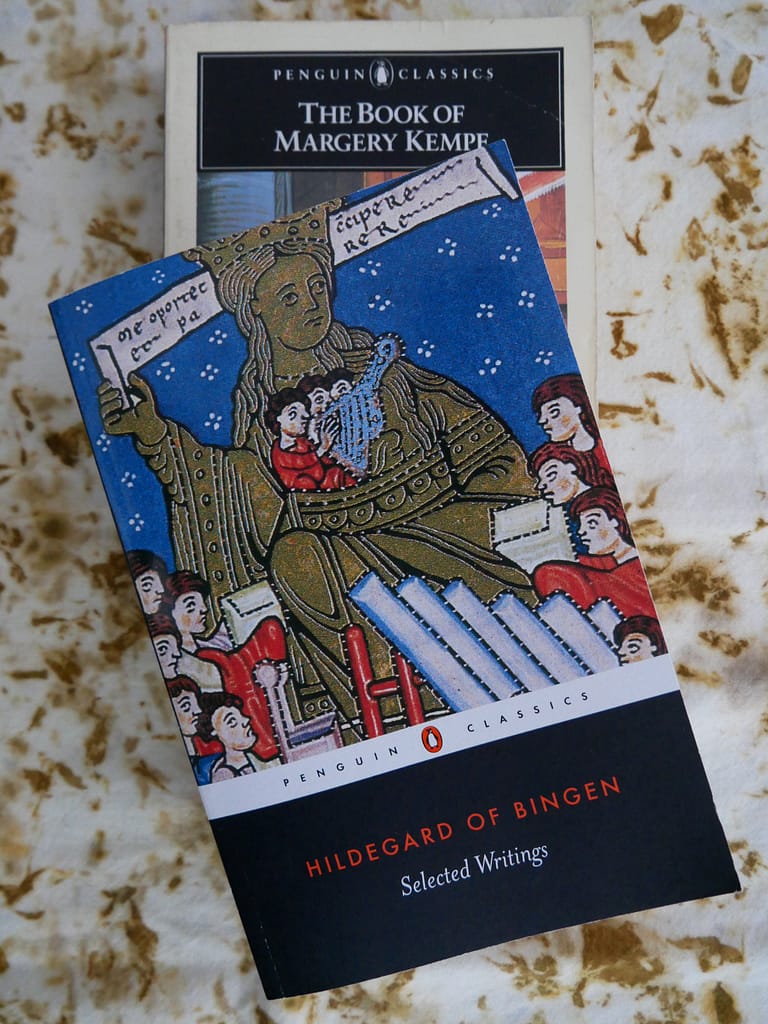
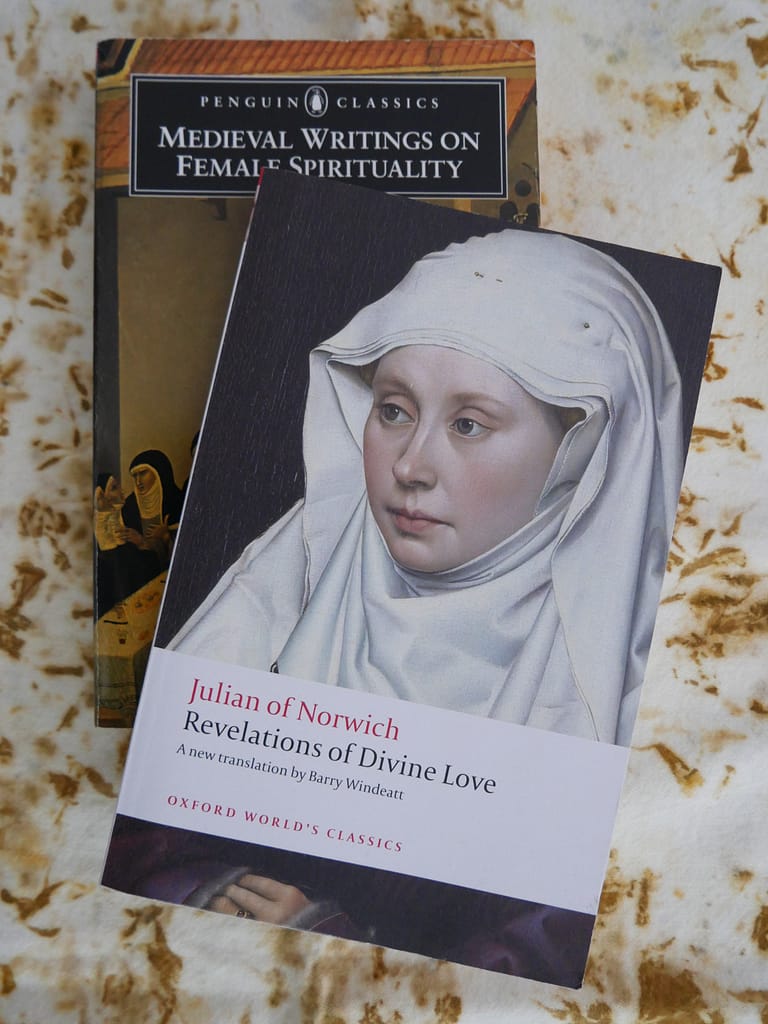
**Some books on my ‘TBR’ taken from my atheist partner’s bookshelf (who’s shelf SHOULD these belong to? Squabbles abound.)
However, coming back to the aggregating term of ‘medieval magic’, Kieckhefer offers at least three options for its constitutive terms: conjuration, symbolic manipulation, and directly efficacious volition. (p. 17-18)
Honing in on symbolic manipulation (hello, art witch here!) Kieckhefer says some really juicy words:
“If a plant shaped like a liver is useful for healing the liver, it is in that sense a sign of what is thought to affect, and the intelligible resemblance is what effects the healing. […] If conjuration is a reprobate branch of religion, symbolic manipulation claims an efficacy like that of science and will be seen by its practitioners as a type of science. The magician who manipulates symbolic links in the natural order might be thought of as tugging on invisible cords that link one level of that order with another. The symbolic links may be articulated in terms of cosmic correspondences and sympathies, at least in sources that provide theoretical grounding for magical practice. If the invisible cords are not thought of as efficacious symbolically, then the process is not magical; the user may not be told explicitly that symbolic links are entailed, and may simply be assured that the results are tried and proven, but in magical operations, the symbolic causality is at least implied by the types of word, ritual and object used.” (p. 17)
Taking this historical analysis and running wild with it in the modern day, I think the analogy of tugging on unseen cords of meaning is just…poetry. This may also provide a very useful visual for what some modern practitioners mean in their discussions of magical correspondences or energetic work. In my view, this perspective posits a model for developing personalised magical symbolism in art as and when it feels creatively powerful to do so. Whether the ‘invisible cords are thought of as efficaciously symbolic’ might be the keystone for agency in that approach. If I were to use the language we have explored here in Kieckhefer’s chapter, then to be an art witch is just as much the work of developing artistic style, an individual (and recognisable) ‘voice’, and recurring visual motifs that – when aggregated – convey an added layer of meaning in the whole that is the finished piece. In other words, they constitute magic.
Art must also speak for itself… but in theory, part of the magick that heightens its efficacy might lie in some of the following: symbolic connections forged by the individual artist; the time spent exploring the meaning of what they want to do or say; practicing techniques for how that might be rendered; and strengthening those motifs (‘correspondences’) over time. Perhaps this is contained in colour choices? Or recurrences in textural play? In different media? Or in more literally repeated visuals like egg symbolism?
I’m reminded of the medieval Irish approach to manuscript illumination and prayer…where the word and all its colours and symbols IS the prayer, IS the presence of the divine in an even more literal sense. (A famous example being the Chi Rho page in the Book of Kells.)
I would very much love to hear your thoughts in the comment sections! How do you feel about the way your creativity or your magick comes together or what that process entails? What do you think about sources of inspiration and how that becomes magickal for you (whether you make art or not!)?
Incidentally, medieval Ireland, medieval Celtic magic, and how that might impact art witchery will be the topic of Part 2 of this post. I’ll leave you with that cliff-hanger – mainly due to space and time constraints – and hope very much to see you there.
Page, Sophie, et al. “Part 1, Chapter 1: Rethinking How to Define Magic.” The Routledge History of Medieval Magic, Routledge, Taylor Et Francis Group, New York, NY, 2019, pp. 15–18.