Hm. This does not feel like one of those moments where I may triumphantly declare:
“I made an Oracle Deck!”
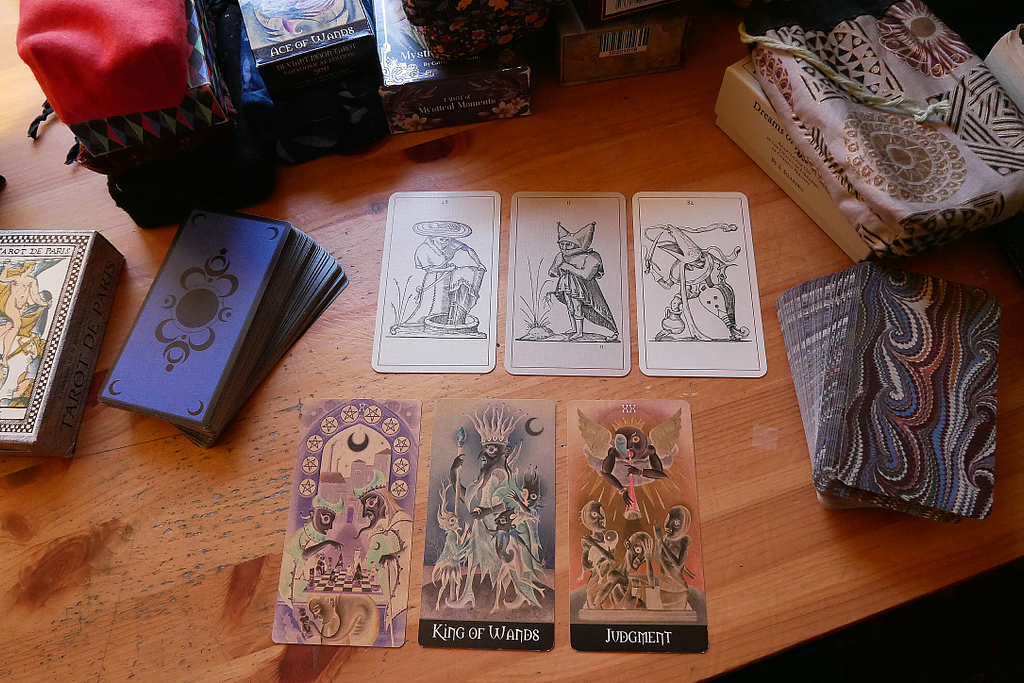
As it happens, I did make one …only I didn’t. It’s called “The Dreams of Pantagruel Oracle” and it is part magical tool, part divination method, and part the extended overtures of a rare old book nerd. The ‘book’ in question is “The Drolatic Dreams of Pantagruel” (original French: Les songes drolatiques de Pantagruel) – a public domain reproduction from 1869 of an original volume from 1565. (See introduction/companion booklet below for more!)

Pantagruel is a giant – a character invented by Francois Rabelais in Renaissance France – whose escapades (and those of his father, Gargantua) form a collection of scholastic, social, and religious commentary as well as baudy, irreverent, often inebriated stories…aimed, it seems, at delighting and enraging the social order of 16th century France.
I did not draw these images… Neither did the 19th century publisher (Tross) of the volume from which they were taken… Neither did the 16th century publisher (Breton) of the volume from which that publisher reproduced them… Neither did Rabelais himself, to whom Breton attributed the artistry of these images… Learned discourse suspects it was illustrator/engraver Louis Desprez who produced other work for Breton in a similar style.
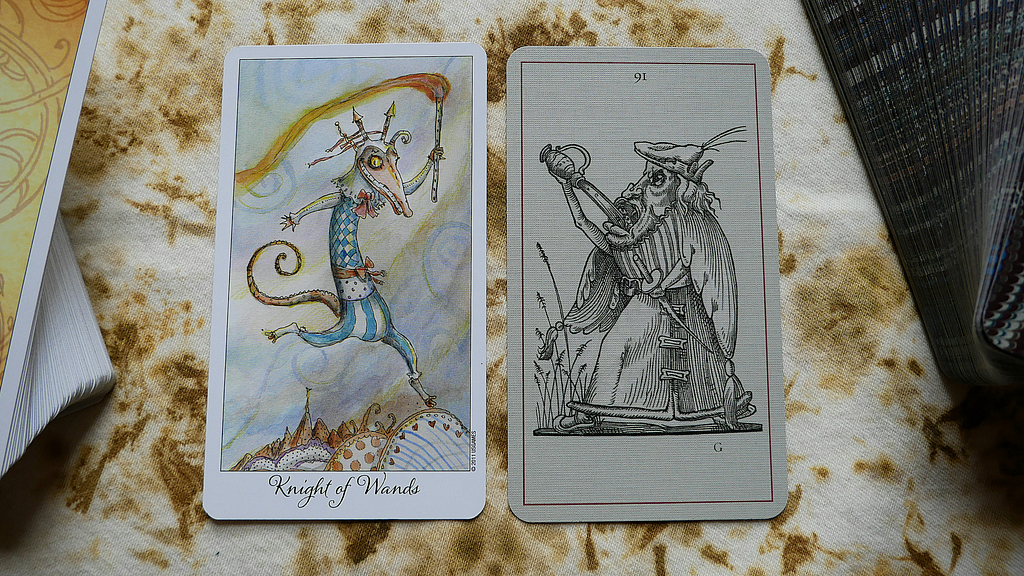
The deck has 123 cards in total, measuring 2.75” x 4.75” (70mm x 120mm) in linen card stock and they are now available on MPC.
In the shoplisting I promised a PDF booklet introducing the deck – it includes some basic historical information, some indications of why I made it (other than just wanting it to exist), asks some questions, and leaves the door very wide open for any manner of uses at the total discretion of those who choose to acquire it. It also includes citations!!!
What follows are some of my own personal initial thoughts about the deck at this time. My journey in using these cards has only just begun but here goes…
Firstly, I am very interested in the weird ‘Bosch’-like world to be found on the margins of society. I like to ask myself questions about how society asks questions. Having worked in different kinds of archives over time, fulfilling queries for different kinds of researchers on different topics, it’s astounding just how much the assumptions in approach inform (or limit) retrieval and results. Of course, the way information is catalogued can also skew things… as do ‘hidden collections’ – collections that exist but are horribly back-logged, invisible until allocation of resources and social priority allow ‘us’ to ‘see’ them.
Secondly, I’m interested in the shapeshifting nature of personal characteristics but I want to be very clear that, in my opinion, equating moral or social value with physical appearance is unacceptable. There is enough work on our hands to undo tropes around ‘disfigurement = sign of evil’ in fairy tales and fantasy without adding to it through the misuse of our creativity going forward. The characters in this deck are not automatically marginalised or considered unfavourable. The worldview that created them was flawed (for one thing Rabelais, author of the Gargantua/Pantagruel stories was definitely sexist!) and the worldview of ‘curious persons’ who view and respond to these images will create what they bring to the deck… to put it bluntly.

Thirdly, assessment is on-going…but this deck is one step in the much larger personal aim of seeing the world in terms of the imaginative qualities of its inhabitants. I guess you could say I wanted a deck of ‘friends’ to support me in that work. “Familiars”? “Servitors”? Demon-cohorts whose names are Legion?
Fourthly, I’m SLOWLY going to be learning as much as I can about the historical details in these images. I already recognise certain clothing elements that leave clues as to what some of the jokes or references might be. (Such as pin cushion codpieces…) It’s not immediately clear to me how much of these images are already understood from an (art) historian’s point of view, but I’m eager to see the extent to which whatever details I uncover influence my own self-styled way of being, visually and otherwise.
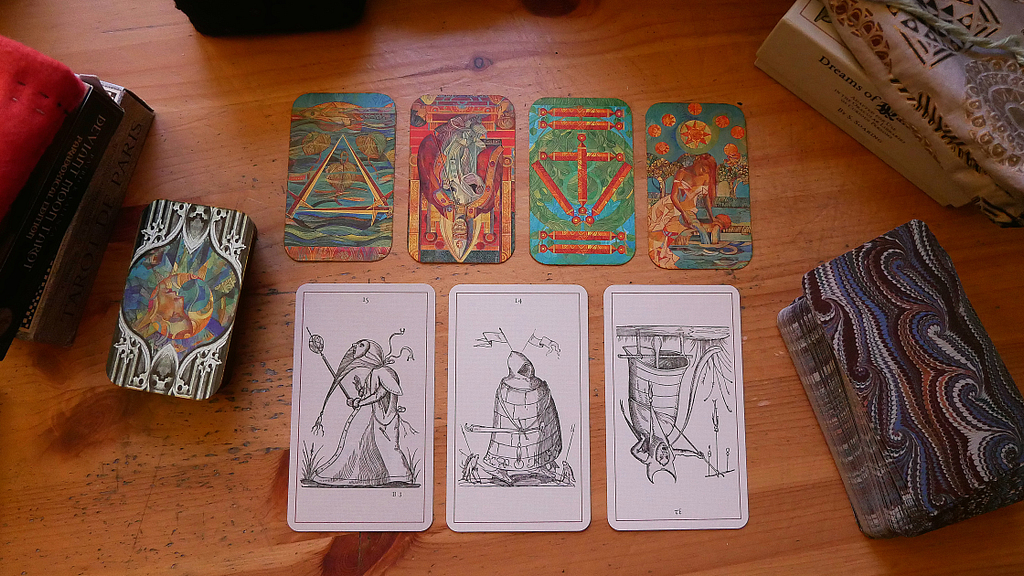
Fifthly, it’s no fluke that Renaissance imagery should make sense in terms of tarot visuals. I’m enjoying the way this pairs with various decks in my own Oracular Library!
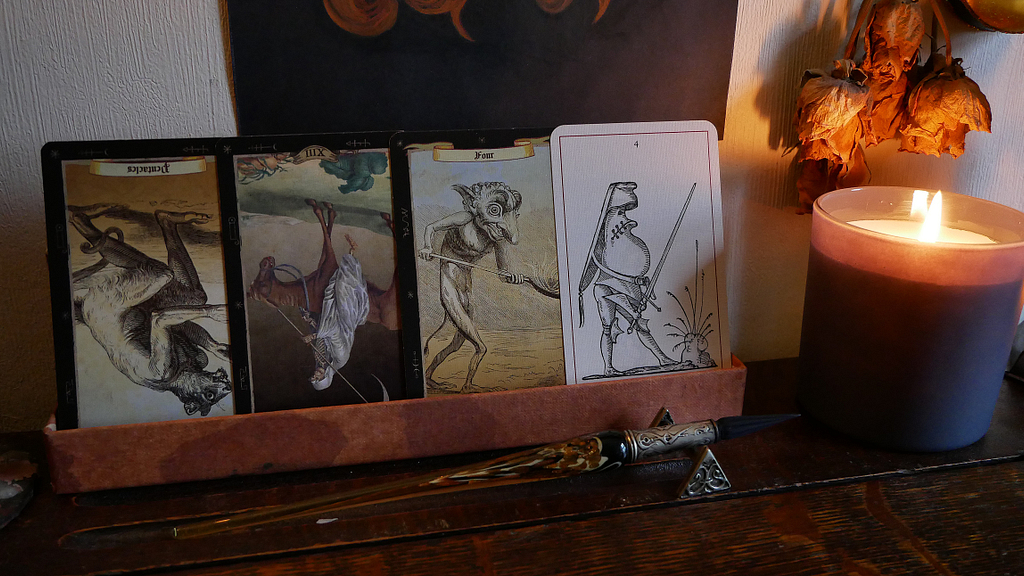
Lastly, within the framework of Irish myth, medieval literature, and various iterations of ‘fairy-faith’ or dealings with the Other Crowd… there is a lot I want to explore about how I perceive denizens of Otherworlds and how that fits into my own mythological/cosmological framework. I’m in the process of exploring and expanding my own astral realm (a place I have been referring to lately as “the little cosmos”) but none of that is solidified and it’s well beyond the scope of this blog post…
I hope my ideas are not too superimposed onto the deck for having shared them a bit here! And I hope very much that whoever decides to buy the deck enjoys it and derives benefit from it in some way. I’m going to explore other ways/platforms of making it accessible in time but, for now, do remember that the images from the 1869 volume are in the public domain! Go check them out too!
Yours in sincere drollery,
Saoirse.