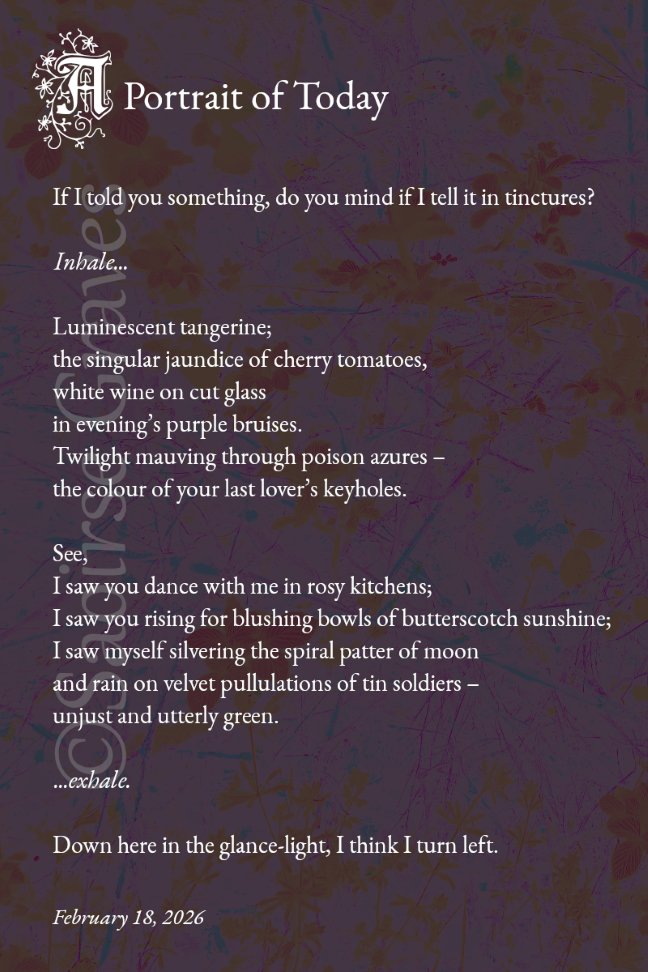
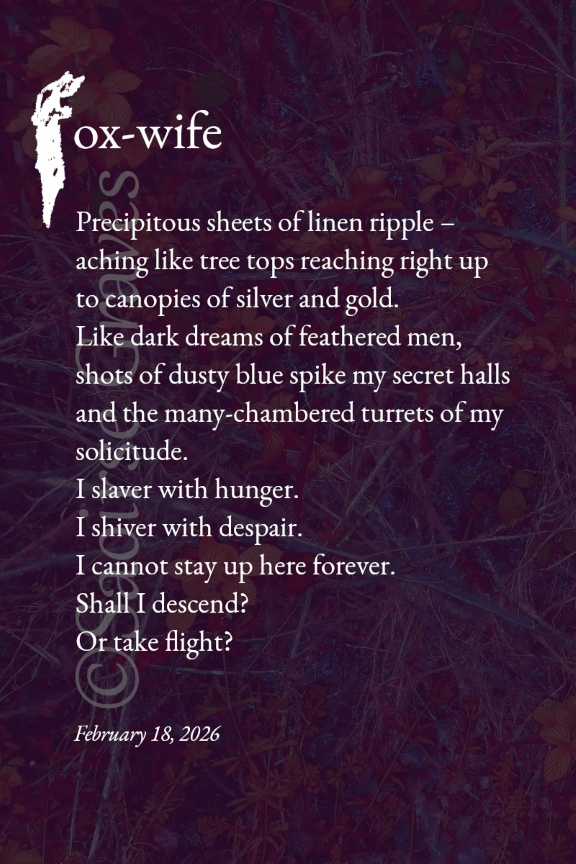
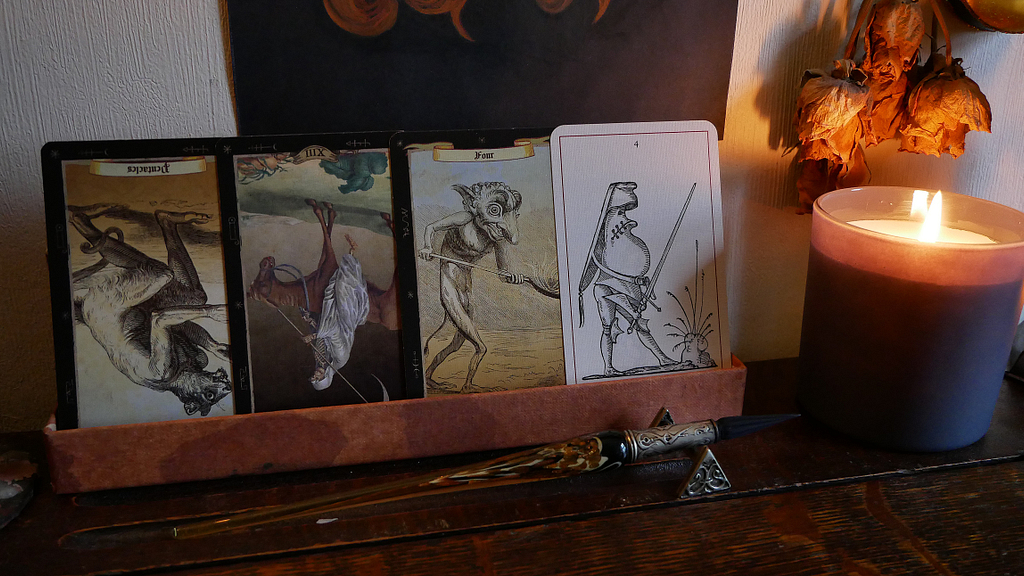
Sitting in my weedy lair, thinking over creative ambition, doors between worlds, and the way witchcraft works wonders – staring out at blackbirds, hooded crows (and a wren!) flitting between drifting spells of rain – I finally finished two poems.
The first, paradoxically, took over a month.
If fantasies are fractals, then Death is periwinkle.
The second was a classic case of how most of my poems emerge… “No-facing” them up from the gut and barfing them all over the page like so much ectoplasm.
The winter weather continues but I’m not sad about it. On Imbolc, I went for a river-side walk for several hours. Starting in the morning mist and ending in the midday sun through fields and several different woods, my partner and I saw two grey herons fly overhead with sticks in their beaks. The Cailleach gathers firewood! Six more weeks of winter. As it happened, we also saw their nesting place: five full grown grey herons perched in the tree tops overhanging the edge of the river… uncanny in their beauty.
~ Saoirse.
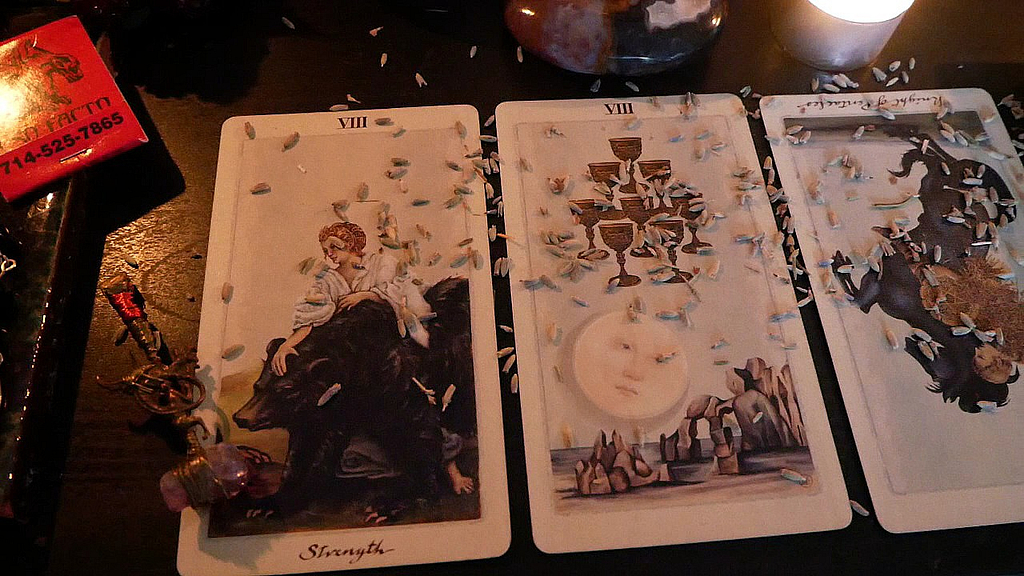
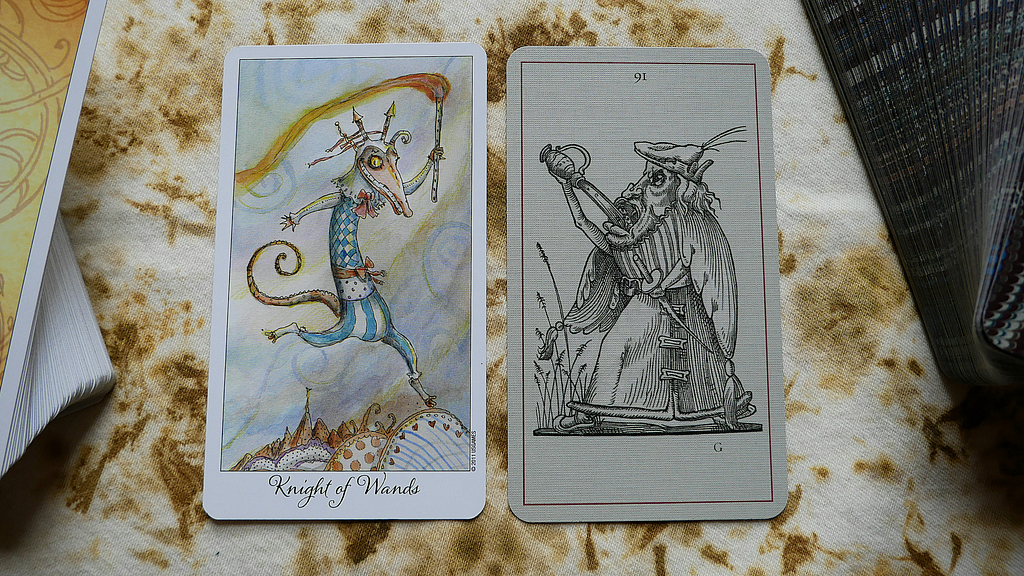
(Decks shown: “Trionfi della Luna (Paradoxical)” – 3 of Coins, Knight of Wands, 2 of Coins – and “Oracle médiéval et merveilleux” – “Colère” – in inverted blacklight)
PS. A personal reminder, “Eviscerate” by Faetooth playing as I post this <3
[CW – there will be reference to symptoms of trauma but I will not discuss details nor will I indicate any specific type of experience other than to discuss how it affects my magico-spiritual process.]
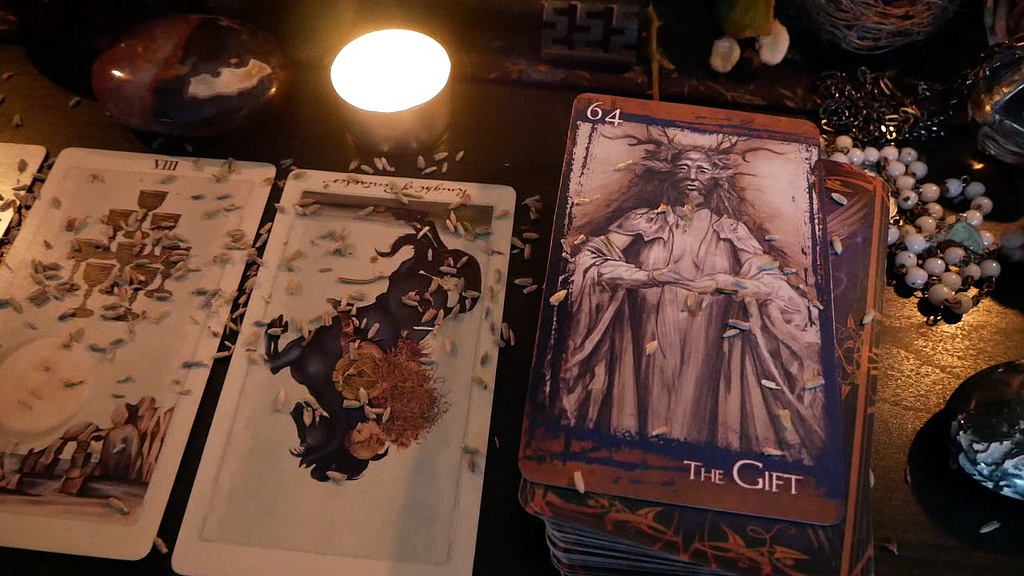
Half moon this morning. Waxing gibbous. Serendipitously, this is the card I received in a single draw from the Pagan Otherworlds Tarot. How apt.
I have been posting a bit more openly about music lately. Mostly here on the blog. I want to talk a little more specifically about why this – for me – constitutes witchcraft and deep magical healing work.
If anyone wants a recommendation for an amazing young musician and singer coming out of the American ‘Old Timey’ Trad world (as distinct from modern bluegrass!) they should check out Nora Brown. Holy shit her work is good. She’s currently collaborating with a fiddler named Stephanie Coleman and equally her style is deep, rhythmic, and rooted.
I’ve known of Nora Brown for a few years now but yesterday I made an attempt to watch the Tiny Desk concert above. I say ‘attempt’ because by the time they started into ‘The Old Blue Bonnet’ I was shaking, hyperventilating and so on. Having too many visceral and deeply loved memories of American-specific experiences… looking up at the moon through pine needles… fireglow shining through a cabin window at the bottom of a mountain valley… a small trickling stream beneath my feet… elk in the morning, bears on a walk. The music of the unassuming – jeans and t-shirts – trading information, laughing, and the deep heartbeat of boots on a floor keeping the tunes flowing. People talking with their feet and singing with their hands…
I couldn’t do it yesterday.
I told my partner it felt like a world had vanished but that I (and only I among anyone I know now) could hear faint echoes of it calling out “Goodbye! Goodbye!”*
So today is the half moon and I drew the half moon card. To me, the card says ‘Now you can do it and I will help.’ I took slooooow breaths, clutching the deck (my bridge between worlds), listened to this gem of a video and let what once was run its course through the channel of my emotions. Tears again but more manageable this time.
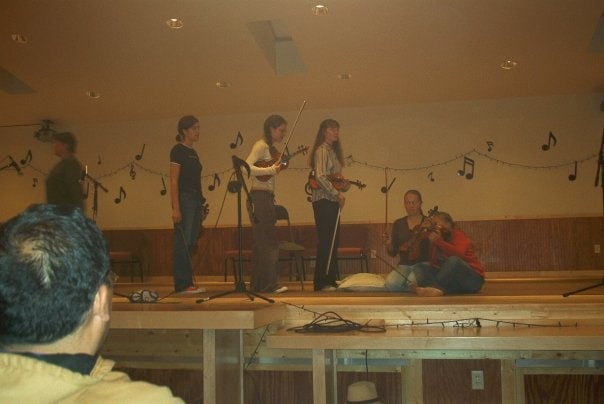
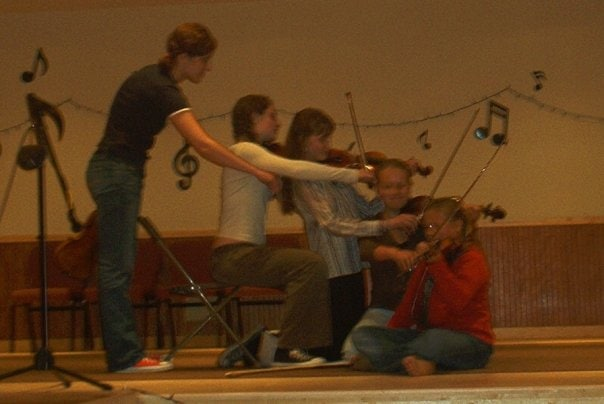
Old grainy photos of a good party trick…if you have lots of fiddlers!
It is, of course, not at all accidental that so much of American trad songs are fixated on war, death, loss, poverty, jail time, labour, loneliness. (The backbone of the ‘American dream’?) When people move too fast over land that isn’t theirs their own pre-existing problems grow with them. I don’t find much to ‘redeem’ about this… but I do find subtlety and nuance, I guess. The tunes I like the most have the least pretense – they’re tunes by and for flawed people. Maybe even the damned (depending on your worldview… I use demonic imagery in my witchcraft for many reasons). They carry no false promises and their dogma sounds tired.
I don’t know if I will ever use my violin for fiddle music again… I have no idea how that would feel in the body. Playing music, by definition, replicates the movements and bodily experiences of the past. That’s what practice IS… taking what you have already done and keeping it alive. Maybe that’s what makes it so hard and so rewarding at once. I am comforted by the knowledge I have of different forms of music and the fact that deep down I am fortunate to have some access to those skills and worlds… but I tend to feel shattered by the awareness that I come from a world in which I did not fit and I live now in a world that doesn’t know about any of that – at all. And I still do not fit.
This, incidentally, is how trad music is formed. Traditions carried. Stories retold and reworked. Sources cited (as is done so amazingly in the Tiny Desk video!)
To be a witch for me (among many other things) is to go to the altar and lay my music at Her feet. To carve a space that is mine… with bits and bobs of my story – the stuff that makes me howl and cry; the stuff that makes me dance; and the stuff that I know emerges syncretic and flawed… and to let it emerge and take its new form anyway. I take it all with me. These things are in my satchel. It’s painful to perceive, now, that no one around me knows it. I’m a person with no context. It must be enough that I know it.
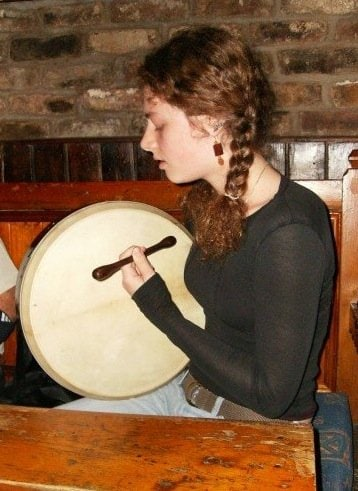
Baby-face Saoirse playing the bodhrán in Ireland. Think this might even have been in Cork!
The half moon will help me see that and shift my perspective back towards joy. And, I’m not totally alone… I can still light a bonfire on occasion and surround myself with other music makers. I know I’ve left things behind for a reason and I guess I’ll keep the practice of fitting into nowhere at all. Chronically transatlantic like so many before me… but hopefully reckoning a bit better with empathy and collective responsibility!
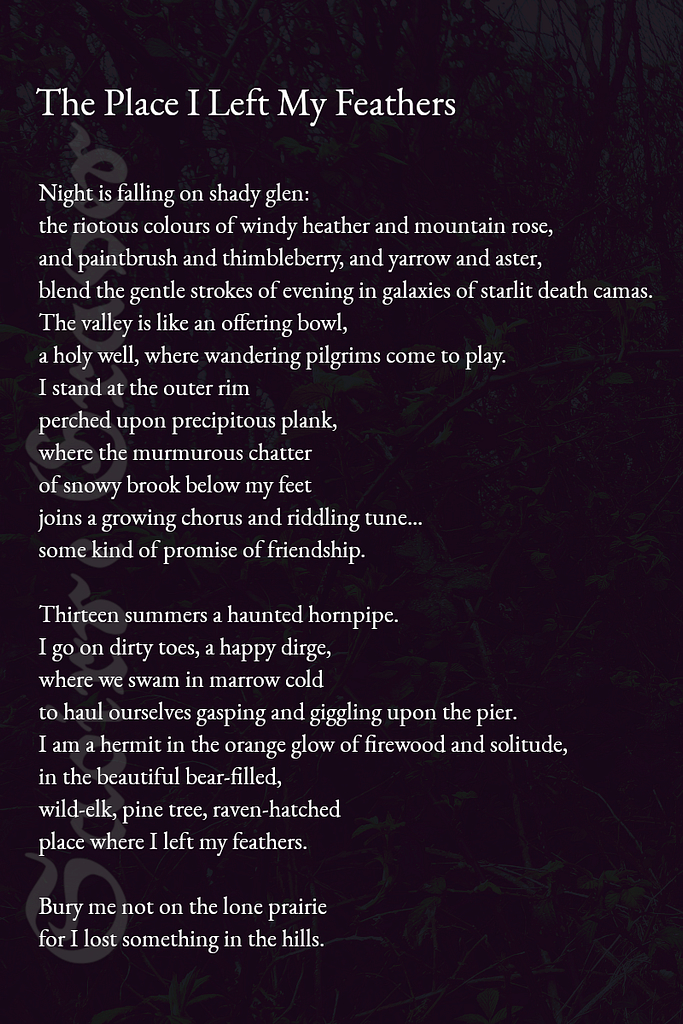
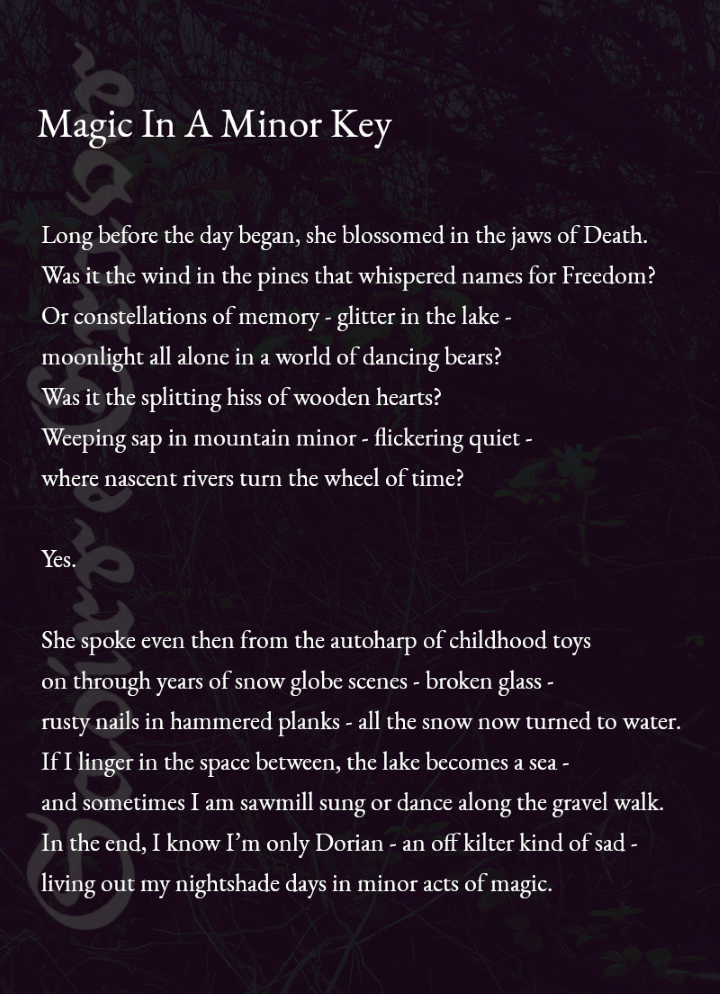
Below, a couple poems I wrote a few years ago, during an earlier phase of processing these things:
The Morrígan often ‘speaks’ to me through verse (UPG) and the following poem felt like an answer to wondering if she was there ‘even then’.
From 2022, it makes reference to John Prine as well as “Blackbird” performed by the Lonesome Sisters (written by Debra Clifford about her mother… Debra herself passed away in 2022.)
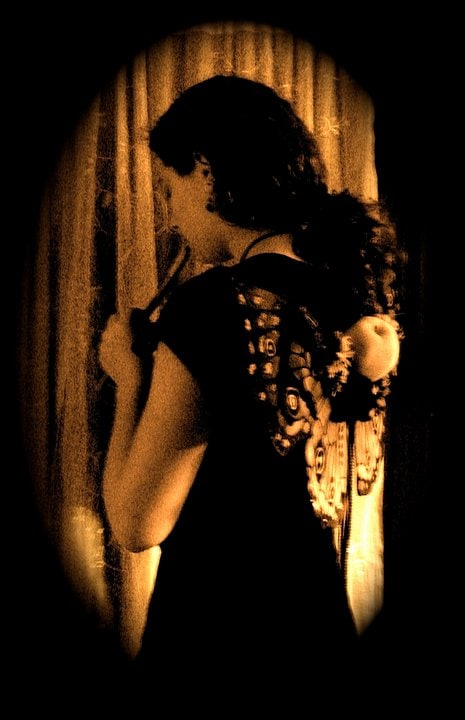
Another old photo. Wistful whistle tunes and homemade wings…
~ Saoirse.
* Rayna Gellert*** has composed some great songs out of this tradition that capture many of these feelings for me – “Strike the Bells” from her album ‘Workin’s Too Hard’ and “Nothing” from her album ‘Old Light: Songs from my Childhood and Other Gone Worlds’ come immediately to mind. Whew!
** This link is to a live performance (including the only mistake I’ve ever heard him make! ^_^) This is important firstly because I think his live renditions have a more dirge-like quality than his recorded version (which is on his album ‘Soon Be Time’) and secondly because he performed this song live for the first time one night at my college (a few years after I had stopped going to the mountains each summer to a camp where he and others taught) … I was talking to him after the gig and he asked me how the tune came across. I told him it was beautiful and made me cry and he told me it was the first time he’d done it on stage!!!
*** Incidentally, the same summer location was where I first had the privilege of meeting Dan Gellert, Rayna’s father. Holy shit that man can play and on the most gorgeous fretless banjo to boot!
I would love to hear your responses, thoughts, etc. in the comments. But please note, I’m not soliciting for comfort or validation. I’m wary of encouraging what I so often interpret in comments as codependent language. I’m fine! I am me and you are you. Concepts & practices such as witchcraft are shared but also truly individual – this is what makes them so potent! 🙂
As with so many things, a simple mental association double checked through the lens of a ‘quick Google’ yields a seriously mind-boggling rabbit hole. This blog post serves as a contextual supplement to this video:
I have had the topic of names on my mind for a long time. Anyone who plays traditional music will know that the name of any given tune is, shall we say, flexible. The way in which a lot of trad music works is that any given player or performer and certainly the more reputable recording artists will cite who’s version of a tune they play, where they have introduced changes, and will often also indicate if their own regional style has affected their playing or not, etc. A living folk tradition needs both that kind of flexibility as well as that kind of connectivity and accountability.
Recently, I decided to approximate a version of Shady Grove, pilfering most of my style and technique from this OLD video by “Gretchenman” (just look at his fingers fly!!!):
In doing so, I did a quick search online to refresh my memory about the lyrics (because I do sing along sometimes when I play) and check in on some basic background information on the song. Shady Grove (Roud 4456) is mostly considered an Appalachian tune [1,2] and there is a possible link with the English/Scottish tune Matty Groves (Roud 52; a famous version of which was recorded by Fairport Convention, for example) [3]. The two songs share the same melody and the fact that one is a murder ballad and the other a song in which a woman’s name has seemingly toponymic qualities interested me from a personal gnosis perspective. Drawing wild and highly metaphorical connections in my own head, I liked the familiarity of something that sounds like a place having an almost euhemerised quality… certainly Ireland abounds with such locations and its medieval literature/mythology has whole genres and stories centered on naming places after people and people after places, or just blending the two entirely.
Now, I’m NOT claiming that there is any such analogy to be drawn in historically viable or collectively verified ontological* terms. It’s just a fun poetic exercise. Creative license, as it were.
However! The rabbit hole referred to earlier drew me from link to link: first investigating the lyrical content of Shady Grove; then to it’s Roud Index Number and associated articles about the development of the song over time (including various collections in which it is annotated as well as different known recordings of it); then to re-acquainting myself with some of the basics on Cecil Sharp (because it’s been a while). Lo and behold… I forgot a) about his nationalism and the troubled legacy of his methodology in seeking out ‘Englishness’ in music, especially in Southern Appalachia [5] but also b) that he was in other ways influenced by William Morris’ socialist lectures and …potentially also approached his work through the lens of spiritualism at some point!? 🤯
This last bit seems totally unclear to me and I am finding it hard to validate until I can actually access some of the academic articles I’ve found online [6]. (This is where I am REALLY happy to have a free external reader’s card with UCC Library…ah, the perks of living in a Uni town!) But in scrolling through the Roud listings on Matty Grove, I saw they had an entry in Sharp’s diary from the 29th of August, 1916 in which he makes use of the word “séance”.
It’s strikes me that it’s possible this word has some other meanings or context of which I am not aware (I yielded no obvious or immediate answers from a quick search online) but it would seem there are a few articles out there at least that might make this clear once I’ve had a chance to read them. In theory, it doesn’t strike me as too unreasonable because this IS a time period in which a lot of academia (especially those with nationalist or otherwise politicised interest in folk movements) drift in and out of spiritualist circles and ‘methods’ of inquiry**.
I am not sure how all of that will go yet but I also hope to read a few more recent assessments of the problems in Sharp’s legacy.
Magickally, one of the things I am doing in playing such a tune (in which I usually face my altar, by the way) is reshaping identity. Drawing creative connections on the euhemerization of names, of nouns as names/names as nouns, and asking questions of my own anthropopathism and ‘pathetic fallacy’***.
At this point, the choice to play “Flatlands” by Chelsea Wolfe and Mark Lanegan over the first part of my video should begin to make added sense.
It all comes back around to walking the razor edge between what seems appealing as a creative or metaphorical idea and what is actually academically and historically viable work. We have to be okay with their inherent dissonance. You might even call it… an art.
* Here I am using the philosphical defintion of ‘ontological’ rather than the metaphysical one!
** Giving the Golden Dawn, Theosophists, and soooo many 19th and early-20th century artists and thinkers bombastic side-eye. Criminal offensive side-eye.
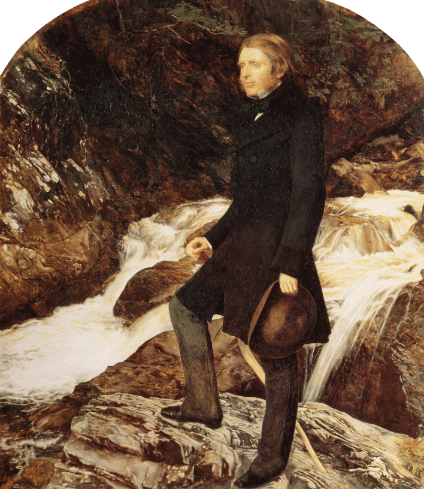
*** Oop! Hello, Ruskin!
§ 9. And thus, in full, there are four classes: the men who feel nothing, and therefore see truly; the men who feel strongly, think weakly, and see untruly (second order of poets); the men who feel strongly, think strongly, and see truly (first order of poets); and the men who, strong as human creatures can be, are yet submitted to influences stronger than they, and see in a sort untruly, because what they see is inconceivably above them. This last is the usual condition of prophetic inspiration.
§ 10. I separate these classes, in order that their character may be clearly understood; but of course they are united each to the other by imperceptible transitions, and the same mind, according to the influences to which it is subjected, passes at different times into the various states. Still, the difference between the great and less man is, on the whole, chiefly in this point of ‘alterability‘. […]
§ 11. Now so long as we see that the ‘feeling‘ is true, we pardon, or are even pleased by, the confessed fallacy of sight which it induces: we are pleased, for instance, with those lines of Kingsley’s, above quoted, not because they fallaciously describe foam, but because they faithfully describe sorrow. [7]
John Ruskin at Glen Finglas by John Everett Millais, 1853-1854 (Public Domain)
(1) Shady Grove (Roud 4456), Mainly Norfolk: English Folk and Other Good Music, mainlynorfolk.info/folk/songs/shadygrove.html. Accessed 6 Feb. 2024.
(2) “Vaughan Williams Memorial Library: Shady Grove.” English Folk Dance & Song Society, http://www.vwml.org/search?q=Shady%20Grove&is=1. Accessed 6 Feb. 2024. (Of note, the English Folk Dance & Song Society owns the Cecil Sharp House.)
(3) Spiegel, Max. “Origins: ‘shady Grove’ a Mondegreen ?” The Mudcat Cafe, mudcat.org/thread.cfm?threadid=131461. Accessed 6 Feb. 2024. (“Mondegreen” is my new favourite word now. Story of my hearing impaired life!)
(5) “Cecil Sharp.” Wikipedia, Wikimedia Foundation, 26 Jan. 2024, en.wikipedia.org/wiki/Cecil_Sharp#Political_Views. (Yes, its Wikipedia ~ but the citations at the bottom of the article look like they’re worth exploring.)
(7) Ruskin, John. “Of the Pathetic Fallacy from ‘modern Painters’ (Volume III, Pt. 4, 1856) by John Ruskin.” The Pathetic Fallacy, Ruskin (1856), http://www.ourcivilisation.com/smartboard/shop/ruskinj/index.htm. Accessed 6 Feb. 2024. (I have no interest or affiliation with the author of this site as a whole, this link is simply where I have accessed an online free readable copy of Ruskin’s writings on the Pathetic Fallacy.)
Hm. This does not feel like one of those moments where I may triumphantly declare:
“I made an Oracle Deck!”
As it happens, I did make one …only I didn’t. It’s called “The Dreams of Pantagruel Oracle” and it is part magical tool, part divination method, and part the extended overtures of a rare old book nerd. The ‘book’ in question is “The Drolatic Dreams of Pantagruel” (original French: Les songes drolatiques de Pantagruel) – a public domain reproduction from 1869 of an original volume from 1565. (See introduction/companion booklet below for more!)
Pantagruel is a giant – a character invented by Francois Rabelais in Renaissance France – whose escapades (and those of his father, Gargantua) form a collection of scholastic, social, and religious commentary as well as baudy, irreverent, often inebriated stories…aimed, it seems, at delighting and enraging the social order of 16th century France.
I did not draw these images… Neither did the 19th century publisher (Tross) of the volume from which they were taken… Neither did the 16th century publisher (Breton) of the volume from which that publisher reproduced them… Neither did Rabelais himself, to whom Breton attributed the artistry of these images… Learned discourse suspects it was illustrator/engraver Louis Desprez who produced other work for Breton in a similar style.
Dreams of Pantagruel with the Joie de Vivre Tarot
The deck has 123 cards in total, measuring 2.75” x 4.75” (70mm x 120mm) in linen card stock and they are now available on MPC.
In the shoplisting I promised a PDF booklet introducing the deck – it includes some basic historical information, some indications of why I made it (other than just wanting it to exist), asks some questions, and leaves the door very wide open for any manner of uses at the total discretion of those who choose to acquire it. It also includes citations!!!
Powered By EmbedPress
What follows are some of my own personal initial thoughts about the deck at this time. My journey in using these cards has only just begun but here goes…
Firstly, I am very interested in the weird ‘Bosch’-like world to be found on the margins of society. I like to ask myself questions about how society asks questions. Having worked in different kinds of archives over time, fulfilling queries for different kinds of researchers on different topics, it’s astounding just how much the assumptions in approach inform (or limit) retrieval and results. Of course, the way information is catalogued can also skew things… as do ‘hidden collections’ – collections that exist but are horribly back-logged, invisible until allocation of resources and social priority allow ‘us’ to ‘see’ them.
Secondly, I’m interested in the shapeshifting nature of personal characteristics but I want to be very clear that, in my opinion, equating moral or social value with physical appearance is unacceptable. There is enough work on our hands to undo tropes around ‘disfigurement = sign of evil’ in fairy tales and fantasy without adding to it through the misuse of our creativity going forward. The characters in this deck are not automatically marginalised or considered unfavourable. The worldview that created them was flawed (for one thing Rabelais, author of the Gargantua/Pantagruel stories was definitely sexist!) and the worldview of ‘curious persons’ who view and respond to these images will create what they bring to the deck… to put it bluntly.
Dreams of Pantagruel with Le Tarot Noir
Thirdly, assessment is on-going…but this deck is one step in the much larger personal aim of seeing the world in terms of the imaginative qualities of its inhabitants. I guess you could say I wanted a deck of ‘friends’ to support me in that work. “Familiars”? “Servitors”? Demon-cohorts whose names are Legion?
Fourthly, I’m SLOWLY going to be learning as much as I can about the historical details in these images. I already recognise certain clothing elements that leave clues as to what some of the jokes or references might be. (Such as pin cushion codpieces…) It’s not immediately clear to me how much of these images are already understood from an (art) historian’s point of view, but I’m eager to see the extent to which whatever details I uncover influence my own self-styled way of being, visually and otherwise.
Fifthly, it’s no fluke that Renaissance imagery should make sense in terms of tarot visuals. I’m enjoying the way this pairs with various decks in my own Oracular Library!
Dreams of Pantagruel with the Magicae Daemonibus Tarot… this morning’s shadow work!
Lastly, within the framework of Irish myth, medieval literature, and various iterations of ‘fairy-faith’ or dealings with the Other Crowd… there is a lot I want to explore about how I perceive denizens of Otherworlds and how that fits into my own mythological/cosmological framework. I’m in the process of exploring and expanding my own astral realm (a place I have been referring to lately as “the little cosmos”) but none of that is solidified and it’s well beyond the scope of this blog post…
I hope my ideas are not too superimposed onto the deck for having shared them a bit here! And I hope very much that whoever decides to buy the deck enjoys it and derives benefit from it in some way. I’m going to explore other ways/platforms of making it accessible in time but, for now, do remember that the images from the 1869 volume are in the public domain! Go check them out too!