I mentioned in last week’s video (“Who Painted the Lion?” or “Medieval Shadows & Cards of the Year”) that I have begun exploring academic perspectives on medieval magic. The first thing of note is a fairly baseline agreement on the historical distinction between ‘magic’ and ‘witchcraft’ (something we see holds true in the early modern period as well through secondary works by the likes of Ronald Hutton etc.) The second thing to highlight is that, as with most things, this is an entire academic discipline and a developing one. My intention is to pursue the points that interest me and then see how it feels to relate some of that back to my own work as a modern practitioner of ‘medieval-infused’ witchcraft and art magic.
The aim of this post and any others like it (e.g. capering treacherously on the border, with historical research or context on one side and personal gnosis or numinous magic on the Other) is simply to show ‘process’:
- How do I gather ideas or inspiration?
- When, how, and why does that inform my magick and art?
- Why might that lead to further UPG (Unverified Personal Gnosis)?
For now, I’ve started with “The Routledge History of Medieval Magic”, edited by Sophie Page* and Catherine Rider and published in 2019. The main goal of the book is to show the current standing of the field but also to illustrate various directions in which it needs expansion. It’s less an overview of what has come before and more an academic call to action with each chapter serving as useful examples, or signposts, for further research. Yes please!!!
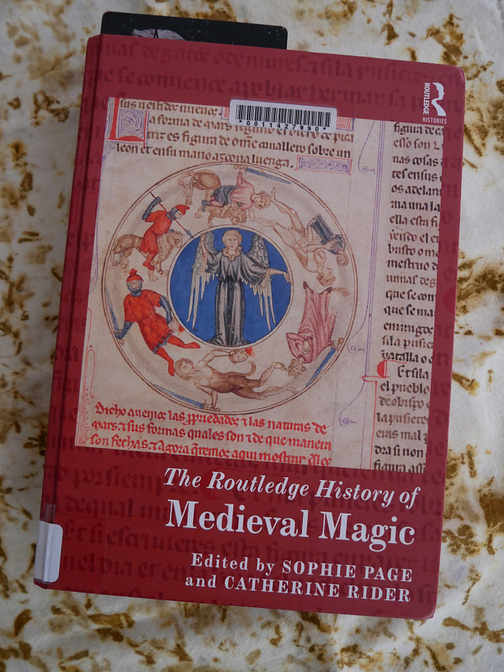
Part I, Chapter I: “Rethinking how to define magic” by Richard Kieckhefer presents some interesting ideas surrounding why magic is difficult to define (even for academics! We’ll steer clear of the choppy waters around definitions of magic and witchcraft in modern practice on this blog!)
Concepts that caught my eye came up as he was establishing his main system of “aggregating terms” vs. “constituitive terms” (pp. 15-16) – i.e. the vague umbrella terms like ‘magic’ vs. better defined component parts. He draws a comparison to the term “mysticism”. Like the word magic, ‘mysticism’ resists attempts at explanation and evokes many different ideas or impressions of what it is.
“A comparison may help. It has long seemed to me useful to think of mysticism […] not as a single phenomenon but rather as a cluster of phenomena that may at times be distinct but tend to become intertwined. There is mystical prayer, mystical relationship and mystical consciousness.” (p. 15)
In the medieval Christian context,
- mystical prayer – involves “fervent and intense, highly concentrated, focused prayer, cultivated within the setting of the contemplative or monastic life.”
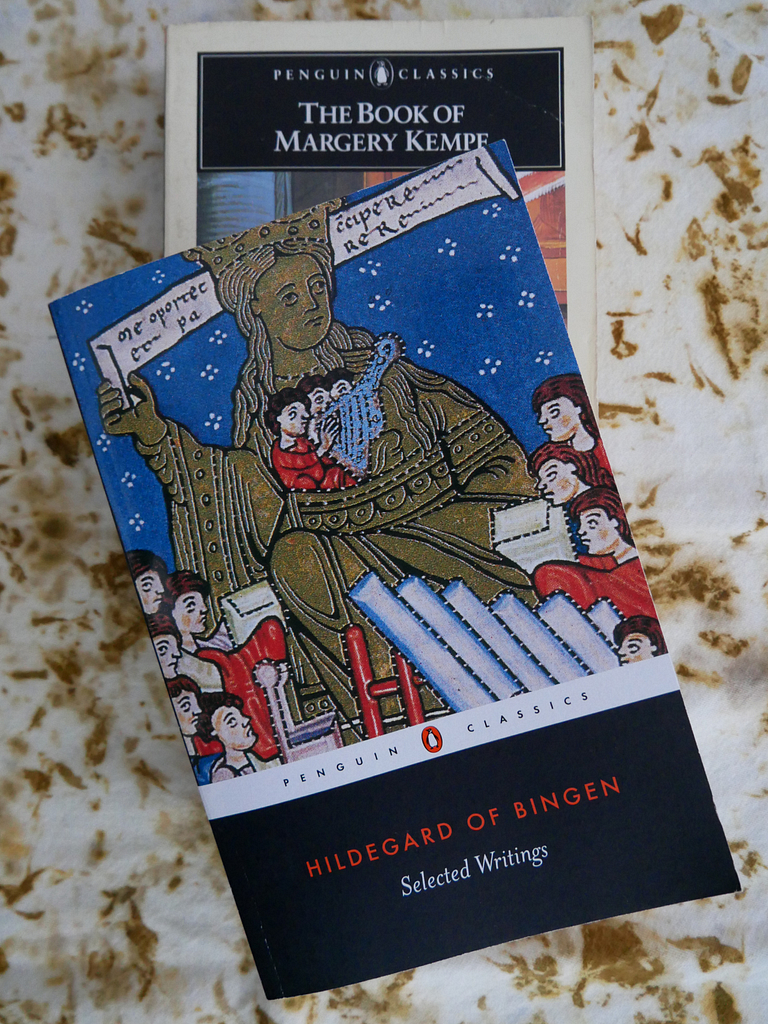
- mystical relationship – Kieckhefer represents through Bernard of Clairvaux or “the German sister books that are deeply steeped in “theoerotic” relationship […] with Christ.”** This is the view in which one might ‘burn with love’ for deity.
- mystical consciousness – Kieckhefer says can be found in the vernacular sermons of Meister Eckhart “who wants his hearers or readers to gain a lively awareness of God’s presence within herself […] and her own true and eternal presence within God.”
Kieckhefer clarifies that these may all be combined in different ways by a single medieval writer. His example is the writing of Teresa of Ávila. (p.15)
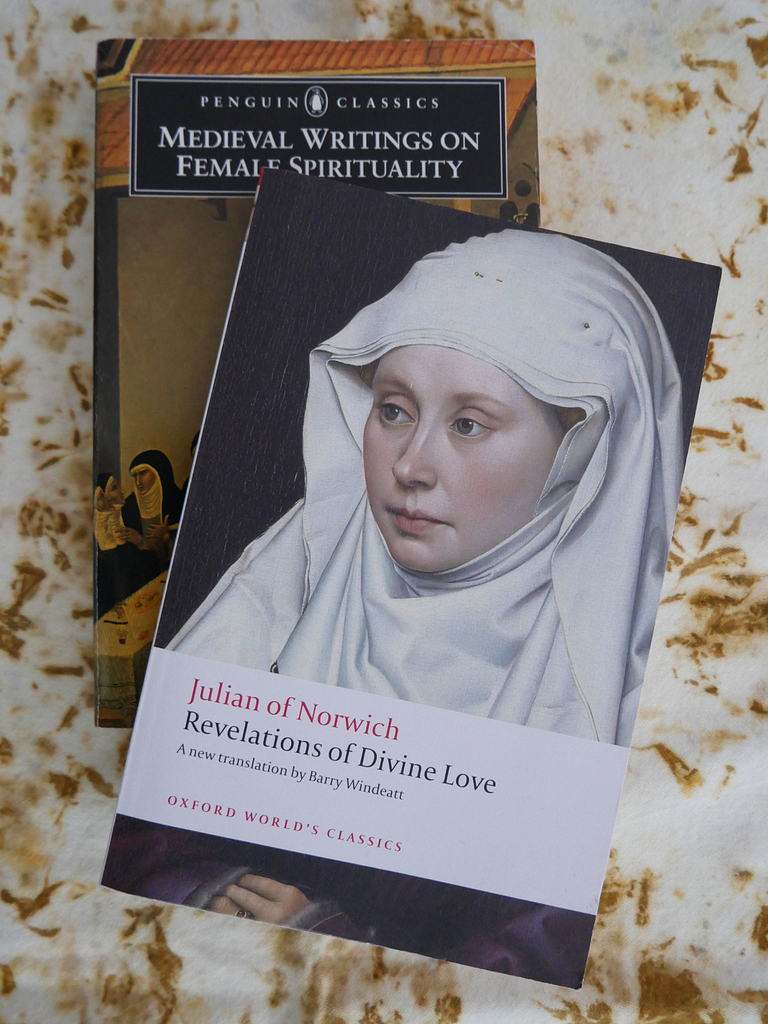
I’m already interested in the murky waters of mystical thinking… not to mention words like “theoerotic” (which, incidentally, might be more readily available to the imaginations of non-Christian devotees of deity or deities).
However, coming back to the aggregating term of ‘medieval magic’, Kieckhefer offers at least three options for its constitutive terms: conjuration, symbolic manipulation, and directly efficacious volition. (p. 17-18)
Honing in on symbolic manipulation (hello, art witch here!) Kieckhefer says some really juicy words:
“If a plant shaped like a liver is useful for healing the liver, it is in that sense a sign of what is thought to affect, and the intelligible resemblance is what effects the healing. […] If conjuration is a reprobate branch of religion, symbolic manipulation claims an efficacy like that of science and will be seen by its practitioners as a type of science. The magician who manipulates symbolic links in the natural order might be thought of as tugging on invisible cords that link one level of that order with another. The symbolic links may be articulated in terms of cosmic correspondences and sympathies, at least in sources that provide theoretical grounding for magical practice. If the invisible cords are not thought of as efficacious symbolically, then the process is not magical; the user may not be told explicitly that symbolic links are entailed, and may simply be assured that the results are tried and proven, but in magical operations, the symbolic causality is at least implied by the types of word, ritual and object used.” (p. 17)
Taking this historical analysis and running wild with it in the modern day, I think the analogy of tugging on unseen cords of meaning is just…poetry. This may also provide a very useful visual for what some modern practitioners mean in their discussions of magical correspondences or energetic work. In my view, this perspective posits a model for developing personalised magical symbolism in art as and when it feels creatively powerful to do so. Whether the ‘invisible cords are thought of as efficaciously symbolic’ might be the keystone for agency in that approach. If I were to use the language we have explored here in Kieckhefer’s chapter, then to be an art witch is just as much the work of developing artistic style, an individual (and recognisable) ‘voice’, and recurring visual motifs that – when aggregated – convey an added layer of meaning in the whole that is the finished piece. In other words, they constitute magic.
Art must also speak for itself… but in theory, part of the magick that heightens its efficacy might lie in some of the following: symbolic connections forged by the individual artist; the time spent exploring the meaning of what they want to do or say; practicing techniques for how that might be rendered; and strengthening those motifs (‘correspondences’) over time. Perhaps this is contained in colour choices? Or recurrences in textural play? In different media? Or in more literally repeated visuals like egg symbolism?
I’m reminded of the medieval Irish approach to manuscript illumination and prayer…where the word and all its colours and symbols IS the prayer, IS the presence of the divine in an even more literal sense. (A famous example being the Chi Rho page in the Book of Kells.)

I would very much love to hear your thoughts in the comment sections! How do you feel about the way your creativity or your magick comes together or what that process entails? What do you think about sources of inspiration and how that becomes magickal for you (whether you make art or not!)?
Incidentally, medieval Ireland, medieval Celtic magic, and how that might impact art witchery will be the topic of Part 2 of this post. I’ll leave you with that cliff-hanger – mainly due to space and time constraints – and hope very much to see you there.
Awkwardly yours,
Sorsha.
Sources:
Harrington, Elaine. “The Book of Kells: Image and Text / the Chi Rho Page – the River.” The Book of Kells: Image and Text – The Chi Rho Page, The River-Side, UCC, 20 Dec. 2022, https://theriverside.ucc.ie/2017/06/01/the-book-of-kells-student-exhibition-ma-in-medieval-history-the-chi-rho-page/.
Page, Sophie, et al. “Part 1, Chapter 1: Rethinking How to Define Magic.” The Routledge History of Medieval Magic, Routledge, Taylor Et Francis Group, New York, NY, 2019, pp. 15–18.
*some people have the coolest names…Sophie Page!?