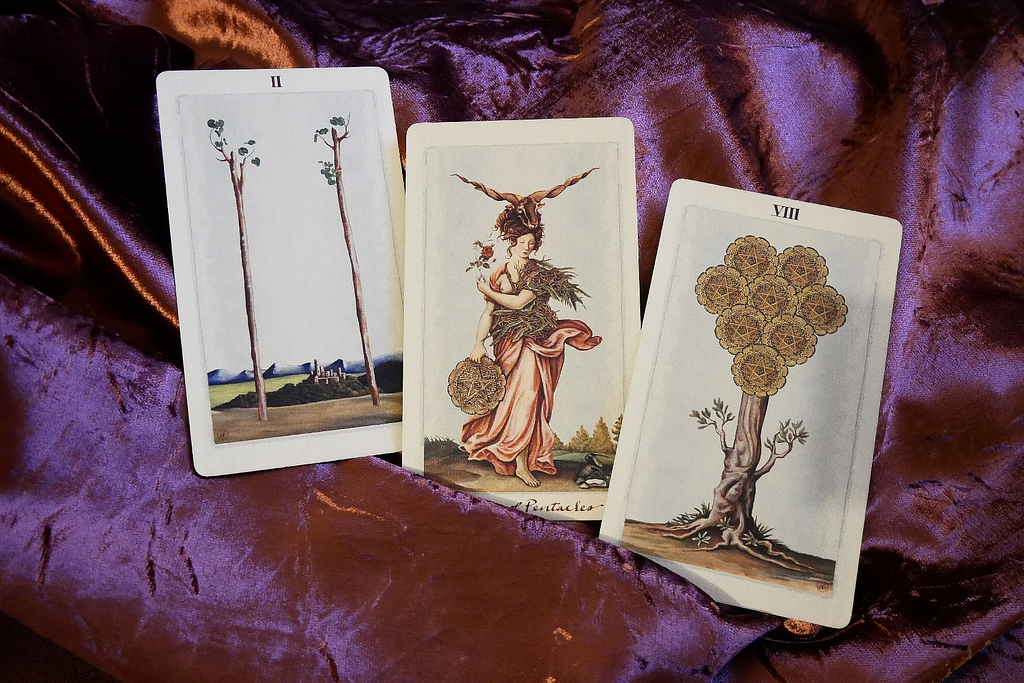
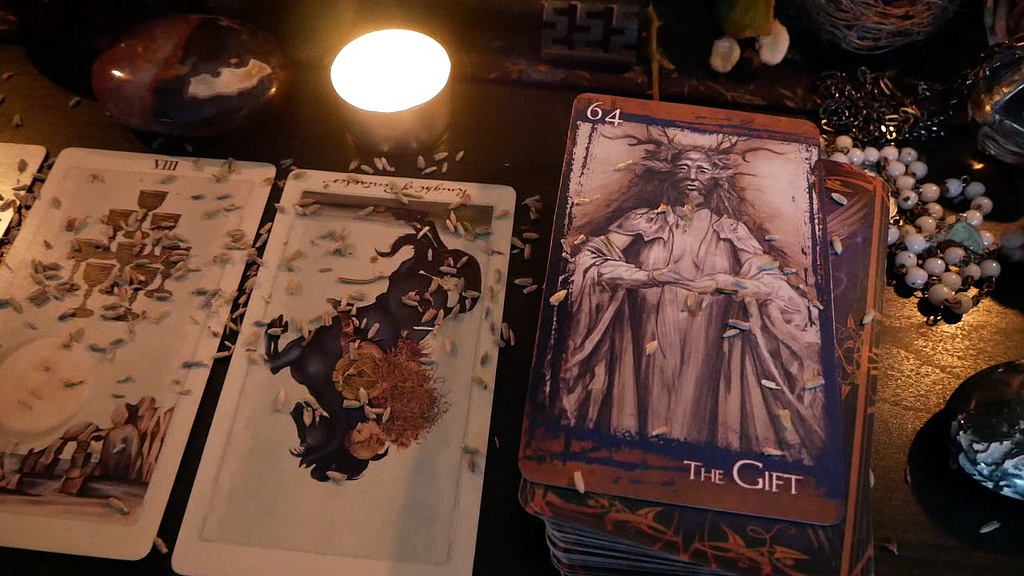
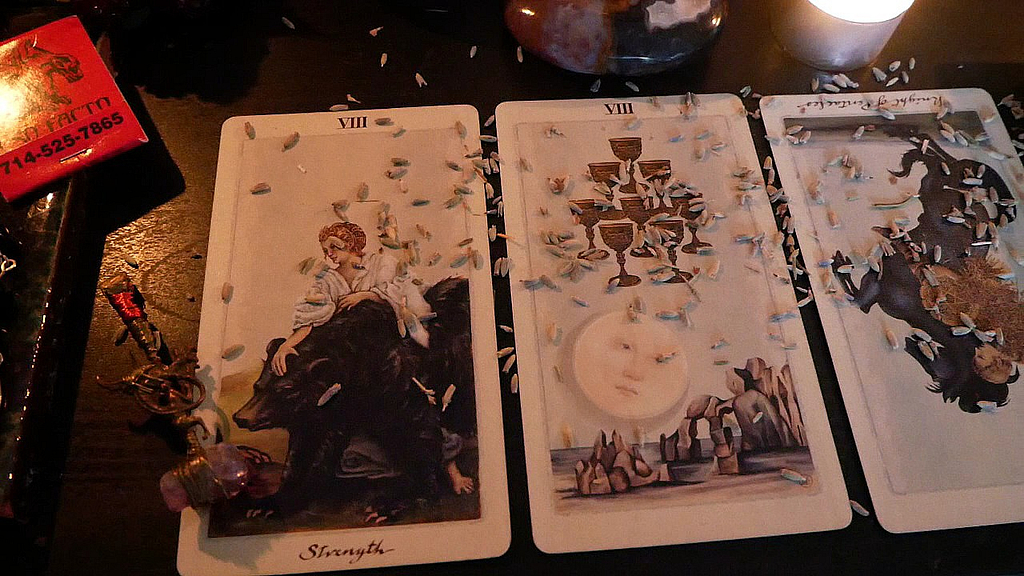
A selection of (some) favourite quotations – read or re-read in the last calendar year.
“One of the blotches of reflected sunlight swayed to and fro across the paunch. This particular pool of light moving in a mesmeric manner backwards and forwards picked out from time to time a long red island of spilt wine. It seemed to leap forward from the mottled cloth when the light fastened upon it in startling contrast to the chiaroscuro and to defy laws of tone. This ungarnished sign of Swelter’s debauche, taking the swollen curve of linen, had somehow, to Mr Flay’s surprise, a fascination. For a minute he watched it appear, and disappear to reappear again – a lozenge of crimson, as the body behind it swayed.”
(Peake, Mervyn. “Swelter.” Titus Groan, Gormenghast Trilogy.)
“She tossed her long hair and it flapped down her back like a pirate’s flag. She stood in about as awkward a manner as could be conceived. Utterly un-feminine – no man could have invented it.”
(Peake, Mervyn. “Fuschia.” Titus Groan, Gormenghast Trilogy.)
“Once, long ago, traveling among the marbles of Rome and Florence, he had seen women like this, kept in stone instead of ice. Once, wandering in the Louvre, he had found women like this, washed in summer color and kept in paint. Once, as a boy, sneaking the cool grottos behind a motion picture theater screen, on his way to a free seat, he had glanced up and there towering and flooding the haunted dark seen a woman’s face as he had never seen it since, of such size and beauty built of milk-bone and moon-flesh as to freeze him there alone behind the stage, shadowed by the motion of her lips, the bird-wing flicker of her eyes, the snow-pale-death-shimmering illumination from her cheeks.
So from other years there jumped forth images which flowed and found new substance here within the ice.
What color was her hair? It was blond to whiteness and might take any color, once set free of cold.
How tall was she?
The prism of the ice might well multiply her size or diminish her as you moved this way or that before the empty store, the window, the night-soft rap-tapping ever-fingering gently probing moths.
Not important.
Far above all – the lightning rod salesman shivered – he knew the most extraordinary thing.
If by some miracle her eyelids should open within that sapphire and she should look at him, he knew what color her eyes would be.
He knew what color her eyes would be.”
(Bradbury, Ray. Something Wicked This Way Comes)
“But what word shall I speak?”, asked the Lady Amalthea. “I have said nothing to him, yet every day he comes to me with more heads, more horns and hides and tails, more enchanted jewels and bewitched weapons. What will he do if I speak?” […]
“No, he does not want my thoughts,” she said softly. “He wants me, as much as the Red Bull did, and with no more understanding. But he frightens me even more than the Red Bull, because he has a kind heart. No, I will never speak a promising word to him.”
The pale mark on her brow was invisible in the gloom of the scullery. She touched it and then drew her hand away quickly, as though the mark hurt her. “The Horse died,” she said to the little cat. “I could do nothing.”
(Beagle, Peter S. The Last Unicorn)
“Bioy Cesares had had dinner with me that evening and we became lengthily engaged in a vast polemic concerning the composition of a novel in the first person, whose narrator would omit or disfigure the facts and indulge in various contradictions which would permit a few readers – very few readers – to perceive an atrocious or banal reality. From the remote depths of the corridor, the mirror spied upon us.
(Borges, Jorge Luis. “Tlön, Uqbar, Orbis Tertius”. Labyrinths.)
I have collected these quotations here in the same manner in which one writes quotations down in a notebook or journal. I want to look at them from time to time… and turn some things over in my head. I hope to make a modest series of quotations arranged each around a theme… ideally, with as little explanation as possible.
So to close, another quotation from The Last Unicorn:
“One eye opened slowly, green and gold as sunlight in the woods. The cat said, “I am what I am. I would tell you what you want to know if I could, for you have been kind to me. But I am a cat, and no cat anywhere ever gave anyone a straight answer.”
Sincerely,
Saoirse.
The header image (in public domain) is a study of Jane Morris for ‘Dante’s Dream’ by Dante Gabriel Rosetti. A bit on the nose, perhaps, with all the Beatrices, Pygmalions, (and even ‘My Fair Lady’s’) being tossed around… The word “gauche” is used above. I will invoke it again here.
Get ready for a spat of unstructured posts. As I have said over on my youtube channel, I’m going to prioritise posting less formalised content for a little while. Honestly, everything about my online presence should be approached like that anwyay so this shouldn’t present much difficulty!
Recently, I have been talking to various people in my life about what we expect and value out of friendship (short and long term). We’ve been talking about aging, about appearances, about performance and body horror, and about external pressures and standards… narratives around expectations and control… and just how many people want to see themselves mirrored in others to the point of trying to force others to reflect what they want to see about themselves. It’s a pain to be fascinating to anyone, it seems. But it’s also a pain to be fascinating to no one. In a lot of cases, both result in people telling you what to be and how to be it the way THEY want…
I assume I’m not alone in feeling these pressures or in seeing how they clash with my expectations for healthy relationships. I don’t really think any age group is immune from them but as I get older I allow myself the liberty I always wanted to toy with these expectations. I love glamour magick and, sure, some of that can be maligned as shallow aesthetics and ‘playing dress up’ (if one is inclined to see such things as negative) but I love to subvert those narratives with accents of rebellion. Flowing gown? Sure. But add confronting skull earrings or drape silver bones around your neck. Velvets, sultry necklines, cute little glistening moonstone jewels, and makeup? Fine. But my lips and eyebrows might be painted “frostbite” blue.
Heck, the number of people who are thrown off by a black frock and tattoos is hilarious so it’s not like it takes much.
People can look and project, but *I* like to make the acknowledgement of death and decay a non-negotiable component of what they’re taking in. I don’t really care what their conclusions are, per se, but *I’m* not going to subvert these elements for their comfort.
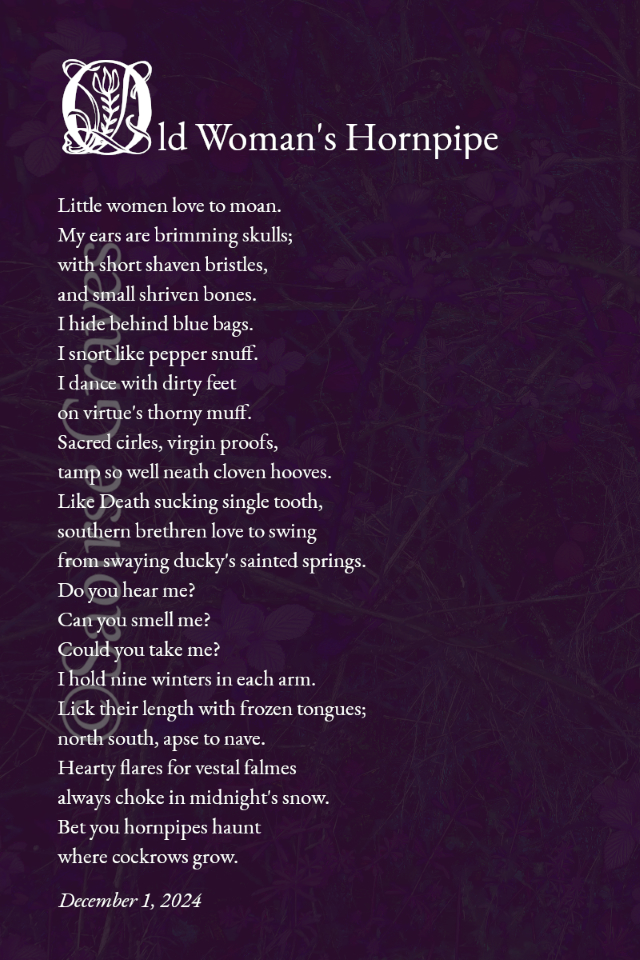
To that effect, I have begun to explore this sort of thing in poetry and so on… and, as is often the case, making the link with other media, like music:
You will note the music reference in the title*. Also, for those who are not aware, a hornpipe is a type of Irish dance tune in 4/4 time. It is also intended in this poem to have a double meaning.
Usually, I’m thinking of many different tunes even if explicitly making reference only to one. Here are some other bits and bobs that have been floating around my head of late:
So far as I can tell, the lyrics are approximately as follows:
LAL LAL ARS’ A’ CHAILLEACH** (chorus) Lal lal, lal lal, lal lal, ars’ a’ chailleach, Lal lal, lal lal, lal lal, ars’ a’ chailleach, Lal lal, lal lal, lal lal, ars’ a’ chailleach, Ith am bò, thogaidh ò, ith am bò, ars’ am bodach.
Am pòs thu fhéin, am pòs thu fhéin, am pòs thu fhéin, ars’ a’ chailleach, Am pòs thu fhéin, am pòs thu fhéin, am pòs thu fhéin, ars’ a’ chailleach, Am pòs thu fhéin, am pòs thu fhéin, am pòs thu fhéin, ars’ a’ chailleach, Pòsaidh mi, pòsaidh mi, pòsaidh mi, ars’ am bodach.
Có an tè, có an tè, có an tè, ars’ a’ chailleach, Có an tè, có an tè, có an tè, ars’ a’ chailleach, Có an tè, có an tè, có an tè, ars’ a’ chailleach, Tha thu fhéin, tha thu fhéin, tha thu fhéin, ars’ am bodach.
Cuin a thig thu, cuin a thig thu, cuin a thig thu, ars’ a’ chailleach, Cuin a thig thu, cuin a thig thu, cuin a thig thu, ars’ a’ chailleach, Cuin a thig thu, cuin a thig thu, cuin a thig thu, ars’ a’ chailleach, As a’ mhionaid, as a’ mhionaid, as a’ mhionaid, ars’ am bodach.
LAL LAL SAID THE OLD WOMAN Lal lal, lal lal, lal lal, said the old woman Eat the cow, you will raise, eat the cow, said the old man.
Will you marry yourself, will you marry yourself, will you marry yourself, said the old woman… I will marry, I will marry, I will marry, said the old man
Who’s she, who’s she, who’s she, said the old woman… You are yourself, you are yourself, you are yourself, said the old man
When will you come, when will you come, when will you come, said the old woman… In a minute, in a minute, in a minute, said the old man.
And here is a lovely live version of the same tune, sung with Julie Fowlis and Muireann Nic Amhlaoibh! Look at them giggling at the lyrics!
It should be noted that my Irish is terrible but my Scottish Gaelic is non-existent.*** I’m wondering if the ‘rise/lift’ in “thogaidh ò” might have a double meaning in this context? Also, as far as I can tell, it’s possible the reflexive pronoun (“fhéin”) serves a similar function to the corresponding word in Irish – as an intensifier or for emphasis, as in “selfsame”. So “tha thu fhéin” is likely to translate more like “You yourself!” etc. Lastly, “co an tè” translates more literally as “who’s the one?” except that “tè” means ‘one’ in a female or feminine context. It reminds me of “who’s your one” (or “yer wan”) here in Ireland to ask “who’s that” with reference to women… but I’m only assuming there’s a link.
Finally, musically speaking, I want to end on a note that packs a more magical and otherworldly punch to these themes I’m exploring. It should be no surprise that, as a devotee of the Morrígan (UPG), I appreciate a good ‘otherworldly woman pursues mortal man’ narrative. Whether she’s rejected or not, it’s an appealing vehicle for commentary!
The lyrics for Sir Mannelig**** are as follows:
Swedish
Bittida en morgon innan solen upprann Innan foglarna började sjunga Bergatrollet friade till fager ungersven Hon hade en falskeliger tunga
Herr Mannelig Herr Mannelig trolofven I mig För det jag bjuder så gerna I kunnen väl svara endast ja eller nej Om I viljen eller ej.
Eder vill jag gifva de gångare tolf Som gå uti rosendelunde Aldrig har det varit någon sadel uppå dem Ej heller betsel uti munnen
Eder vill jag gifva de qvarnarna tolf Som stå mellan Tillö och Ternö Stenarna de äro af rödaste gull Och hjulen silfverbeslagna
Eder vill jag gifva ett förgyllande svärd Som klingar utaf femton guldringar Och strida huru I strida vill Stridsplatsen skolen I väl vinna
Eder vill jag gifva en skjorta så ny Den bästa I lysten att slita Inte är hon sömnad av nål eller trå Men virkat av silket det hvita
Sådana gåfvor jag toge väl emot Om du vore en kristelig qvinna Men nu så är du det värsta bergatroll Af Neckens och djävulens stämma
Bergatrollet ut på dörren sprang Hon rister och jämrar sig svåra Hade jag fått den fager ungersven Så hade jag mistat min plåga
English
Early one morning before the sun rose up Before the birds began to sing The mountain troll proposed to the handsome young man She had a false tongue
Herr Mannelig, herr Mannelig, will you be betrothed to me? For that, I offer you gifts very gladly Surely you can answer only yes or no If you wish to or not.
To you I wish to give the twelve horses [palfreys] That go in the grove of roses Never has there been a saddle upon them Nor a bridle in their mouths
To you I wish to give the twelve mills That are between Tillö and Ternö The stones are made of the reddest gold And the wheels are covered in silver
To you I wish to give a gilded sword That chimes of fifteen gold rings And fight however you fight [well or badly] The battle site you would surely win
To you I wish to give a shirt so new The best you will want to wear It was not sewn with needle or thread But worked of white silk
Such gifts I would surely accept If thou wert a Christian woman However, thou art the worst mountain troll The spawn of the Neck and the Devil
The mountain troll ran out the door She shakes and wails hard If I had got the handsome young man I would have got rid of my plight
The narrative structure here bears a lot of similarity to an old favourite of mine, “The Loathly Lady” … a version of which is called “King Henry” by Steeleye Span. Steeleye Span also sings a version of “Allison Gross” and so on. There are many traditional variations on the theme of promising/demanding gifts and goods. Sometimes it’s in the hopes of lifting a curse, other times in bestowing one, all of which can occur with or without ‘conjugal felicities’ at the end.
I feel especially drawn towards wondering about “between states” though… so much of the media available to us either focuses almost entirely on young women (with what is subjectively for me an uncomfortable current trend towards childlike china-doll makeup styles) or much older fully grey women (if any older women at all). What about the process of *becoming*? Neither young nor old but anything and everything in between? Are we not shapeshifters?
Aren’t these divisions all rather broadly brushed in the end? Who does ‘maiden, mother, crone’ apply to anyway… I’m not aware of there being a straightforward “maiden” component to the Morrígan, for example, and I think her “motherhood”-relevant narratives are deeply complicated. Ultimately – at least from my lived perspective and my own religious Unverified Personal Gnosis – that’s not really a paradigm that illuminates much. Aging is interesting but dividing it according to sexual reproductive function as a marker of social development and value? …Perhaps only with biting sarcasm. At best it’s one variable with rather limited pre-conditions.
Hence the reference to my current age in the poem.
Sincerely,
Saoirse.
* This Baltimore Consort recording seems to be the only one I can find of this tune. Incidentally, I did have this album growing up and I have mixed feelings about it. For example, the vocalist is American and she mispronounces “cailín” in “Pretty Maid Milking Her Cow” at one point…
*** I’m really thrown by Scottish accent marks. I’m used to Irish having only the fada!
**** Erik Ask-Upmark is as well known Swedish folk musician and performer of various traditional and historical nordic music. His main musical groups are Dråm, Svanevit, and Falsobordone. I have had the great privilege of meeting him as well as hearing him lecture and perform (including Sir Mannelig!) Also, here is the wiki article for Herr Mannelig ~ https://en.wikipedia.org/wiki/Herr_Mannelig
The header image is a Portrait of Christina of Denmark (incidentally ca. 36-37 years old :P), Duchess of Milan and of Lorraine, dated 1558, by François Clouet … There is another more famous Holbein portait of Cristina done when she was as teen widow.
PLEASE NOTE ~ I didn’t do a great job of diversifying my language in this post. It may come across as specific to cis-gendered female experiences but I want it to be clear that I think these pressures apply to all genders… and to the extent that the cis-gendered experience differs from others, I see that mainly as part of the over-arching problem of external – often valueless – pressures.
I have been working on categorising my poetry. I knew there were a few themes that, in general, a lot of my poetry might fall under… but I have spent the last week or so slowly charting, dating, accounting for and making sure I had back ups of my poetry and the first realisation that came out of this is that I have written over 70 poems since the beginning of 2021.
There are almost no poems before that until you travel back about 10 years.
Turns out field-working autistic burnout and shuffling personal care away from heavily medicated *misdiagnoses* brings the poet back out in a person… but I digress.
What is challenging about assigning organised and uniform categories to my poetry is that, of course, there is organic overlap. This is precisely what it is to be an archivist (i.e. why we don’t rearrange physically what we categorise intellectually) …Or if I were to try and write up a descriptive summary of each poem and derive collection schema from there… THAT would be more like the work of a rare books librarian wrangling unique/historic items into DCRM(B) and MARC-XML friendly formats.
…I digressed again.
The point is, it’s tough but I LOVE doing this sort of thing… ad infinitum, it seems.
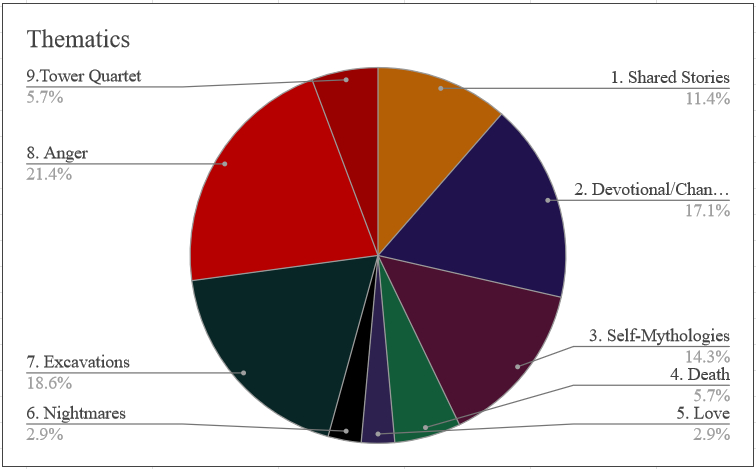
Here is a pie chart I have constructed and colour-coded to represent the themes and distribution of my poetry as of right now. Representing 71 poems written between January 9th, 2021 and October 15th, 2024. (I’ve written a few more but for various reasons they are not included on this list.)
(Interestingly, there are a few I cannot find copies of though I know I at least have physical copies somewhere. Bad LIS-professional! No cookie!!!)
The colours are loosely significant but the important thing to absorb here is that a) poetry is one of the main ways I channel my anger… especially as an autistic who goes largely non-verbal under social/interpersonal duress and b) I actually think of the Tower Quartet and (Channeled) Anger as subsets of a larger intellectual fonds …which is called “Excavations”. You will see that title in the pie chart as pertaining to a single slice, but really you can also view “Excavations” more broadly as occupying just over 45% of the chart! …The unifying emphasis is on digging deep, getting into the chthonic, and shadow-working my shit… oh, and a little revenge poetry here and there.
The thematics in the rest equally relate to each other pretty intensely. My poetry is always devotional in nature but some poems are more direct forms of near-audible gnosis. This makes sense to me from a mythic perspective as it is (personally) derived from the function of verse, alliteration, sorcery, ‘supplication’, evocation, and so on in medieval Irish literature.
I have made “Death” green mainly to evoke a #deathpositive association – ‘verdure from void’. I could equally (and perhaps should) have made it some kind of gold colour:
“I know you’ll remember me when I’m gone
remember my stories, remember my songs
I’ll leave them on earth, sweet traces of gold
oh, they’re calling me home, they’re calling me home.”
~ “They’re Calling Me Home”, Rhiannon Giddens
I will likely include little blurbs illuminating each category on a basic level whenever I manage to post them.
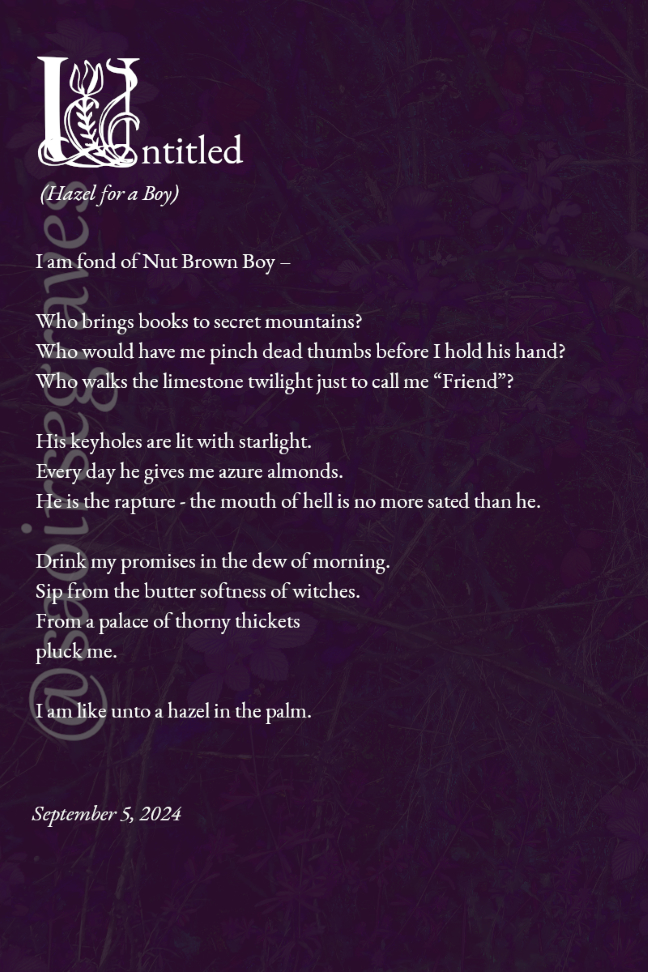
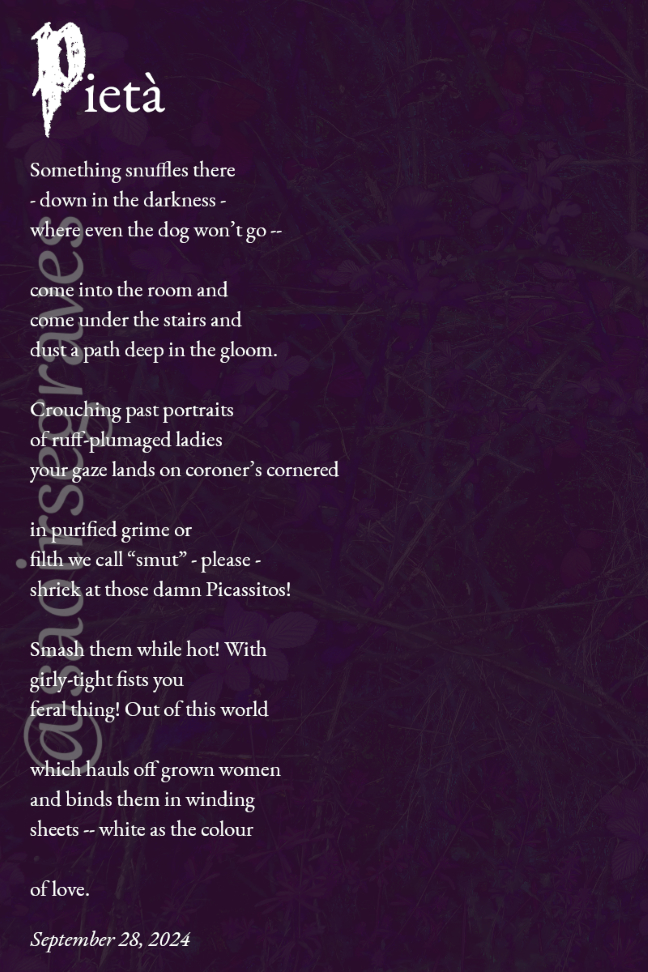
At any rate, I still need to figure out how to create a poetry gallery where poems that can’t occupy a single slide might appear… Until then, here are some of the poems I’ve written in September and October (minus “Athame”… which I have posted already.)
I suppose this set is all rather on the nose, but the themes of each are as follows: Love, Excavation, Death, Anger, and Anger.
For what it’s worth, I guess.
~ Saoirse.
* Get it? Theme-attics and Scheme-attics? Because it’s a post about poetry thematics and schematics? And I have a thing for sad attics? Ba-dum-tssshhh!!! Genius at it’s finest. I kill me.
With the recent spike in subscription prices over on Youtube and with their prohibition of ad blockers and so on getting out of control, I will now also be sharing each video here as an embedded link.
I’m going to work on uploading what I care to keep of my back-catalogue as well.
Videos will continue to be uploaded to Youtube but I wanted there to be an option for people who cannot or don’t want to afford Youtube Premium to be able to watch whatever they find interesting in my content for free without ad interruptions.
It’s only a small form of rebellion but it feels important to provide viewers/audiences with options.
Let me know if there are any specific videos you would like me to prioritise uploading!!!
At the moment, I’m in the midst of a massive change. Posts and so on are going to be sparse for a little while…
However, I want to offer some thoughts and updates on how I have been interfacing with the world and raise some perspectives that, honestly, I’ll never be ‘finished’ exploring.
The best feeling of sanctuary is well before sunrise.
Ever since I was little I have been obsessed with the minutiae of what it’s like to live creatively. Have you ever read a favourite book (in my case, mostly fantasy) and then seen a photo (sometimes at the back of the book with a short bio) of ‘the author at home’. Or perhaps you have stumbled across a photograph, blog post, or a short video essay that portrays ‘the artist in studio’. Have you ever seen this and thought I need to know how they got to that point in their life?
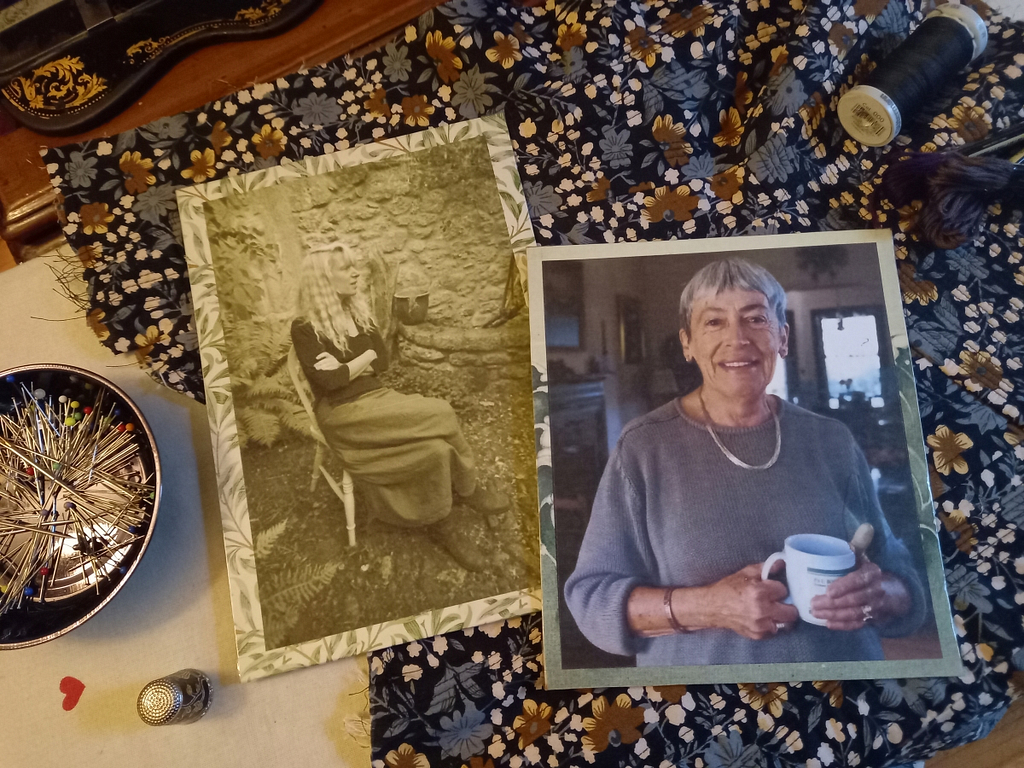
Cardboard cutouts I made years ago of Terri Windling and Ursula K. Le Guin. I used to tuck them in my planner and bring them with me everywhere!
I don’t mean ‘art for art’s sake’ but rather something very much embodied in the world and part of it’s extended network of sensibilities. Something that interfaces with real ecosystems or socio-economic environments and real time periods.
Is there any purer form of magic than the little glimpses you get of those lives? I don’t think they require endless descriptive detail because the idea is not to replicate them. You have to make your own for it to work and that’s what witchcraft *feels* like to me. It’s what I spend most of my youtube channel, this blog, my whole life pursuing.
Recent reading right before a VERY intense first time experience.
In my case, it has output that others can experience because I feel the creativity must go somewhere but I’ve never been the best at keeping track of my portfolio (and, indeed, I was always rubbish at tracking my repertoire when I was a performing violinist too. #myexecutivefunctionsucks)
But this is why I’ll so often mention something in detail, something relatively mundane but *just* off the beaten track (debatable) and then go “see? Witchcraft!”
And the reading AFTER that experience to get a sense of where it was going.
I love scenes in fantasy stories** that describe the seemingly mundane elements of a witch’s living space. Let’s say you’re in the Brooklyn apartment belonging to your aunt (umpty times removed). She has a gas hob that she lights with matches. There’s a colourful pot of coffee on. A fruit bowl sits on the coffee table below a daffy painting of old lovers in clashing robes. You wonder why their necks are so long… A cat lounges near an old pile of yarn or perhaps on a tatty armchair tucked in the corner. You look out the kitchen window to see she’s let the black-eyed susan vine overtake the fire escape …something looks different about the city though. “Honey, pick a different window” or “Sweetheart, come look at this old book of poems… people go mad looking out there too long.”
A reading about a specific… quandary and lived/sensory question.
Is it just because of the city chaos? Or is that the road to an Otherworld? What’s the difference between personal eccentricity and a real witch? Who gets to make that call?
… I’ve taken to washing my hair once every three weeks now instead of the usual two. I’m combing it, which I never thought possible with curls, but it seems that the key lies in using a wooden comb. I oil it with olive oil mixed with peppermint, fenugreek seeds, and rosemary (which I cooked in it myself. Magical intentions included.) Recently, I changed up my henna mixture for colouring too… the henna kept oxidizing far too dark and I prefer a lighter pinker red. I did a whole bunch of research on it and ended up with henna, catnip, and madder root! There are medieval recipes for colouring hair but I went with modern recommendations made by those interested in retaining length. Just in case.
So now I’ve got even more of a medieval-inspired head! Though I have no idea if it will register on camera over time, I’m very happy with the difference.
I’m making myself a new (to me) type of corset. And I’m going so very slow with it … partly because most of my time is eaten up with something else non-negotiable at the moment. But progress is happening! Hopefully, I’ll like it? I’m learning so much in the process though.
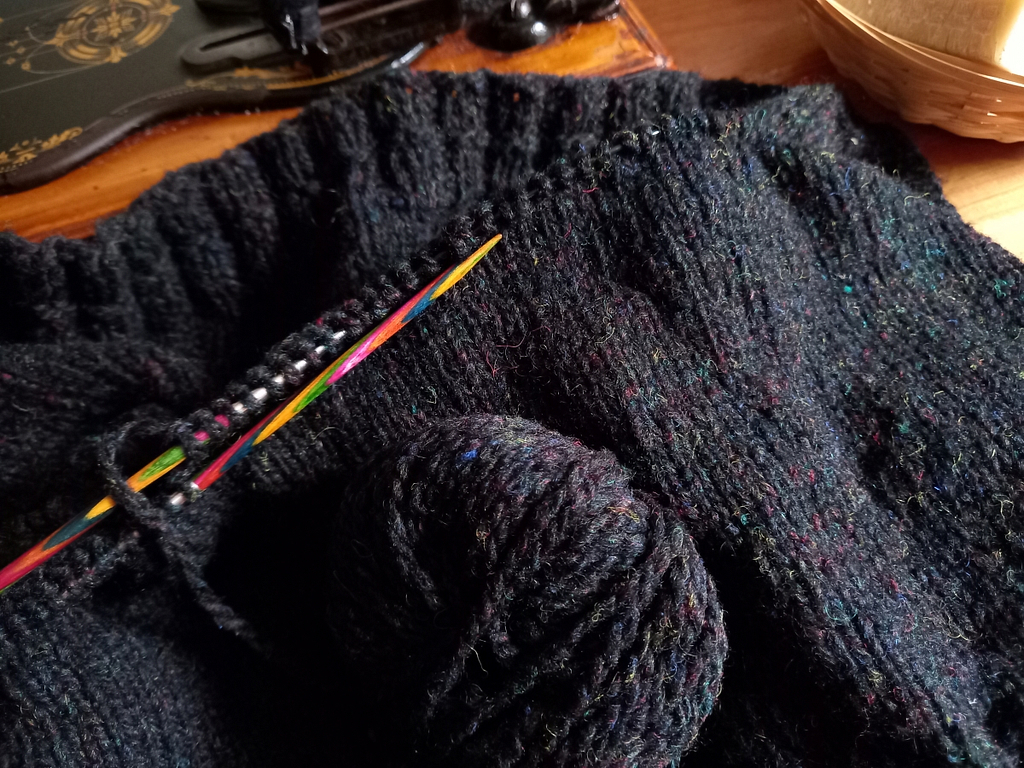
I’m still working on my current jumper project… historically inspired with billowing sleeves. And yarn the colour of crow feathers (black, but with many tiny multicolour fibres within so it has the optic effect of shimmering.) I can’t wait to finish it!!!
In other lights it looks more blue green!
I’ve also migrated over to the dumb phone life. I’d wanted to do this for a long time and had steadily uninstalled as much as I could from my old Samsung (having left a certain soul-sucking fruit-named empire behind years ago!) But the thing was still such a drain on my life.
My internet is based in my hotspot so my dumphone does have that capability. It’s the Matrix phone, for anyone wondering. A Nokia 8110 4G – and oddly it’s WAY faster than the old hotspot. I theorised to my techie BIL it might be that I couldn’t entirely keep my smartphone from doing other things in the background. He agreed.
In the absence of so much stimulation elsewhere, I have been getting better at aimlessly browsing less. And my witchcraft has immediately felt more real. More present. It’s colours are more vibrant. My relationship with deity has been reviving. Not that it was ‘dead’ but I had felt like I was fighting some kind of film that lay over it before I could really access it. That is much less the case now and I anticipate it changing further.
I mean, for example, Macha and Badb make an appearance masquerading as artists and tarot readers… They call themselves ‘Melodie Moonlight’ and ‘Breda Fairfoul’. One has blue hair, the other red. They ride a motorbike. They chew tobacco and smoke cigars. They file enamel handcuffs with their teeth and cry acid tears! What more could you want!
The way I keep describing it is, “I feel like I can see things better.” It’s not the best analogy but it will suffice for now.
Which brings us back to the magic in the mundane. Call it aesthetics, but I want to make real what I feel and perceive to be important. It takes sketches, notes, and even pin boards just as much as it takes altar work, moon phases, or wax drippings. Magic is art, art is sensory, and art and magic are visual-tactile-aural living.
The end.
(Or the beginning?)
~ Saoirse.
PS. I’ve been re-reading a lot of old favourites… Hounds of the Morrigan, The Left Hand of Darkness and so on… but I’ve also been embarking on a shocking amount of new stuff for me! Movies I’d never seen… The Crow (1994), What We Do In the Shadows, Witches of Eastwick, Beetlejuice (1988)****. I have THOUGHTS about all of this that links into what I’ve laid out above. Hopefully, I’ll get to post again soon!
** Urban fantasy is great for this but I can think of a few Patricia A. McKillip moments or Patricia C. Wrede moments and many others that do this really well too.
*** The header image is just a bunch of old photos of me aged approx. 16-21.
What if Madame Nostradamus, our “witty little knitter”, wanted her OWN scarf? Things are gonna get properly nerdy with this one. Strap in – I have no chill!
Note ~ my knit gauge was a little tighter than called for in the double knit weight, so I used the inches chart. I preferred the slightly denser look so I didn’t bother adjusting my gauge too much.
Paintings featured (anti-clockwise):
The Arnolfini Wedding by Jan van Eyck, 1434
Portrait of Christina of Denmark by Hans Holbein the Younger, 1538
Portrait of a Young Woman/Isabella of Spain and Denmark by Jan Gossaert, 16th c.
Portrait of a Lady by Rogier van der Weyden, c. 1460
Cornelis Aerentsz van der Dussen by Jan van Scorel, c. 1535
The Wedding Dance by Pieter Bruegel the Elder, 1566
A Young Princess (Possibly Dorothea of Denmark) by Jan Gossaert, 1530
Music featured:
Je suis d’Allemagne – Je suis trop jeunette by Ensemble Unicorn (Album ~ “Art & Music: Raphel – Music of his Time”)
Comment qu’a moy lonteinne by Falsobordone (Album ~ “1350 Music for a Plague”)
Recently, I have been trying to give form to certain ideas. At a snail’s pace, my kind of speed. One of these ideas has to do with a burgeoning awareness that something I have always been able to feel and certainly always yearned for is taking shape… Simply put, it can be called ‘lifestyle’ or ‘vocation’. It’s about the sensory experience of every day. It’s about how that intermingles with the hopes and dreams of the past. It’s even about certain life goals that have recently become a little more tangible.
It can be glimpsed in my thoughts about ‘between’ spaces. I’ve been calling this place ‘the Labyrinth’.
In the Labyrinth, rooms are often arranged according to discipline or genre. Style of activity. Or by medium. It has places that are dominated by memory. Or by myth. Rooms and halls devoted to presence. It has a rotting fairy Versaille, sidhe mounds lie just beyond the walls of it’s outer gardens. I know what grows in it’s crevices. I know what areas get built vs. which simply materialise and I know why – I know what I’m trying to do there. It can only be entered or exited from this side of reality… on the far side it might be infinite. I have not checked.
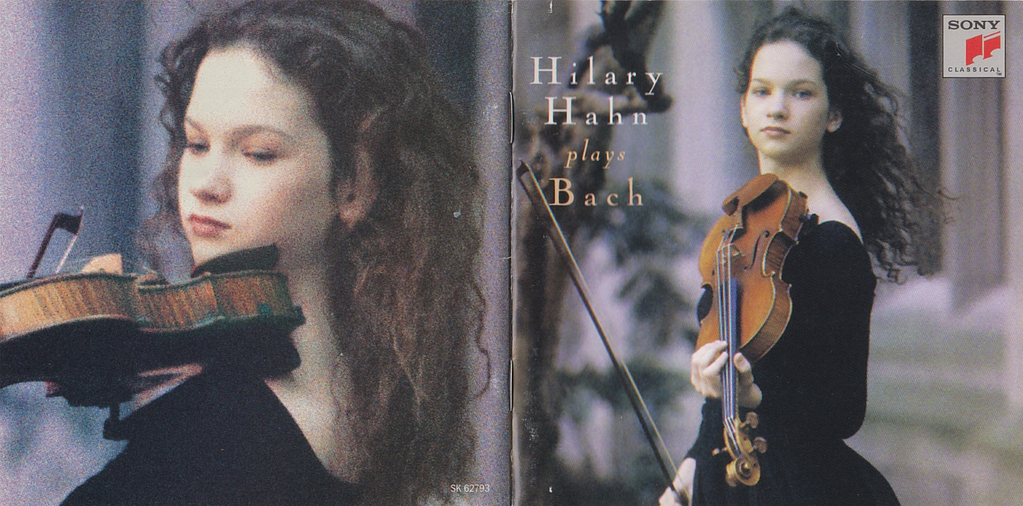
Though Hilary’s performance style isn’t my favourite now, her work & THIS ALBUM were deeply formative… This cannot be overstated.
In the Labyrinth are all the scariest saddest most soul crushing things I have ever personally encountered. In the Labyrinth are also the scariest saddest things my loved ones have encountered…
In certain rooms in the Labyrinth, it has windows to Nazi Germany. To two little girls in the rubble of Cologne. In other rooms hang portraits of Sarah Chang, Ani Kavafian, Hilary Hahn, Nathan Milstein, Andrew Manze – the violin room. In another, Carter Brey, Andre Emilianoff, Rostropovich, and Jacqueline Du Pré… though I hasten to say the cello room is much scarier than the violin room. More horror and shadow. In the violin room, baroque music echoes from an old scratched record player that I can’t find. It floats between sage green curtains with gold fringe, it gathers in gusts of dusty leaves strewn along the floor. It’s faded tiles are arranged a little like a chess board (but not quite). The violin room has a fallen wall that leads outside. It’s almost always Autumn from that vantage point.
Imagine… Sibelius echoing through the ghostly gallery of memory.
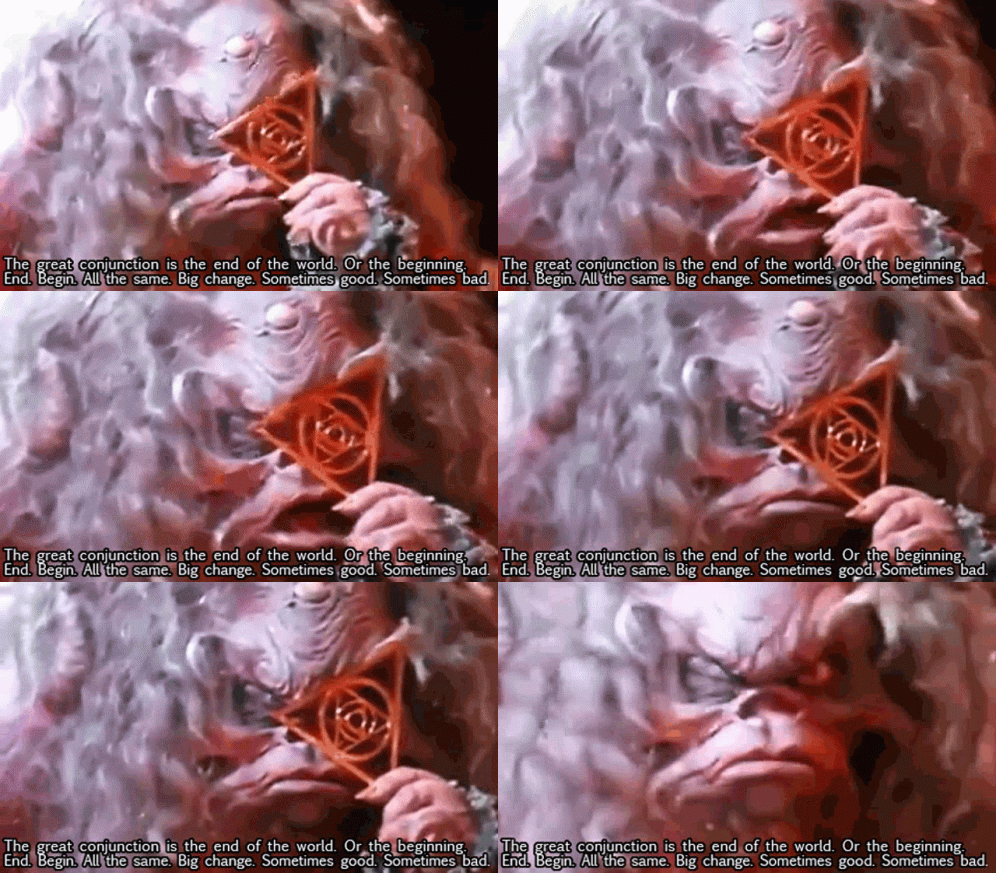
There is joy in the Labyrinth. Some of the most beautiful sunlit gardens I have ever seen. Bright and fresh of a cool morning. In some parts of it I have lots of little demon fairy friends… absolutely inspired by the work of Brian and Wendy Froud, Jim Henson, and others.
“Step out of the page into the sensual world.” ~ Kate Bush
Many parts of the Labyrinth give me the eerie feeling I have seen them before. If you have seen The Storyteller series with John Hurt (and Brian Henson as his dog!) you’ll recognise much of the look of my Labyrinth – including the way a room filmed from a different angle looks like a different story.
If I have something big and overwhelming to face, I walk the number of steps and turns and corridors and gardens it takes to get there. And then I come back.
And therein lies an important nuance – Big and Overwhelming Things. These are not just bad things. Not just lost things.
Yesterday, I sat down to work on sketching out wardrobe ideas. The goal has been taking shape in my mind for quite some time of what colour palette I want. What silhouettes I like that also work on my body and my sensory preferences. What works where I live and what I can have ethically shipped or acquired? What layering? What technique? What cheeky little references? How shall I paint myself? Where will I hide symbols & sigils? Which tattoos will I allow people to see? How semi-permeable do I want my persona to be? What kind of variations do I want to build into that without always causing getting dressed to be such a cognitive burden (as fun as it ALWAYS is – I even enjoy pjs!)
JEEZUZ! 7 of Cups, this is getting personal!
It’s hard to go from basic learning to a cohesive finished result. I’m convinced a practiced artist is able to make something and 51% of the time say to themselves, “that was deliberate”. >_< In performance, they always said that the true masters spend their whole lives practicing to make the hardest things seem easy. No one wants their audience to wince in anticipation of a famously difficult passage!
But if I have a flare for aesthetics and a knack for getting my hands to make what I envision, that’s all I have. “Flare” and “Knack”. Good fairy names, to be sure… good to have on side, but not synonymous with a finished project. Not yet the bit where I’ve crafted and lived in my visions. Not yet corporeal. And the tension or dissonance of this arises in a few key places:
Clarity of vision requires honing and specification. Decisions in favour of one thing at the expense of another. Do I have ‘talent’ for this kind of executive functioning?
NO. (It’s one of my specific autistic ‘traits’ that I suck at this.) It will not just take practice. It will require a lot of frustration, erasing (::gasp!::), paper with pencil dents in it that won’t erase any more, bad stitching… and quite literal ‘blood, sweat, and tears’ because I really shouldn’t be trusted with so many sharp implements.
Do I know how to manage my fabrics to minimise waste without being over precious?
Ehhhhhhh… always a question, never an answer to that one.
What happens if I change my mind?
What happens if my tastes change?
What if my body changes?
Should I plan contingency into these patterns?
Could I remake them into something else?
Where should I store repair-remnants so they don’t get eaten by moths?
Shit, I ripped something… again.
But if I draw something after a lot of work and swear words (while also being happy and absorbed in the process) and I show that sketch online and “it looks well enough to the untrained eye” (as it has been drawn by an untrained person!) and some people like it… is that ‘talent’? Or is it burgeoning skill. Is it diligence? Or is it bare minimum that I managed to draw it at all…
Found some old stuff!Self-portraits. 2021 & 2023?Experiments – derivative but useful!
What then if the drawings truly do become clothes. (Doesn’t that sound like magic!?) Is THAT talent? Or is it… propensity? Am I pretentious? Am I ‘talented’ or am I just a fucking handful? Who’s gonna hoover up the trail of threads and linen dust…
Maybe I have a talent for being a handful!
If I share process online, who is my audience?
I literally have no idea… but I HAVE always felt that documentaries about creative process, textbooks and lectures about the preparatory sketches and intentional symbolism of art, and old photographs of ‘artist in studio’ were the most magical Otherworldly thing on the planet.
I want to make the clothes I find in The Labyrinth. I want to come back along those corridors still wearing what I saw there. I want to help that stuff cross the divide – not just the clothes but the air quality, the poetry, the paintings, the furnishings, the music, the ideas.
It’s a stormy yellow-green coloured day today. Deeply blustry and misting with rain. I have a massive headache. But I want to build Otherworlds and I want to learn what it takes to do that.
The word ‘talent’ is a value judgement that has no objective significance at all. In my experience, ‘talent’ is a word used to diminish not only the hard work of others but also the reality of what it is to try something and kind of suck at it until you kind of suck a little less! Perhaps people accidentally sabotage themselves in using this word. If it’s always someone else that is so talented… What do we think their talent is? Is it the same as what they want it to be or thought it was? Have we ever seen what their work looked like not just when they started but at every point along the way? Good days? Bad days? Days where they had a dentist appointment and forgot to cover their paints so everything dried up? Days where they’ve LOVED baking until they realised they mis-measured their yeast …or the oven stopped working but the light stayed on? Days where the internet told them they were great but a favourite family member grimaced at their ideas?
What if you’re a 60 year old man who wants to learn to swim after years of being body shamed. What if you used to dream of talking to fish and you want to explore that again in the physical realm? I bet you could become an expert at loving water – not just a ‘talented’ swimmer.
Some people have opportunity, privilege, & support. Too many people don’t. Maybe most people have an incorrigible mix of these things. A pervasive paradox.
Culturally agreed upon standards for what looks like talent totally exist… but they are relative at best. Not very nice and of limited use. Picasso, Dante Gabriel Rossetti and other such humans dwell in the realm of talent and genius only because they deny entry to others. Sabotaging others with jealousy and aggression. Their work is good, just not THAT good. The idea of ‘inherent talent’ (to me) just screams ‘big fish, little pond’.
The concept of ‘perseverance’ exists but I think it gets misapplied to the point of losing a lot of what’s useful about it. Can you persevere at being scatter brained? Do we value that word internally or are we waiting for it to be applied externally?
Play TOTALLY exists. But if ‘play’ is ‘talent’, then can talent be ‘lost’? And if talent can be lost, then I think it must not be inherent. Which, to me, means you could be 96 years old and still decide to redevelop it if you chose… just because you can. That sounds more like curiosity and skill-building! Achievable things! Real magic.
If ‘talent’ exists, then everyone must have it. I think it’s down to the inherent tension and dissonance of asking yourself what yours are… and inventing them when necessary!
~ Saoirse.
P.S. It’s a total joke that I put my own work next to all these amazing true geniuses. I laugh at myself, not them!
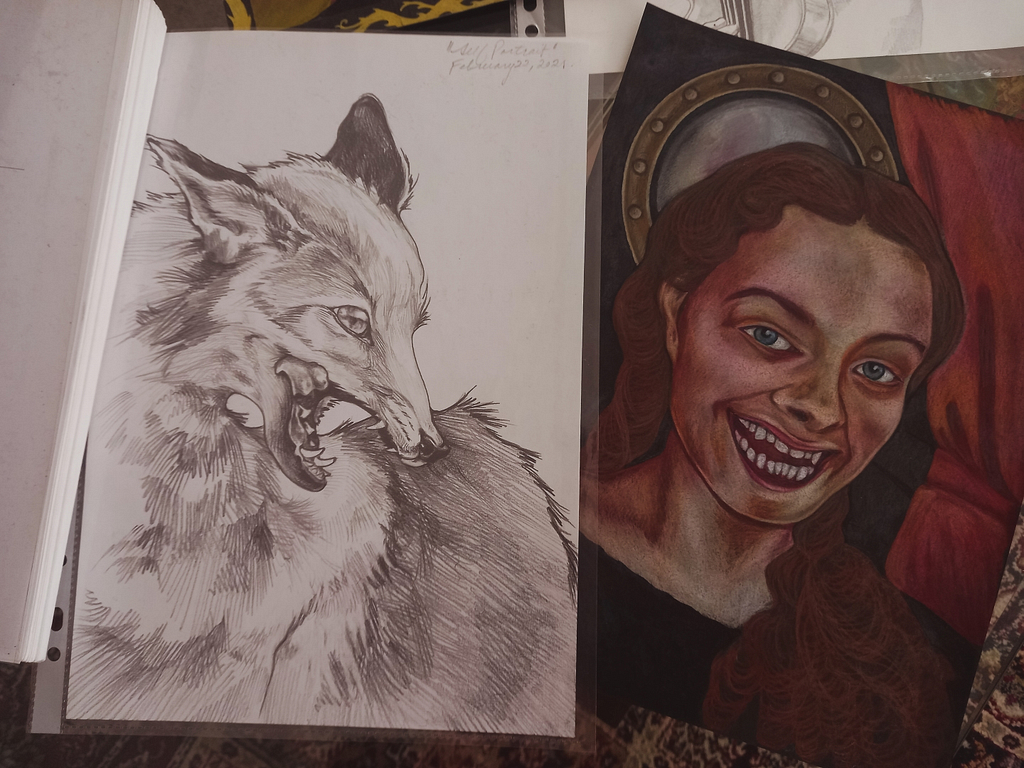
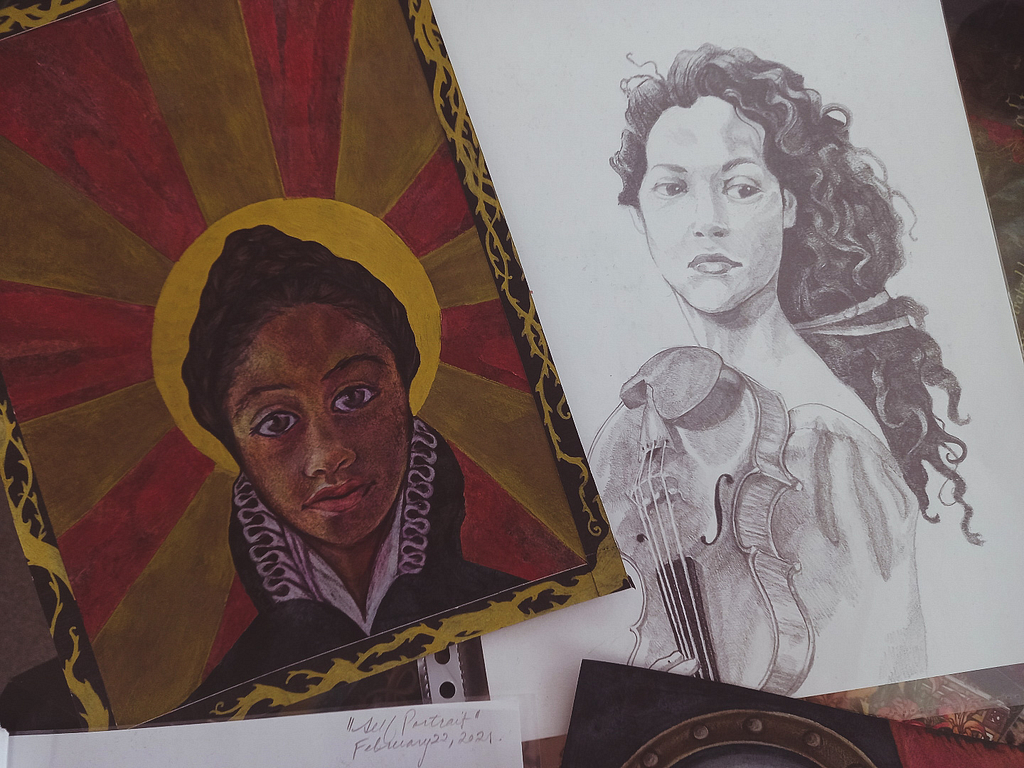
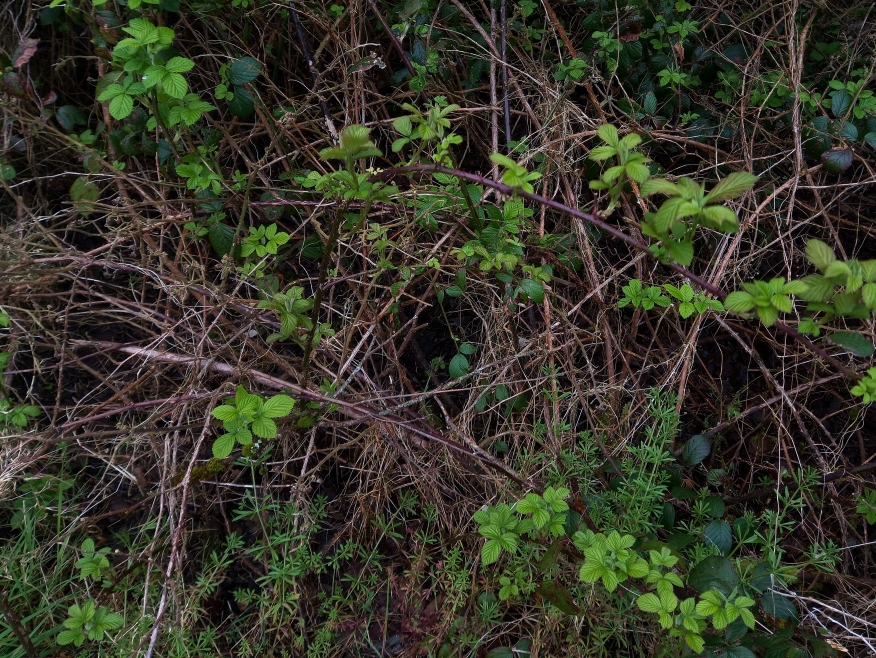
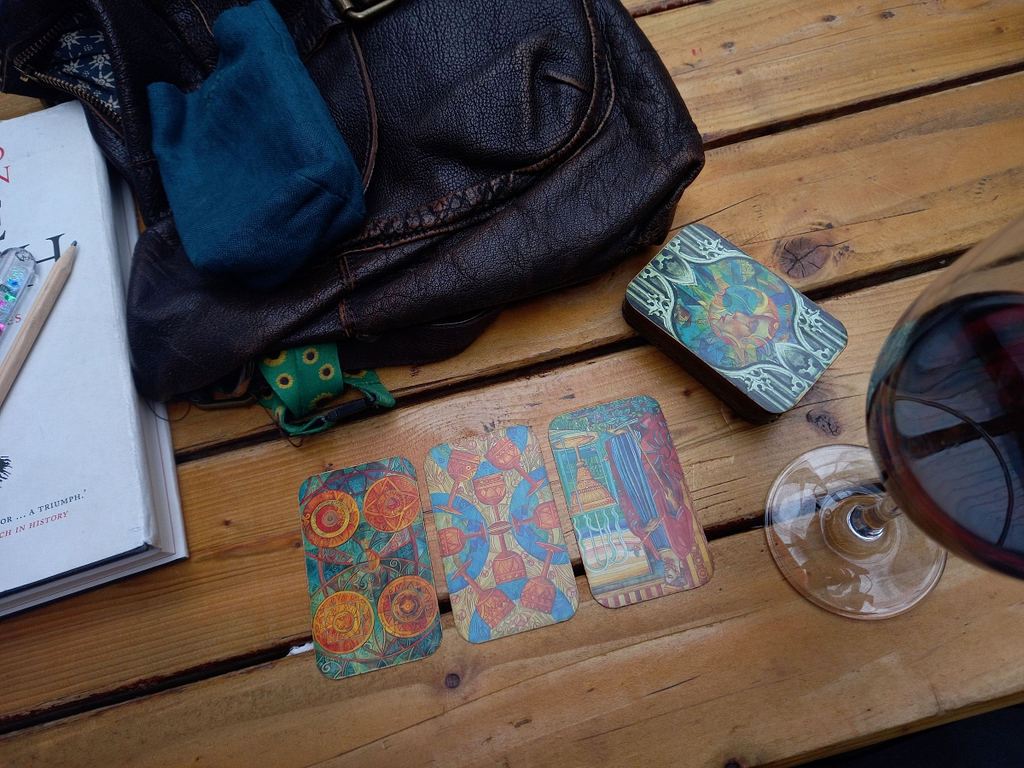
I wanted to share some recent moments of simple joy & presence. These photographs were not necessarily taken for the purpose of sharing in a public format. However, I am in the habit of taking constant photos of brambles, for example… Such photos in turn make up a good back catalogue of plant/animal material to from which to practice drawing**, to practice seeing, and to practice layering concepts.
Whether something gets shared or not is rarely planned (at least rarely planned fully) and the follow-through on any such plans also rarely correlates to the intent in taking the photograph. It’s all a bit loosey goosey up in here.
For me, it has become increasingly clear that the intent to share (or not?) is not so binary… Thus, some recent moments of craft, joy, & sensory immersion.
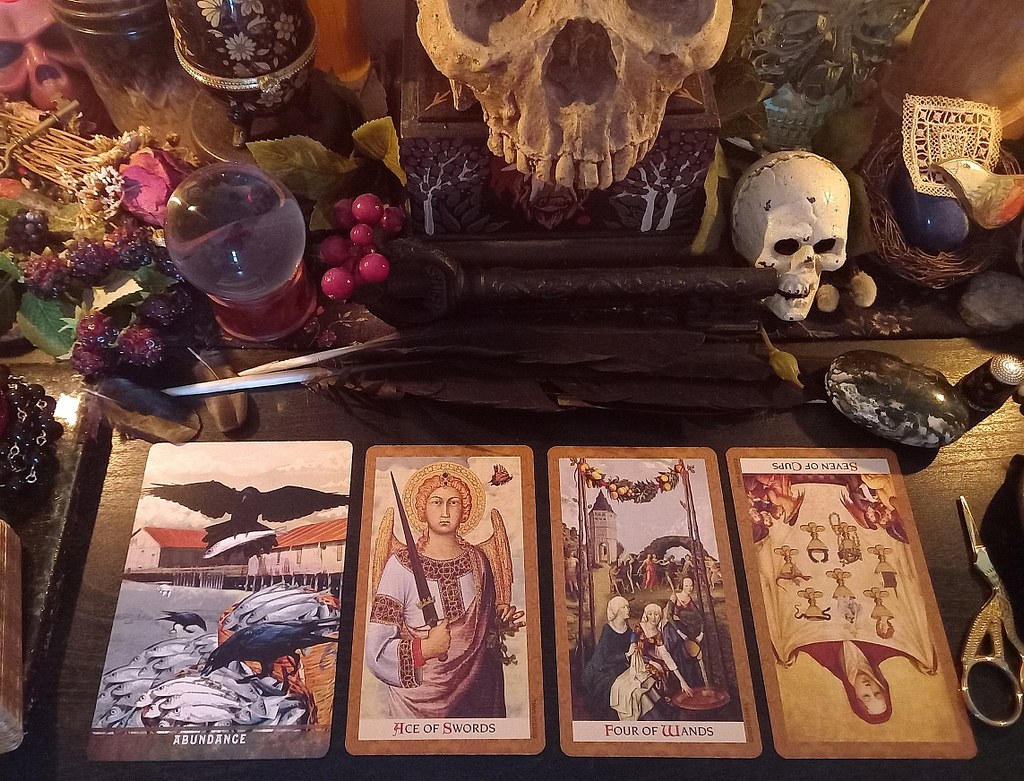
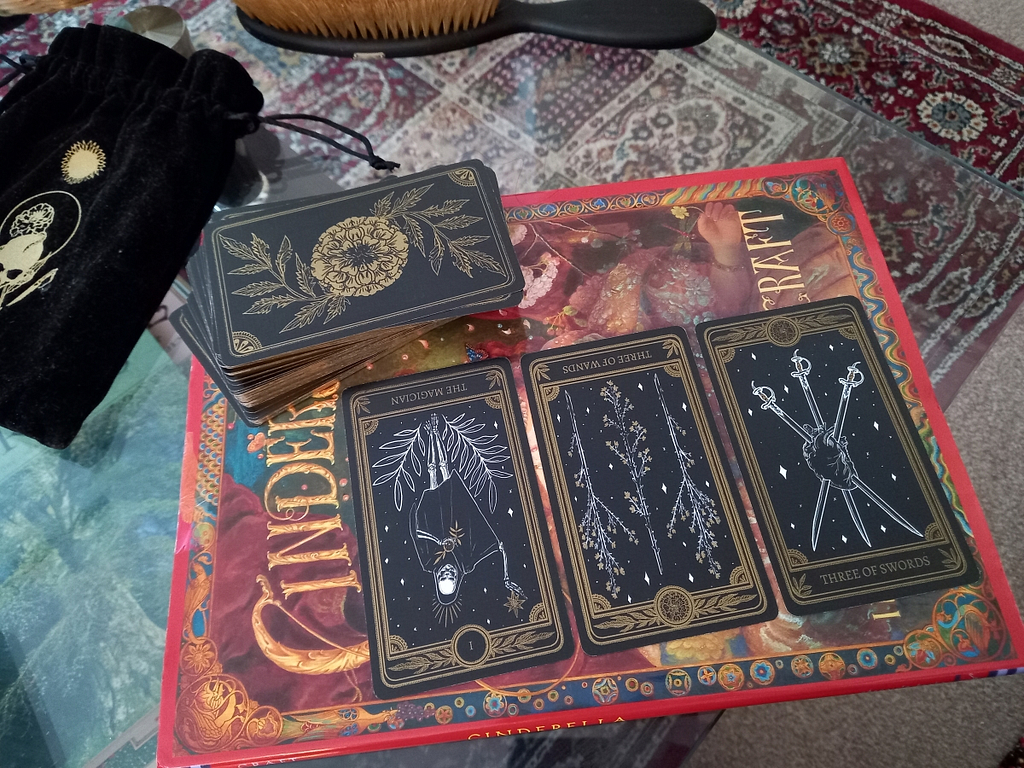
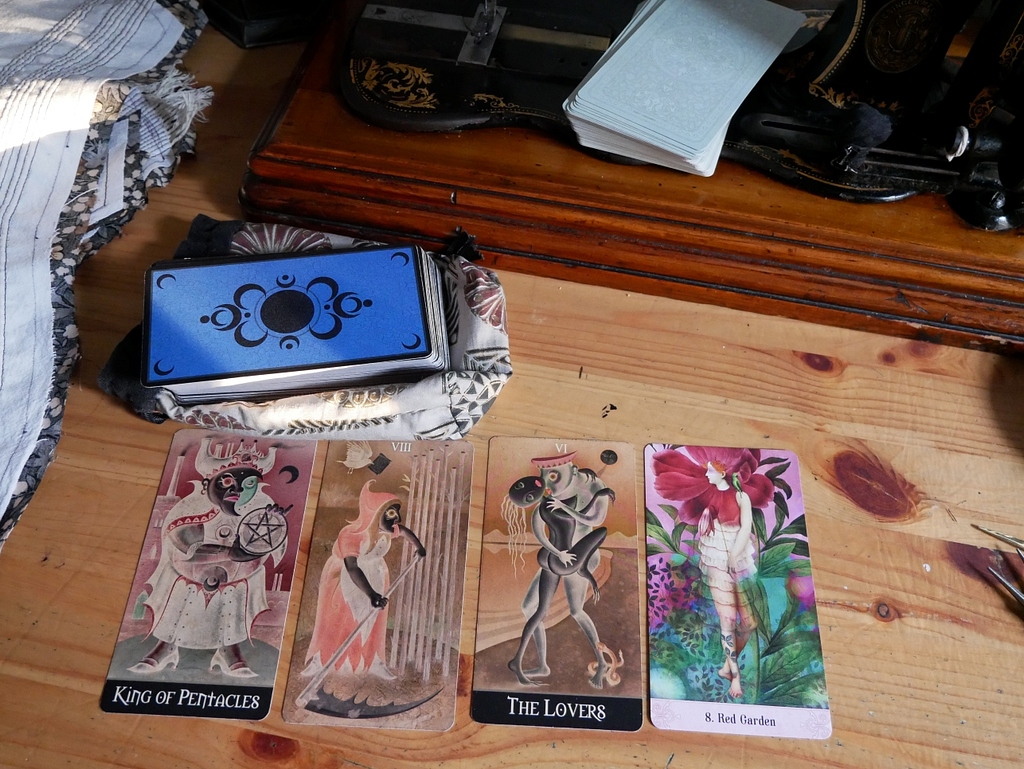
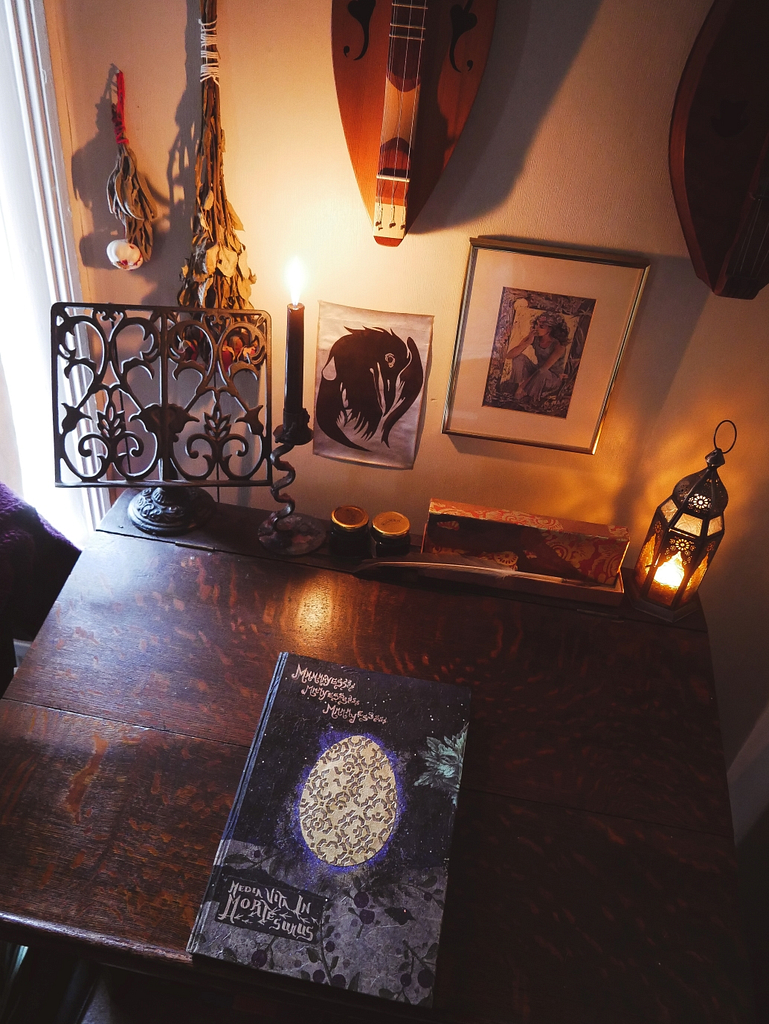
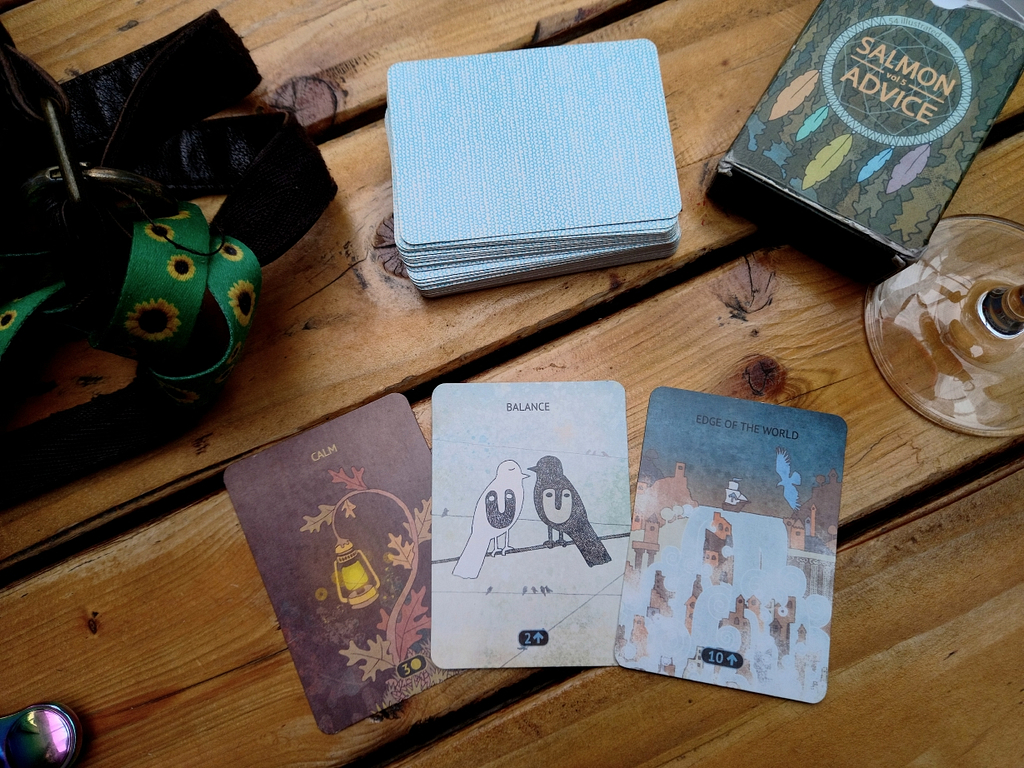
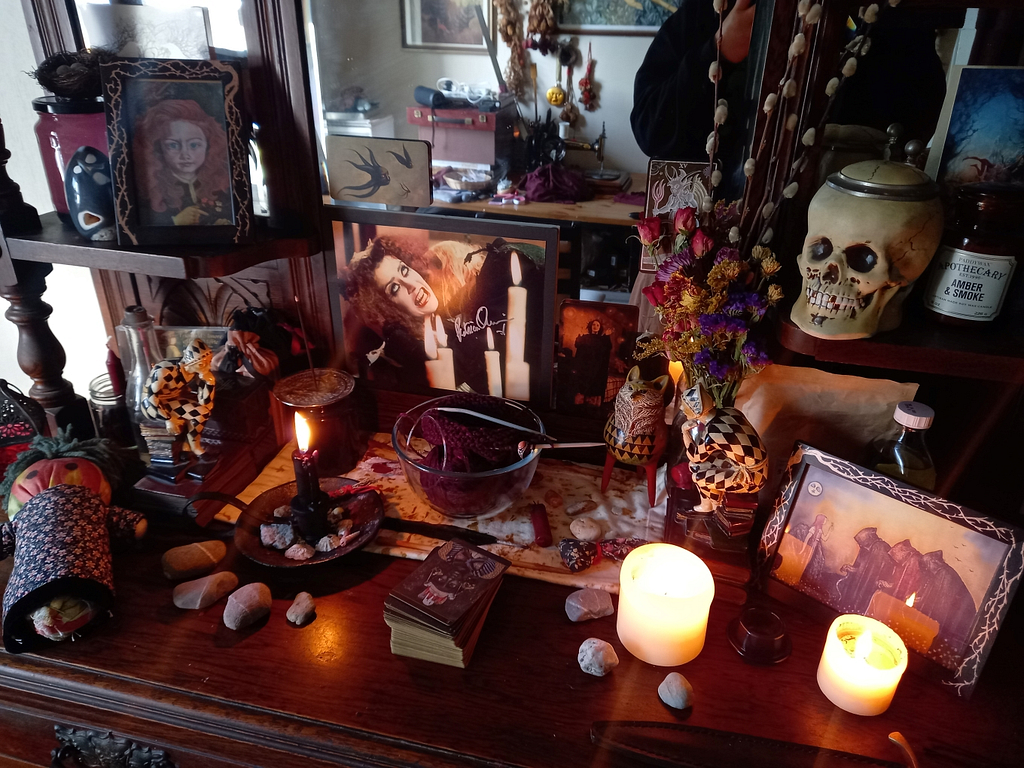
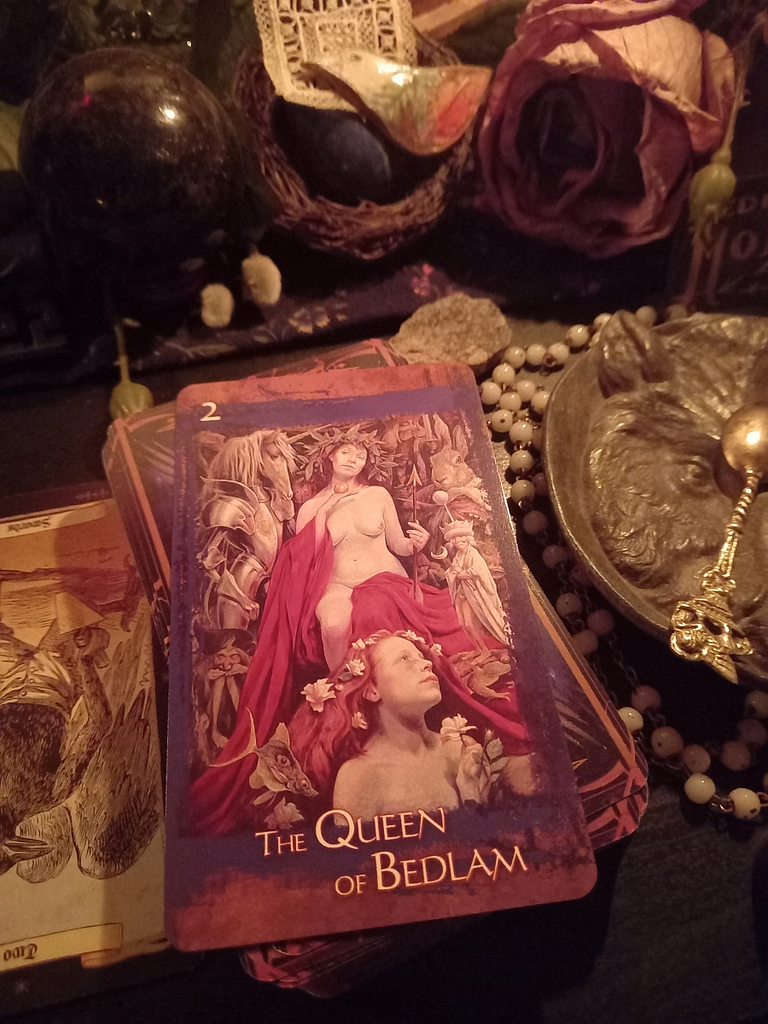
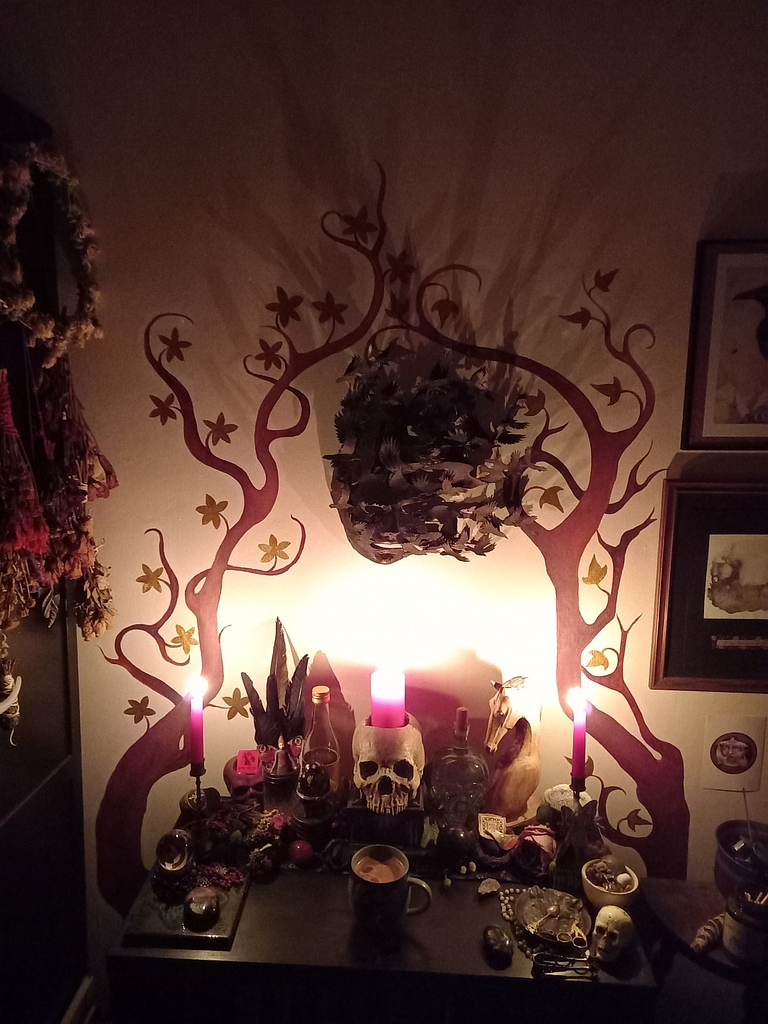
Little doors…“Down among the weeds, down among the thorn” (‘Tam Lin’; Child Ballad 39, Roud Index 35)Looking for Miss Tittlemouse…Tarot decks ‘in sa phub’! (Crystal Tarot, my trusty travel deck.)Salmon Advice cards …not sure this is the correct Vol. box though…The Glamour altar… among other things.A moment of ‘synchronicity’ with a friend 🙂5 am, after nightmares.Colour, texture, & lots of hidden flora & fauna amidst curvilinear existence.
For some context on what I’m doing with the header image, you might like to watch this video of mine on The Hush Tarot & it’s references to Arthur Rackham/the Golden Age of Illustration:
An oldie but a goodie…
~ Saoirse
* A reference to the highly influential (1970s) art historical work of the same name by John Berger. You can watch it for free here. I’ve actually not watched all of it myself yet but the significance of this was two fold – to challenge what was up to that point a more traditionalist method of interpreting art historical work & to introduce the viewing audience to ways of questioning & analysing the art they take in or experience.
** The header image is a composite of my own photography of birch trees and a print I own of “The Fairy Tightrope”/”Fairy Dancing on a Spiderweb” by Arthur Rackham. You can see an early version of this image in a 1912(?) copy for free from the New York Public Library here. I guess you can also be glad I’m not sharing my photographs of dead rats and such 😛
*** Check out the album Child Ballads by Anaïs Mitchell & Jefferson Hamer. It has a *gorgeous* version of Tam Lin that keeps the pregnancy/poison narrative in! …I mean, check out Anaïs Mitchell in general ::drool::
Something that has gripped my imagination my entire life is the idea of ‘Building Other Worlds’. Importantly, I don’t mean only as ‘substance behind narrative genres’. World-building for a fantasy novel or for game play, though deeply interesting, is only one popular iteration of a much broader interdisciplinary creative drive to make and experience other worlds. What of Art? Architecture? Costume? Music? Theatre? Ecological experience? Folklore? What of symbolism or spacial awareness? Where do we get ideas for what our worlds look like and what tools do we use to build them?
I have been wanting to write about this for a long time but have been puzzled about where to start. Do I start by explaining some things about art history? About perspective, image composition, numerology? Do I dig into how tiered worlds in late medieval and renaissance literature make their way into contemporary visual language? What about modern art? What about tarot or oracle? Witchcraft, sewing, or poetry? Would tracing themes of port cities and their proximity to marshland or wetland habitats get the message across? What about folkloric recordings of Victorian vs. Medieval streets in Irish town centres!? Ultimately, I realised I’m going to have to start where I am and, if you wish, you can follow me down each corridor as and when I get there.
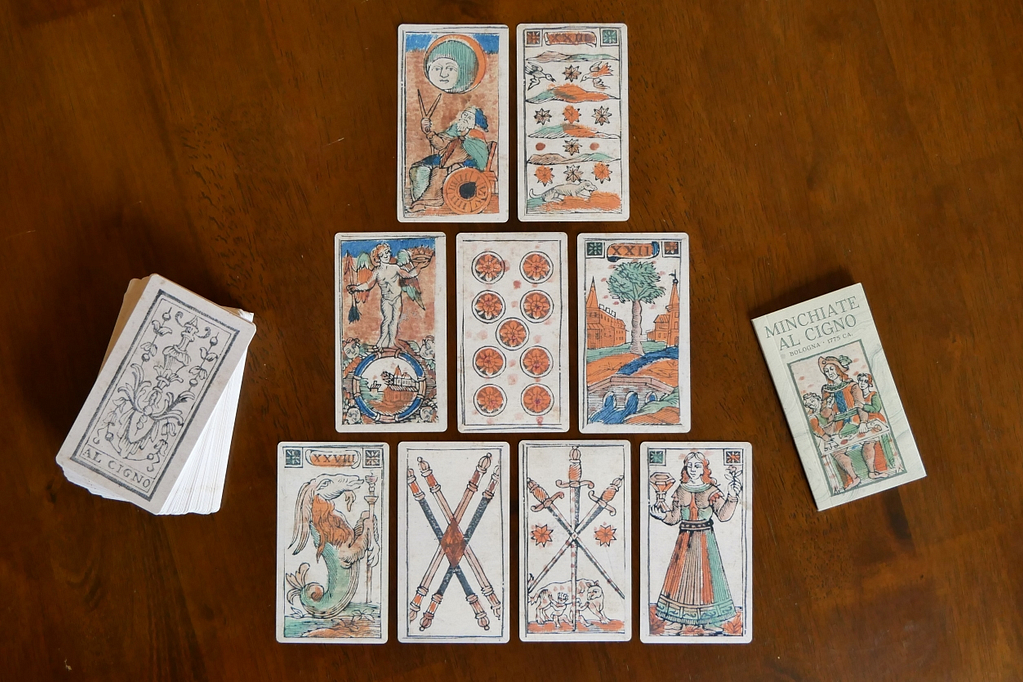
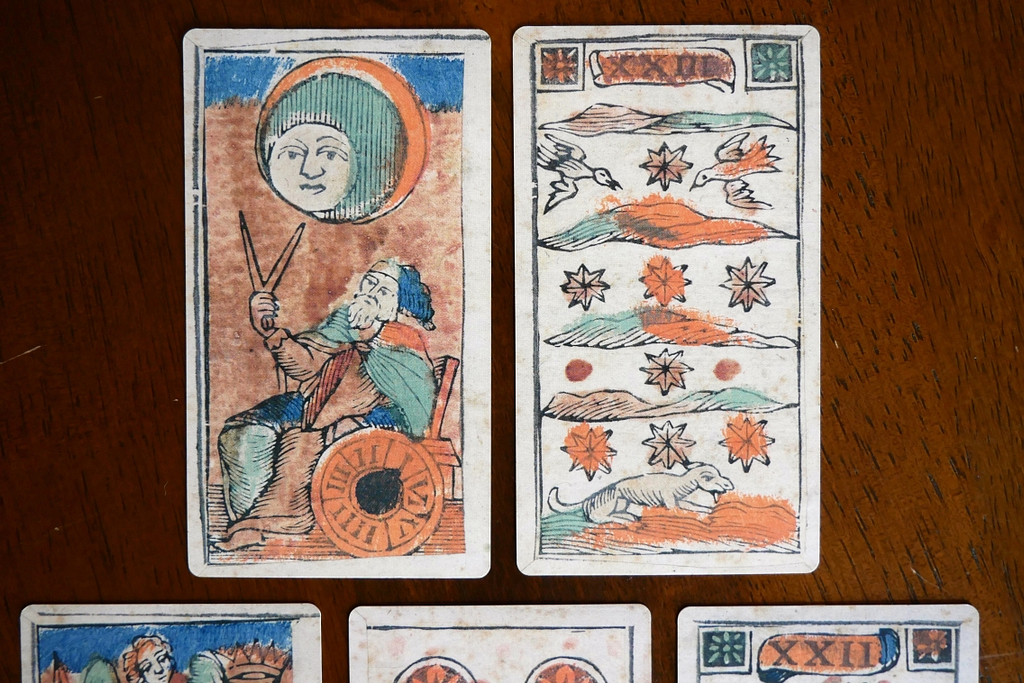
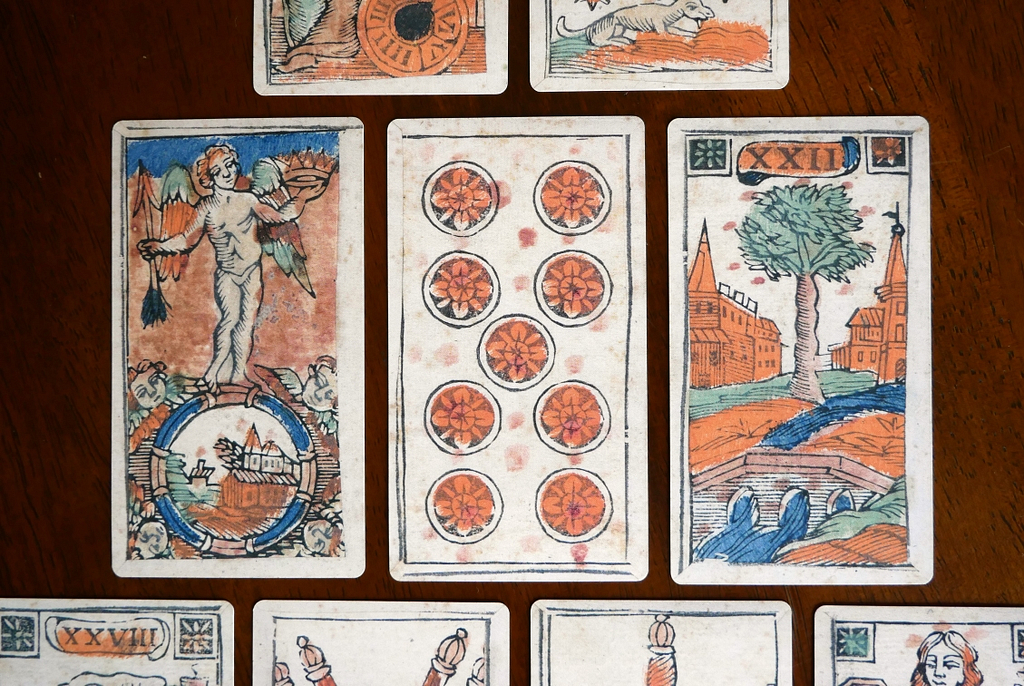
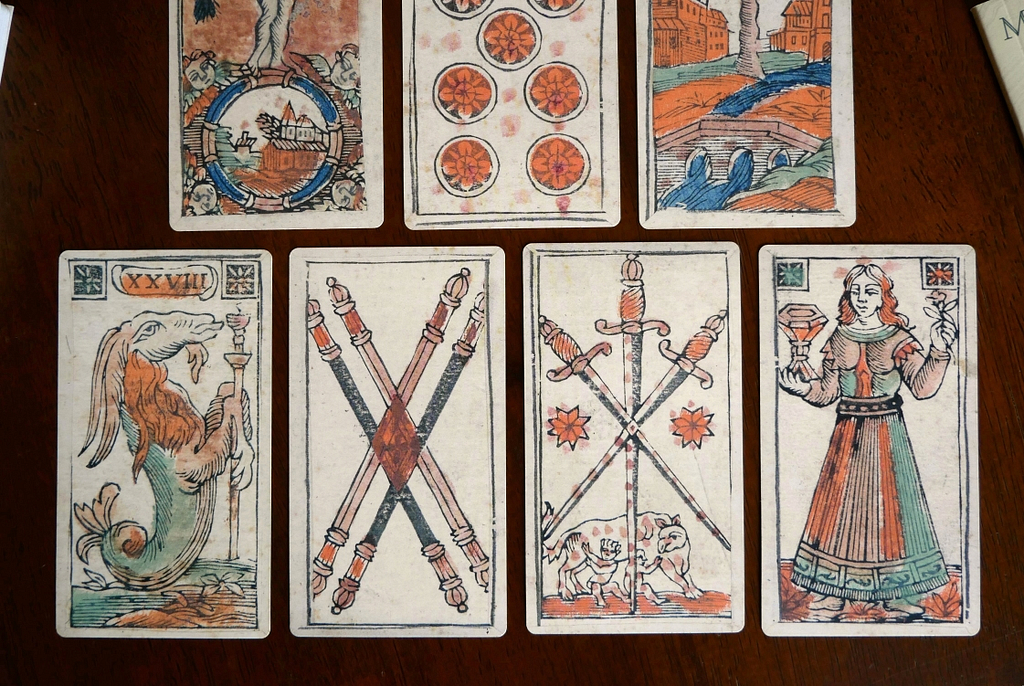
Here are some purposefully drawn 18th c. Minchiate cards illustrating how card visuals can help you construct doors to Otherworlds and populate them in turn with architecture, characters, and landscape …with pips for ‘scaffolding’!
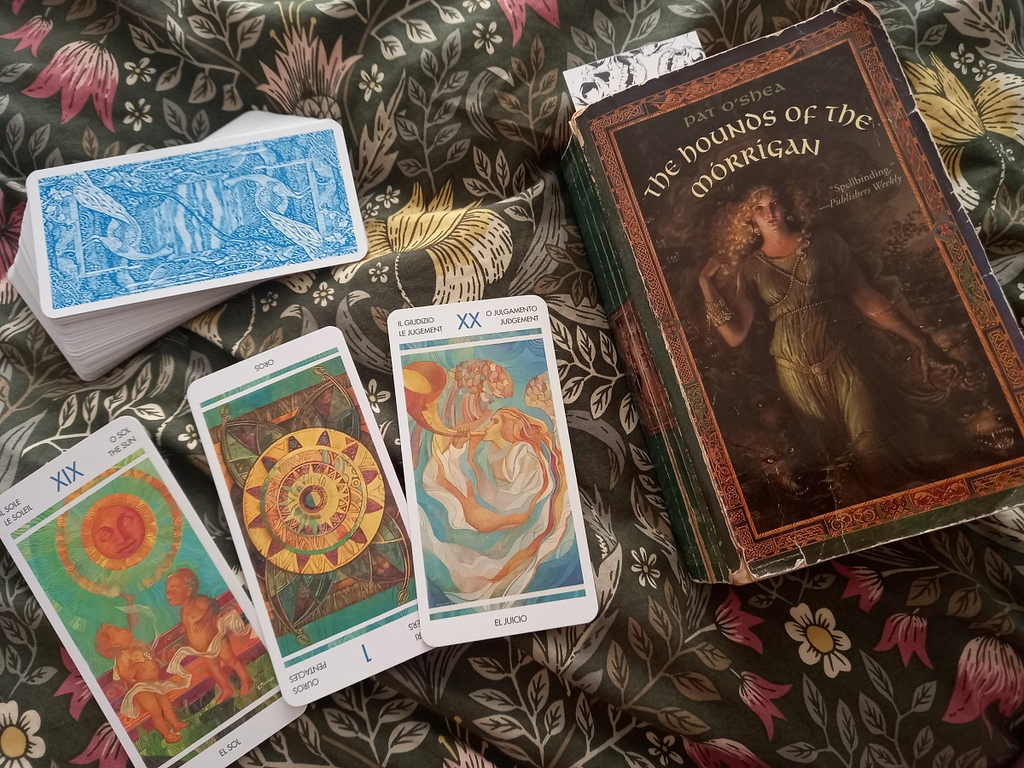
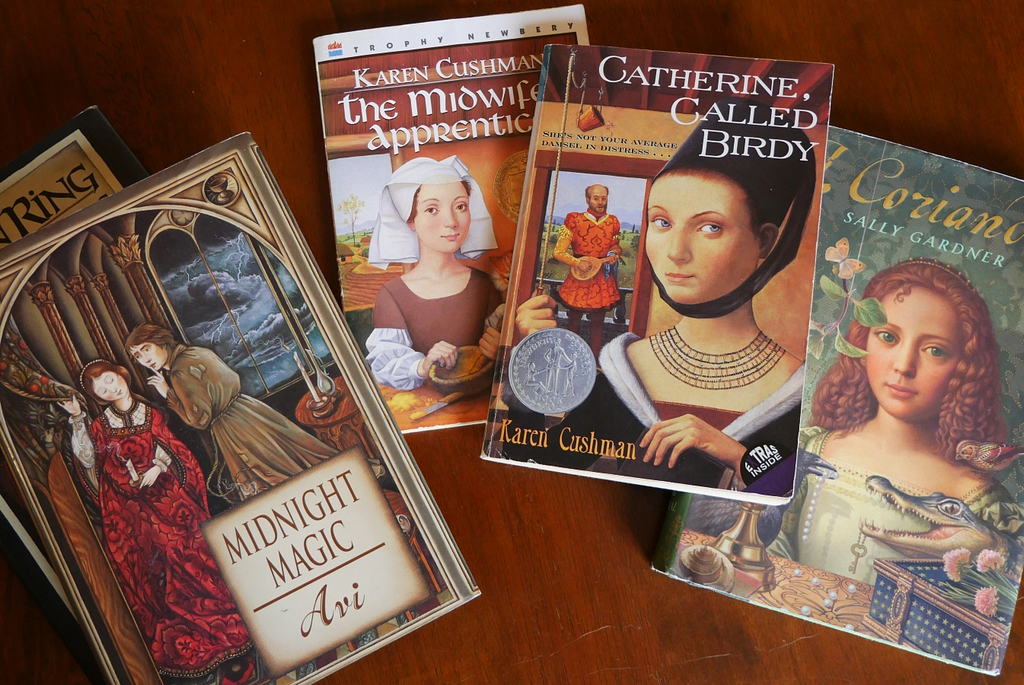
Recently, I revisited some books that were instrumental in helping me to identify myself when I was young. These follow very much in a similar vein to other favourites of mine such as Pish Posh, Said Hieronymus Bosch, The Books of Earthsea, The Chronicles of Prydain, The Hounds of the Mórrígan, or Jonathan Strange & Mr Norrell… and I took special care to obtain secondhand copies of the specific covers I grew up with as well.
I have yet to re-read The Raven Ring although I know I will love it as I can’t remember how many times I would have read it growing up.
There are five books in all (for now) – each of which features scenes relating to tarot, tarocchi, or otherwise emphasise attention to historical detail within their fictional plots.
* Midnight Magic by Avi (part of a series that didn’t exist yet when I was younger. I won’t talk about this one much because – as it turns out – it wasn’t as good as I remembered and it’s representation of tarot is tangential to the plot and seems fairly ignorant of what tarot is. I still LOVE the cover though!)
* Catherine, Called Birdy by Karen Cushman (no, I am not going to watch the new film abomina…I mean, adaptation of this beautiful wonderful highly intelligent book.)
* The Midwife’s Apprentice by Karen Cushman
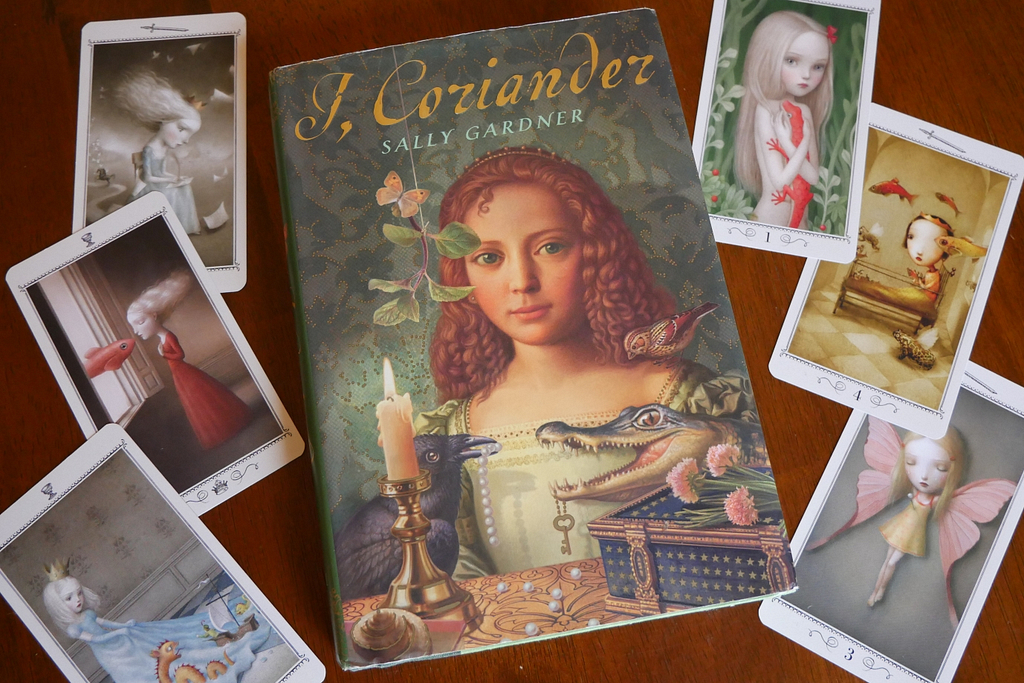
* I, Coriander by Sally Gardner
* The Raven Ring by Patricia C. Wrede (part of the Lyra series but I have not read any of the others.)
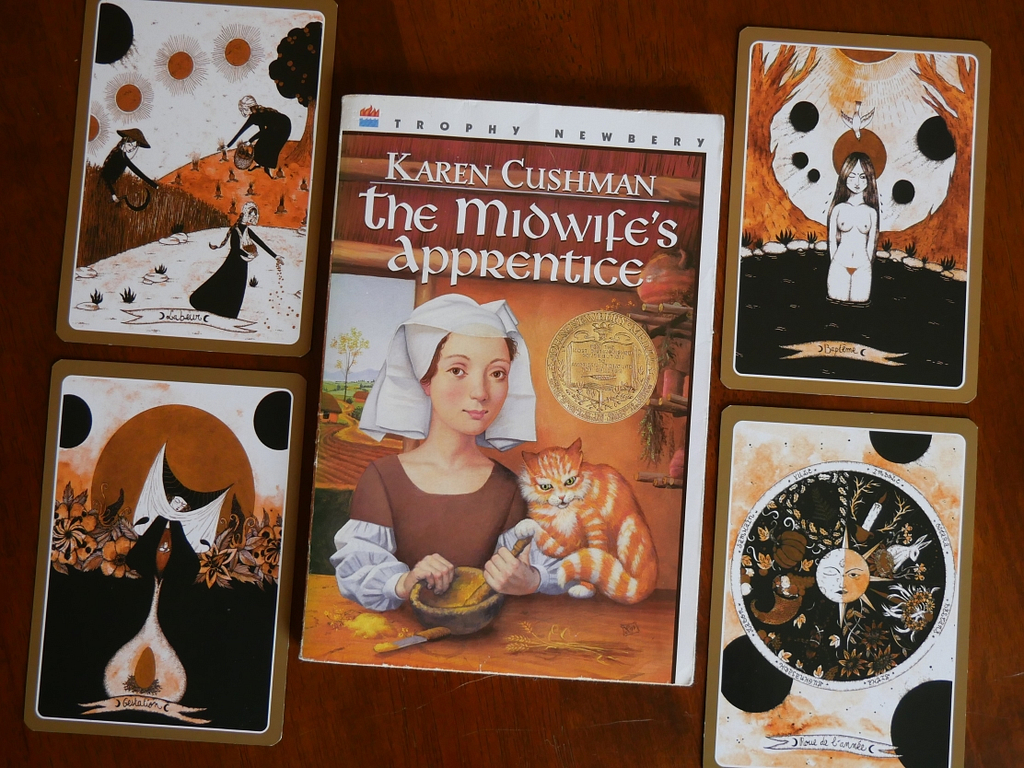
The Midwife’s Apprentice is pictured here with selected plot-relevant cards from Oracle Médiéval et Merveilleux by Gulliver l’Aventurière & Julien Miavril. (No spoilers!)
For one thing, all of these books (except Midnight Magic) were aimed, perhaps, at Young Adult readers generally socialised as feminine but at no point did they talk down to them. They were an excellent foray into how creative and narrative detail coexists wonderfully with good historical enquiry. There is an emphasis on trade and commerce. Some of these feature port cities or otherwise thriving commercial principalities and their conflicts with rural living and tradition. They discuss textiles as if their readers can and will care about how they affect plot. And they treat Otherworlds and/or magic with the same expectation: that readers are curious to know detail and will put in the imaginative effort. To me, this is how the imagination grows.
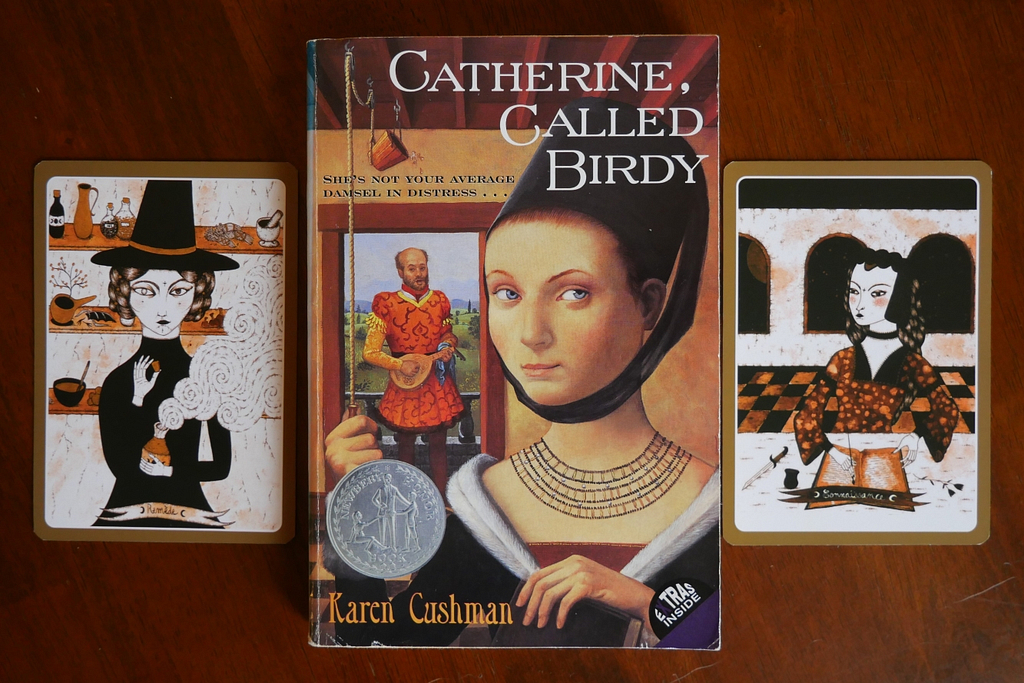
Catherine, Called Birdy is pictured here with two cards from the Oracle Médiéval et Merveilleux that are… relevant to the story. 😉
Artistically, a glance at these covers will possibly explain a thing or two about my own preference for facial portraiture and the art of the late middle ages and early renaissance. The time periods in the books vary a little more widely than the covers. I, Coriander, for example, is set mostly in Cromwellian England and the time period represented art historically on Catherine, Called Birdy is about 200 years later than the setting of the book (i.e. 15th century visuals [1] vs 1290-1291 book setting.) I was lucky enough, however, to have an aunt who overlooked things like that. For example, she focused instead on showing me how the play in perspective with the rope and bucket and the figural proportions on the cover of Catherine, Called Birdy were all little art historical jokes that the artist had borrowed from real historical painters. The implication was that if I was clever and curious, I could find them out …and I did!
Obviously there is so much to say even just about these books… so for now I will draw a few connections between I, Coriander and a few tarot and oracle decks that I have.
I, Coriander pictured here with selected cards from the Nicoletta Ceccoli Tarot. Once again, the penchant for strange emotionally intelligent portraiture!
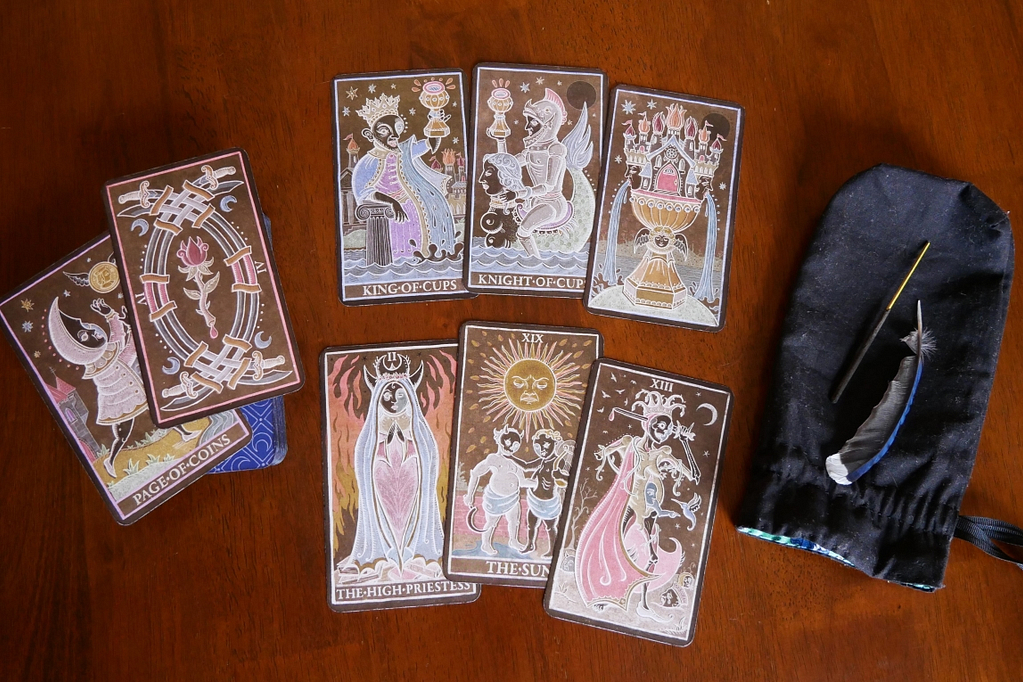
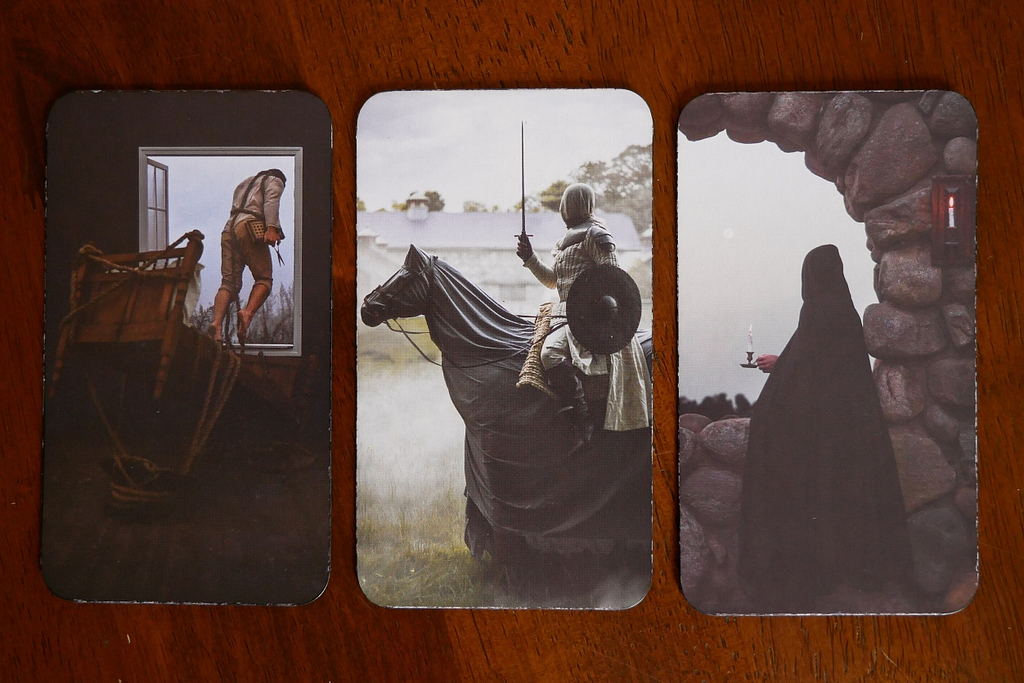
In the first place there is reference to a pair of wedding portraits in I, Coriander …a woman in the foreground holding an oak-leaf, a tiny hunting scene nearly hidden in the wooded middle-ground behind her, and a citadel in the distance. Her spouse is positioned in front of a fantastical city with a river or estuary intended (thematically) to mirror his connection with trade and the Thames. But in this city, there are mermaids and fantastical boats in the water among other things… I couldn’t help but picture certain cards from the Trionfi della Luna (paradoxical pictured below.) Or perhaps wander into a landscape just beyond the borders of such a city… might we find the world of the Somnia tarot there? People in old robes and linen shifts wandering in among the wetlands and sedge grasses gazing at the stars or riding silent sad horses?
Cards chosen from the Trionfi della Luna to mirror aspects of the story in I, Coriander… along with various imaginings of my own about the space we inhabit in the Somnia Tarot.
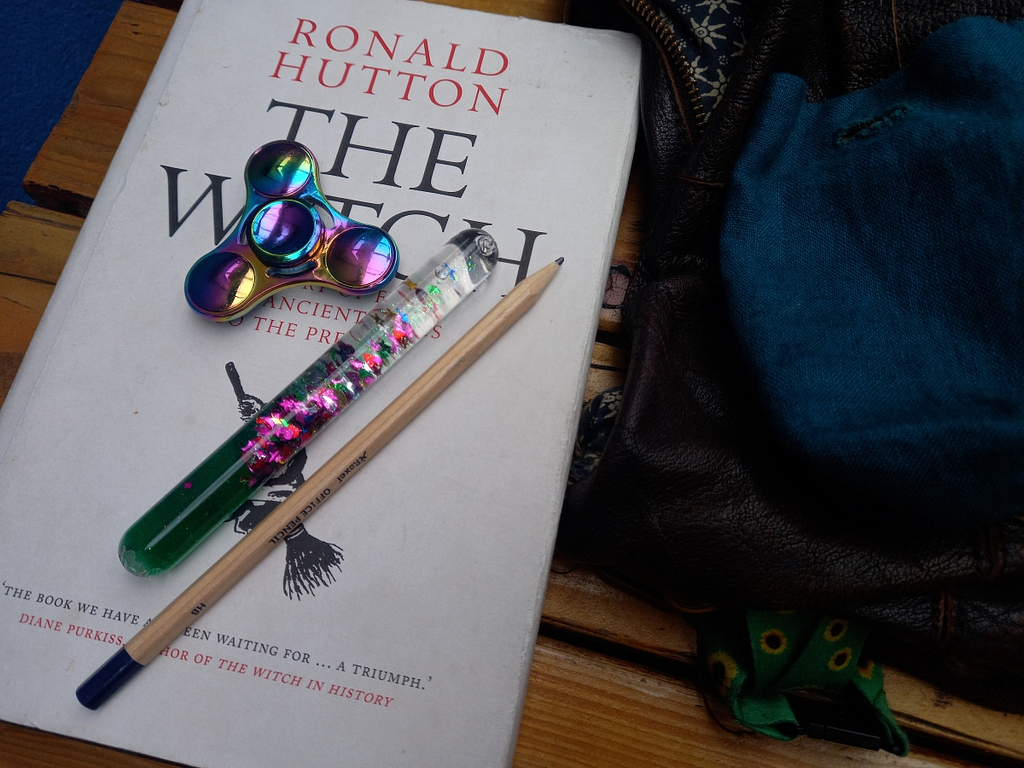
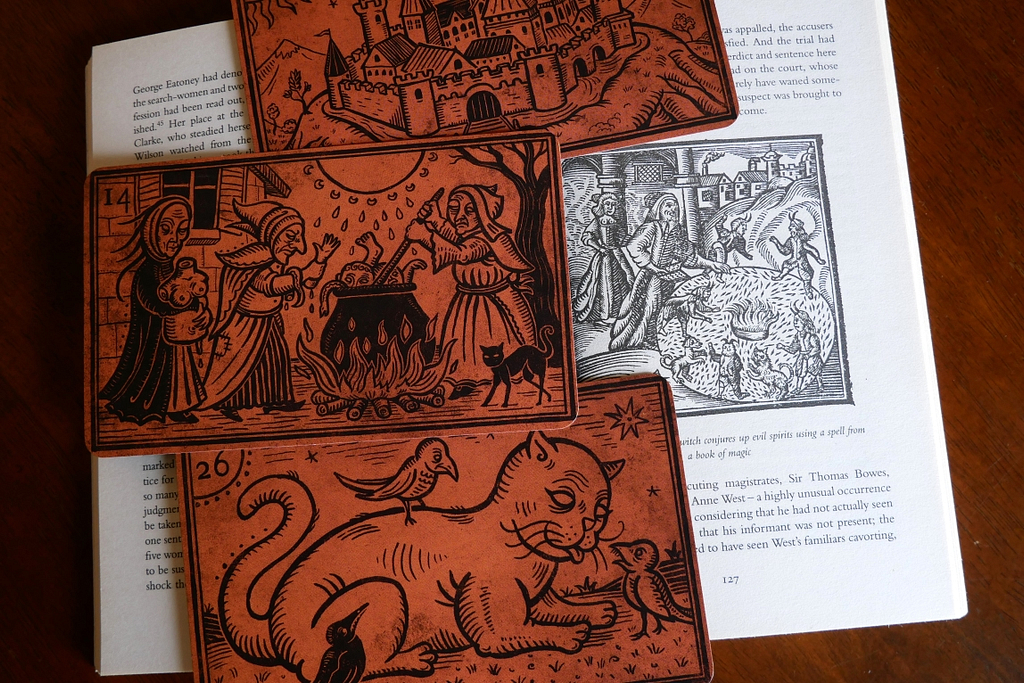
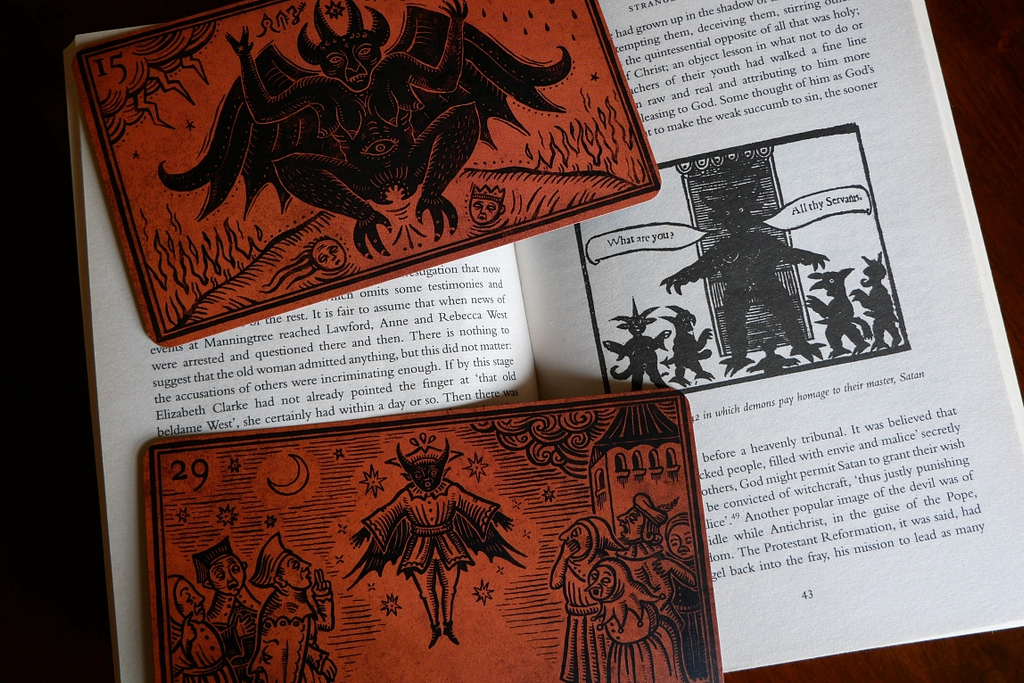
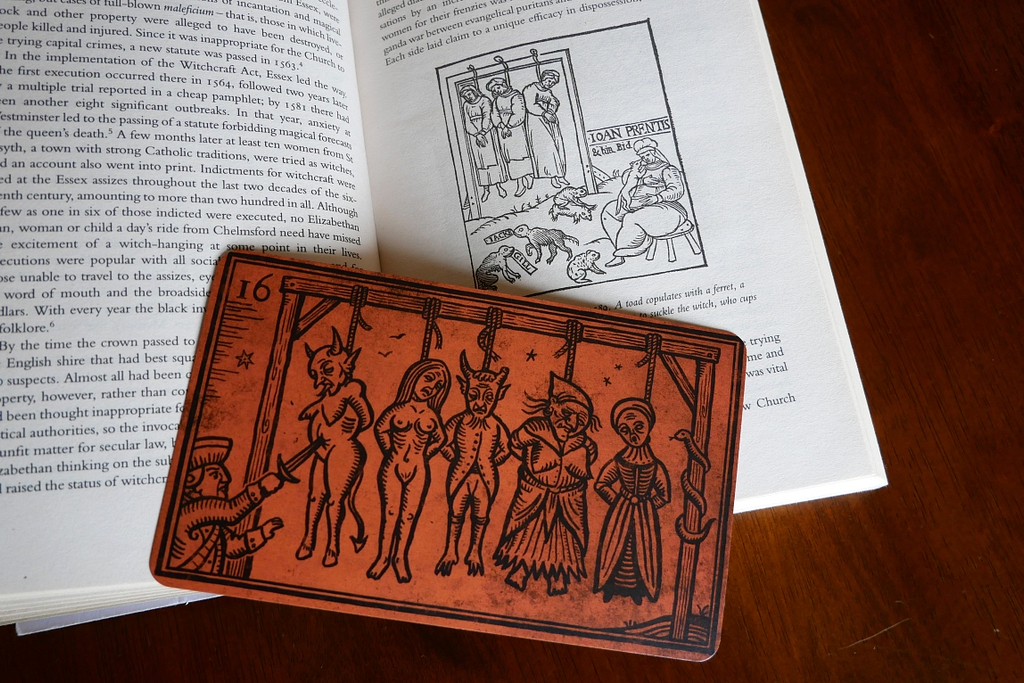
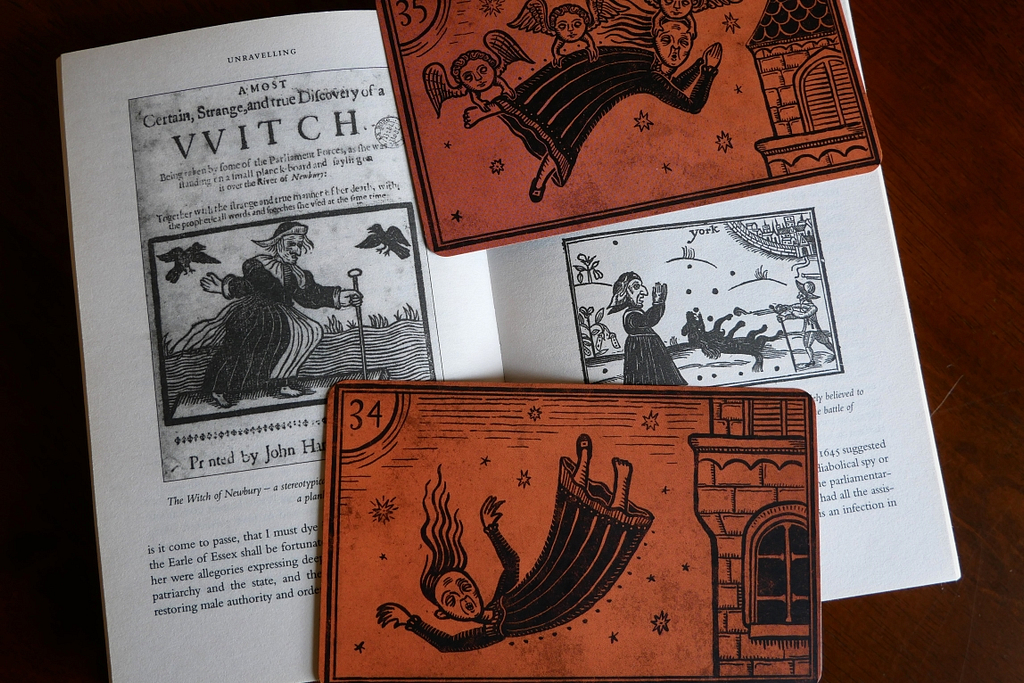
I should note I have also recently read Witchfinders by Malcolm Gaskill and am currently working my way through The Witch: A History of Fear from Ancient Times to the Present by Ronald Hutton… Of course, in so far as witch hunts in England overlapped with civil war tensions between Royalists and Parliamentarians (and occurred along Puritan vs ‘Popish’ lines), I, Coriander made for an excellent fictional backdrop! Also, I really enjoyed drawing cards from the Oracle of Black Enchantment (also by Deviant Moon Inc.) while reading Witchfinders as a visual processing exercise*.
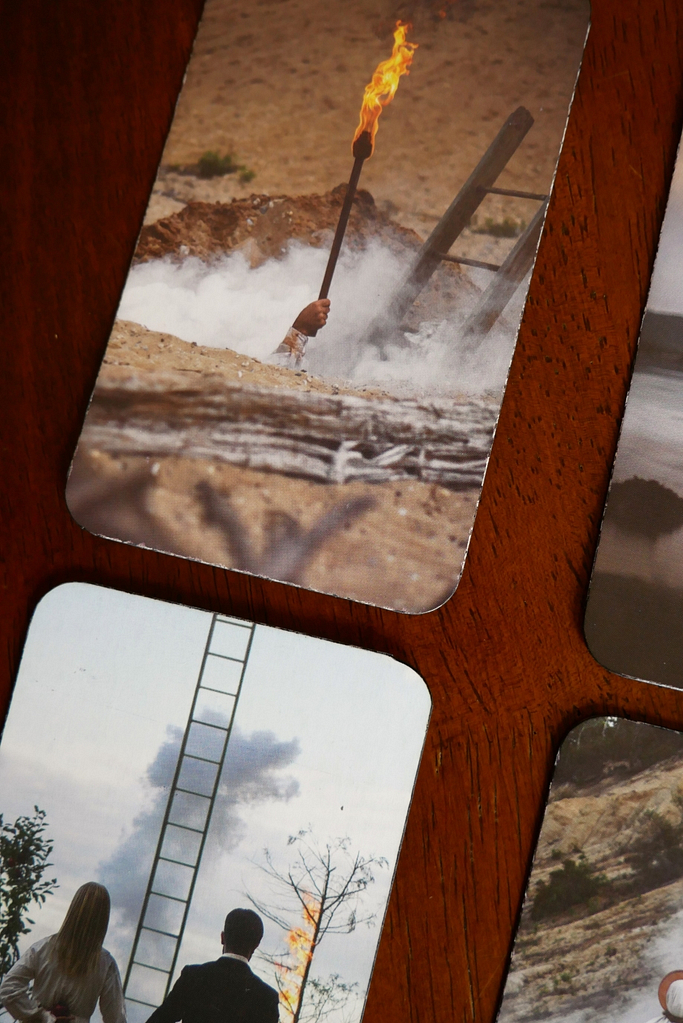
Pages from Malcolm Gaskill’s Witchfinders featured here with various cards from the Oracle of Black Enchantment (Samhain edition.) Patrick Valenza’s art historical source material (at least in part) should be fairly evident…
Lastly, this emphasis on the detail of Otherworlds – their textiles, buildings, landscapes, emotional experiences, social relationships, flora and fauna etc. – is playing a huge role in my current artistic endeavours. I tend to see pip decks as decks full of concepts/characters (in the majors and courts) and their scaffolding and architectural surroundings (in the pips). Sometimes this visual architecture is metaphorical and sometimes it is fairly literal. It depends on the reading. But it’s also helping me to tease out what it feels like to think of tarot decks in this way and what that might mean for creating a tarot deck of my own. Furthermore, I have been rebuilding a former world of mine and have recently begun sewing some clothing that I envisioned there…
And, of COURSE, the Pagan Otherworlds Tarot… featured here over (deadstock) cognac red crushed velvet ::drool::
Perhaps the act of sewing my own clothes is really the process of bringing fairy clothes over the divide? It would explain the time traveler vibes, don’t you think? 😉
So… this post has mostly been about my own personal explorations and impressions. I plan to return soon, however, with some better grounded and CITED analytical material about art history and technique.
Sincerely,
Saoirse.
* Please note! Literally any deck will aid in visual processing or reinforcing thematic content for literally any book. There is no need to acquire any deck not already within your means or comfort zone. Decks/products/material items are mentioned here for illustrative purposes only! It’s PRAXIS that matters.
** All decks featured here of my own volition and arising from my own use of them. I have neither been invited nor commissioned to do so and I have no affiliation with any of their creators. The TdL (paradoxical) was a private gift from a friend. All others were purchased by me.
[1] See images by artists like Petrus Christus (especially ‘Portrait of a Young Girl’, 1460s) and his contemporaries. The cover here has a very Burgundian look with a single truncated hennin among other distinguishing features…
As with so many things, a simple mental association double checked through the lens of a ‘quick Google’ yields a seriously mind-boggling rabbit hole. This blog post serves as a contextual supplement to this video:
I have had the topic of names on my mind for a long time. Anyone who plays traditional music will know that the name of any given tune is, shall we say, flexible. The way in which a lot of trad music works is that any given player or performer and certainly the more reputable recording artists will cite who’s version of a tune they play, where they have introduced changes, and will often also indicate if their own regional style has affected their playing or not, etc. A living folk tradition needs both that kind of flexibility as well as that kind of connectivity and accountability.
Recently, I decided to approximate a version of Shady Grove, pilfering most of my style and technique from this OLD video by “Gretchenman” (just look at his fingers fly!!!):
In doing so, I did a quick search online to refresh my memory about the lyrics (because I do sing along sometimes when I play) and check in on some basic background information on the song. Shady Grove (Roud 4456) is mostly considered an Appalachian tune [1,2] and there is a possible link with the English/Scottish tune Matty Groves (Roud 52; a famous version of which was recorded by Fairport Convention, for example) [3]. The two songs share the same melody and the fact that one is a murder ballad and the other a song in which a woman’s name has seemingly toponymic qualities interested me from a personal gnosis perspective. Drawing wild and highly metaphorical connections in my own head, I liked the familiarity of something that sounds like a place having an almost euhemerised quality… certainly Ireland abounds with such locations and its medieval literature/mythology has whole genres and stories centered on naming places after people and people after places, or just blending the two entirely.
Now, I’m NOT claiming that there is any such analogy to be drawn in historically viable or collectively verified ontological* terms. It’s just a fun poetic exercise. Creative license, as it were.
However! The rabbit hole referred to earlier drew me from link to link: first investigating the lyrical content of Shady Grove; then to it’s Roud Index Number and associated articles about the development of the song over time (including various collections in which it is annotated as well as different known recordings of it); then to re-acquainting myself with some of the basics on Cecil Sharp (because it’s been a while). Lo and behold… I forgot a) about his nationalism and the troubled legacy of his methodology in seeking out ‘Englishness’ in music, especially in Southern Appalachia [5] but also b) that he was in other ways influenced by William Morris’ socialist lectures and …potentially also approached his work through the lens of spiritualism at some point!? 🤯
This last bit seems totally unclear to me and I am finding it hard to validate until I can actually access some of the academic articles I’ve found online [6]. (This is where I am REALLY happy to have a free external reader’s card with UCC Library…ah, the perks of living in a Uni town!) But in scrolling through the Roud listings on Matty Grove, I saw they had an entry in Sharp’s diary from the 29th of August, 1916 in which he makes use of the word “séance”.
It’s strikes me that it’s possible this word has some other meanings or context of which I am not aware (I yielded no obvious or immediate answers from a quick search online) but it would seem there are a few articles out there at least that might make this clear once I’ve had a chance to read them. In theory, it doesn’t strike me as too unreasonable because this IS a time period in which a lot of academia (especially those with nationalist or otherwise politicised interest in folk movements) drift in and out of spiritualist circles and ‘methods’ of inquiry**.
I am not sure how all of that will go yet but I also hope to read a few more recent assessments of the problems in Sharp’s legacy.
Magickally, one of the things I am doing in playing such a tune (in which I usually face my altar, by the way) is reshaping identity. Drawing creative connections on the euhemerization of names, of nouns as names/names as nouns, and asking questions of my own anthropopathism and ‘pathetic fallacy’***.
At this point, the choice to play “Flatlands” by Chelsea Wolfe and Mark Lanegan over the first part of my video should begin to make added sense.
It all comes back around to walking the razor edge between what seems appealing as a creative or metaphorical idea and what is actually academically and historically viable work. We have to be okay with their inherent dissonance. You might even call it… an art.
* Here I am using the philosphical defintion of ‘ontological’ rather than the metaphysical one!
** Giving the Golden Dawn, Theosophists, and soooo many 19th and early-20th century artists and thinkers bombastic side-eye. Criminal offensive side-eye.
*** Oop! Hello, Ruskin!
§ 9. And thus, in full, there are four classes: the men who feel nothing, and therefore see truly; the men who feel strongly, think weakly, and see untruly (second order of poets); the men who feel strongly, think strongly, and see truly (first order of poets); and the men who, strong as human creatures can be, are yet submitted to influences stronger than they, and see in a sort untruly, because what they see is inconceivably above them. This last is the usual condition of prophetic inspiration.
§ 10. I separate these classes, in order that their character may be clearly understood; but of course they are united each to the other by imperceptible transitions, and the same mind, according to the influences to which it is subjected, passes at different times into the various states. Still, the difference between the great and less man is, on the whole, chiefly in this point of ‘alterability‘. […]
§ 11. Now so long as we see that the ‘feeling‘ is true, we pardon, or are even pleased by, the confessed fallacy of sight which it induces: we are pleased, for instance, with those lines of Kingsley’s, above quoted, not because they fallaciously describe foam, but because they faithfully describe sorrow. [7]
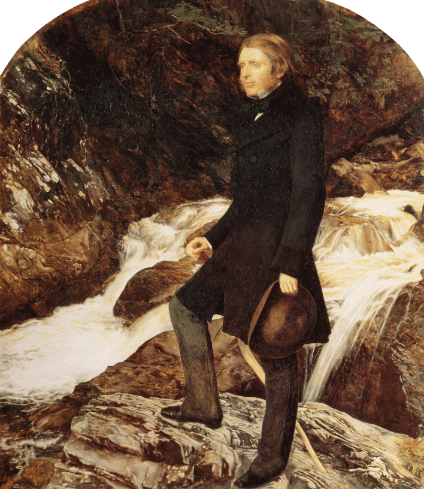
John Ruskin at Glen Finglas by John Everett Millais, 1853-1854 (Public Domain)
(1) Shady Grove (Roud 4456), Mainly Norfolk: English Folk and Other Good Music, mainlynorfolk.info/folk/songs/shadygrove.html. Accessed 6 Feb. 2024.
(2) “Vaughan Williams Memorial Library: Shady Grove.” English Folk Dance & Song Society, http://www.vwml.org/search?q=Shady%20Grove&is=1. Accessed 6 Feb. 2024. (Of note, the English Folk Dance & Song Society owns the Cecil Sharp House.)
(3) Spiegel, Max. “Origins: ‘shady Grove’ a Mondegreen ?” The Mudcat Cafe, mudcat.org/thread.cfm?threadid=131461. Accessed 6 Feb. 2024. (“Mondegreen” is my new favourite word now. Story of my hearing impaired life!)
(5) “Cecil Sharp.” Wikipedia, Wikimedia Foundation, 26 Jan. 2024, en.wikipedia.org/wiki/Cecil_Sharp#Political_Views. (Yes, its Wikipedia ~ but the citations at the bottom of the article look like they’re worth exploring.)
(7) Ruskin, John. “Of the Pathetic Fallacy from ‘modern Painters’ (Volume III, Pt. 4, 1856) by John Ruskin.” The Pathetic Fallacy, Ruskin (1856), http://www.ourcivilisation.com/smartboard/shop/ruskinj/index.htm. Accessed 6 Feb. 2024. (I have no interest or affiliation with the author of this site as a whole, this link is simply where I have accessed an online free readable copy of Ruskin’s writings on the Pathetic Fallacy.)