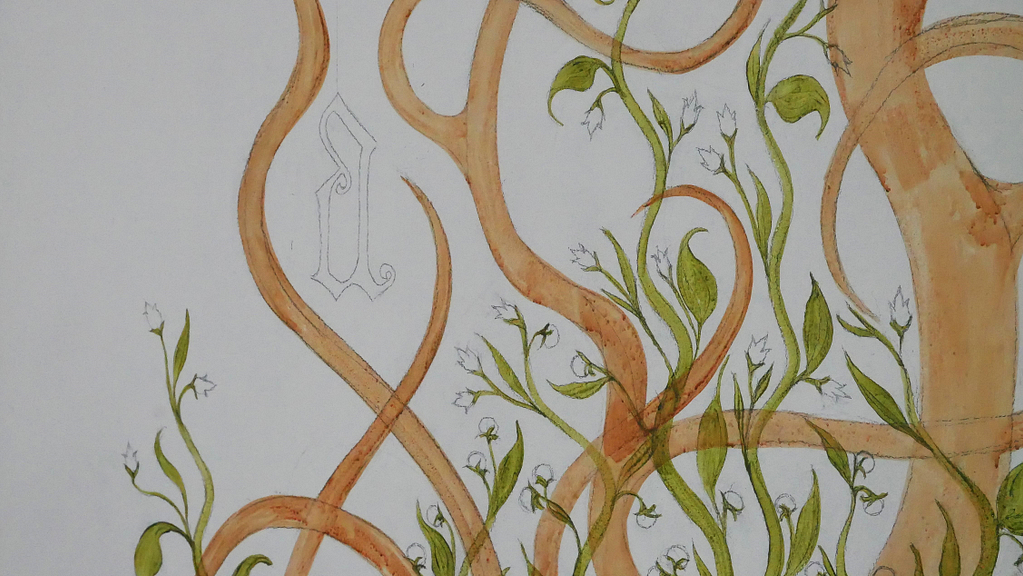
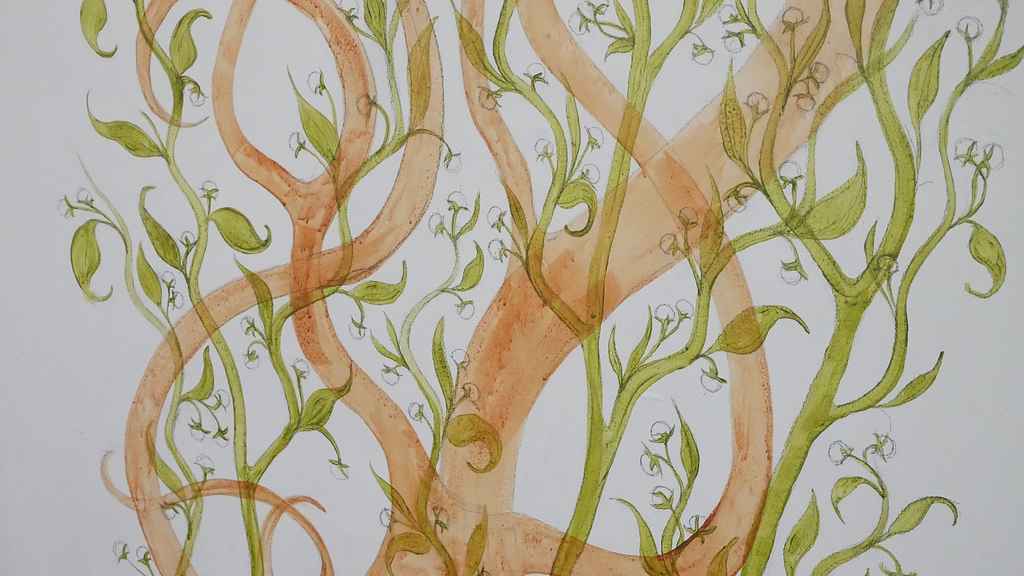
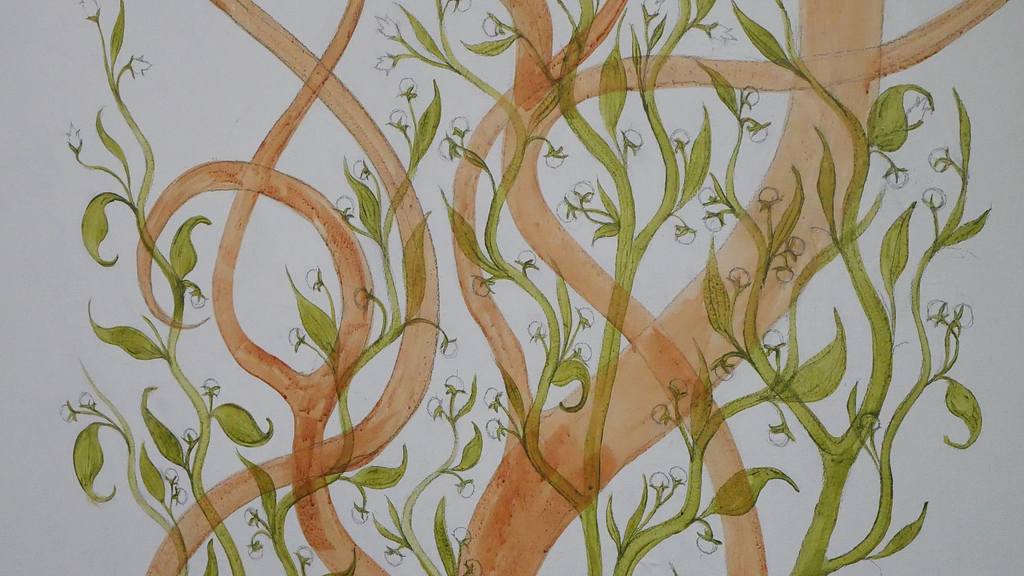
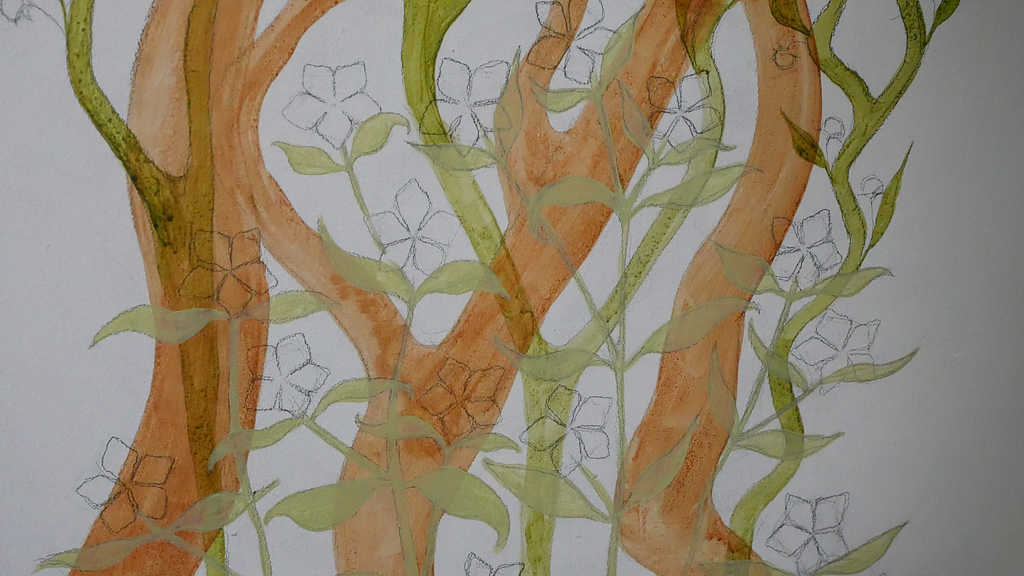
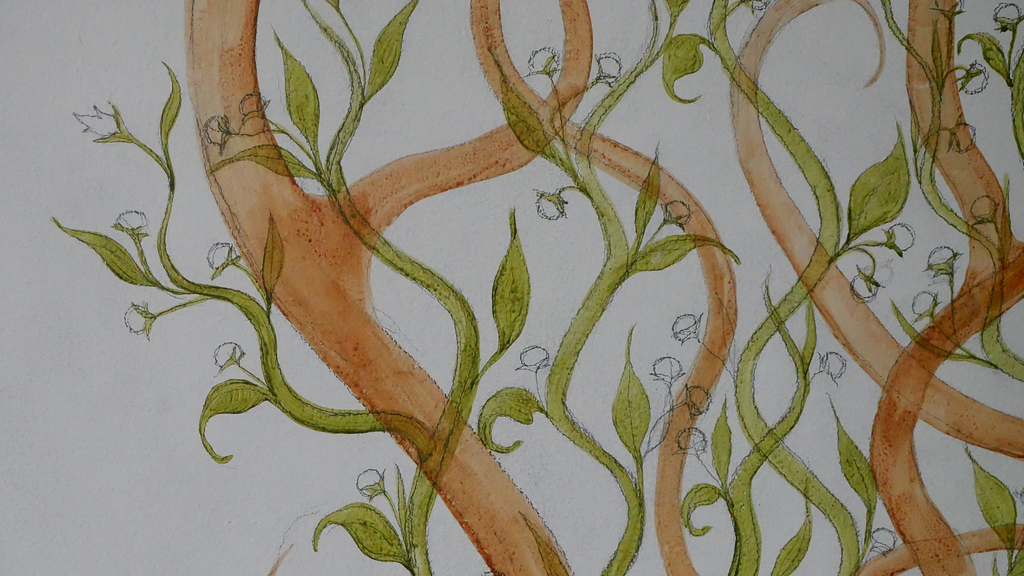
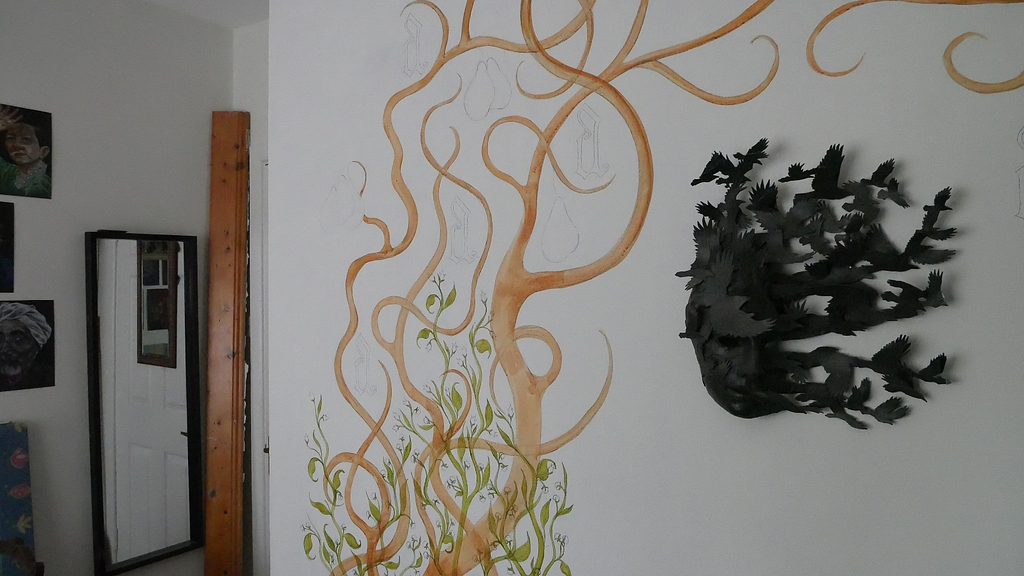
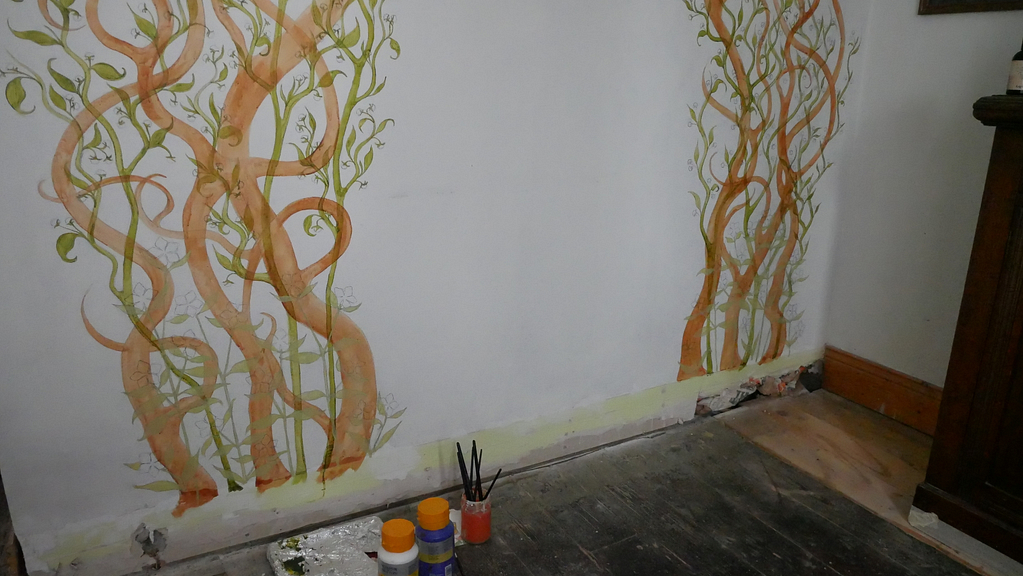
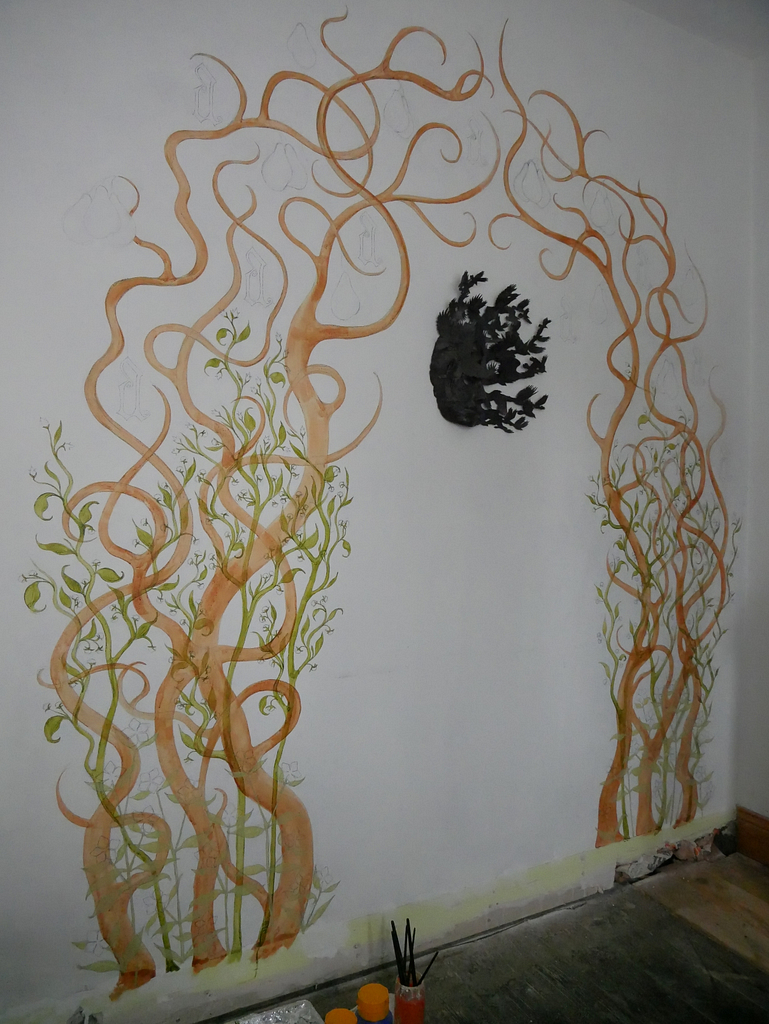
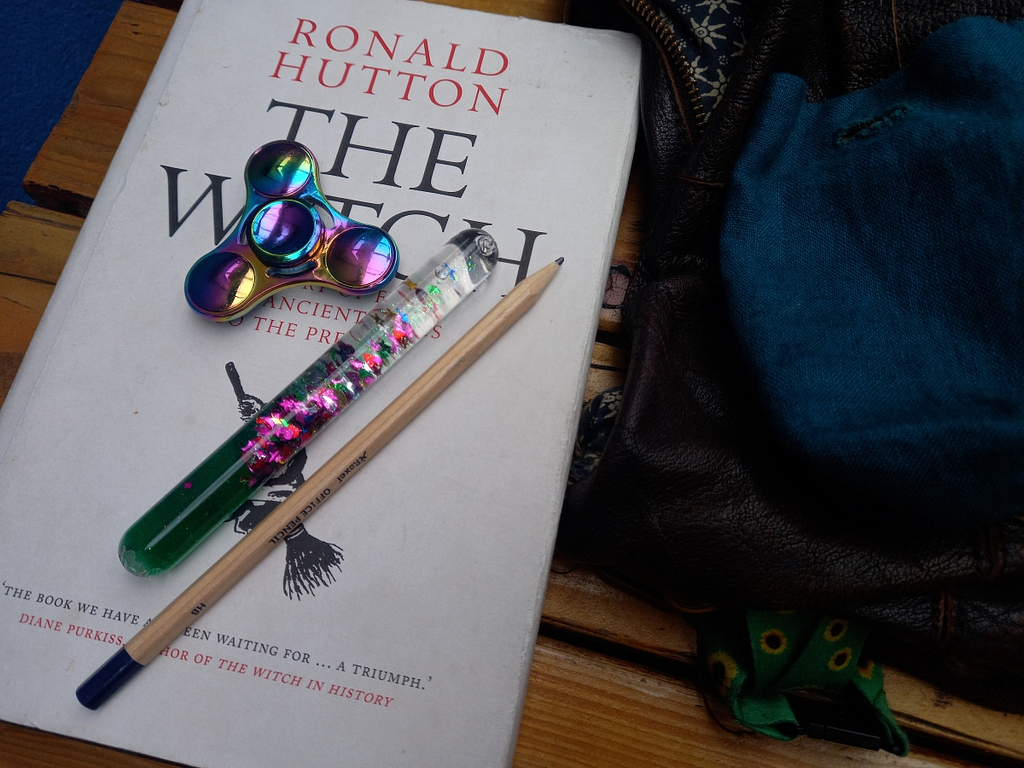
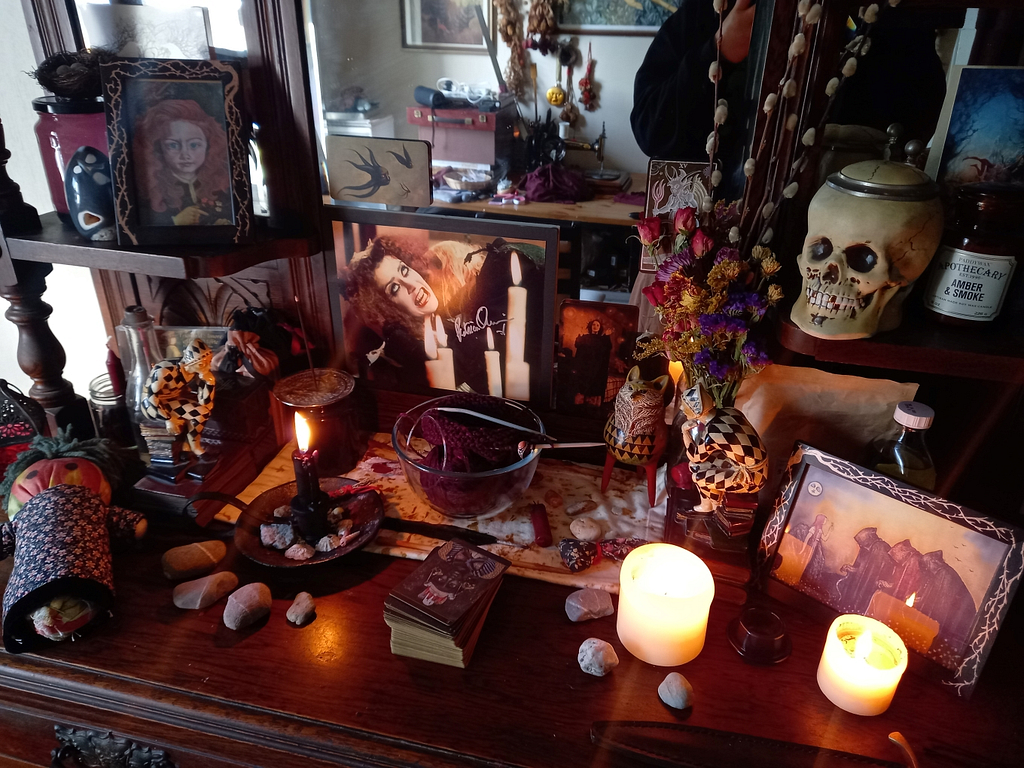
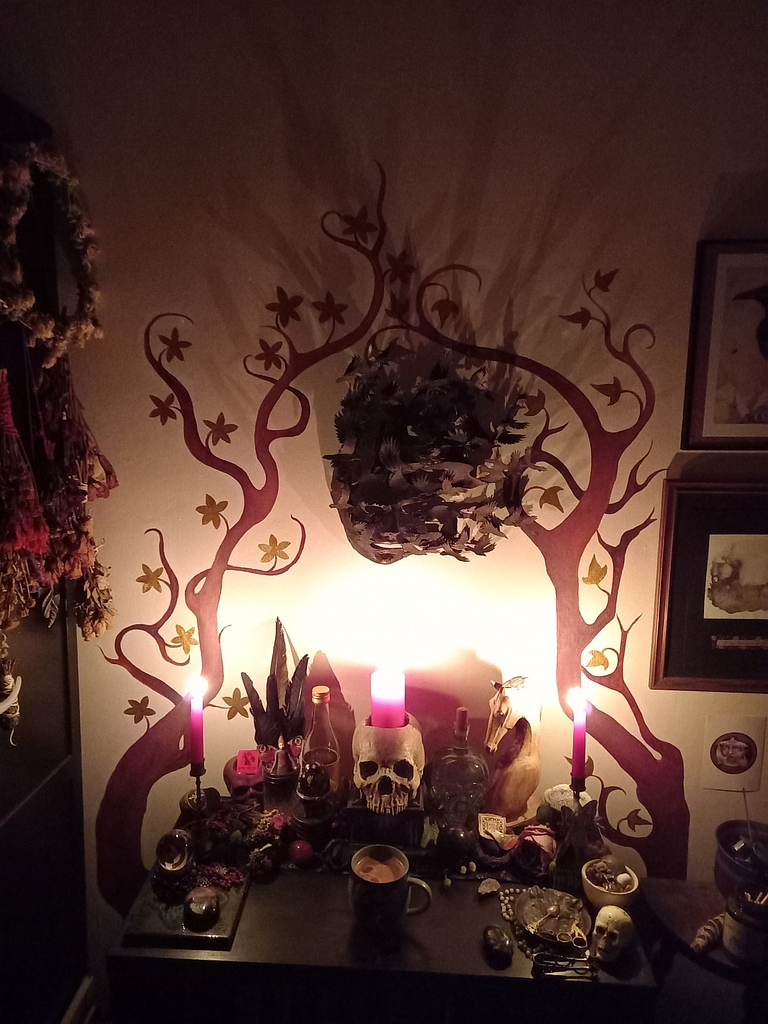
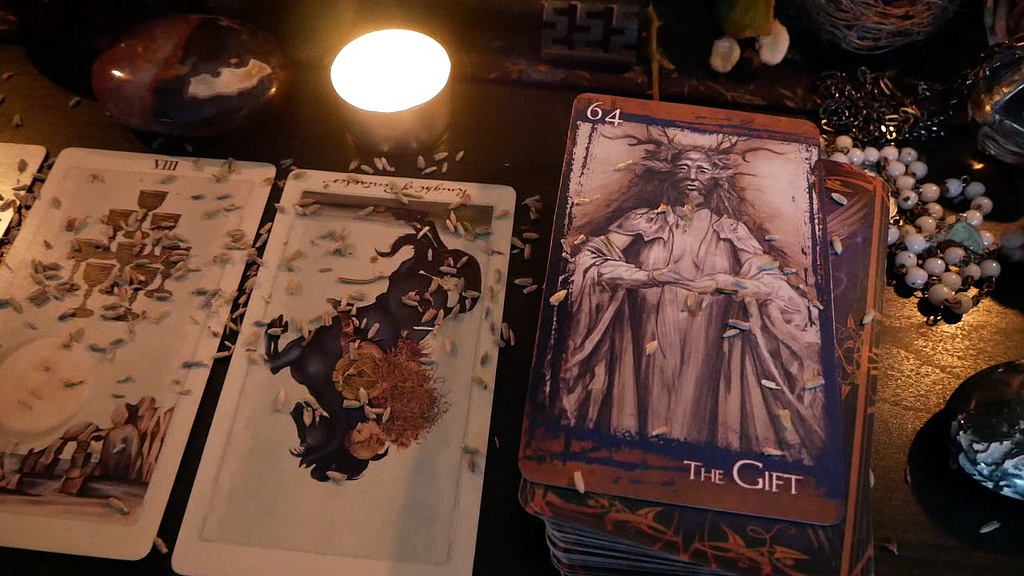
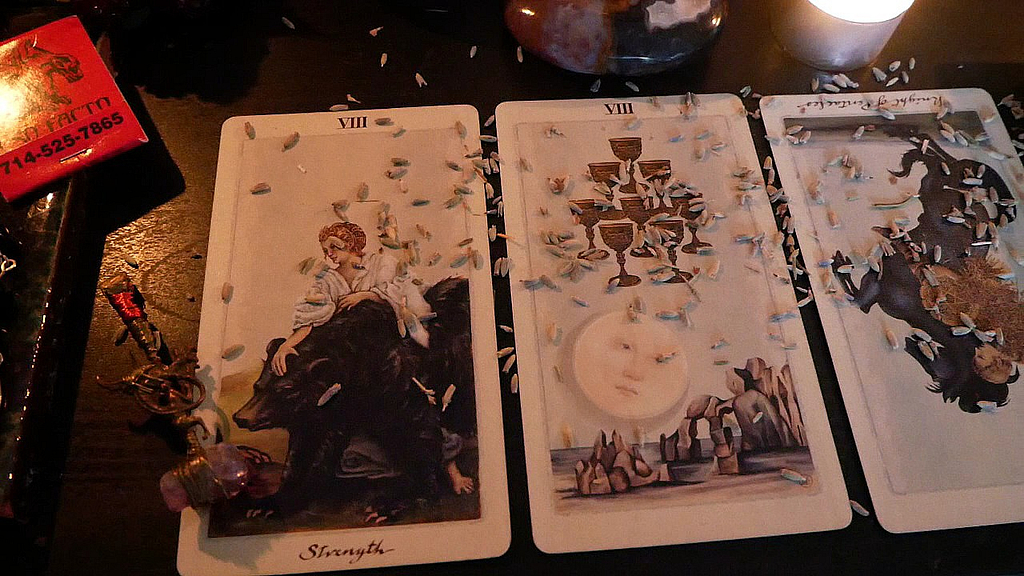
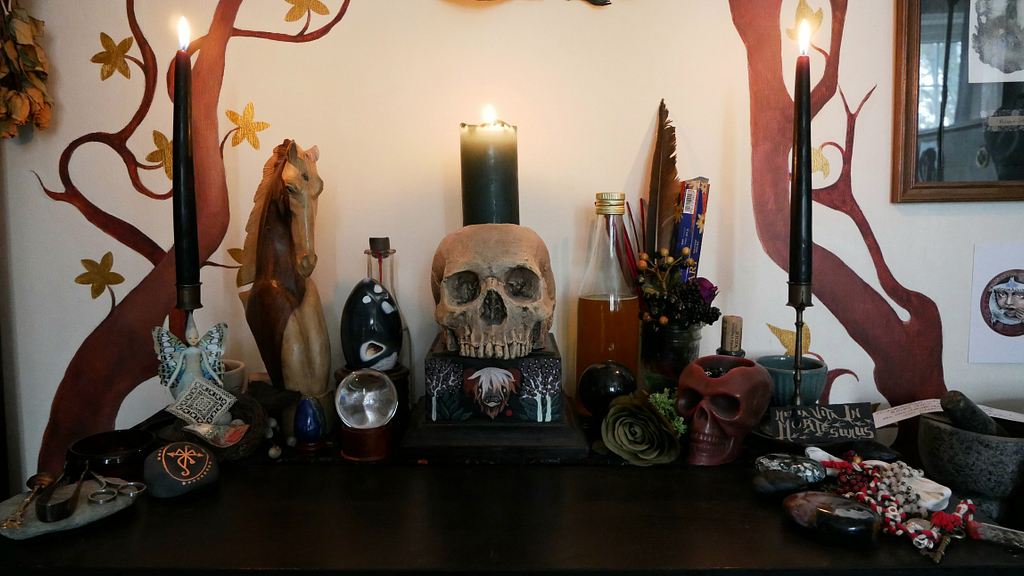
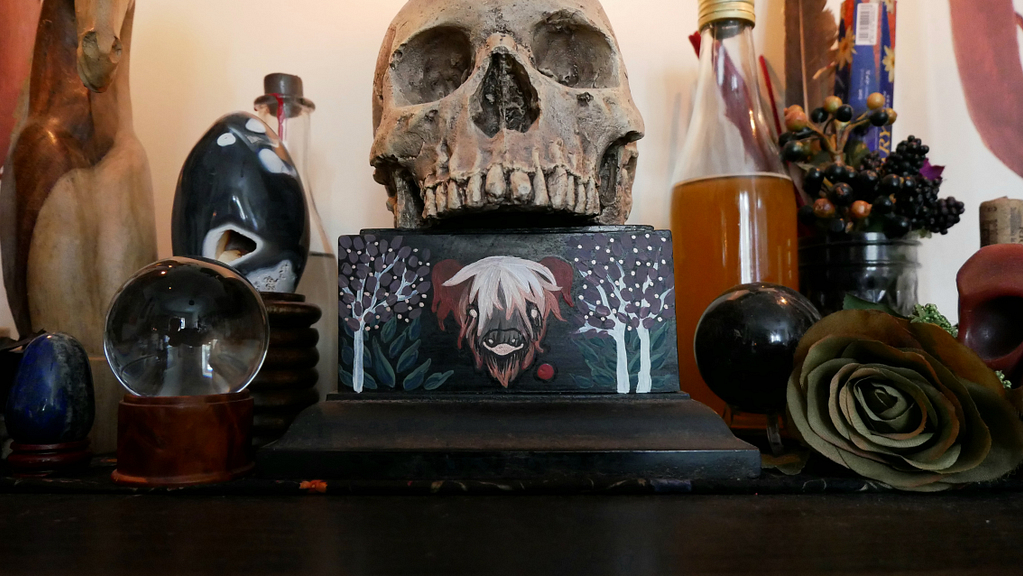
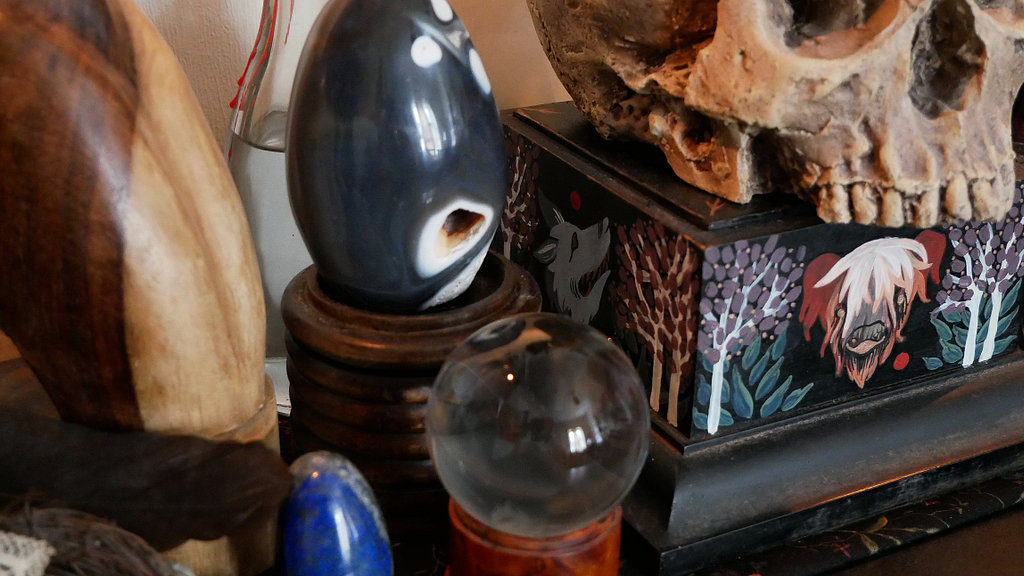
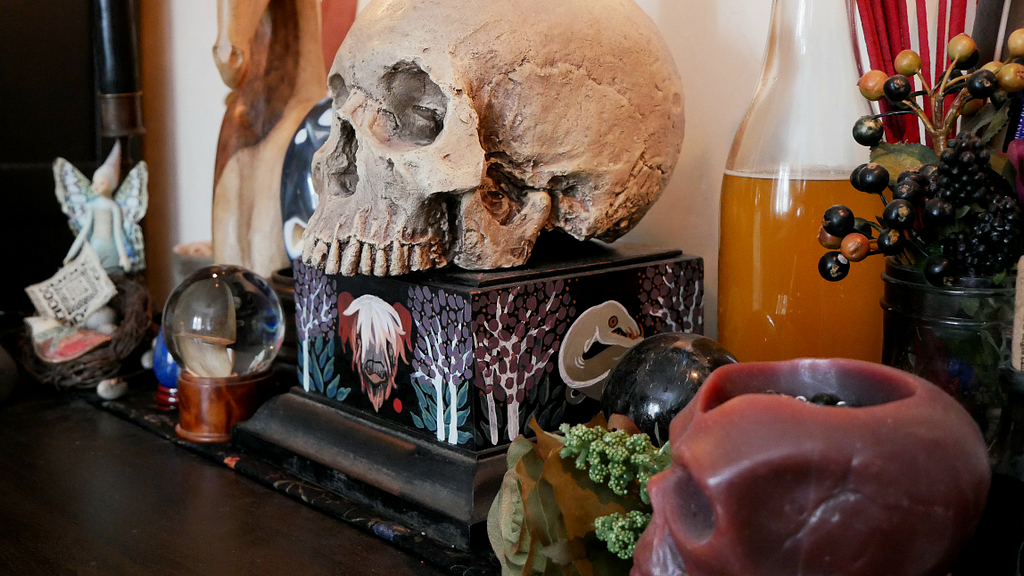
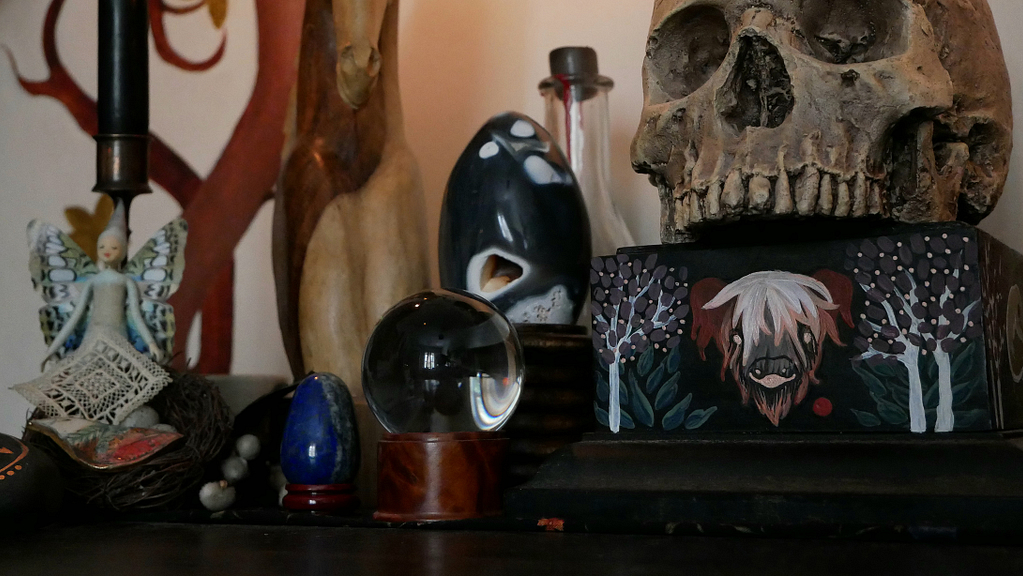
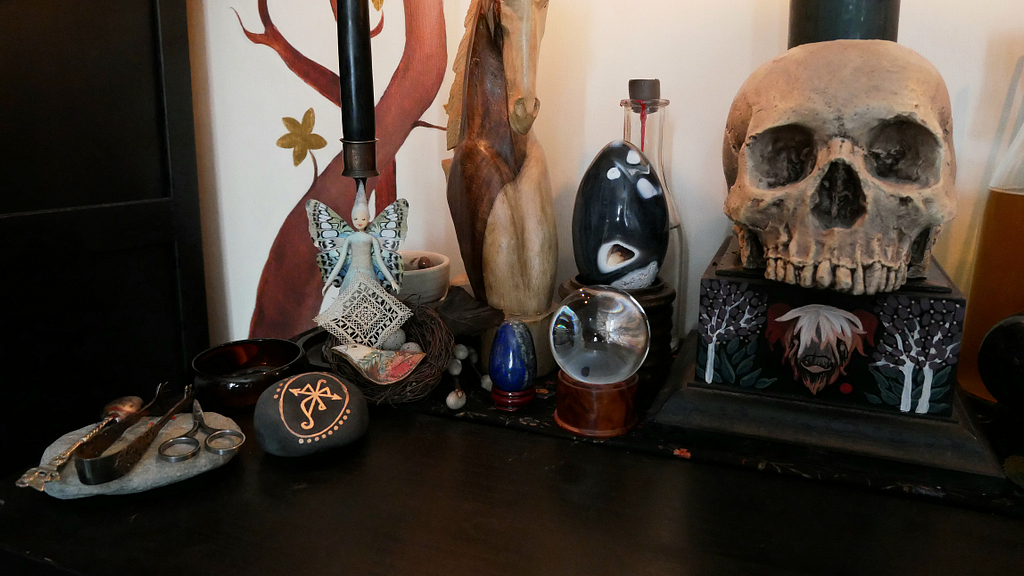
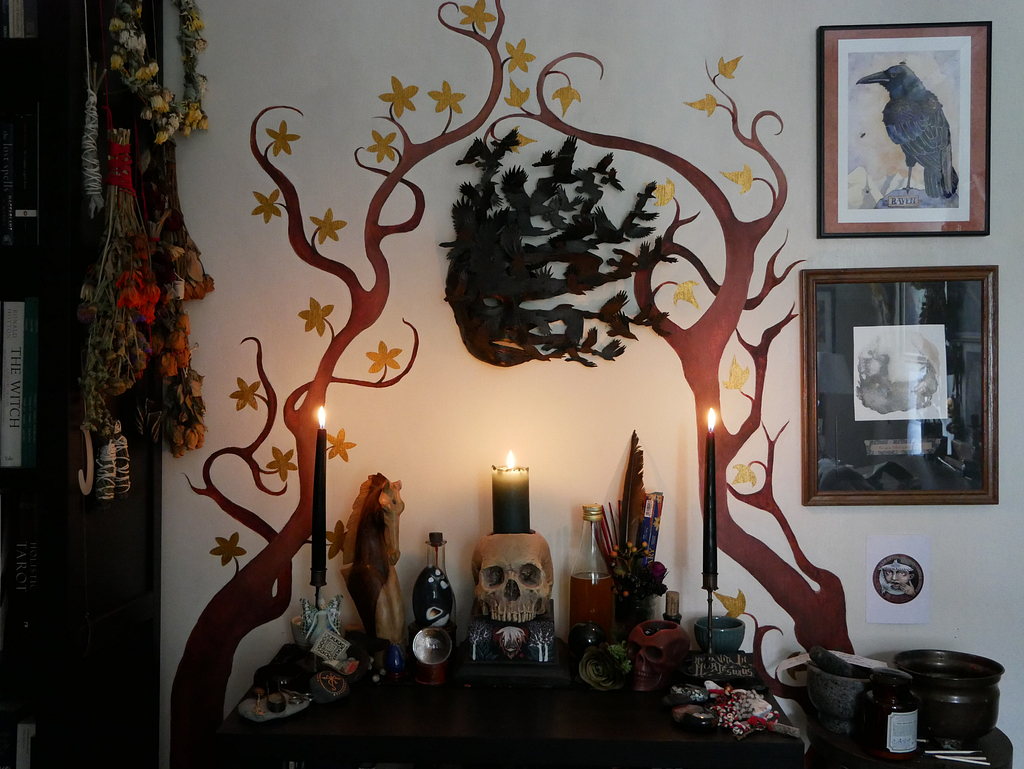
For anyone interested in a few detail photographs of the altar mural featured in my recent “Underpainting” video, here is a little gallery of semi-decent shots! The room is quite small which means the mural is difficult to capture within a single frame despite being very easily taken in, in person. This is probably for the best from the perspective of magickal integrity… it is, after all, intended to flank my altar! At any rate, I have included the Makertube link for the video below (via the ad-free, collective, non-profit from France – PeerTube)!
Here is the video…
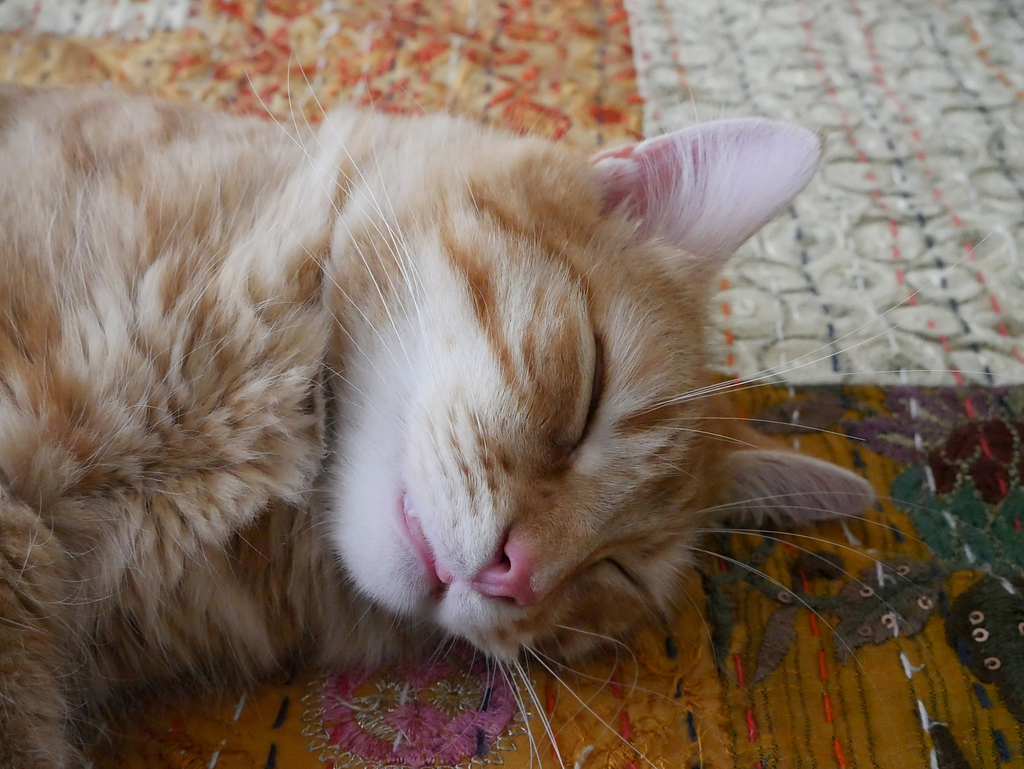
AND here is some bonus cute kitty ‘content’ courtesy of Gurgi:
Wobbly sleepy songs about crows and true love at a witches altar… #lifegoals I guess! #tradmusic #morningperson #altar #paganaltar #altarspace #hygge
“Blackest Crow” is one of MANY variations on the traditional lover’s lament… other versions sometimes are called The Turtle Dove, or, As Time Draws Near. It has lots of ‘floating verses’ and lyrics are pretty hard to pin down.
Bruce Molsky has a famous version on his album “Lost Boy” that I’ve listened to since I was very young and which formed the basis for my harmony part ~ https://www.youtube.com/watch?v=DJzQNQoUe6w (Side Note: I first met Bruce when I was about 13 or 14… a wonderfully nice guy and a great teacher! Took his fiddle classes a few summers running as a teen and ran into him years later in college on the night he played ‘Bury Me Not on the Lone Prairie’ live for the first time ever. He asked me afterwards what I thought and I answered honestly that it had made me cry. Sometimes memories sound like they must have happened to someone else!)
The tune I sort of badly transition into (normally I do this whole chord thing but I wasn’t awake enough) is called “Wildwood Flower” and I can’t find the original version that I used as a base! I thought it was from Brett Ridgeway’s list of sample tunes but I’m not sure now… anyway, here’s Stephen Seifert’s version instead ~ https://www.youtube.com/watch?v=FGQuVVEnqDU
(If you can mentally filter out the Christian elements, there is no better feeling than waking up on a cold mountain morning to someone playing music like this on a cabin porch.)
I promise I normally play it better but like… with more coffee and less camera!!!!!!
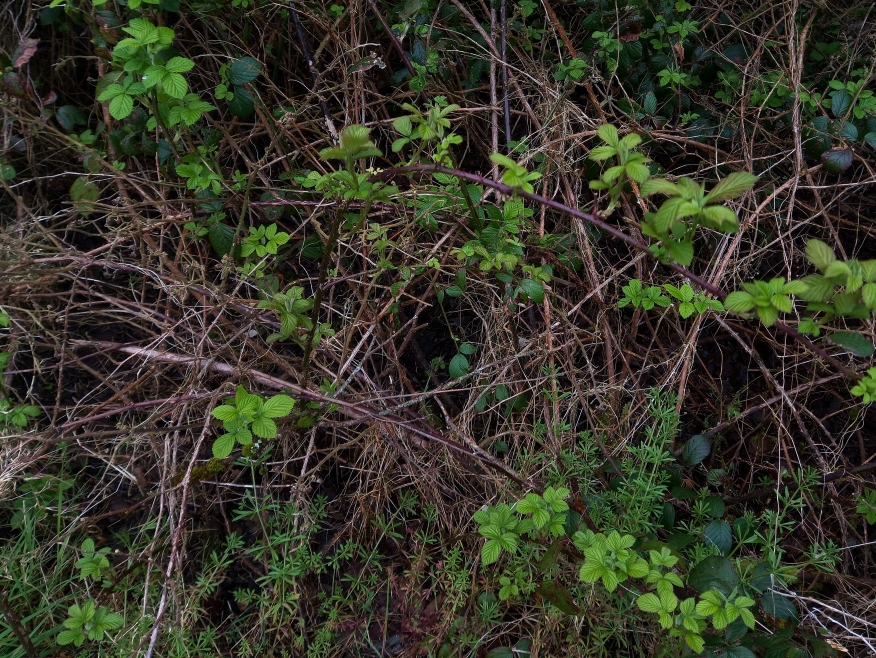
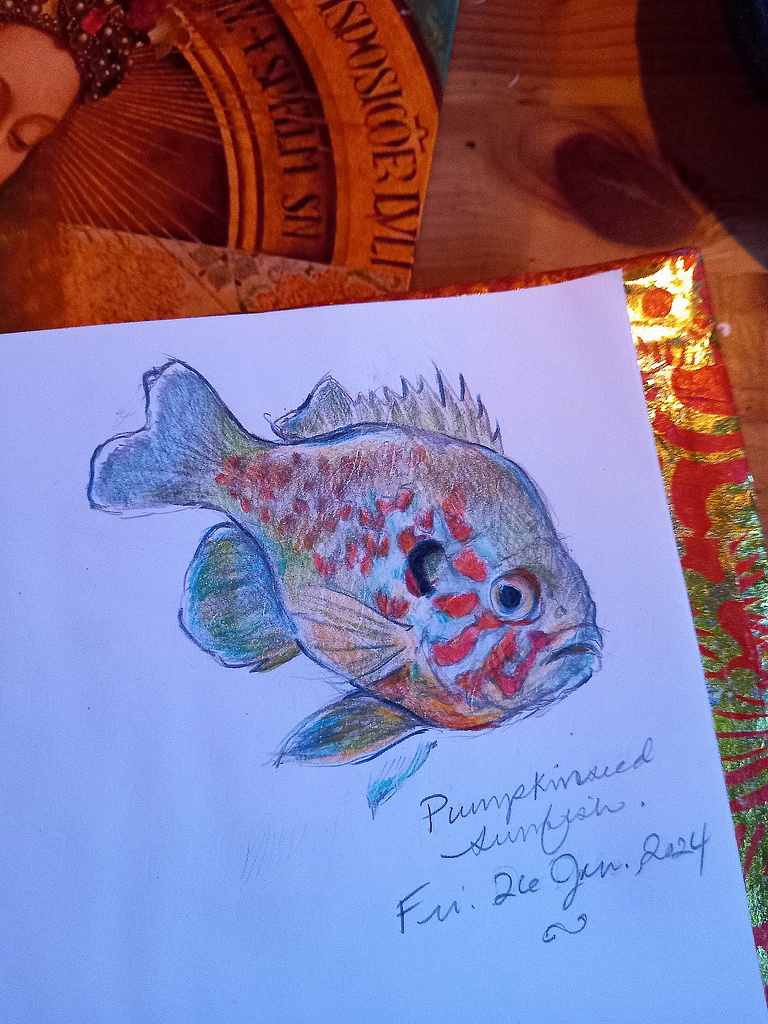
I wanted to share some recent moments of simple joy & presence. These photographs were not necessarily taken for the purpose of sharing in a public format. However, I am in the habit of taking constant photos of brambles, for example… Such photos in turn make up a good back catalogue of plant/animal material to from which to practice drawing**, to practice seeing, and to practice layering concepts.
Whether something gets shared or not is rarely planned (at least rarely planned fully) and the follow-through on any such plans also rarely correlates to the intent in taking the photograph. It’s all a bit loosey goosey up in here.
For me, it has become increasingly clear that the intent to share (or not?) is not so binary… Thus, some recent moments of craft, joy, & sensory immersion.
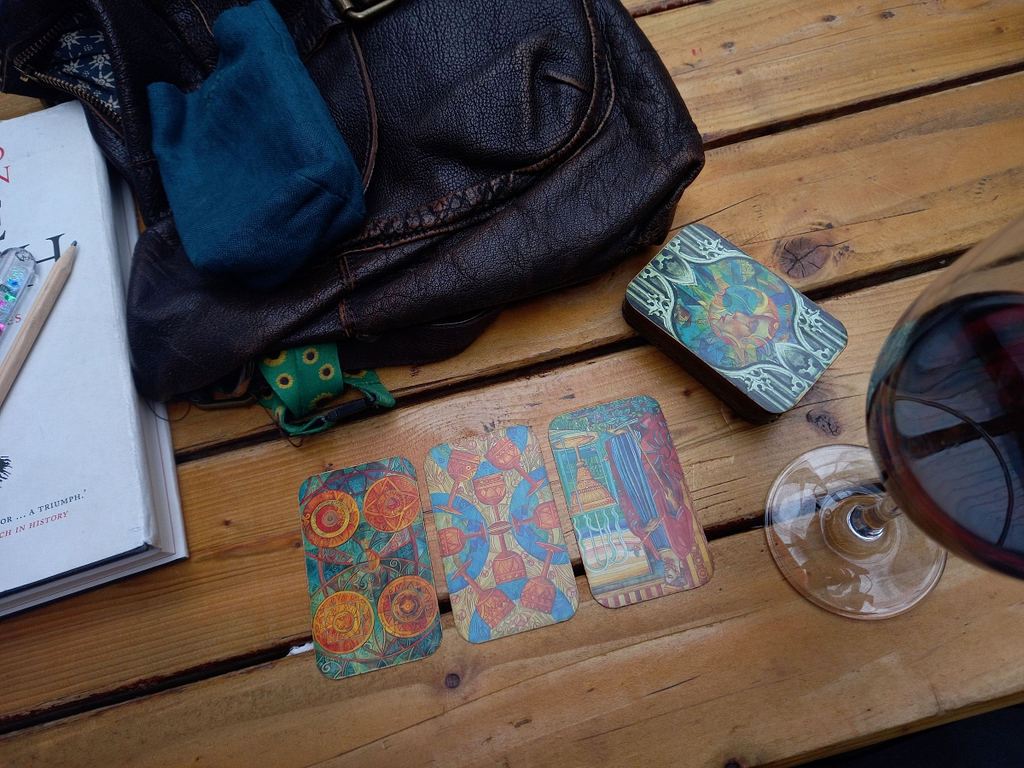
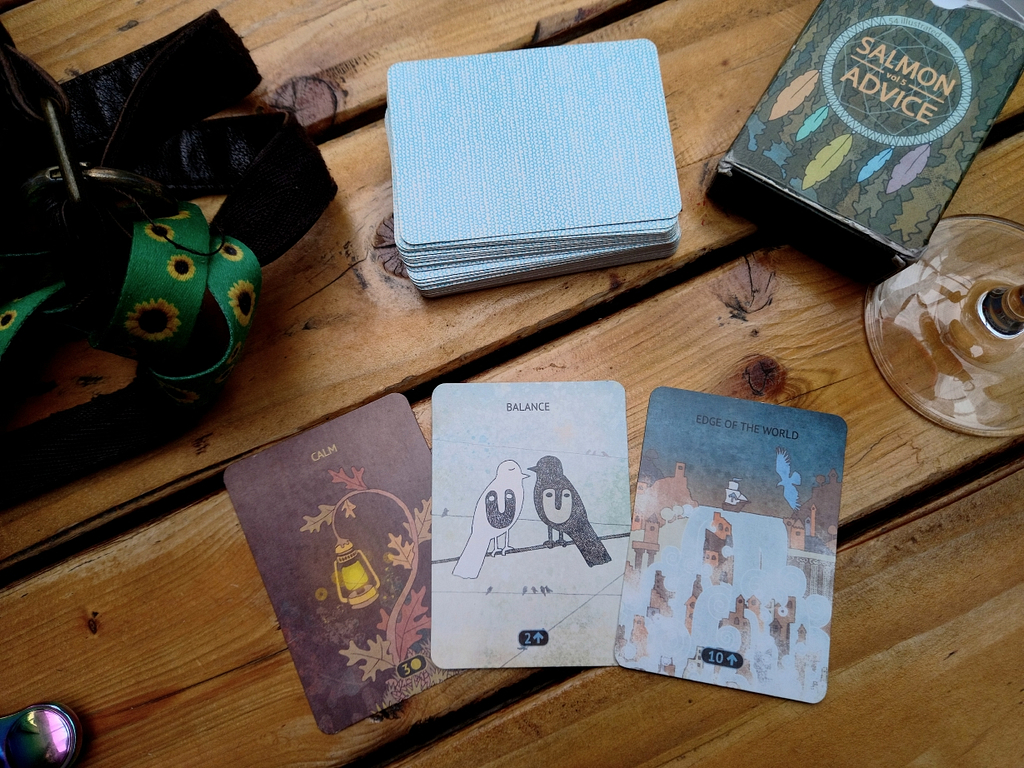
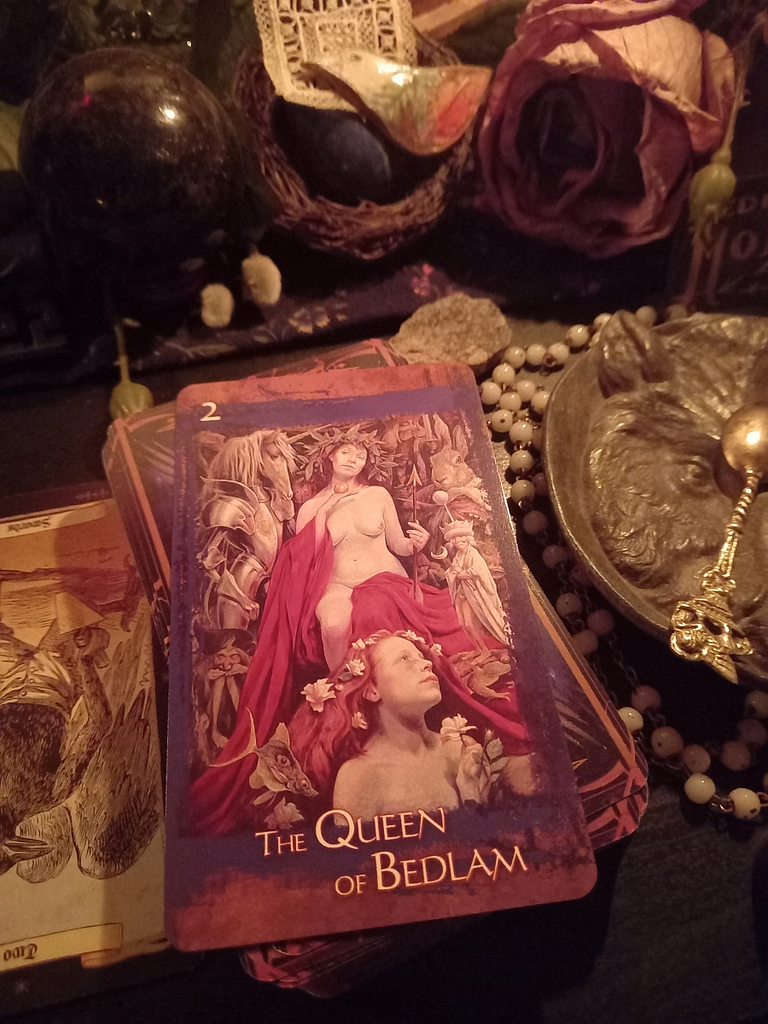
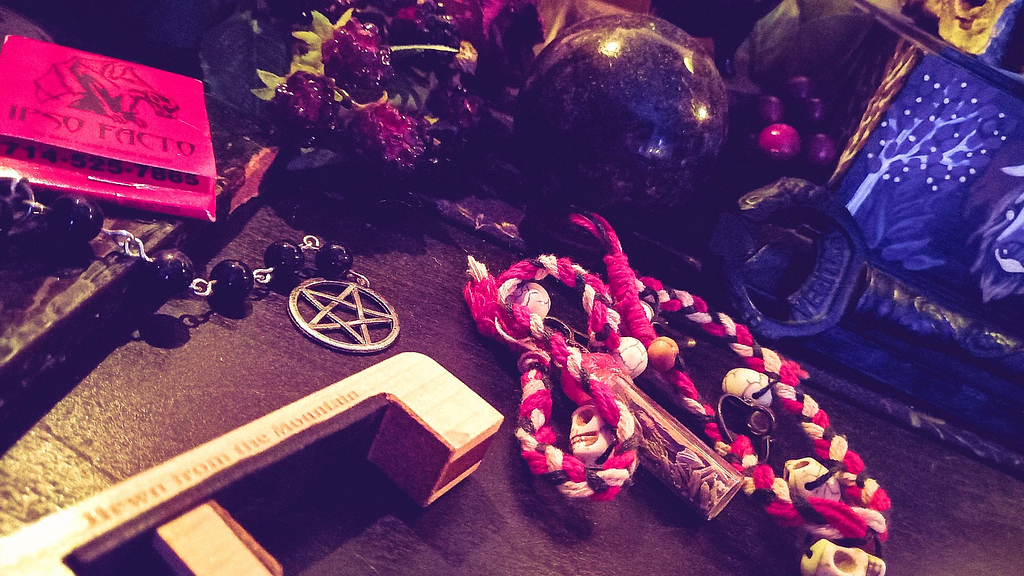
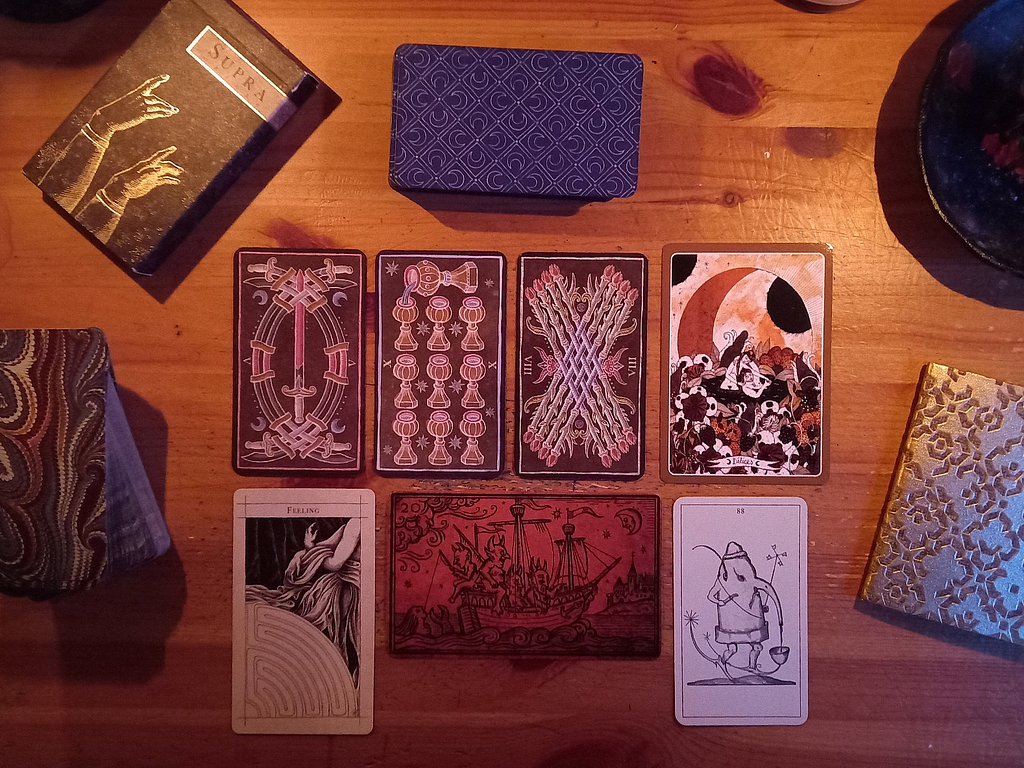
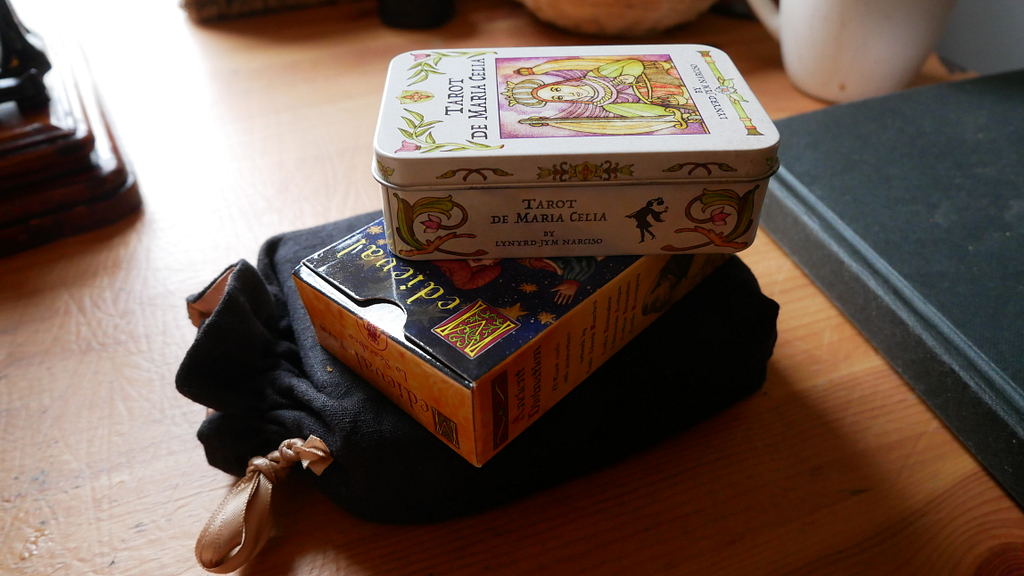
Little doors…“Down among the weeds, down among the thorn” (‘Tam Lin’; Child Ballad 39, Roud Index 35)Looking for Miss Tittlemouse…Tarot decks ‘in sa phub’! (Crystal Tarot, my trusty travel deck.)Salmon Advice cards …not sure this is the correct Vol. box though…The Glamour altar… among other things.A moment of ‘synchronicity’ with a friend 🙂5 am, after nightmares.Colour, texture, & lots of hidden flora & fauna amidst curvilinear existence.
For some context on what I’m doing with the header image, you might like to watch this video of mine on The Hush Tarot & it’s references to Arthur Rackham/the Golden Age of Illustration:
An oldie but a goodie…
~ Saoirse
* A reference to the highly influential (1970s) art historical work of the same name by John Berger. You can watch it for free here. I’ve actually not watched all of it myself yet but the significance of this was two fold – to challenge what was up to that point a more traditionalist method of interpreting art historical work & to introduce the viewing audience to ways of questioning & analysing the art they take in or experience.
** The header image is a composite of my own photography of birch trees and a print I own of “The Fairy Tightrope”/”Fairy Dancing on a Spiderweb” by Arthur Rackham. You can see an early version of this image in a 1912(?) copy for free from the New York Public Library here. I guess you can also be glad I’m not sharing my photographs of dead rats and such 😛
*** Check out the album Child Ballads by Anaïs Mitchell & Jefferson Hamer. It has a *gorgeous* version of Tam Lin that keeps the pregnancy/poison narrative in! …I mean, check out Anaïs Mitchell in general ::drool::
As with so many things, a simple mental association double checked through the lens of a ‘quick Google’ yields a seriously mind-boggling rabbit hole. This blog post serves as a contextual supplement to this video:
I have had the topic of names on my mind for a long time. Anyone who plays traditional music will know that the name of any given tune is, shall we say, flexible. The way in which a lot of trad music works is that any given player or performer and certainly the more reputable recording artists will cite who’s version of a tune they play, where they have introduced changes, and will often also indicate if their own regional style has affected their playing or not, etc. A living folk tradition needs both that kind of flexibility as well as that kind of connectivity and accountability.
Recently, I decided to approximate a version of Shady Grove, pilfering most of my style and technique from this OLD video by “Gretchenman” (just look at his fingers fly!!!):
In doing so, I did a quick search online to refresh my memory about the lyrics (because I do sing along sometimes when I play) and check in on some basic background information on the song. Shady Grove (Roud 4456) is mostly considered an Appalachian tune [1,2] and there is a possible link with the English/Scottish tune Matty Groves (Roud 52; a famous version of which was recorded by Fairport Convention, for example) [3]. The two songs share the same melody and the fact that one is a murder ballad and the other a song in which a woman’s name has seemingly toponymic qualities interested me from a personal gnosis perspective. Drawing wild and highly metaphorical connections in my own head, I liked the familiarity of something that sounds like a place having an almost euhemerised quality… certainly Ireland abounds with such locations and its medieval literature/mythology has whole genres and stories centered on naming places after people and people after places, or just blending the two entirely.
Now, I’m NOT claiming that there is any such analogy to be drawn in historically viable or collectively verified ontological* terms. It’s just a fun poetic exercise. Creative license, as it were.
However! The rabbit hole referred to earlier drew me from link to link: first investigating the lyrical content of Shady Grove; then to it’s Roud Index Number and associated articles about the development of the song over time (including various collections in which it is annotated as well as different known recordings of it); then to re-acquainting myself with some of the basics on Cecil Sharp (because it’s been a while). Lo and behold… I forgot a) about his nationalism and the troubled legacy of his methodology in seeking out ‘Englishness’ in music, especially in Southern Appalachia [5] but also b) that he was in other ways influenced by William Morris’ socialist lectures and …potentially also approached his work through the lens of spiritualism at some point!? 🤯
This last bit seems totally unclear to me and I am finding it hard to validate until I can actually access some of the academic articles I’ve found online [6]. (This is where I am REALLY happy to have a free external reader’s card with UCC Library…ah, the perks of living in a Uni town!) But in scrolling through the Roud listings on Matty Grove, I saw they had an entry in Sharp’s diary from the 29th of August, 1916 in which he makes use of the word “séance”.
It’s strikes me that it’s possible this word has some other meanings or context of which I am not aware (I yielded no obvious or immediate answers from a quick search online) but it would seem there are a few articles out there at least that might make this clear once I’ve had a chance to read them. In theory, it doesn’t strike me as too unreasonable because this IS a time period in which a lot of academia (especially those with nationalist or otherwise politicised interest in folk movements) drift in and out of spiritualist circles and ‘methods’ of inquiry**.
I am not sure how all of that will go yet but I also hope to read a few more recent assessments of the problems in Sharp’s legacy.
Magickally, one of the things I am doing in playing such a tune (in which I usually face my altar, by the way) is reshaping identity. Drawing creative connections on the euhemerization of names, of nouns as names/names as nouns, and asking questions of my own anthropopathism and ‘pathetic fallacy’***.
At this point, the choice to play “Flatlands” by Chelsea Wolfe and Mark Lanegan over the first part of my video should begin to make added sense.
It all comes back around to walking the razor edge between what seems appealing as a creative or metaphorical idea and what is actually academically and historically viable work. We have to be okay with their inherent dissonance. You might even call it… an art.
* Here I am using the philosphical defintion of ‘ontological’ rather than the metaphysical one!
** Giving the Golden Dawn, Theosophists, and soooo many 19th and early-20th century artists and thinkers bombastic side-eye. Criminal offensive side-eye.
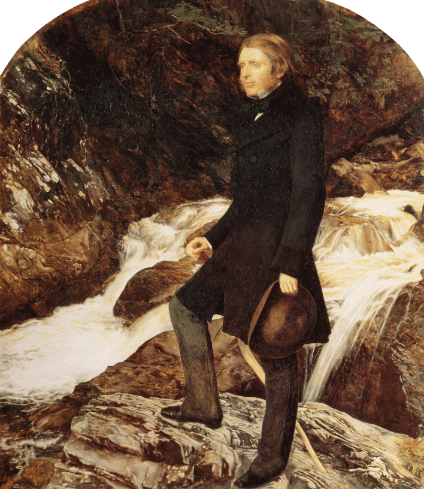
*** Oop! Hello, Ruskin!
§ 9. And thus, in full, there are four classes: the men who feel nothing, and therefore see truly; the men who feel strongly, think weakly, and see untruly (second order of poets); the men who feel strongly, think strongly, and see truly (first order of poets); and the men who, strong as human creatures can be, are yet submitted to influences stronger than they, and see in a sort untruly, because what they see is inconceivably above them. This last is the usual condition of prophetic inspiration.
§ 10. I separate these classes, in order that their character may be clearly understood; but of course they are united each to the other by imperceptible transitions, and the same mind, according to the influences to which it is subjected, passes at different times into the various states. Still, the difference between the great and less man is, on the whole, chiefly in this point of ‘alterability‘. […]
§ 11. Now so long as we see that the ‘feeling‘ is true, we pardon, or are even pleased by, the confessed fallacy of sight which it induces: we are pleased, for instance, with those lines of Kingsley’s, above quoted, not because they fallaciously describe foam, but because they faithfully describe sorrow. [7]
John Ruskin at Glen Finglas by John Everett Millais, 1853-1854 (Public Domain)
(1) Shady Grove (Roud 4456), Mainly Norfolk: English Folk and Other Good Music, mainlynorfolk.info/folk/songs/shadygrove.html. Accessed 6 Feb. 2024.
(2) “Vaughan Williams Memorial Library: Shady Grove.” English Folk Dance & Song Society, http://www.vwml.org/search?q=Shady%20Grove&is=1. Accessed 6 Feb. 2024. (Of note, the English Folk Dance & Song Society owns the Cecil Sharp House.)
(3) Spiegel, Max. “Origins: ‘shady Grove’ a Mondegreen ?” The Mudcat Cafe, mudcat.org/thread.cfm?threadid=131461. Accessed 6 Feb. 2024. (“Mondegreen” is my new favourite word now. Story of my hearing impaired life!)
(5) “Cecil Sharp.” Wikipedia, Wikimedia Foundation, 26 Jan. 2024, en.wikipedia.org/wiki/Cecil_Sharp#Political_Views. (Yes, its Wikipedia ~ but the citations at the bottom of the article look like they’re worth exploring.)
(7) Ruskin, John. “Of the Pathetic Fallacy from ‘modern Painters’ (Volume III, Pt. 4, 1856) by John Ruskin.” The Pathetic Fallacy, Ruskin (1856), http://www.ourcivilisation.com/smartboard/shop/ruskinj/index.htm. Accessed 6 Feb. 2024. (I have no interest or affiliation with the author of this site as a whole, this link is simply where I have accessed an online free readable copy of Ruskin’s writings on the Pathetic Fallacy.)
My aim with my online presence in a holistic sense is to do the work of further developing a unique and authentic artistic style and to build that as an inseparable part – maybe even just an outward expression of – my witchcraft and personal paganism. (In some ways, my goal is also to work myself up to a place where I can open my etsy shop and trust myself to handle things like paper work and post offices with reliability.)
There are many topics that get poured into this massive cauldron of bubbling inspiration and what I want to do is explore that process in a conscientious, intentional manner so that whatever comes out (at any given time) does so as fully considered, balanced, and informed as it can be at that time. Some recent ingredients (or topics) of focus have centred around revamping my altar and strengthening the practical aspects of my devotion to the Morrígan.
I wanted the art on my altar to function more directly on the Morrígan in her many aspects. I have felt for a long time that I was placing too much emphasis on her bird forms (Badb), her horse forms (assuming we take Macha to be a facet of the same goddess or even her sister), and to some extent her association with war and death. Thus, the altar has the bird, the horse, and the more cosmic otherworldly aspect accounted for but no wolf, cow, or eel… and also no succinct representation of triplicates either! (It used to but hasn’t had for a while – long story.)
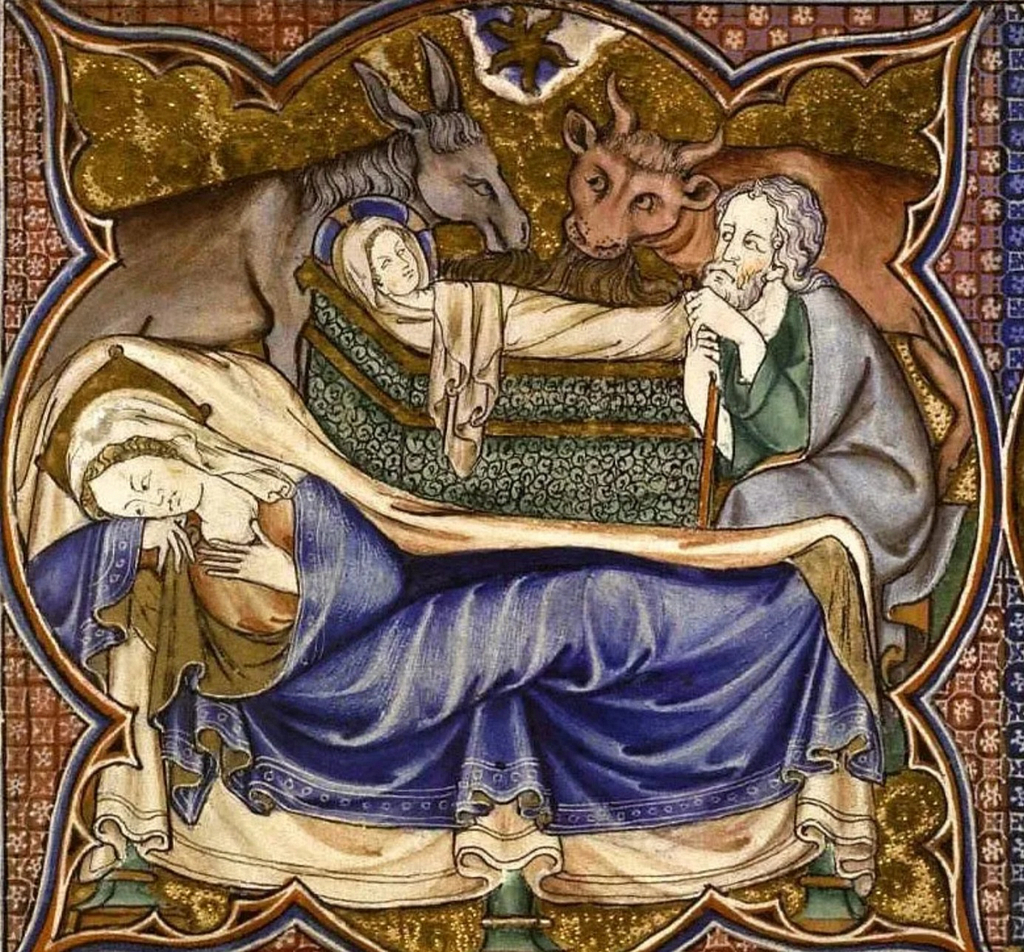
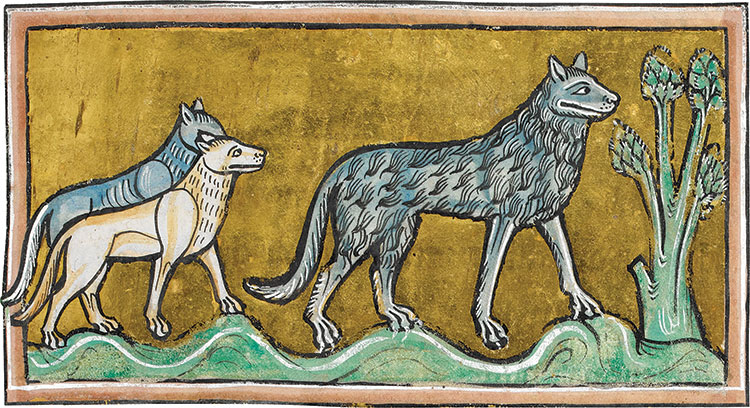
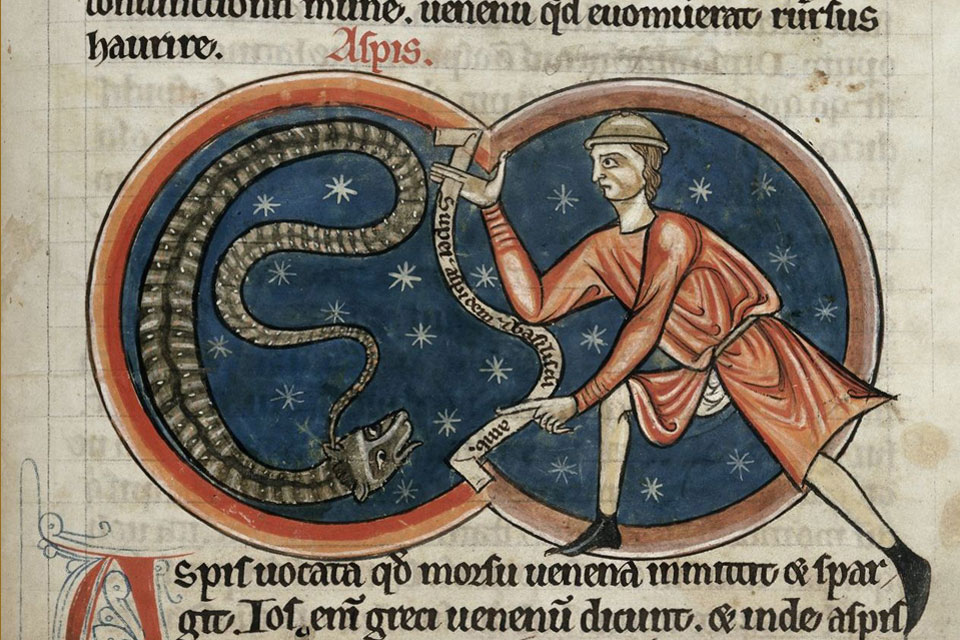
The next question I had was how could I represent so many new animal forms without entirely dismantling my altar for a new layout? I generally take a medieval inspired approach to Irish myth so the first place I looked was medieval manuscripts for representations of the animals in question (or near enough). Below are some examples (including source information) of wolves, cows, and…anything like a snake or fish to give a stylistic basis for drawing an eel. (Oddly, eels were fairly commonplace food items in the middle ages but I’ve had a hard time sourcing properly cited examples. Thanks Pinterest 🙄)
Psalter of Robert De Lisle, c.1310Rochester Bestiary, c. 1230Der Naturen Bloeme of Jacob van Maerlant, c. 1350Harley MS 4751 (ft. additions of Gerald of Wales’ Topographia Hibernica, late 12th-early 13th c.
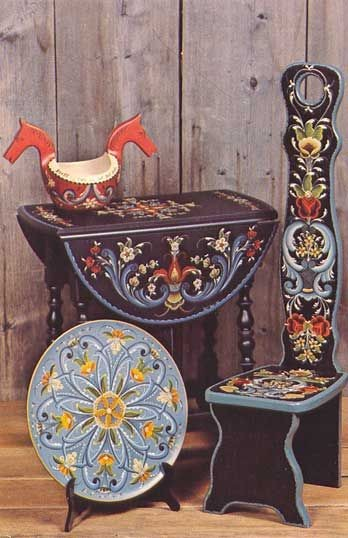
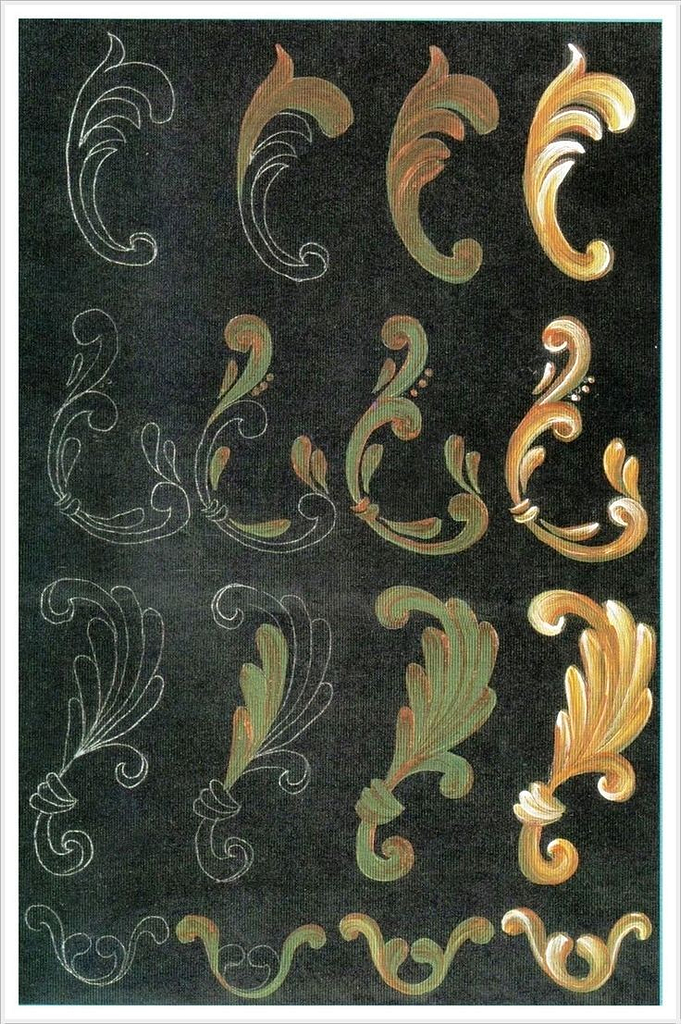
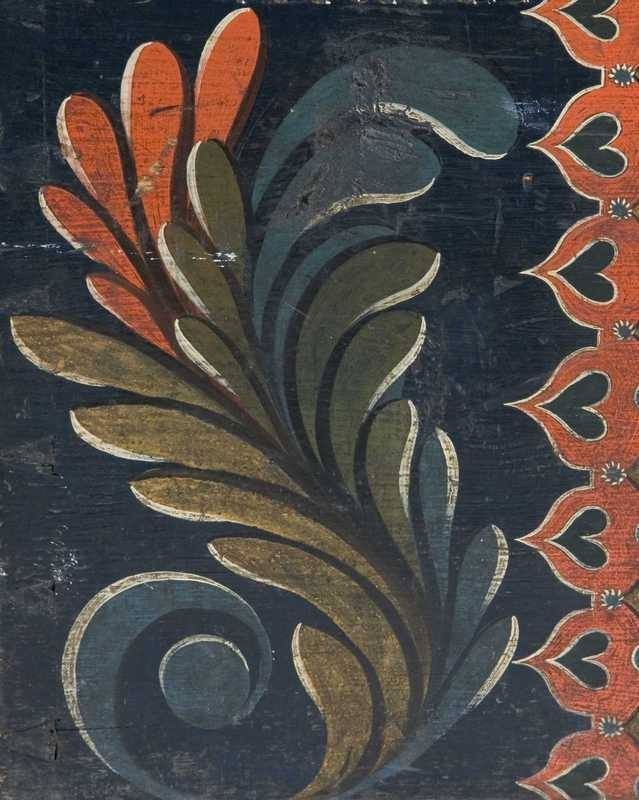
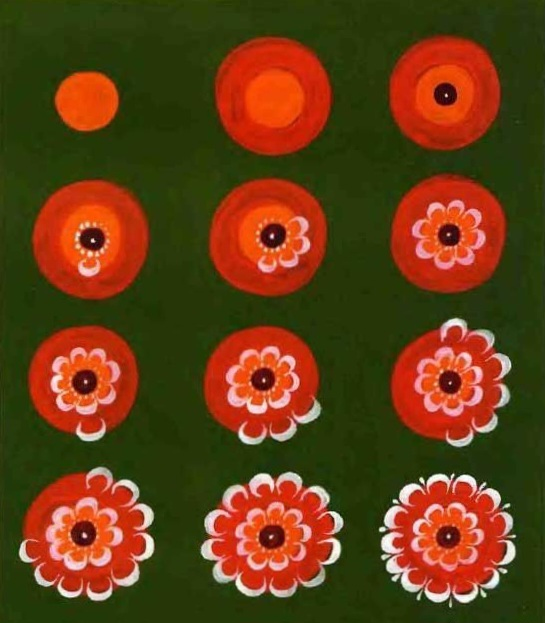
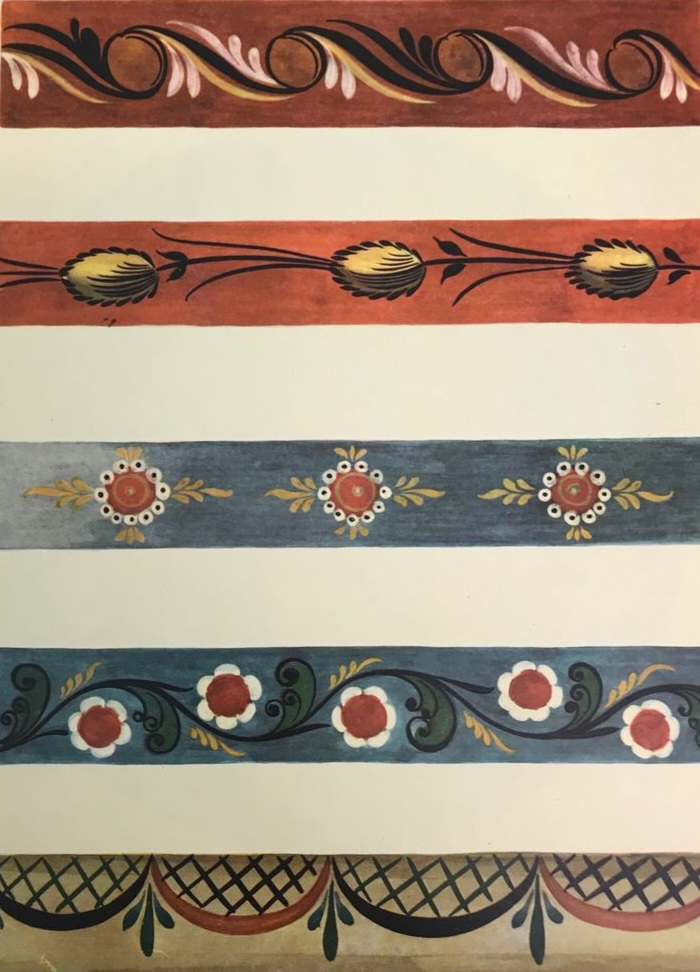
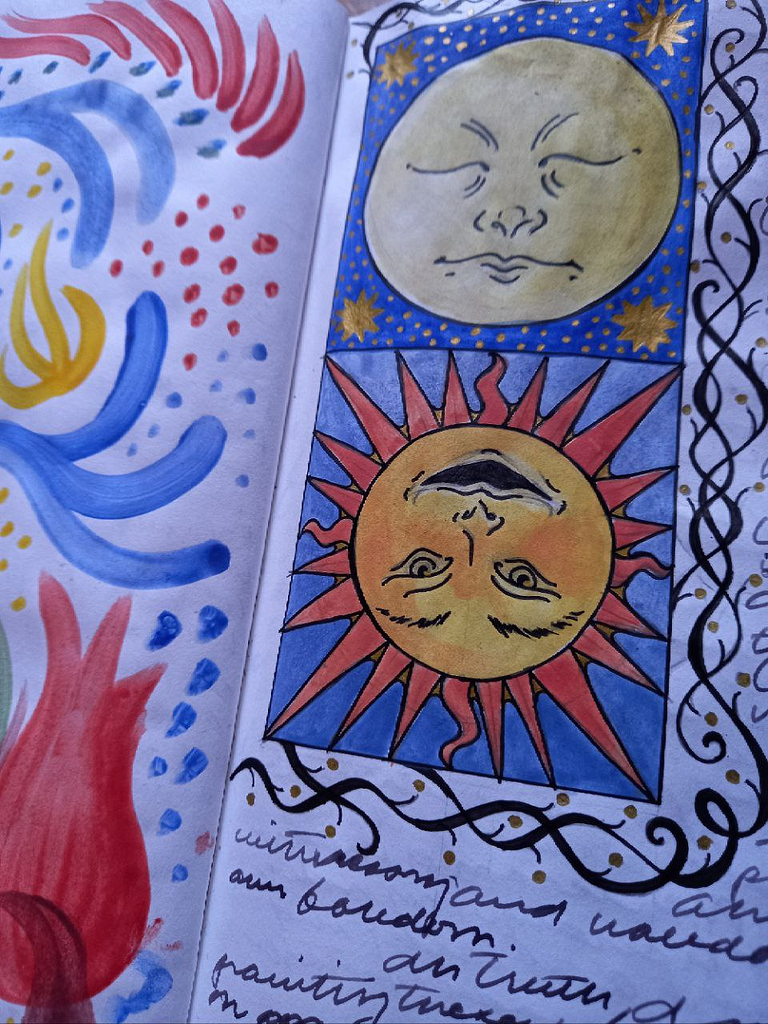
I am also always itching to paint on my furniture (and my walls…as with my altar space) and this seemed like a very good, risk free chance to work on developing my own technique inspired by medieval aesthetics and mimicking various folk styles such as Scandinavian (esp. Norwegian) rosemaling. I also grew up and worked in an area of the US with a lot of old houses that featured strange old paintings in their attics from the folk arts movement – an artistic tradition that included painting folk motifs on furniture as well. Below are some examples that I used as a basic reference as well as a page of my Book of Illuminations where I had some fun practising brush strokes!
Examples of rosemaling style painting – largely uncredited on Pinterest.
So I went to the vintage/antique shopping. Among other treasures such as a white rosary specked with what I assume is years of incense resin and a really beautiful old green glass bottle…I found a black wooden statue base. Bought it, took it home, cleaned it up and worked on designing how to paint it! Yorick was being fussy about the box he had been on anyway. 😉
Out of all of this I designed three panels for the statue platform. I incorporated a few William Morris/Arts & Crafts movement/stained glass inspired elements as well (most notably in the birch trees and the leaves behind them.) Note! The cow faces forward and is also somewhat based on modern highland cows… The part of the Táin where the Morrígan takes this form describes Her as a ‘hornless red heifer’. I decided to lighten the colours on her head and keep her ears red as a slight nod to otherworldly cows or cows from the sidhe which are often described as white with red ears. The final product also shows three drops of blood, one for each animal, which are placed spatially in such a way as vaguely indicates where Cúchulainn’s sling shot injured Her in each case. Below are my notes and sketches!
Astral egg symbols abound!Paint experiments.Sketches based on medieval examples – focusing on directionality of brush strokes. Eel modeled loosely on a fresh water species.
The final result up close and in situ! This shrine feels so much more complete now. Best believe the gold of Her eyes lights up in reflected candle light.
A video showing some of this process will follow in a day or so, so stay tuned for that! I will endeavour to update this blog post with the embedded video when it is ready.
Perhaps it is the time of year – verging on the vernal equinox and a hushed but stirring feeling in the air. On Imbolc, some say that fine weather means six more weeks of winter: the Cailleach has cleared the clouds so that she may gather dryer firewood for more cold weather. If you see a bird fly by with sticks in its beak, on the day, that’s her! The birds have indeed been gathering with a frenzy of late, the weather gusts cold and wet, and everywhere are light burgeoning shades of green and delicate hints of mauve.
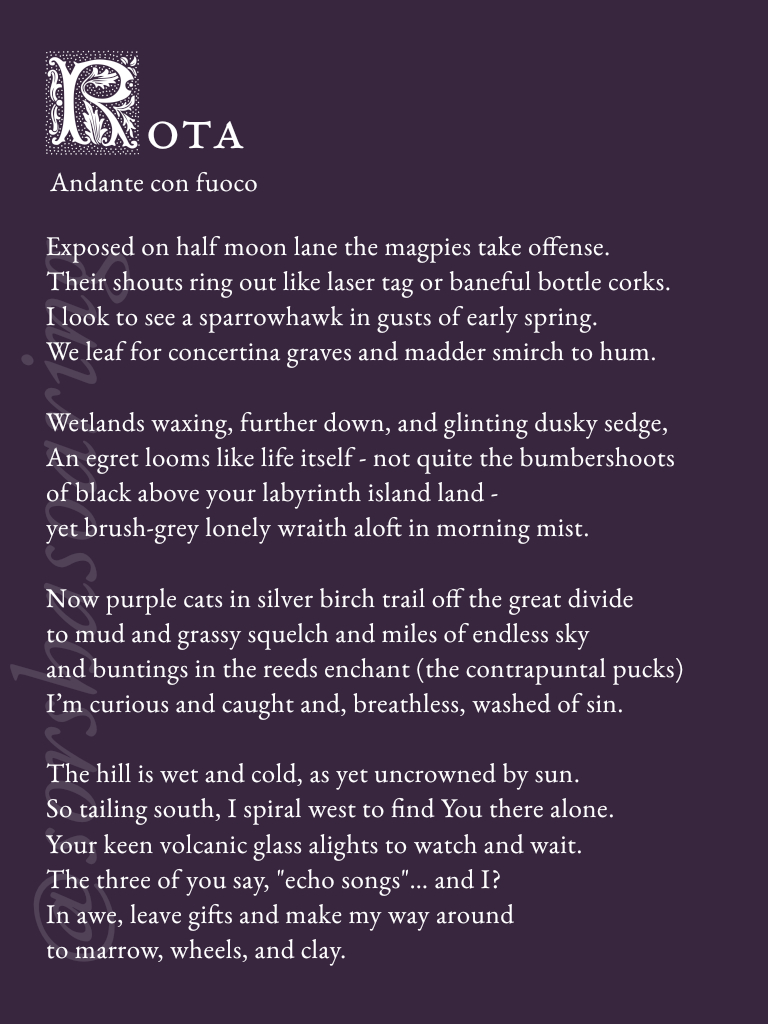
This one felt stuck until this morning…go figure. Note ~ “rota” (wheel…) or “rondellus” is the medieval term for a round. “Andante con fuoco”, also in music, means “at walking pace, with fire”.
I’ve been feeling restless – even anxious – and keenly aware that my priorities need a rearrange. It’s been weeks since I’ve been able to sit at my altar without knocking something over or dropping cinders on the floor – that’s strange. I like to spend most of my time alone and yet the world seems very loud and backlit with blue flickering light – that’s telling. I’ve been losing sense of what I love, what projects I want to work on, feeling anxious to meet deadlines that don’t exist – time to slow down. After all, this year’s motto is: NO RUSH.
Gorse… beautiful and so very sharp. I like it for protection/warding work.
It may not seem like much, but I’m leaving Instagram. I feel I am responsible for my own use of time, my own sense of honesty or personal connection with others (and with the collective!), and my own health. Instagram makes it seem that those who live with flare and authenticity have no trouble documenting that on their platform…but I have not found this to be the case in my life. Instagram also makes it seem as though there is no such thing as agency or artists or social awareness or anything at all without their dicey validation.
When catkins look like corpses… “I’ll cut you in half, while you’re smiling ear to ear/And the freedom that you sought/is drifting like a ghost amongst the trees…” (Magic by Bruce Springsteen)
But there ARE other ways to show process, to document inspiration, and to allow others to partake in the kind of slow quiet beauty I wish to cultivate. Hence, this blog post features some examples of the few moments of quiet that I have recently pursued and remembered to value… none of which were posted on Instagram but that I’m happy to highlight here as a signpost for the future.
Variations on a theme…Current corset progress…Modded Somnia Tarot.
A thread of red in the labyrinth of life.
Quietly yours,
Sorsha.
*First line of the Morrígan’s prophecy to the Donn Cúailgne, as translated by Thomas Kinsella.