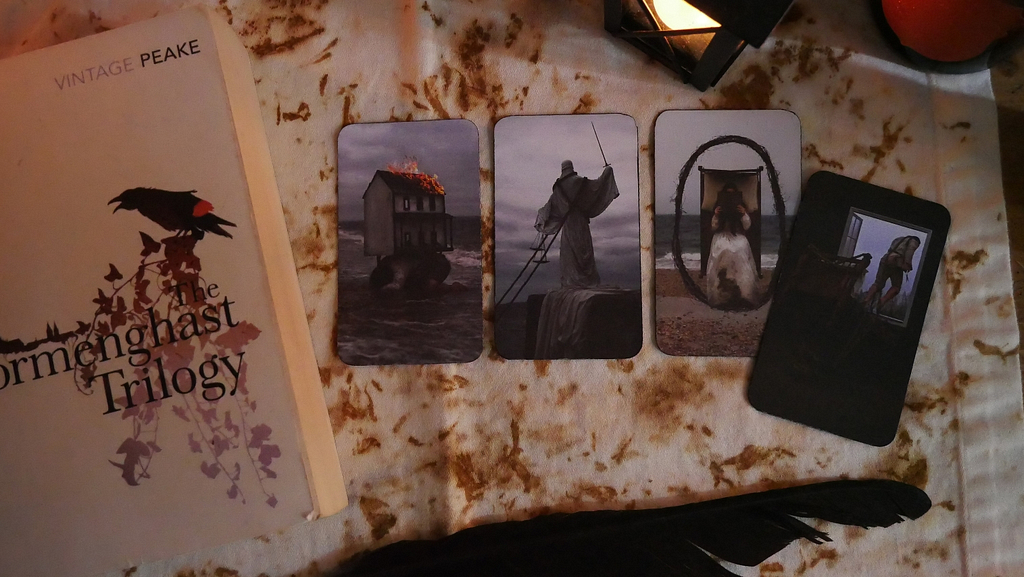
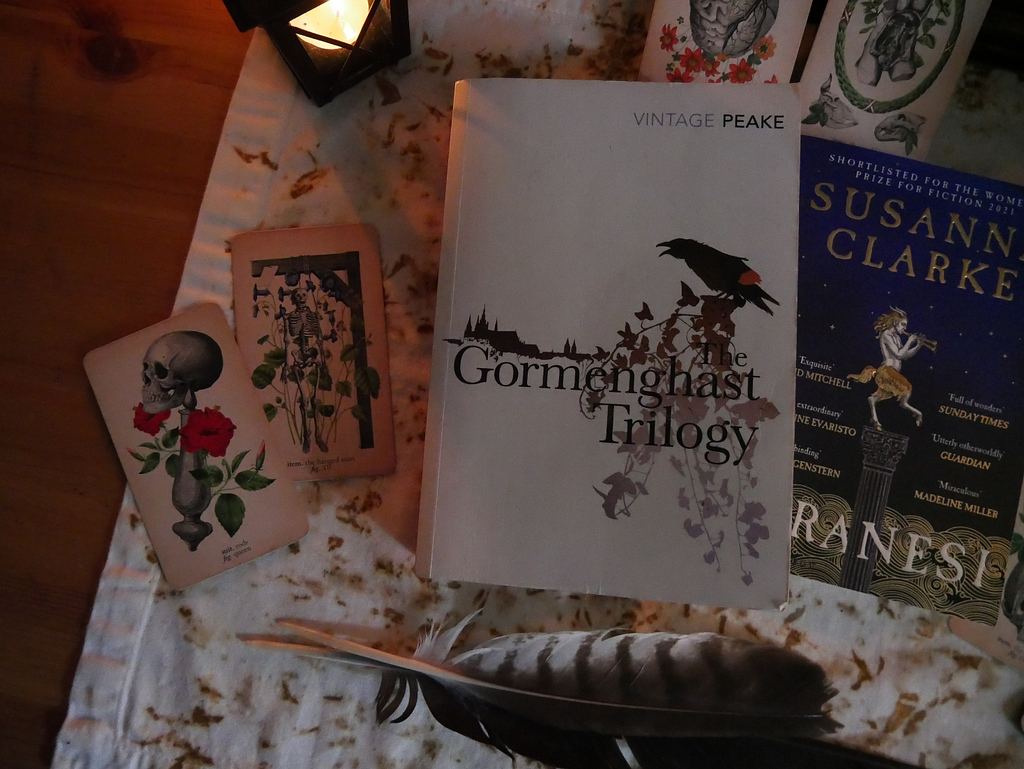
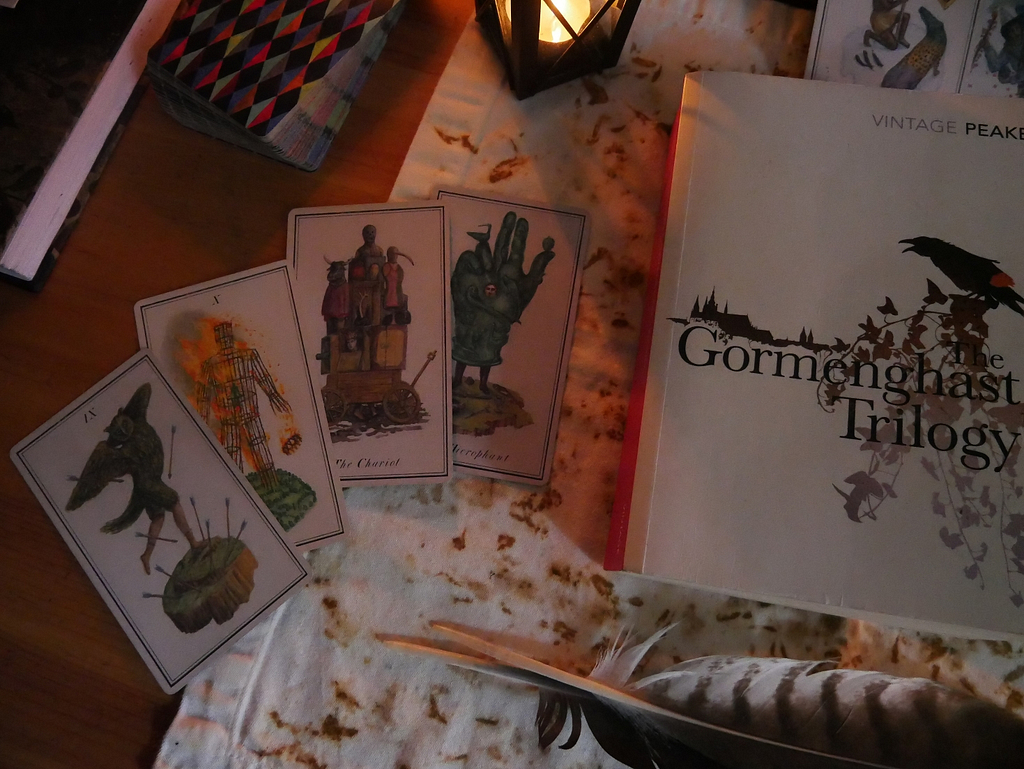
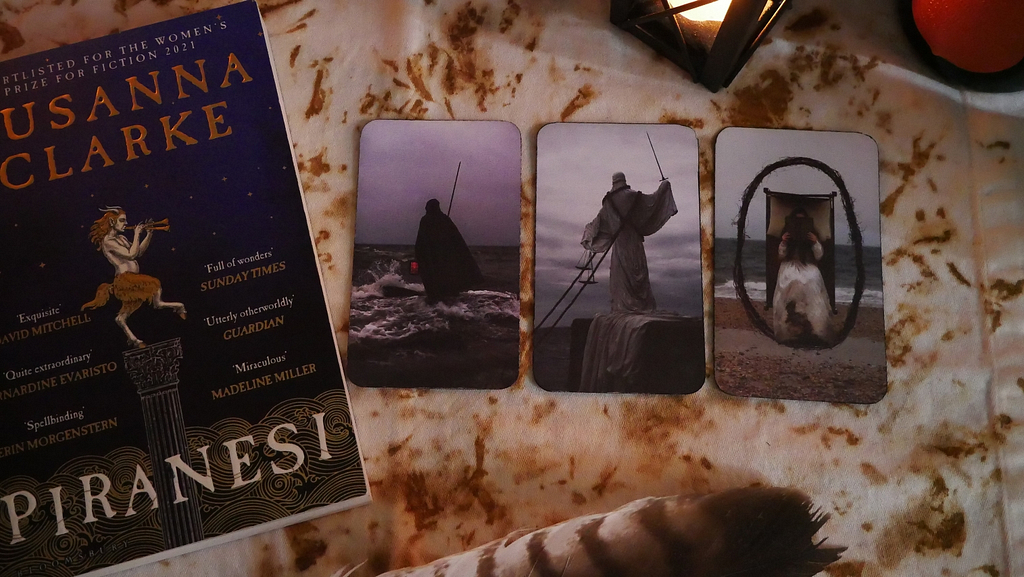
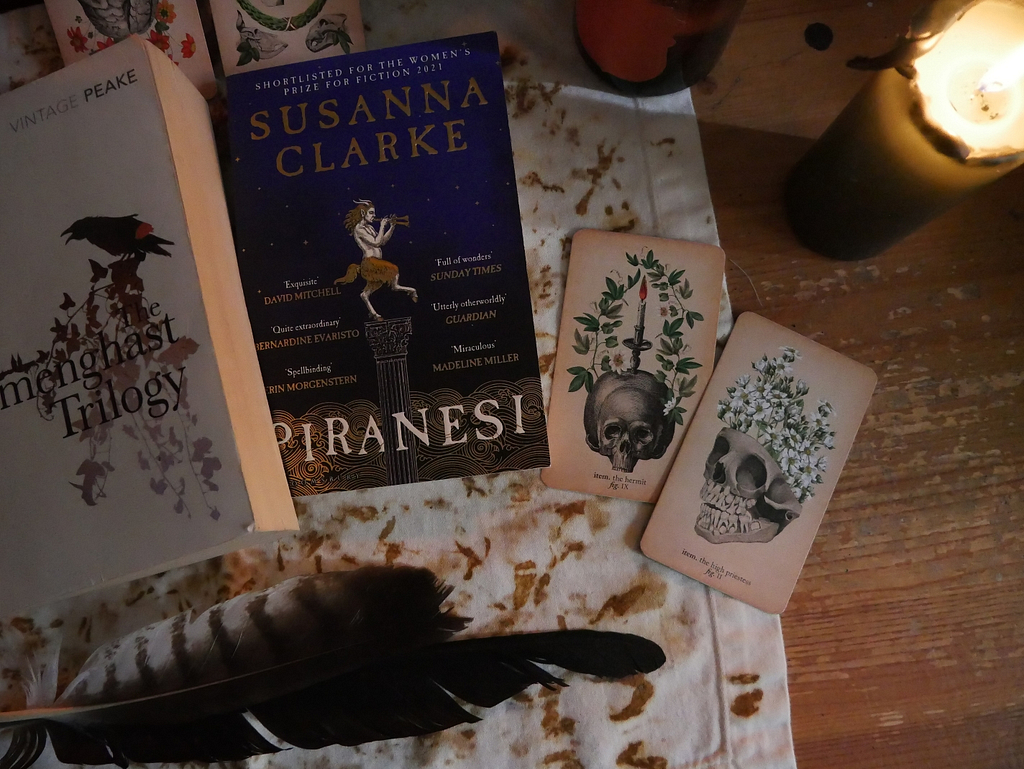
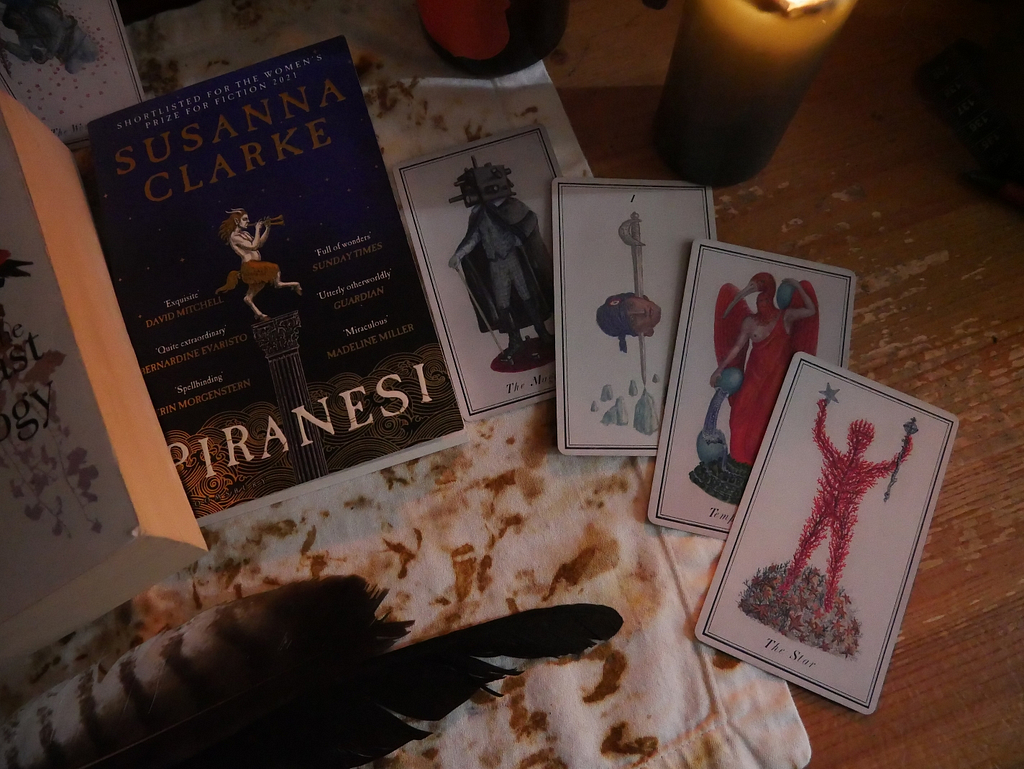
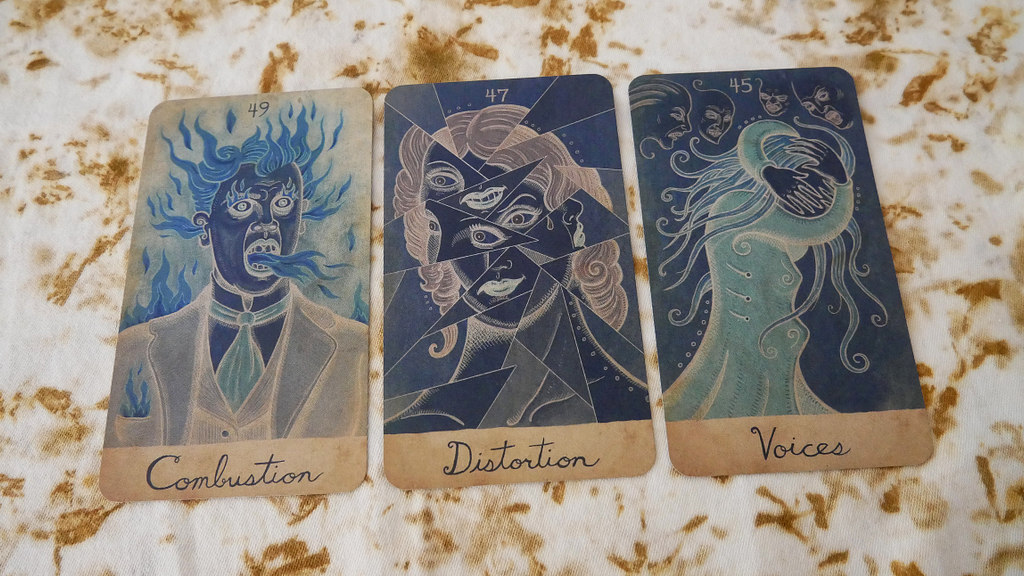
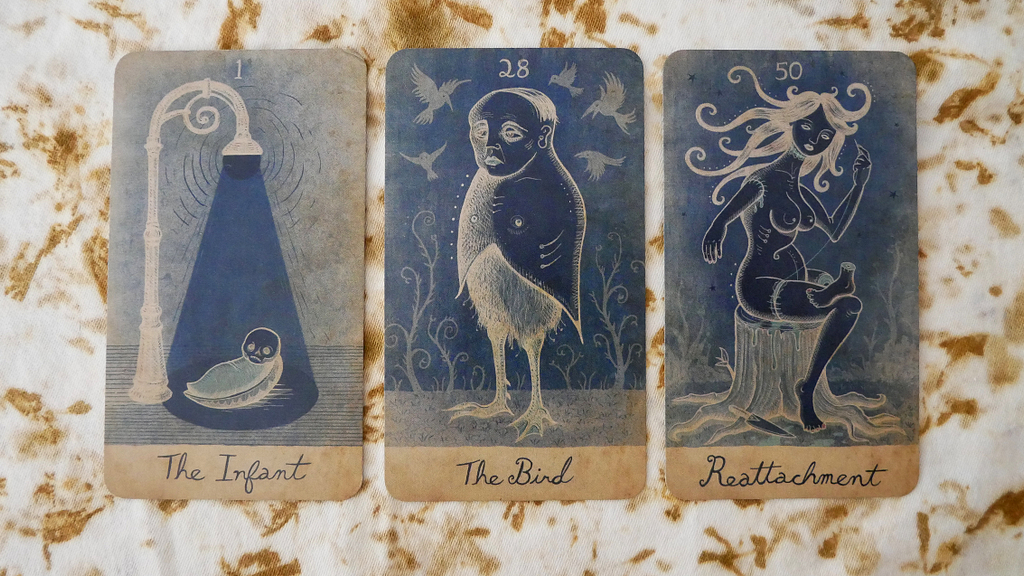
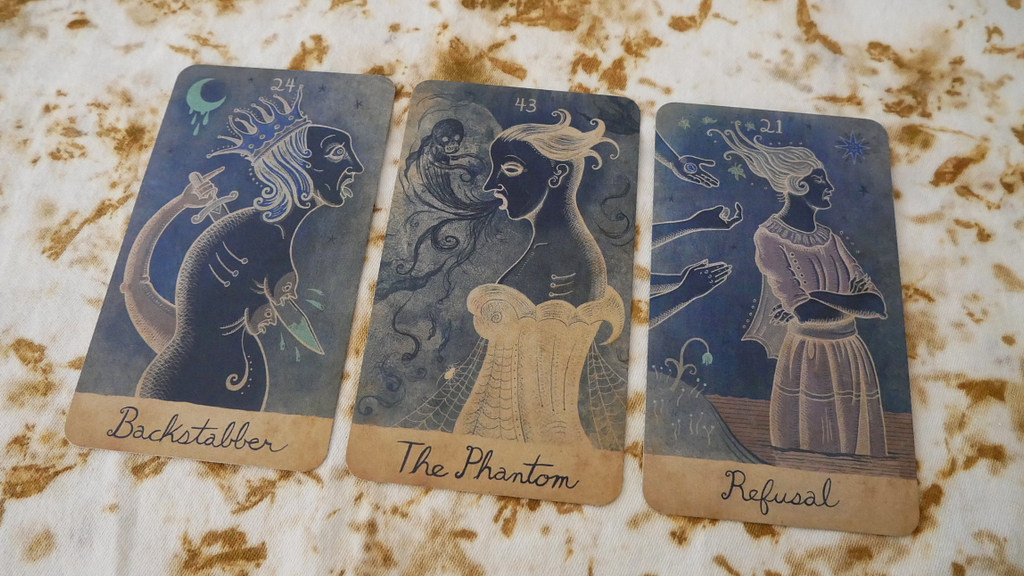
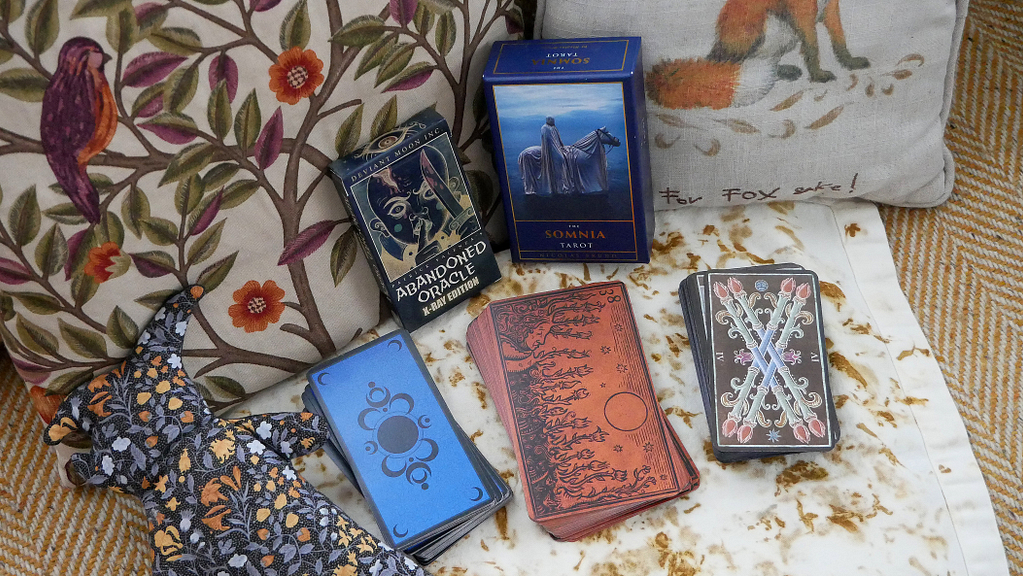
Two books that strike me as worth reading in tandem with tarot are “Piranesi” by Susanna Clarke and “Titus Groan” by Mervyn Peake. It would be tempting to consider picking a specific deck to work with in each case but there might be the risk of over associating that deck with those books afterwards. An idea to be approached with caution, perhaps.
I seem to have regained my ability to read fiction for the first time, properly, in over a decade! There are many reasons for this but paramount for the purpose of this blog post is that I have been allowing myself to define my own terms for my taste. I know what I’m looking for in a work of fiction at this current stage in my life and I am allowing myself to articulate that and pursue it.*
Titus Groan
I can’t vouch yet for the further Gormenghast novels (the rest in the trilogy or any of the further works – short stories, the ‘rediscovered’ book written by Peake’s wife and so on) but I suspect they would all make an interesting study with tarot.
As I finished Titus Groan one specific card leaped to mind: Justice. Justice, in any system (meaning whether you see it at the 8th or 11th Major Arcanum, I think it would apply).
From my admittedly limited experience, the Justice card will often get described as cosmically neutral. It’s not automatically synonymous with legal justice, or social justice, or anything anthropocentric in nature. It’s often viewed as possessing the kind of neutrality that registers to the subjective human mind (and the collective) as “cruel”… unfeeling.
What is interesting about that, however, is that in any given reading where we receive the Justice card, we rely on the cards surrounding it to provide context. In Titus Groan there is a bewildering amount of heavily detailed (deliciously rotten) context. There is a total pointed stylistic preoccupation with the minutiae of a given moment from many vantage points. The book doesn’t really have chapters as such but the manner in which it is structured seems aimed at giving the reader a very specific kind of whiplash…and gaslights you about it too. It oscillates between the estate/house of Gormenghast occupying all our ideas and definition of ‘the world’ or ‘the cosmos’… gets us deeply invested even in the movements of its motes of dust (so often likened to starlight) let alone the emotional landscape of it’s morose and Bosch-like characters… only to zoom far out, like a choppy jump cut, to the world outside the walls; full of archetypal passion plays, journeys, trade routes, forests, and mythic relationships. Every switch takes only a page or so to re-frame your sense of perspective and proportion. It warps your sense of time and space in a deeply compelling way. To be back inside the walls of Gormenghast is almost to forget the narrative of only a few pages prior.
And none of this sense of “loyalty” that you develop in the reading is particularly well rewarded if what you’re hoping for is Justice in its more desirable or “fair” aspects. “Loyalty” is actually an explicit theme in the book but it’s presented as a lived reality, an arch concept, and a dysfunctional source of festering rot. Justice lurks behind it all. Past a certain point, every page feels like a waiting game and you, the reader, bear witness to sociopathic plots and action with no clear idea of the deeper motivations or drive behind specific characters …other than as projection of the rotten dysfunction of Gormenghast itself. Gormenghast (with its own societal ideas of “Justice”) is the living breathing house that is THE world but is also only one small estate inhabited by the rigid seemingly endless loyalty to pattern, ritual, and heritage. What is structurally integral and societally established IS ‘just’ and ‘good’… right?
If this rendering of Justice makes you feel rather enclosed and sweaty, I think its supposed to. It’s also weirdly sympathetic though. I felt continually rather caught and called out!
In Gormenghast, Justice is communicated through sensory experience… a pendulous blotch of wine on white linen flashing in and out of the shadows… its details never relent but that’s the point: perspective becomes acrobatic!
All of this is enhanced, of course, by the fact that Titus Groan is only the first book – as far as I am aware – for the convenience of publication. Weren’t the Gormenghast materials intended as one long work of fiction? As the book opens and closes it feels very much like you have only read a near 400 page ‘first act’.
The Justice card stood out to me throughout not, per se, in its conspicuous absence (though… kind of) but more because the book just screams out that you don’t even know what Justice IS. You are just as limited and ridiculous and totally absurd and strange as any other character in this narrative.
Piranesi
With its overt thematic play on labyrinths, Piranesi feels similar in genre to Gormenghast. The writing is much more direct, the method for telling the story is totally different than Gormenghast. But the tarot also would make a great tool for exploring the book. And the book would do the same for exploring tarot.
What is our concept of Justice in Piranesi? I’m reminded in a way of the development of mind, voice, and perspective in the works of Albert Camus: the Stranger, the Plague, and the Fall. Each has their sort of hints at the next, archetypal touchstones… anchor points.
In Piranesi there are many deliberately archetypal presences. The albatross is a purposeful one, both real and full of reference. The point, perhaps, is that the literary reference is what makes it real to begin with. The statues take on roles almost of silent guides, warnings, or companions. Popes, charioteers, cloaked figures shining lamps in the dark or perpetually pouring vessels of water, nature goddesses, fauns, personifications of becoming, personifications of time or of youth and innocence and so on. There is explicit divination in the book too of course which I found totally riveting… “ornithomancy”.
I loved the book SO intensely and, as is often the case with me when I really get into something, I read it in a single evening. It’s not long and it’s characterised by a clear and open writing style (unlike Gormenghast) so it wasn’t difficult to just sort of… flow through it. It’s also very deliberately structured and that the reader might ‘flow’ through it’s clear and segmented ‘structure’ is VERY apropos and clearly purposeful.
The way it depicted divination, spiritiual knowing, and total quietude felt uncanny in that it reflected so well how I think and feel about these things. Even down to the use of certain phrases – which, of course, to my mind is the act of affirming the efficacy of witchcraft… To me, it’s not a “what are the chances!?” perspective. It’s a “but of course” perspective. If you’re engaging with it and pursuing what you care about than many aspects of it will feel shared even as they differ in various details.
That’s how we get to talk about things like thought forms, egregores, shared culture, collective gnosis, and build systems like tarot!
But the book also shows us the dark abusive side of this. In my opinion, it makes for GREAT reading if you are already a little familiar with the history of Western Occultism… some of the specifics of societies like the Golden Dawn, figures like Aleister Crowley and so on. I’m sure the more you know the more you’d notice is snuck into the pages of Clarke’s fiction, but a baseline acquaintance will do! The book absolutely ‘goes there’ in looking at the dark underbelly of magic and the occult, particularly in its collective iterations. It asks what each of us become, what ‘being’ is vs what ‘doing’ is… What the evil, the ambiguous, the perpetrator, the victim, the isolated neutral, and the open work of having curiosity all are.
Justice sits behind all of this too. And both books don’t ‘answer’ our feelings on it, in my opinion, mainly because the Justice card/archetype isn’t a question. A tarot reading is often predicated on the formation of a question but, paradoxically, Justice isn’t an answer without that subjective context… the role of the reader and/or querent.
Neither of these books answer anything or even exist unless it be in the moment of interaction with their reader(s) and in so far as their readers share how they experienced them.
Okay, so maybe …two Major Arcana: Justice… and the World. But again, no answers. Only contemplation after the provision of context.
Have you read either of these books?
If you have (or if you haven’t and you don’t mind spoilers) let me know what you think! Would you pick the same cards or something else entirely?
~ Saoirse.
* I think the proliferation of blogs, aesthetic terms, and the existence of booktube have helped with this. As a ‘fantasy lover’, back in the day, there was a lot of pressure to ‘read everything you can get your hands on’ … which has never possible for me. Now I feel more able to just say what I’m aiming to read and why!
Something that has gripped my imagination my entire life is the idea of ‘Building Other Worlds’. Importantly, I don’t mean only as ‘substance behind narrative genres’. World-building for a fantasy novel or for game play, though deeply interesting, is only one popular iteration of a much broader interdisciplinary creative drive to make and experience other worlds. What of Art? Architecture? Costume? Music? Theatre? Ecological experience? Folklore? What of symbolism or spacial awareness? Where do we get ideas for what our worlds look like and what tools do we use to build them?
I have been wanting to write about this for a long time but have been puzzled about where to start. Do I start by explaining some things about art history? About perspective, image composition, numerology? Do I dig into how tiered worlds in late medieval and renaissance literature make their way into contemporary visual language? What about modern art? What about tarot or oracle? Witchcraft, sewing, or poetry? Would tracing themes of port cities and their proximity to marshland or wetland habitats get the message across? What about folkloric recordings of Victorian vs. Medieval streets in Irish town centres!? Ultimately, I realised I’m going to have to start where I am and, if you wish, you can follow me down each corridor as and when I get there.
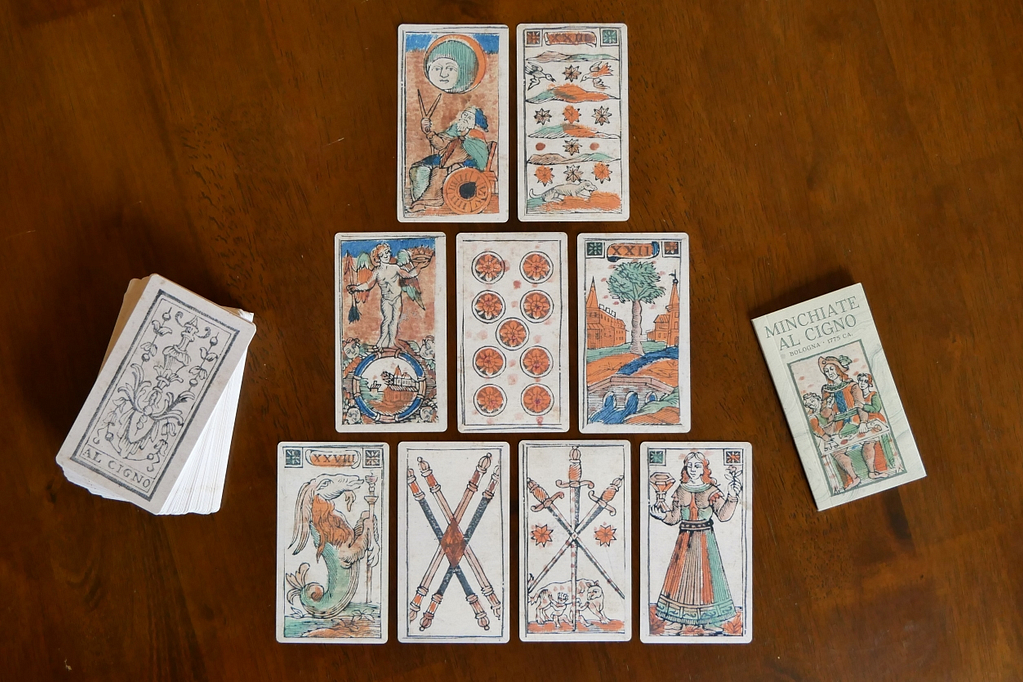
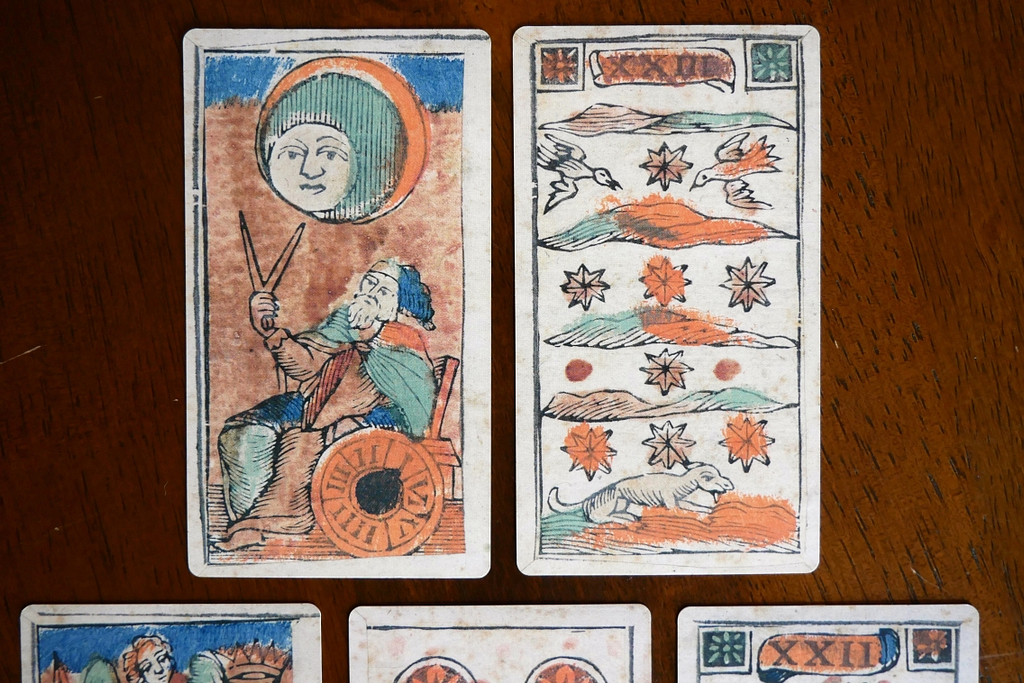
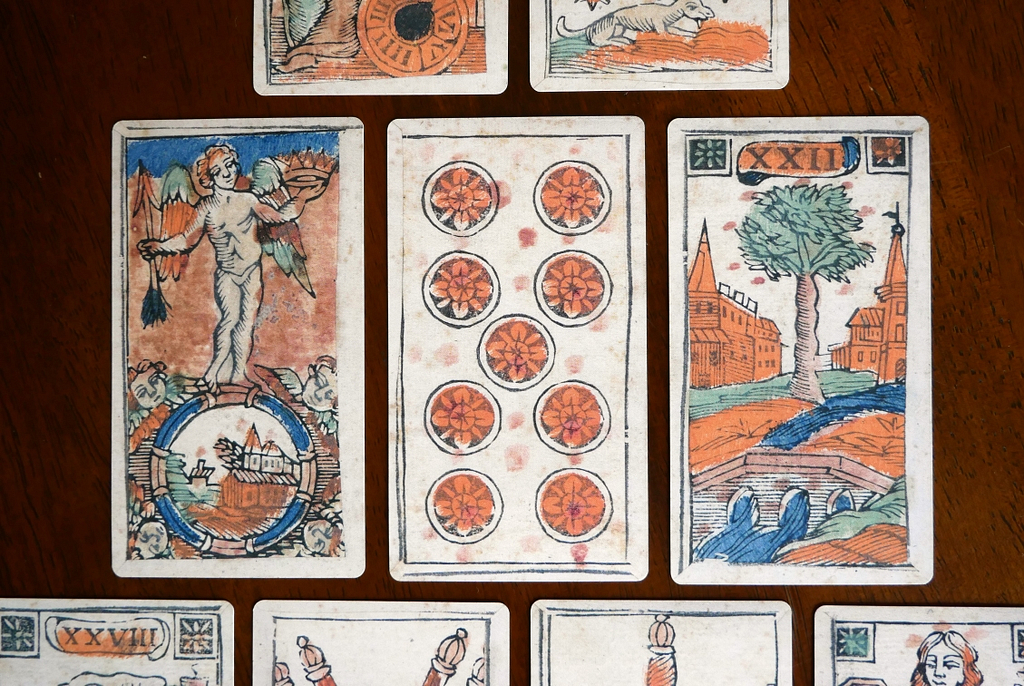
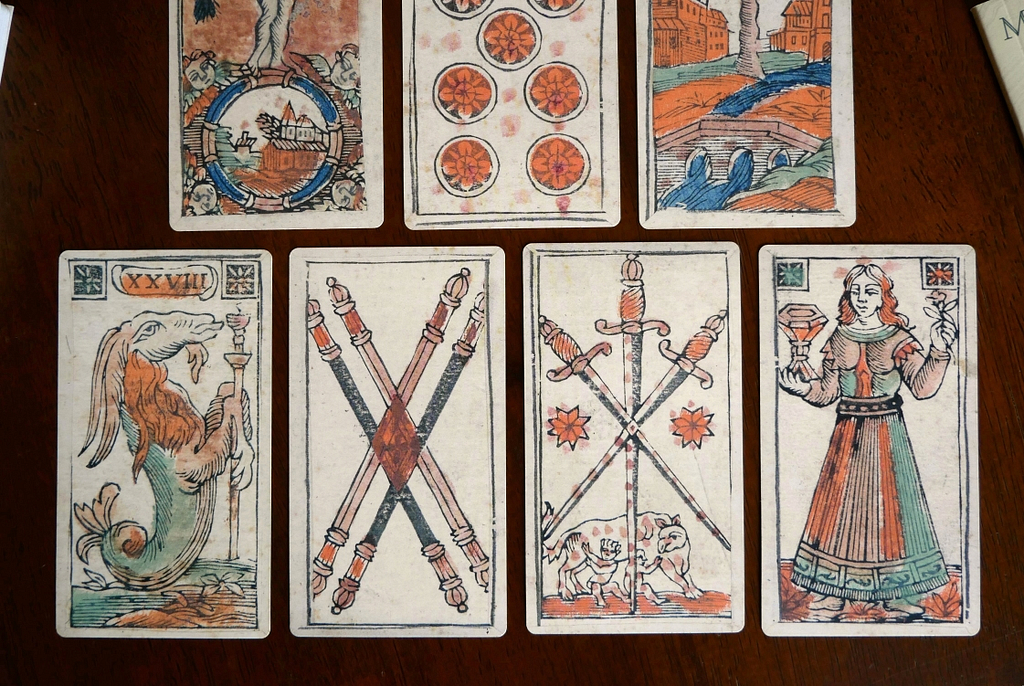
Here are some purposefully drawn 18th c. Minchiate cards illustrating how card visuals can help you construct doors to Otherworlds and populate them in turn with architecture, characters, and landscape …with pips for ‘scaffolding’!
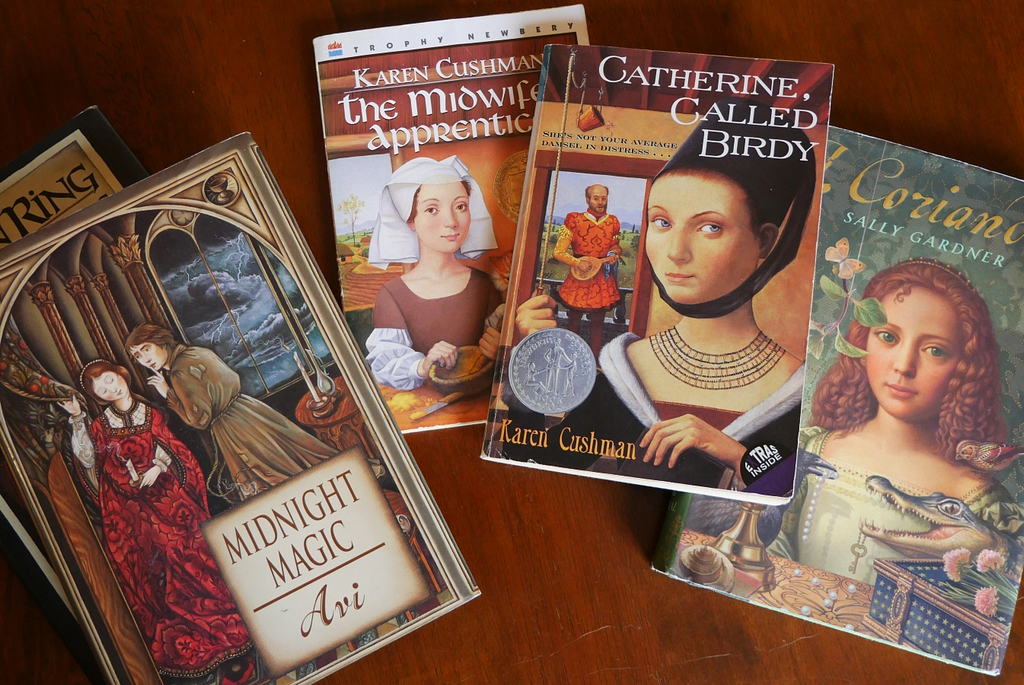
Recently, I revisited some books that were instrumental in helping me to identify myself when I was young. These follow very much in a similar vein to other favourites of mine such as Pish Posh, Said Hieronymus Bosch, The Books of Earthsea, The Chronicles of Prydain, The Hounds of the Mórrígan, or Jonathan Strange & Mr Norrell… and I took special care to obtain secondhand copies of the specific covers I grew up with as well.
I have yet to re-read The Raven Ring although I know I will love it as I can’t remember how many times I would have read it growing up.
There are five books in all (for now) – each of which features scenes relating to tarot, tarocchi, or otherwise emphasise attention to historical detail within their fictional plots.
* Midnight Magic by Avi (part of a series that didn’t exist yet when I was younger. I won’t talk about this one much because – as it turns out – it wasn’t as good as I remembered and it’s representation of tarot is tangential to the plot and seems fairly ignorant of what tarot is. I still LOVE the cover though!)
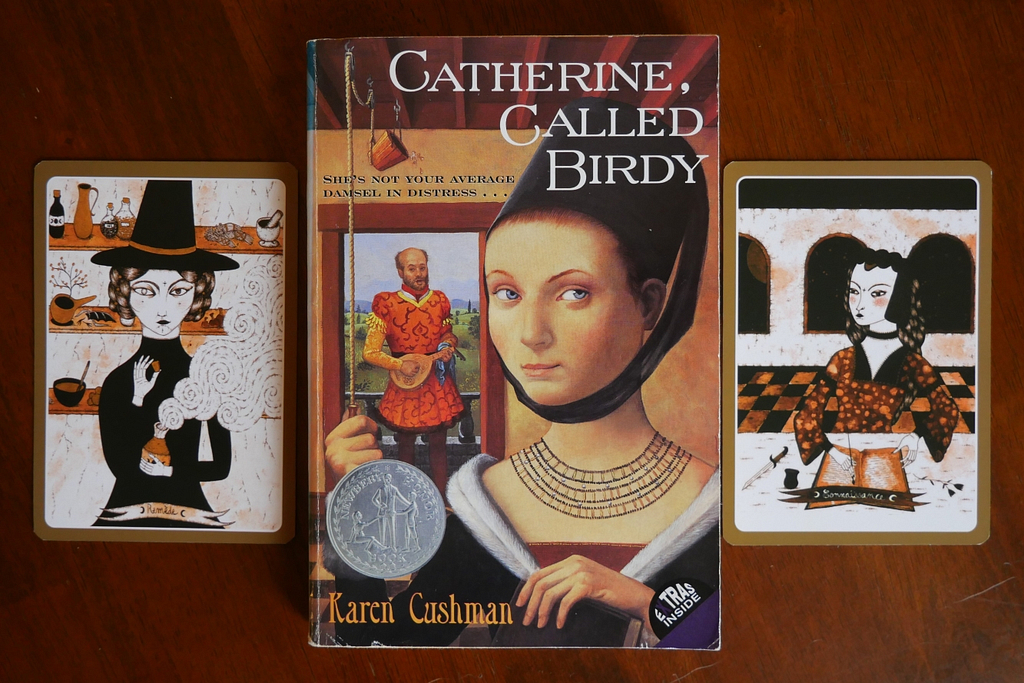
* Catherine, Called Birdy by Karen Cushman (no, I am not going to watch the new film abomina…I mean, adaptation of this beautiful wonderful highly intelligent book.)
* The Midwife’s Apprentice by Karen Cushman
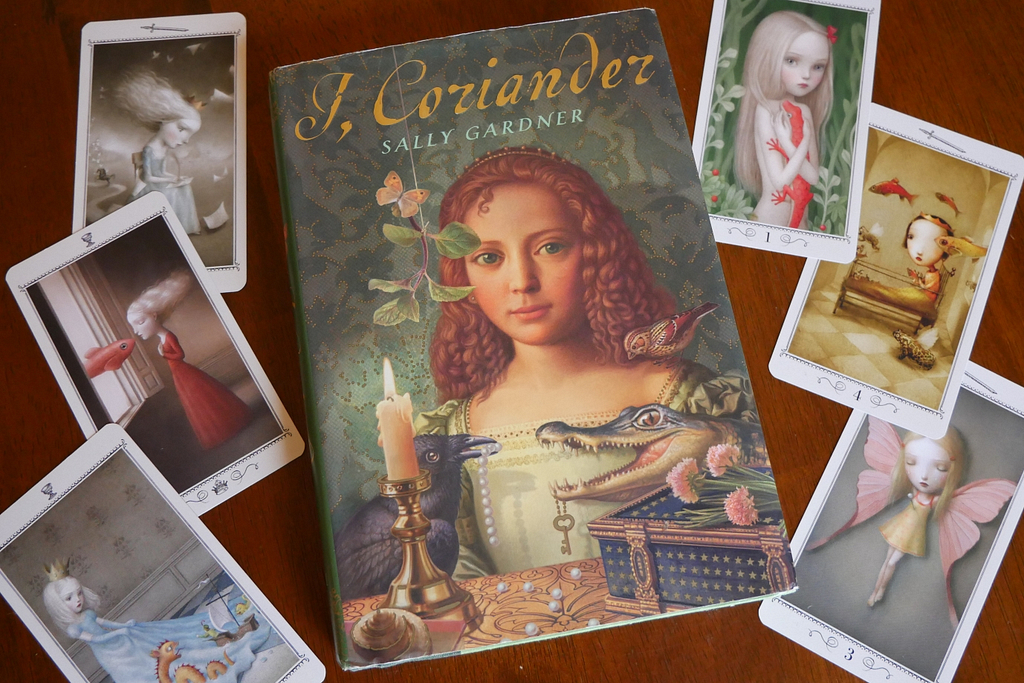
* I, Coriander by Sally Gardner
* The Raven Ring by Patricia C. Wrede (part of the Lyra series but I have not read any of the others.)
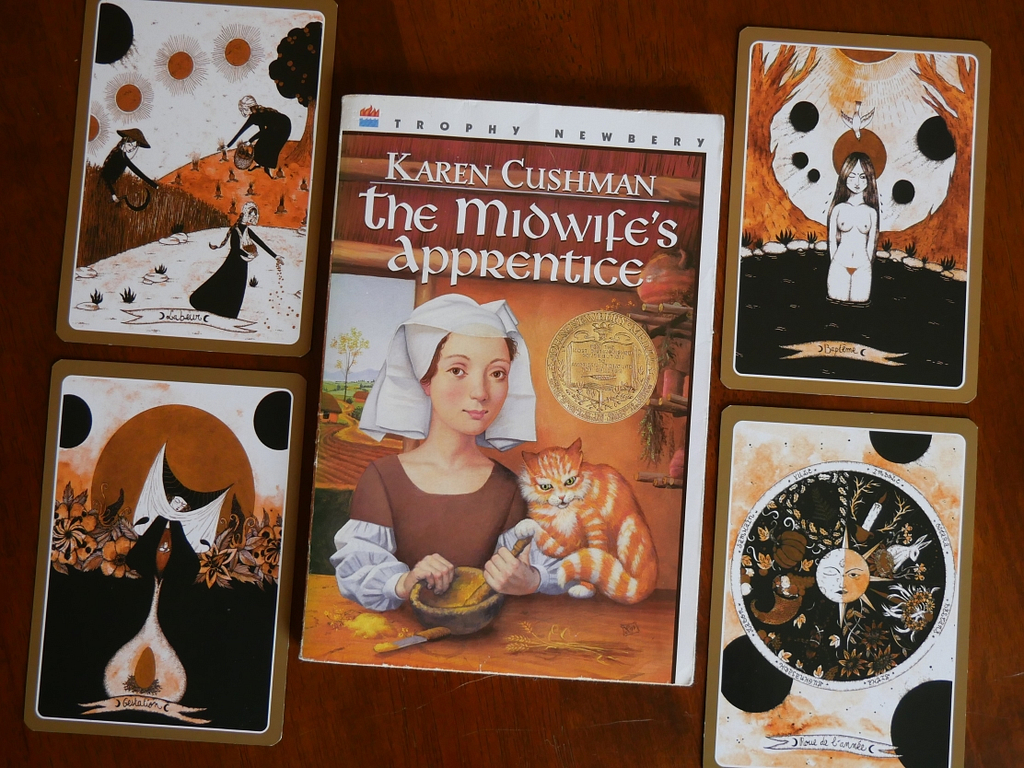
The Midwife’s Apprentice is pictured here with selected plot-relevant cards from Oracle Médiéval et Merveilleux by Gulliver l’Aventurière & Julien Miavril. (No spoilers!)
For one thing, all of these books (except Midnight Magic) were aimed, perhaps, at Young Adult readers generally socialised as feminine but at no point did they talk down to them. They were an excellent foray into how creative and narrative detail coexists wonderfully with good historical enquiry. There is an emphasis on trade and commerce. Some of these feature port cities or otherwise thriving commercial principalities and their conflicts with rural living and tradition. They discuss textiles as if their readers can and will care about how they affect plot. And they treat Otherworlds and/or magic with the same expectation: that readers are curious to know detail and will put in the imaginative effort. To me, this is how the imagination grows.
Catherine, Called Birdy is pictured here with two cards from the Oracle Médiéval et Merveilleux that are… relevant to the story. 😉
Artistically, a glance at these covers will possibly explain a thing or two about my own preference for facial portraiture and the art of the late middle ages and early renaissance. The time periods in the books vary a little more widely than the covers. I, Coriander, for example, is set mostly in Cromwellian England and the time period represented art historically on Catherine, Called Birdy is about 200 years later than the setting of the book (i.e. 15th century visuals [1] vs 1290-1291 book setting.) I was lucky enough, however, to have an aunt who overlooked things like that. For example, she focused instead on showing me how the play in perspective with the rope and bucket and the figural proportions on the cover of Catherine, Called Birdy were all little art historical jokes that the artist had borrowed from real historical painters. The implication was that if I was clever and curious, I could find them out …and I did!
Obviously there is so much to say even just about these books… so for now I will draw a few connections between I, Coriander and a few tarot and oracle decks that I have.
I, Coriander pictured here with selected cards from the Nicoletta Ceccoli Tarot. Once again, the penchant for strange emotionally intelligent portraiture!
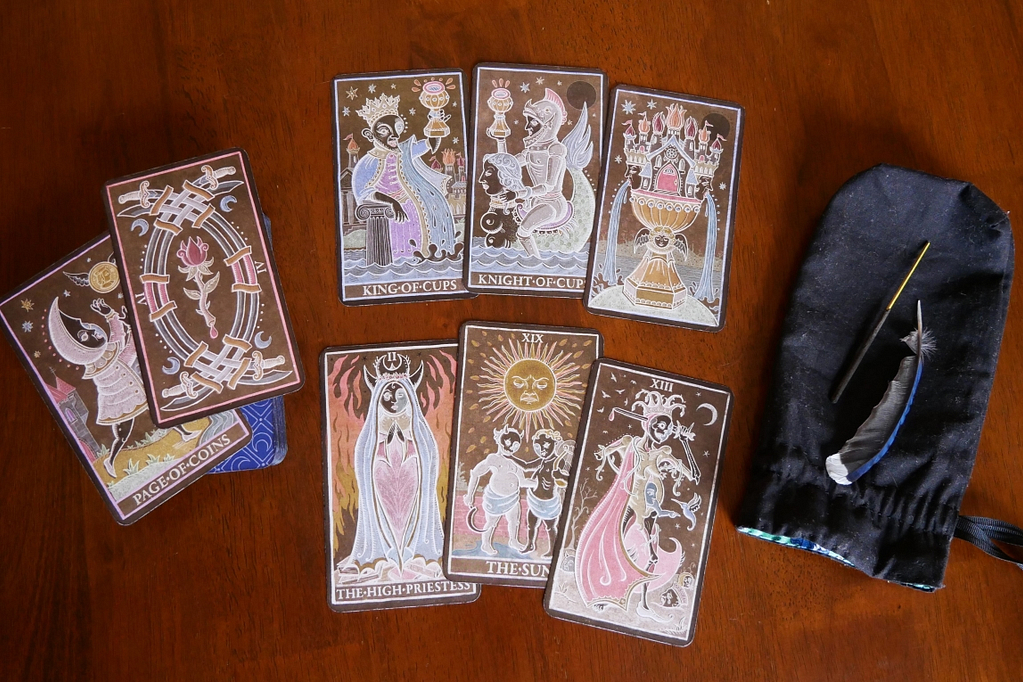
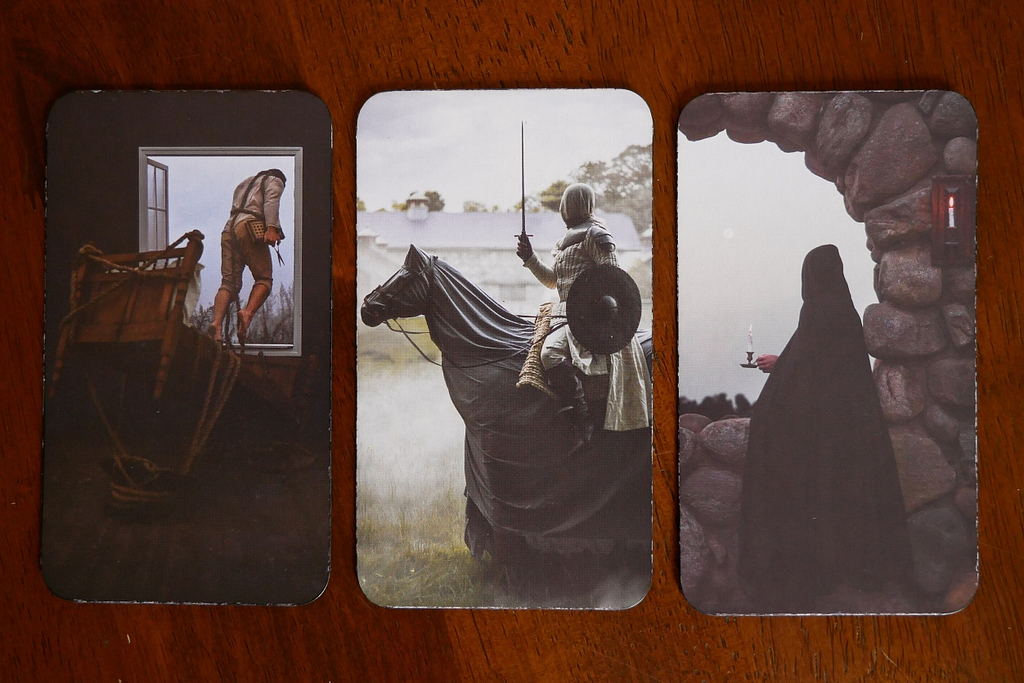
In the first place there is reference to a pair of wedding portraits in I, Coriander …a woman in the foreground holding an oak-leaf, a tiny hunting scene nearly hidden in the wooded middle-ground behind her, and a citadel in the distance. Her spouse is positioned in front of a fantastical city with a river or estuary intended (thematically) to mirror his connection with trade and the Thames. But in this city, there are mermaids and fantastical boats in the water among other things… I couldn’t help but picture certain cards from the Trionfi della Luna (paradoxical pictured below.) Or perhaps wander into a landscape just beyond the borders of such a city… might we find the world of the Somnia tarot there? People in old robes and linen shifts wandering in among the wetlands and sedge grasses gazing at the stars or riding silent sad horses?
Cards chosen from the Trionfi della Luna to mirror aspects of the story in I, Coriander… along with various imaginings of my own about the space we inhabit in the Somnia Tarot.
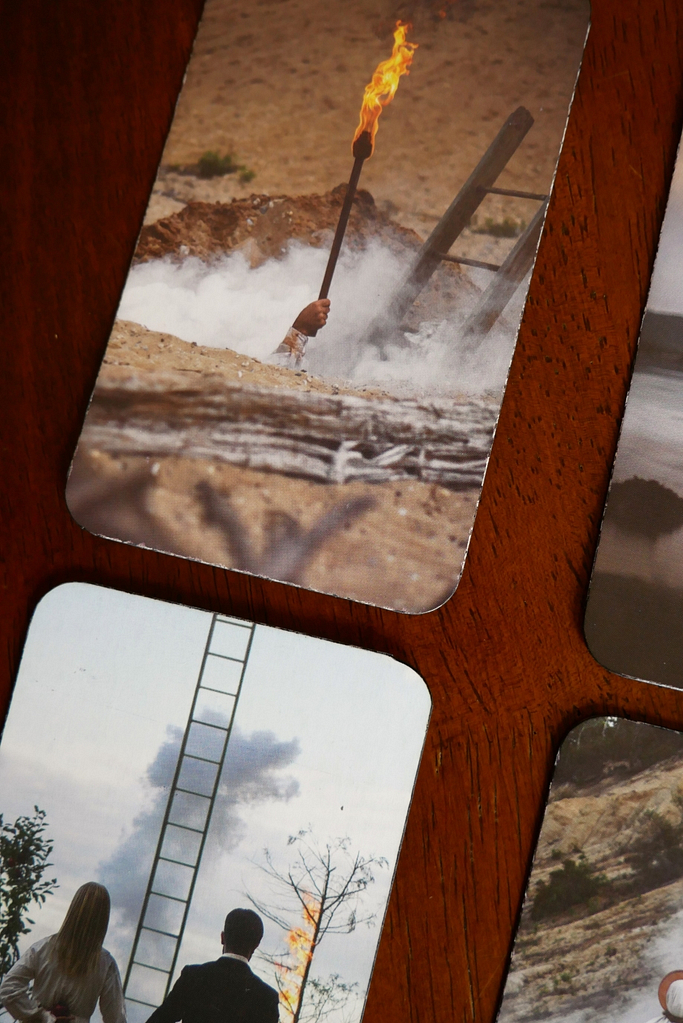
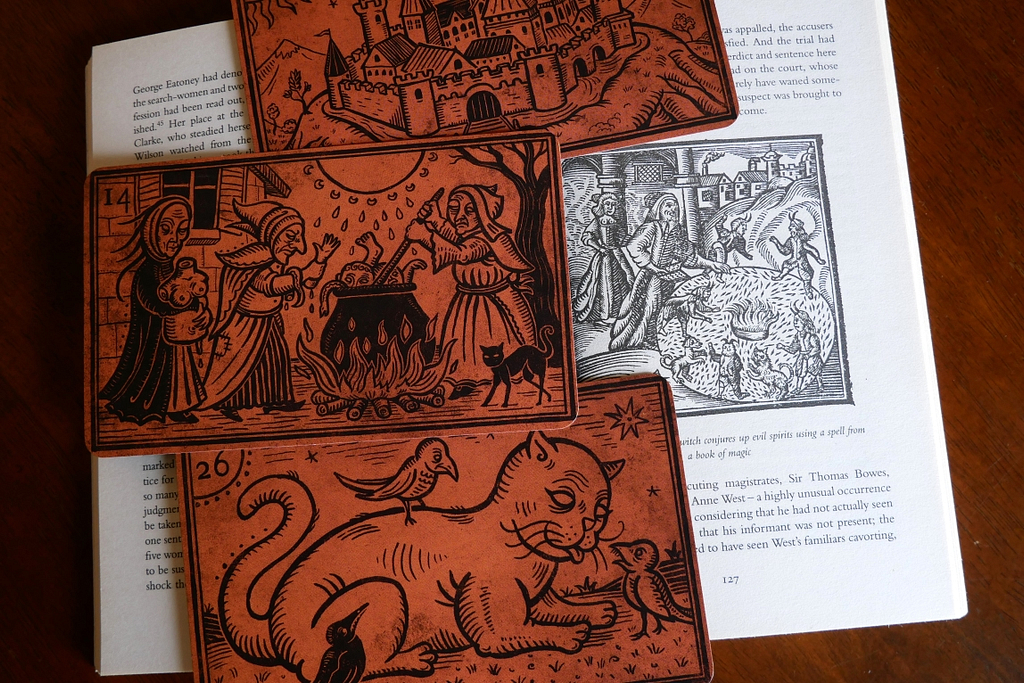
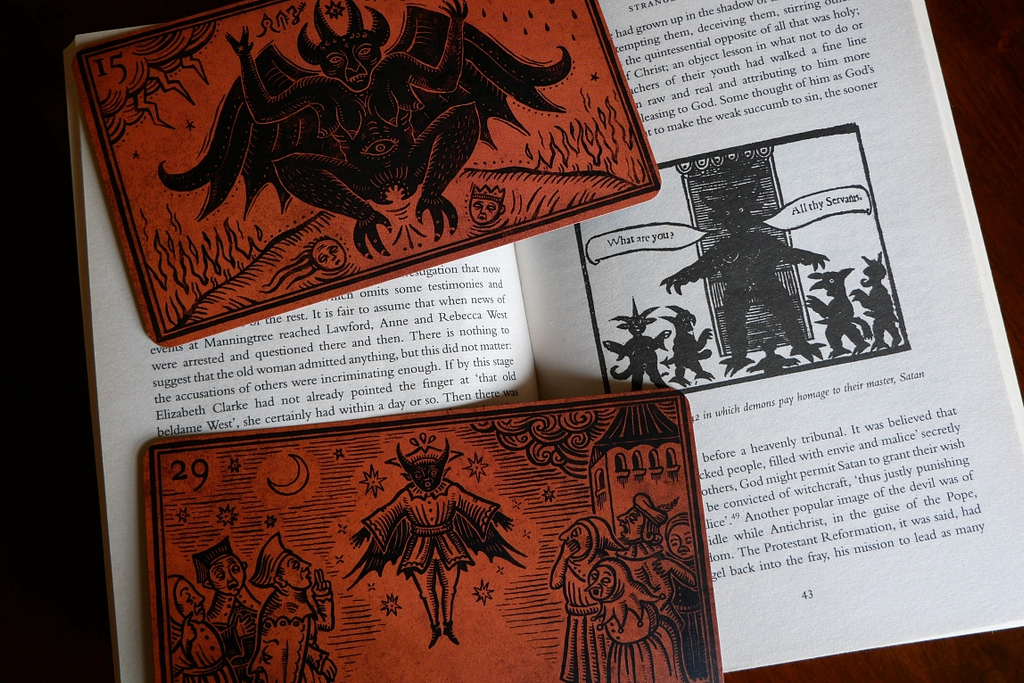
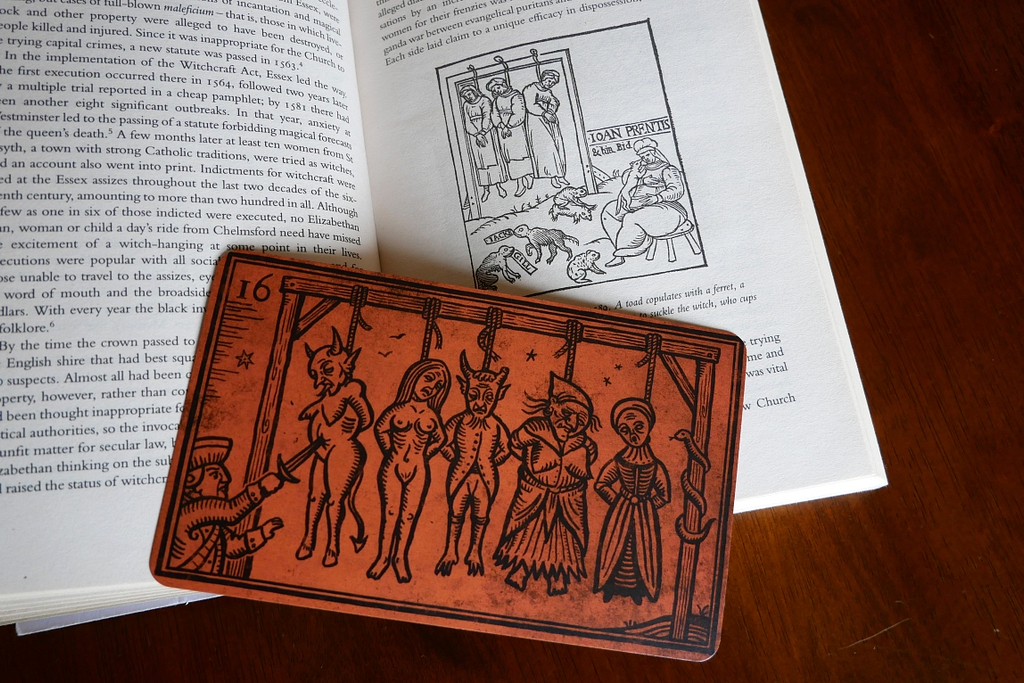
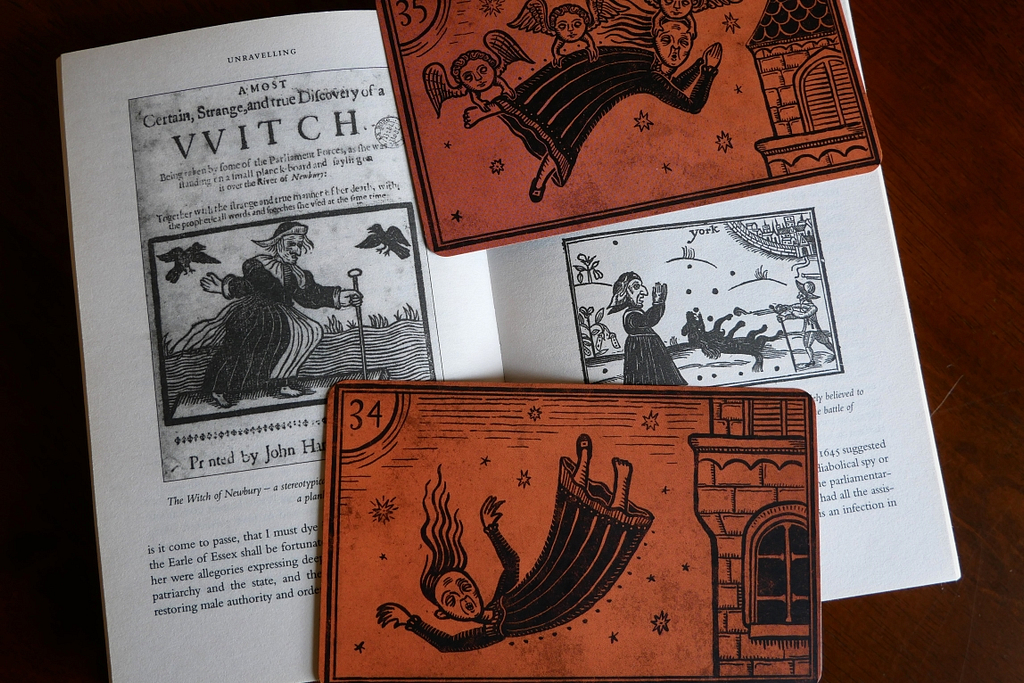
I should note I have also recently read Witchfinders by Malcolm Gaskill and am currently working my way through The Witch: A History of Fear from Ancient Times to the Present by Ronald Hutton… Of course, in so far as witch hunts in England overlapped with civil war tensions between Royalists and Parliamentarians (and occurred along Puritan vs ‘Popish’ lines), I, Coriander made for an excellent fictional backdrop! Also, I really enjoyed drawing cards from the Oracle of Black Enchantment (also by Deviant Moon Inc.) while reading Witchfinders as a visual processing exercise*.
Pages from Malcolm Gaskill’s Witchfinders featured here with various cards from the Oracle of Black Enchantment (Samhain edition.) Patrick Valenza’s art historical source material (at least in part) should be fairly evident…
Lastly, this emphasis on the detail of Otherworlds – their textiles, buildings, landscapes, emotional experiences, social relationships, flora and fauna etc. – is playing a huge role in my current artistic endeavours. I tend to see pip decks as decks full of concepts/characters (in the majors and courts) and their scaffolding and architectural surroundings (in the pips). Sometimes this visual architecture is metaphorical and sometimes it is fairly literal. It depends on the reading. But it’s also helping me to tease out what it feels like to think of tarot decks in this way and what that might mean for creating a tarot deck of my own. Furthermore, I have been rebuilding a former world of mine and have recently begun sewing some clothing that I envisioned there…
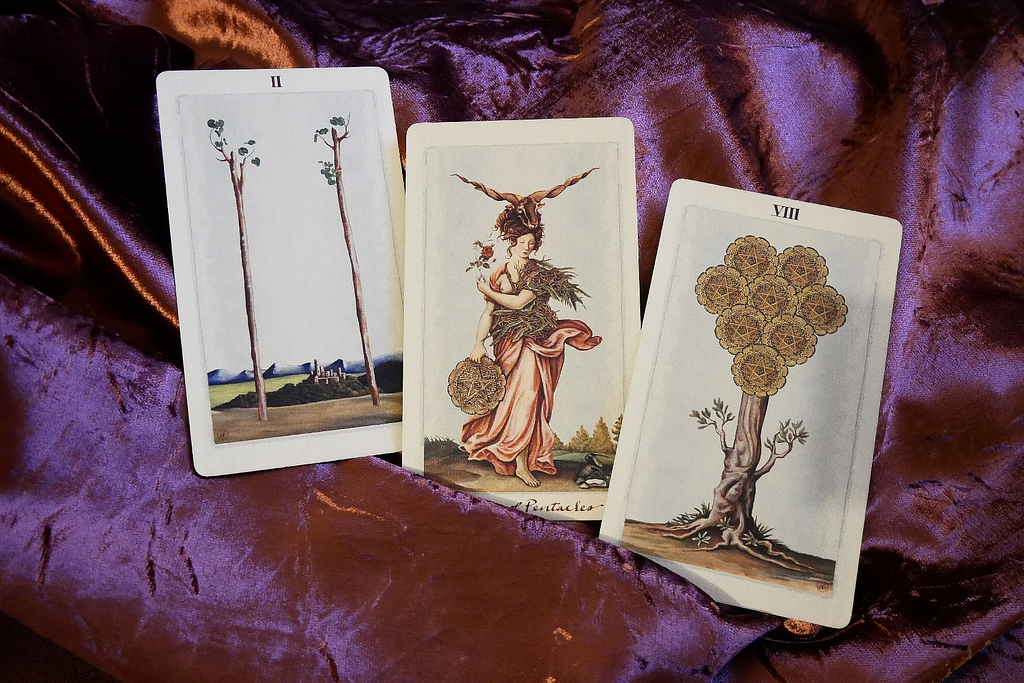
And, of COURSE, the Pagan Otherworlds Tarot… featured here over (deadstock) cognac red crushed velvet ::drool::
Perhaps the act of sewing my own clothes is really the process of bringing fairy clothes over the divide? It would explain the time traveler vibes, don’t you think? 😉
So… this post has mostly been about my own personal explorations and impressions. I plan to return soon, however, with some better grounded and CITED analytical material about art history and technique.
Sincerely,
Saoirse.
* Please note! Literally any deck will aid in visual processing or reinforcing thematic content for literally any book. There is no need to acquire any deck not already within your means or comfort zone. Decks/products/material items are mentioned here for illustrative purposes only! It’s PRAXIS that matters.
** All decks featured here of my own volition and arising from my own use of them. I have neither been invited nor commissioned to do so and I have no affiliation with any of their creators. The TdL (paradoxical) was a private gift from a friend. All others were purchased by me.
[1] See images by artists like Petrus Christus (especially ‘Portrait of a Young Girl’, 1460s) and his contemporaries. The cover here has a very Burgundian look with a single truncated hennin among other distinguishing features…
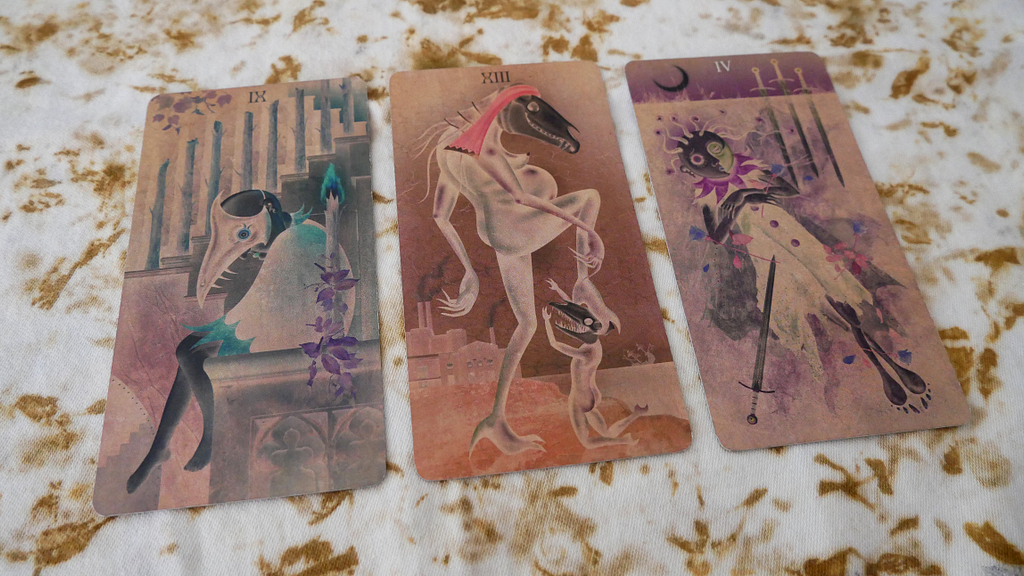
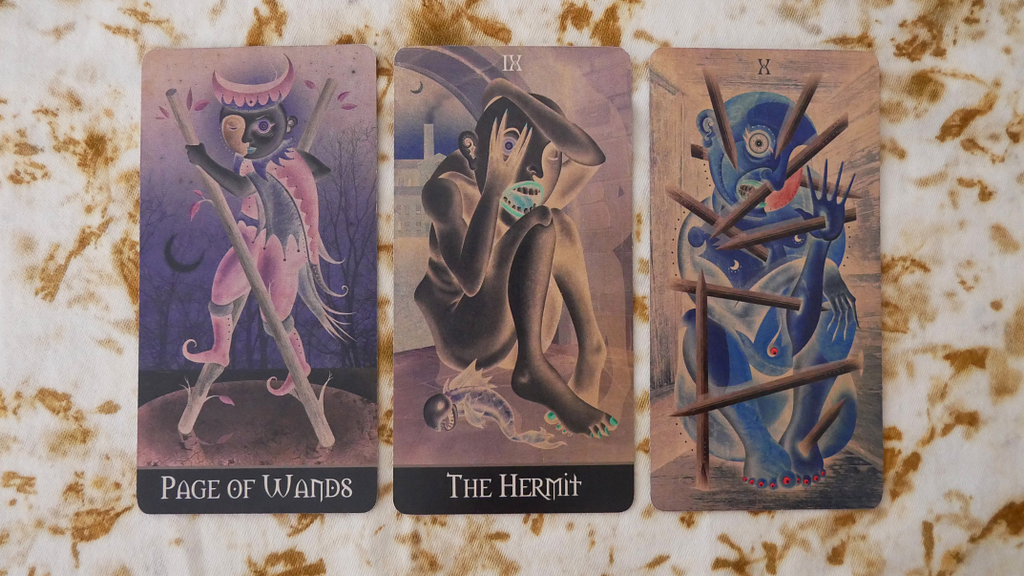
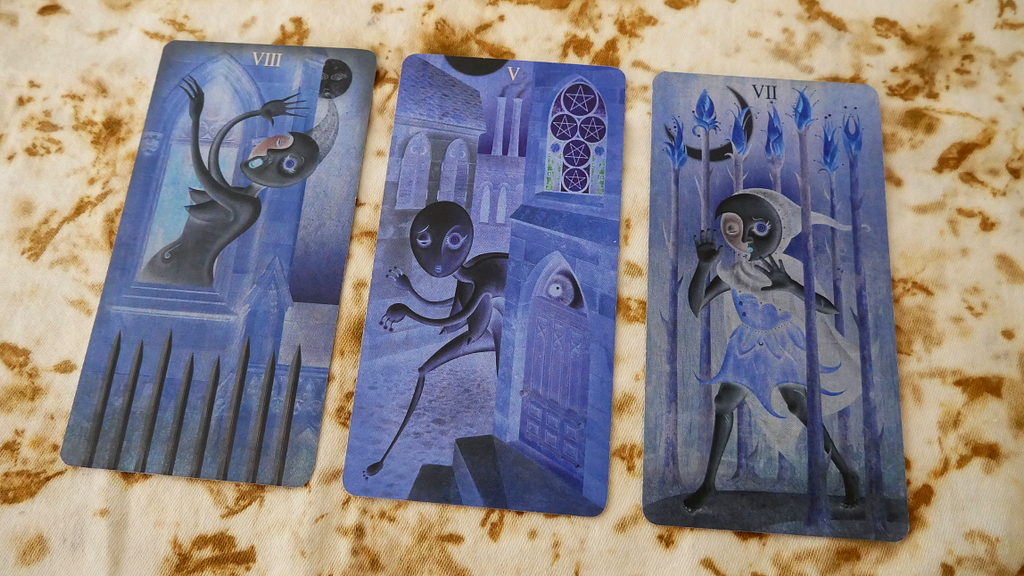
It’s birthday month… and for the last few months I have been working away on what visual links I can find in certain tarot and oracle decks, who created them, where they were created, and what I think that means about the experience of place on the minds of those prone to nightmares. I’ve been calling this the “Nightmare Children of the Tri-State Area” project… but of course if we approach it art historically, it will always be rather Beksinksi or Bosch-like in this realm too. (Also Escher…)
“In Hoc Signo Vinces” by Zdzisław Beksiński. Reproduced here under Creative Commons Licence (Attribution Non-Commercial Share Alike 2.0 Generic) from “Gandalf’s Gallery” with whom I have no affiliation. Another amazing Beksinski piece to check out is “Figure (1978)”.
For now, here’s a sneak peek into what artistic themes are playing a role here:
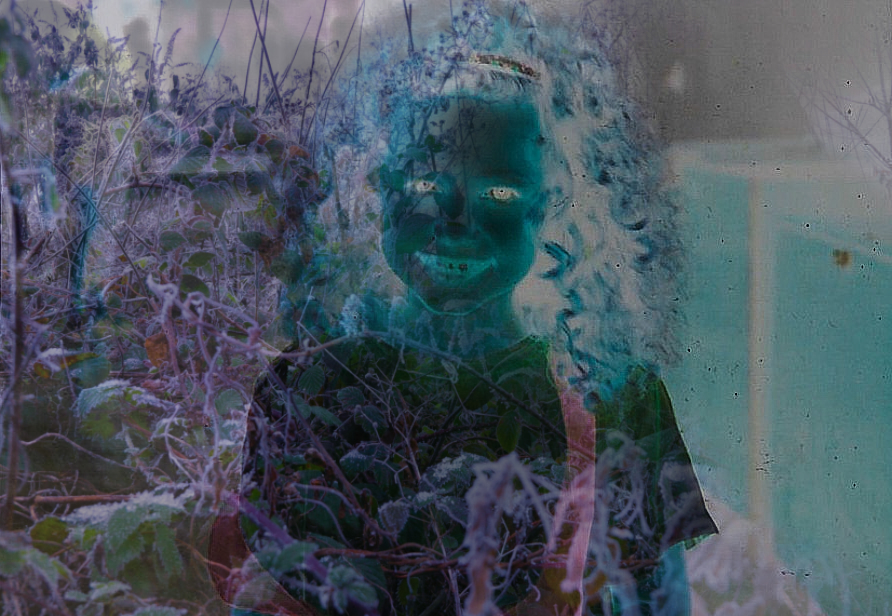
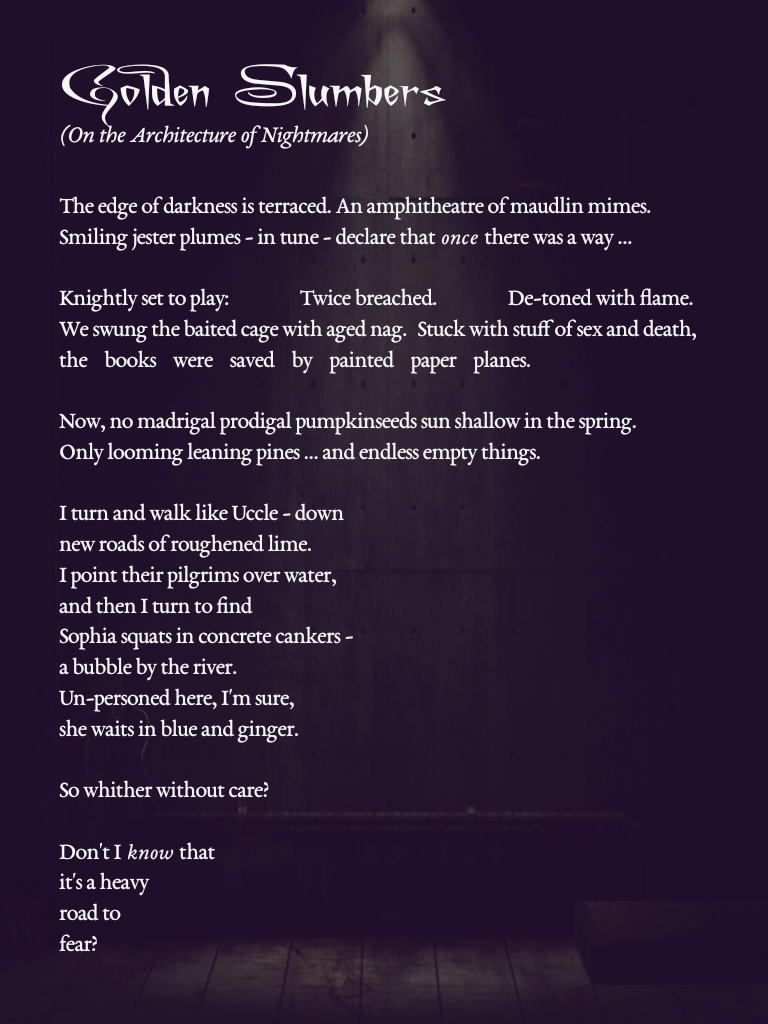
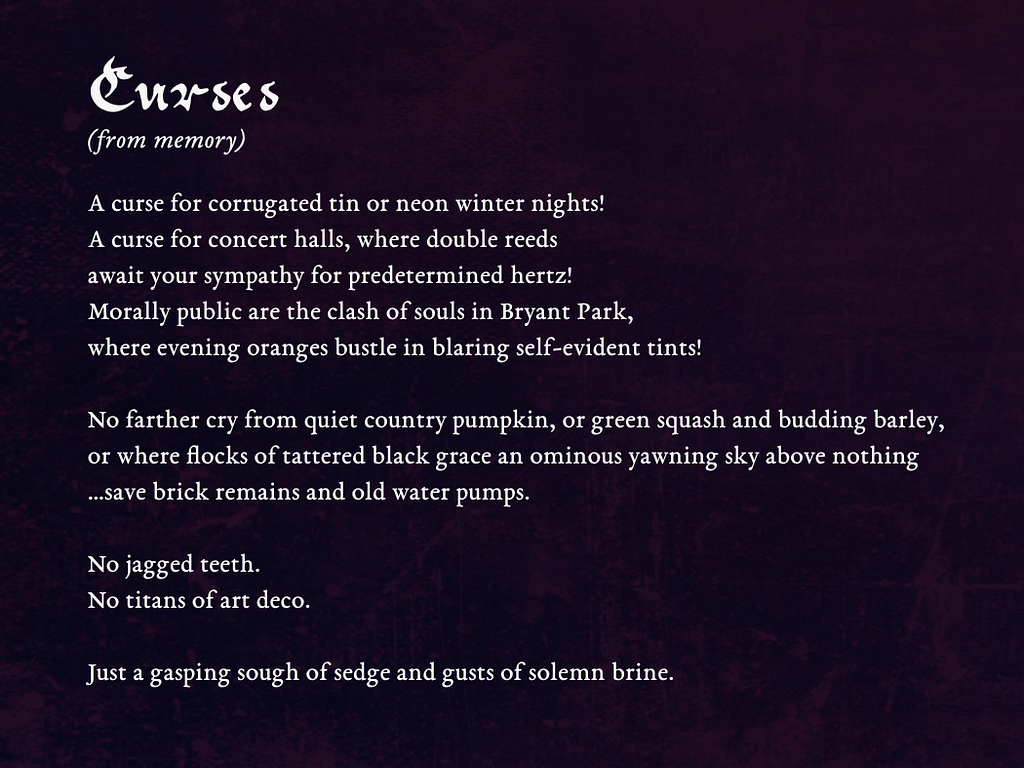
“Six in the City” A & B ~ self-portraits from old photos edited together with my own outdoor photography.“Golden Slumbers” is a poem I wrote on October 14, 2023 while walking through my memory of specific nightmares and giving them more collective language. I have been feeling very inspired by Escher and Piranesi in this, among others…“Curses” is a poem I wrote on November 26, 2023 while walking through my memory of specific experiences in the wetlands around New York and New Jersey… and giving them more collective language.
The decks in question*:
More sketches, explorations, and thoughts to follow soon! In the meantime, let me know what you think 👻
Hell Panel (detail), Garden of Earthly Delights, Hieronymus Bosch (between 1490-1510?) Reproduced here from Wikimedia Commons.
Sincerely,
Sorsha.
* All decks featured here of my own volition and arising from my own use of them. I have neither been invited nor commissioned to do so and I have no affiliation with Deviant Moon Inc. or Nicolas Bruno. Apart from having one of these decks (the TdL Paradoxical) given to me by a friend, I have purchased all of these myself.
This week’s video is, in part, an update on my tarot & art practice, projects, & preferences… as well as a discussion of archetypes, imagination, and social expectations. I find endless interest in how this comes to bear on decks that defy or exist tangential to traditional tarot systems.
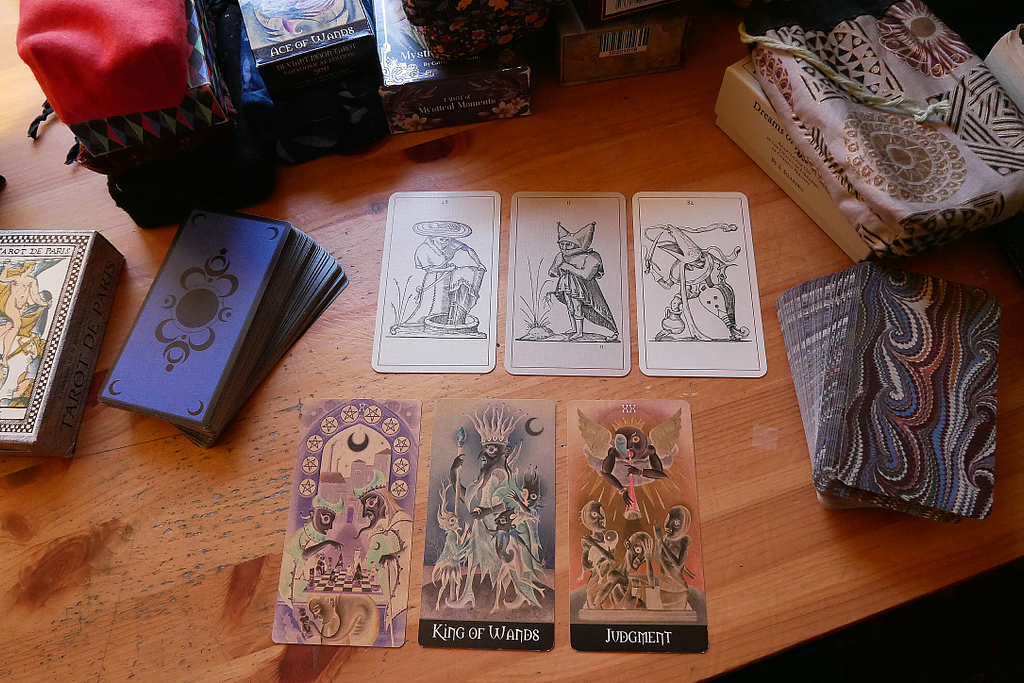
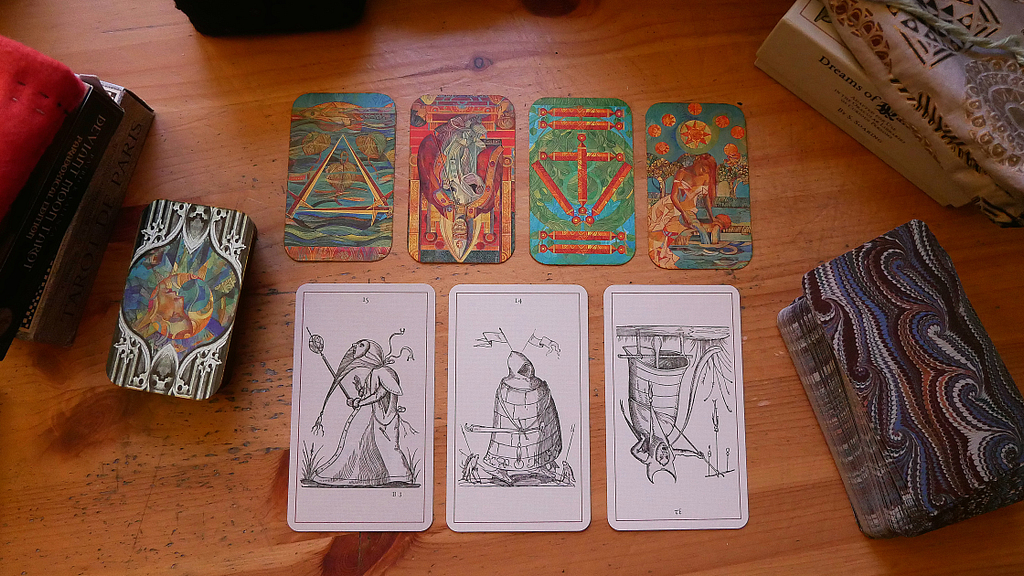
I also briefly showed my current Oracle deck project, titled “Dreams of Pantagruel”. I will dedicate a video to introducing it properly soon but I must also say a special THANK YOU to Lennan Smith, who made me aware of these images in the first place! I’m still blissfully going down the rabbit hole on this one.
Experiments are on-going in terms of seeing how the deck feels to use. I’m currently focusing on exploring how it reads in conjunction with other decks. You can see a sneak peek of that in the video – I show it next to the Carnival at the End of the World Tarot – but here are some photos of other combinations explored this week:
Dreams of Pantagruel with The Deviant Moon (Paradoxical) by Patrick ValenzaDreams of Pantagruel with a modded Crystal Tarot – incidentally, also an ‘in-between’ deck system…
You can also see it in the featured image for this post along with some very interesting input from the Golden Tarot by Kat Black.
Decks Shown in the video –
Trionfi della Luna Tarot – Pagan Otherworlds Tarot – Medieval Scapini Tarot (modded) – Crystal Tarot (modded) – Hush Tarot Magicae Daemonibus Tarot – Tarot of Mystical Moments – Lonely Dreamer Tarot – Carnival at the End of the World Tarot … deck mentioned but not shown: The Dreaming Way Tarot